The Portable Nation
Football, Migration, and the Making of Belonging
Before a World Cup match begins, the nation appears to become visible.
The camera moves slowly along a line of players. A flag rises above the stadium. An anthem begins. Some players sing with closed eyes; others remain silent, their faces fixed on the match ahead. Millions of viewers inspect these bodies for evidence of pride, sincerity and loyalty. For several ceremonial minutes, eleven human beings are asked to stand for an entire country.
The ritual encourages a deceptively simple interpretation. This is France. This is Morocco. This is Germany. This is Curaçao. Each team appears to have emerged naturally from the territory whose colours it wears.
Yet the biographies beneath the shirts tell a more complicated story.
A player may have been born in one country, raised in another, trained professionally in a third and eligible to represent several. His parents may speak one language at home while he uses another at school and a third in the dressing room. His family history may carry the memory of colonial rule, labour migration, political exile, war, refugee displacement or an ordinary parental decision to seek a safer and more prosperous life.
The 2026 FIFA World Cup has made this reality unusually difficult to overlook. FIFA confirmed 1,248 players across 48 squads. Research by Oxford University’s Centre on Migration, Policy and Society identified 289 players who were born outside the country they represent.
The calculation is straightforward:
289 ÷ 1,248 × 100 = 23.16 per cent.
Almost one player in four is therefore foreign-born. In eight of the 48 squads, foreign-born players constitute a majority. Twenty-five of Curaçao’s 26 players were born abroad; the proportions were approximately 85 per cent for the Democratic Republic of the Congo and 73 per cent for Morocco. These figures count birthplace, not ethnicity, identity or migration background, but they provide a striking starting point. (Brindle and Sawyer 2026; FIFA 2026a).
The World Cup has not consequently become post-national. The flags remain. The anthems remain. The emotional force of national rivalry remains. Indeed, the tournament may be one of the most powerful surviving rituals of international nationalism.
The nation has not disappeared.
It has become portable.
What Is a Portable Nation?
A portable nation is not a country without borders. Nor is it simply a multicultural squad or a poetic synonym for diaspora.
It is a nation whose public representation is increasingly assembled through lives, institutions and attachments that exceed the territorial state. It is carried through citizenship and descent, but also through family memory, migration routes, football academies, media images, federation recruitment and emotional inheritance.
The concept has at least six interconnected dimensions.
The first is legal portability. Citizenship and football regulations allow national membership to travel through birth, ancestry, naturalisation and residence.
The second is genealogical portability. Parents and grandparents transmit connections to places where their descendants may never have lived permanently.
The third is institutional portability. A player can be produced by the schools, academies and clubs of one country while representing another.
The fourth is historical portability. Colonial, labour and refugee routes continue to shape which populations connect which countries.
The fifth is affective portability. Supporters may adopt a foreign national team through television, style, memory, family tradition and political imagination.
The sixth is conditional portability. A racialised or migrant-background player may be welcomed as fully national when successful but treated as an outsider when he fails, protests or refuses the expected performance of gratitude.
These dimensions make the national team something more than a reflection of population. It becomes a temporary political and emotional arrangement: a way of turning mobile lives into a national image.
A team sheet names players. Beneath those names lie routes.
The Nation Does Not Merely Appear; It Is Performed
Benedict Anderson famously described nations as imagined communities. His argument did not mean that nations are unreal. It meant that members of even the smallest nation will never know most of their fellow members, yet imagine a meaningful bond with them (Anderson 2006).
Football gives this imagined relationship a visible body.
The flag, the shirt, the anthem and the simultaneous attention of millions allow dispersed strangers to experience themselves as part of the same collective. Michael Billig’s concept of banal nationalism helps explain how national belonging is continually reproduced through ordinary symbols and habits, while Sven Ismer’s research demonstrates how football rituals and shared emotions can embody collective identity (Billig 1995; Ismer 2011).
The national team should therefore not be treated as a neutral photograph of an already completed nation. It is one of the institutions through which the nation is repeatedly made.
Selection gives some citizens exceptional visibility and leaves others outside the frame. Commentary interprets players’ faces, surnames and family histories. Supporters decide who appears naturally national and whose allegiance needs explanation. Politicians use victories as proof of unity. Defeats reopen questions that success had temporarily silenced.
Sport does not simply express nationalism. It gives nationalism rhythm, emotion and bodily form. Reviews of the field consistently identify sport as a major arena of nation-building, collective identification and boundary-making (Arnold 2021).
This is why the diverse national team is politically important. It does not merely show that migration has occurred. It publicly answers the question of who may be seen embodying the nation.
But the answer is never final.
A Note on Terminology
Any serious analysis must avoid reading migration directly from a player’s appearance.
A dark-skinned player is not necessarily foreign-born. A foreign-born player is not necessarily a migrant in any meaningful biographical sense. A player born inside the country he represents may belong to a recently arrived family. Another born abroad may have moved as an infant and possess almost no personal relationship with his birthplace.
Several categories must therefore be distinguished.
A foreign-born player represents a country different from the state or territory recorded as his birthplace.
A player with a migration background may have been born locally but have one or more parents or grandparents who migrated.
A dual-eligible player possesses a legally recognised connection to more than one football association.
A diaspora player is connected to an ancestral homeland through family, social or institutional relationships, although scholars caution that diaspora should not be treated as a single, naturally unified identity (Brubaker 2005).
A naturalised player acquired citizenship rather than receiving it automatically at birth.
An association switch occurs when FIFA authorises a player who previously participated in one national setup to represent another under defined conditions.
These categories overlap, but they are not interchangeable.
Van Campenhout, Van Sterkenburg and Oonk have shown that even the apparently objective category of birthplace becomes complicated by changing borders, dissolved states, colonial territories and forced annexations. Their work warns against using static databases to impose a simple migrant–non-migrant division upon complex historical lives (Van Campenhout, Van Sterkenburg and Oonk 2019a).
Ethnicity, meanwhile, should not be assigned from names, faces or presumed religion. It should be discussed only where there is reliable biographical information or self-identification.
The nation cannot be read directly from the body.
The Myth of the Homogeneous Team
It is tempting to imagine an earlier World Cup in which each country fielded an ethnically uniform population, before migration complicated the picture.
That past never fully existed.
Foreign-born players have participated in the World Cup since its early editions. Before FIFA established more restrictive eligibility rules in the 1960s, players could even represent more than one national association during their careers. Political upheavals also changed nationality without players moving at all. The 1938 tournament, for example, was distorted by Nazi Germany’s annexation of Austria, after which Austrian players were absorbed into the German system.
A historical study of 4,761 players from 15 regularly participating national teams between 1930 and 2018 identified 301 foreign-born players. The proportion fluctuated rather than rising in a straight line, but the general trend—especially from the mid-1990s onward—was toward greater volume and diversification of foreign-born participation (Van Campenhout, Van Sterkenburg and Oonk 2019b).
The homogeneous national team is therefore partly a retrospective myth. Earlier teams may have looked more racially uniform, particularly from a contemporary visual perspective, but appearance alone cannot establish social homogeneity. Internal regional differences, indigenous populations, religious divisions, forced assimilation, mixed ancestry and historical migrations were often hidden beneath a unified national label.
The important transformation is not that mobility suddenly entered football. It is that migration has become larger, more visible, institutionally organised and politically contested.
The 2026 tournament represents a significant intensification. France was the birthplace of 73 players who represented other countries. The equivalent totals were 42 for the Netherlands, 25 for Germany and 23 for England. France-born players appeared for the DR Congo, Haiti, Senegal, Ivory Coast, Algeria, Tunisia, Morocco, Ghana and Cape Verde. Twenty-five Netherlands-born players represented Curaçao and six represented Cape Verde.
These flows are not random.
They form a map of modern history.
A Team Sheet Is a Migration Map
Van Campenhout and Van Sterkenburg use the idea of migration corridors to explain why particular national teams repeatedly draw players from particular countries.
Some corridors emerged through colonialism. Others developed through postwar guest-worker programmes, refugee displacement, neighbouring borders or established migration networks. The authors conclude that the appearance of foreign-born players in national teams frequently represents an echo or reversal of earlier population movements (Van Campenhout and Van Sterkenburg 2021).
A family may move from Morocco to France, from Curaçao to the Netherlands, from the former Yugoslavia to Switzerland or from the DR Congo to Belgium. A generation later, a descendant may represent the ancestral country.
The player does not necessarily repeat the family’s journey physically. He may remain based in Europe and spend his entire club career there. Yet his sporting nationality makes the earlier route publicly visible.
This is return without returning.
The player returns symbolically through the shirt. A family history previously narrated as departure acquires another direction. Genealogy becomes representation.
This approach also prevents the World Cup from being interpreted through isolated biographies alone. The question is not simply why one individual chose one country. It is why the same pairs of countries remain connected across thousands of decisions.
The answer often lies in empire.
Empire’s Afterlife
France offers the clearest example.
The country’s national team has frequently been celebrated as evidence of republican integration: citizens with different family histories united beneath the tricolour. But French football also emerged from relationships connecting metropolitan France with North Africa, West and Central Africa and the Caribbean.
Laurent Dubois’s Soccer Empire traces how empire, migration, race and football shaped modern France, particularly through the lives of Zinedine Zidane and Lilian Thuram. His work demonstrates that colonial history does not simply precede multicultural football. It survives within the routes and political debates that make multicultural football possible (Dubois 2010).
The same pattern is visible at the 2026 World Cup. France does not merely select French citizens whose families were shaped by postcolonial migration. French neighbourhoods, academies and clubs also train players who represent former colonies and other migration-linked states.
Paris and its suburbs function almost like a transnational football territory. A child may grow up within the French educational and football systems while remaining eligible for Algeria, Senegal, Morocco, Haiti, Cameroon, the DR Congo or another ancestral country.
The Netherlands and Curaçao offer a parallel example. Curaçao is a constituent country within the Kingdom of the Netherlands and was formed through Dutch colonial history. At the 2026 World Cup, 25 of its players were born in the Netherlands. Cape Verde’s squad similarly drew heavily from European diaspora communities, including six players born in the Netherlands.
These teams are not simply importing convenient foreigners. They are drawing upon populations whose presence in Europe was produced through long histories of political rule, economic inequality, labour demand and family movement.
Empire may disappear from official maps while remaining alive in languages, passport systems, city populations, flight routes, academies and scouting networks.
To call a team “diverse” describes its visible composition. It does not explain why that diversity has taken this particular form.
A more serious question is not only who is present?
It is which histories made their presence possible?
The Diaspora Nation
Morocco provides perhaps the most developed example of the national team as a diaspora institution.
Nineteen of Morocco’s 26 players at the 2026 World Cup were born outside the country. Myriam Cherti’s analysis of Morocco’s senior-player pool between 2017 and 2026 identified 61 foreign-born players. Thirty-three appeared to have aligned with Morocco from the beginning of their international development, while 28 had previously participated in another national setup. In the 2026 squad itself, 11 of the foreign-born players had apparently chosen Morocco early and eight had moved from another setup (Cherti 2026).
This evidence complicates a familiar accusation: that diaspora players represent an ancestral country only after being rejected by a stronger European team.
Career opportunity undoubtedly matters. Some players change associations because one route offers more playing time or a greater likelihood of reaching a major tournament. But opportunity does not automatically make belonging insincere.
Family relationships, language, religion, summer visits, food, community life, media and parental memory can make a place emotionally important to someone born elsewhere. A player can be socially formed in Belgium, professionally trained in the Netherlands and still experience Morocco as a meaningful national home.
These attachments do not have to cancel one another.
Modern belonging does not always move in single file.
A Moroccan-background player’s decision to represent Morocco does not necessarily prove that integration in Europe has failed. Nor does it necessarily indicate rejection of France, Spain, Belgium or the Netherlands. It may show that integration into one society does not erase connection to another.
The diaspora nation is therefore not merely an expanded ethnic family. It is an institutional project.
Morocco has combined diaspora scouting with investment in domestic football, including the Mohammed VI Football Academy, regional training infrastructure, federation capacity and youth development. This balance matters because diaspora recruitment can create resentment if it appears to displace locally trained players. It becomes more legitimate when local and diaspora pathways are presented as interconnected rather than competing sources of national talent.
Diaspora populations should also not be portrayed as passive reserves waiting for the homeland to claim them. Players and families negotiate with federations, evaluate opportunities and interpret their own histories. Their agency matters.
The homeland recruits, but the diaspora chooses.
Choosing a Country
FIFA attempts to turn this field of layered belonging into a set of administrable rules.
A player must possess the nationality of the country he represents. Where nationality alone does not provide a sufficient connection, eligibility can depend on birthplace, the birthplace of a parent or grandparent, or a qualifying period of residence. Under defined conditions, a player who has appeared for one association—especially at youth level—may request permission to change sporting nationality (FIFA 2021, 2025).
The rules establish eligibility. They cannot determine emotional authenticity.
A player’s decision may be influenced by family feeling, federation recruitment, coaching relationships, playing opportunity, childhood memory, discrimination or the experience of being welcomed by one country and overlooked by another.
A biographical study of German-born elite youth players with Turkish family backgrounds identified three broad narratives: following the nominations available to them, reconsidering national belonging and adding up professional chances. Crucially, the study found that national selection does not merely express an identity formed in advance. Experiences within football can alter a player’s sense of national connection. Recognition may deepen belonging; rejection and othering may weaken it (Seiberth et al. 2022).
Identity can therefore shape selection, but selection can also shape identity.
A federation calls. A coach offers trust. Parents see their family history recognised. Supporters sing the player’s name. The ancestral country becomes emotionally more immediate.
This is why the language of “mercenaries” is often inadequate. It assumes that emotional attachment and professional calculation cannot coexist. Yet most major life decisions combine affection, opportunity, obligation and uncertainty.
Choosing a national team is no different.
The passport determines eligibility. It does not exhaust belonging.
The Conditional National Body
The inclusion of migrant-background players is often presented as proof that the nation has become tolerant and modern.
But inclusion may remain conditional.
Mesut Özil’s 2018 resignation from the German national team became the defining example. Özil argued that he was treated as German when the team succeeded and as an immigrant when it failed. Research on the controversy interprets it as evidence that racialised athletes may be admitted to the nation through an unstable moral economy of deservedness (Van Campenhout and Van Houtum 2021).
Metzger and Özvatan describe football controversies between Germany and Türkiye as “games of belonging,” in which media, political actors and football institutions demand singular national loyalty from people whose lives are transnational. Özil and Nuri Şahin disrupted this demand by embodying attachments that could not easily be contained within an either–or framework (Metzger and Özvatan 2020).
The migrant-background player may thus become a conditional national body.
When he succeeds, his family history is used to demonstrate the openness of the nation. His goals become evidence that diversity works. Politicians praise him. Advertisements place his face beside the flag.
When he fails, the same history may be turned against him. His loyalty is questioned. His relationship with an ancestral country becomes suspicious. His silence during the anthem is examined. His political speech is described as ingratitude.
Victory can nationalise the player.
Defeat can racialise him.
This does not mean that every criticism of a migrant-background player is racist. Players can be criticised legitimately for performance, judgement and political choices. The problem arises when failure is attributed to ancestry, supposed cultural difference or insufficient national feeling in a way that would not be applied to a player regarded as ethnically native.
The asymmetry is the issue.
Some players belong without explanation. Others must repeatedly produce evidence.
Research on Dutch television commentary similarly finds that meanings attached to race, ethnicity and national diversity change across historical contexts and are often organised around a few symbolically important players. Diversity does not speak for itself; commentators and institutions give it meaning (Van Campenhout, Van Lienden and Van Sterkenburg 2023).
A legally equal passport can therefore coexist with unequal public belonging.
The Foreign-Coach Paradox
The 2026 World Cup exposes another contradiction that deserves far more attention.
Players must establish citizenship and a recognised national connection. Coaches generally do not.
At the beginning of the tournament, 27 of the 48 teams were managed by a foreign national, compared with nine teams four years earlier. England employed the German Thomas Tuchel; Belgium employed the French Rudi Garcia; Brazil entrusted its national football project to the Italian Carlo Ancelotti.
This produces a remarkable institutional asymmetry.
The body that scores the goal must be national.
The mind that designs the team may be imported.
A player with multiple national connections can be accused of opportunism for choosing one country over another. A highly paid foreign coach can cross the same symbolic boundary through an employment contract.
The contrast reveals that national authenticity is distributed differently according to role. The player is expected to embody the country. The coach is increasingly treated as a technical specialist operating within a global labour market.
Historically, major football nations resisted foreign coaches because the national team was expected to display a distinct national style. A foreign manager could be perceived as evidence that the nation no longer trusted its own football knowledge. But club football has globalised tactical ideas, training practices and professional careers. National styles are now more porous than their mythologies suggest.
The foreign coach consequently expands the idea of the portable nation. It is not only populations and ancestries that travel. Expertise travels too.
Yet only some travellers are required to prove love.
The Border That Opens for Talent
International football is often celebrated as evidence that borders are becoming less important.
A more accurate conclusion is that borders have become selectively flexible.
Federations scout diaspora communities, contact parents and compete for dual-eligible teenagers. Governments may facilitate citizenship for elite athletes. Clubs invest in international recruitment networks. Valuable players move through contracts, agents and specialised legal procedures.
At the same time, ordinary migrants, refugees and low-wage workers encounter very different border regimes.
The comparison should be made carefully. An elite athlete, an asylum seeker and an undocumented worker occupy different legal positions. But their unequal reception reveals how mobility is valued.
The footballer’s movement is classified as talent.
Another migrant’s movement may be classified as risk.
The national team does not abolish the border. It reveals whom the border is willing to welcome.
This selectivity operates within football itself. European clubs and academies occupy powerful positions in the global football economy. Research on African football academies has shown how development systems may offer genuine opportunity while also transferring athletic labour and economic value from African societies toward wealthier European leagues (Darby, Akindes and Kirwin 2007).
Sport-migration scholarship therefore cautions against presenting athlete mobility as an uncomplicated story of freedom. Migration takes place within relations involving clubs, agents, federations, owners, families, media companies and unequal national economies (Maguire and Falcous 2011).
An emerging 2026 preprint introduces the term leg drain to describe the redistribution of football value through multinational eligibility. Using data on more than 92,000 footballers, its authors argue that wealthy European countries gain disproportionate value while African and Caribbean countries experience substantial losses relative to the size of their economies. They also identify former colonial ties as strong predictors of these flows (Lehner and Righetto 2026).
Because the study is a preprint, its precise estimates should be treated as preliminary rather than settled evidence. Its broader question is nevertheless essential:
Who trains the player? Who bears the cost? Who captures the economic value? And who later claims his success as national?
The portable nation is not equally portable for everyone.
Some move with contracts, passports and agents.
Others move with temporary documents, family debt or memories of displacement.
Mobility is global. Mobility rights remain hierarchical.
Beyond Methodological Nationalism
Social research has often assumed that the nation-state is the natural container of society. Andreas Wimmer and Nina Glick Schiller call this assumption methodological nationalism: the tendency to treat state, nation and society as if they were naturally congruent units (Wimmer and Glick Schiller 2002).
The national team invites precisely this mistake.
A list headed “France” or “Morocco” encourages us to imagine that every player’s meaningful history is contained within that national heading. But the biographies connect several societies at once.
The portable nation requires a different unit of analysis.
Rather than beginning with the country and asking which players belong inside it, we can begin with the routes: the family movement, the academy, the city, the citizenship rule, the federation call, the television audience and the ancestral memory.
This does not make the nation irrelevant. It shows how the nation is produced through relationships that cross its borders.
Aihwa Ong’s concept of flexible citizenship examines how individuals and families strategically navigate multiple states and opportunities under global capitalism. Elite football provides a highly visible version of such flexibility, although players’ choices are constrained by rules, careers and unequal institutions rather than being entirely free (Ong 1999).
Nira Yuval-Davis’s distinction between belonging and the politics of belonging is equally important. Belonging concerns emotional attachment and feeling at home. The politics of belonging concerns the power to determine who is included, on what terms and according to which boundaries (Yuval-Davis 2006).
A player may feel that he belongs to several countries.
Football institutions require him to represent one.
Supporters and commentators then judge whether his choice is genuine.
The first is belonging.
The second and third constitute the politics of belonging.
The Fan with No Passport
Players are not the only people carrying nations across borders.
FIFA requires a player to demonstrate citizenship and an eligible national connection. A supporter requires neither.
A fan may adopt a country through a childhood match, a legendary player, a style of football, a shirt, a television broadcast or a family tradition. In this affective geography, physical distance may be less important than inherited memory.
Bangladesh offers one of the world’s most powerful examples.
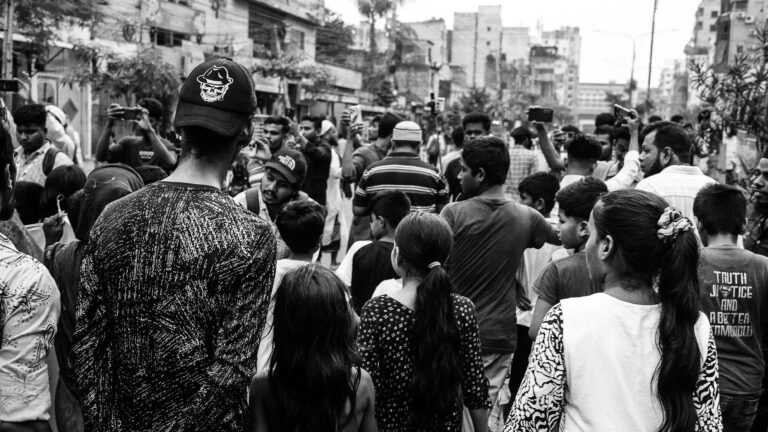
During each World Cup, cities, towns and villages fill with the colours of Argentina and Brazil. Houses are painted. Enormous flags cross fields and roads. Families inherit team allegiance across generations. Bangladesh has never qualified for the World Cup, and most supporters have never visited South America, but Argentina and Brazil are spoken of not merely as admired foreign teams but as “ours.”
Recent scholarship has begun to examine this phenomenon. Ana Raquel Romeu Aguiar’s research on Kerala analyses how supporters produce intense local identifications with Brazil and Argentina. Srutayu Bhattacharya’s study of Bangladesh and India examines how social media reshaped the relationship between Argentina and its adopted supporters during the 2022 World Cup (Romeu Aguiar 2024; Bhattacharya 2025).
Reporting from the 2026 tournament also documents how Bangladeshi allegiance emerged through the fame of Pelé, the spread of television, the 1986 World Cup, admiration for Maradona and Messi, and postcolonial identification with South American teams that defeated or challenged European powers. The attachment has been carried into the Bangladeshi diaspora, where supporting Brazil or Argentina can paradoxically become a way of remembering Bangladesh itself.
This is not conventional diaspora nationalism. Bangladeshi supporters do not generally claim Argentine or Brazilian citizenship or ancestry.
It is better described as adopted national intimacy.
The distant team enters neighbourhood history. Maradona becomes part of family storytelling. A father’s allegiance becomes a child’s inheritance. A match played on another continent becomes attached to memories of a courtyard, a tea stall, a university hall or a village television.
The national symbol is detached from citizenship and relocated within everyday life.
The modern World Cup therefore brings together two kinds of movement.
Players represent countries in which they may not have grown up.
Supporters embrace countries in which they may never live.
The player moves through citizenship, descent and federation approval.
The supporter moves through images, memory and affect.
Both demonstrate that national attachment can exceed territory.
The Gendered Nation
There is another boundary that the phrase “national team” often hides.
In ordinary football speech, the men’s national team is frequently treated as the unmarked national team, while the women’s side must be specifically identified as women’s football. The male athletic body is therefore more readily authorised to stand for the nation as a whole.
National projects have always been gendered. Nira Yuval-Davis shows that ideas of nationhood are tied to particular expectations of masculinity, femininity, reproduction and cultural continuity (Yuval-Davis 1997).
The World Cup’s representation of the nation is consequently not only racialised and territorial. It is also masculine. Strength, sacrifice, aggression, protection and victory are attached to male bodies presented as national defenders.
This essay concentrates on the men’s 2026 World Cup, but the portable nation should not become a theory of men alone. Women’s international football, refugee teams and players competing from exile may reveal even more sharply how nation, citizenship and embodiment can become separated.
Afghan Women United, formed through refugee players dispersed across several countries, returned Afghan women to international competition after the Taliban had excluded them from organised sport. Their case makes the portable nation almost literal: a national team can exist beyond the control of the regime governing its territory.
The national team is therefore not only a representation of who belongs.
It is also a struggle over who is allowed to represent.
What Diversity Cannot Prove
Diverse squads are sometimes treated as evidence that racism has been defeated or that multiculturalism has succeeded.
Neither conclusion follows automatically.
A team can be ethnically diverse while the wider society remains unequal. Minority players can be celebrated as national heroes while minority communities face discrimination. A federation can recruit diaspora athletes without giving comparable attention to domestic development. A state can embrace an exceptional footballer while restricting ordinary migrants.
Foreign-born recruitment also does not guarantee sporting success. Reuters’s analysis of the 2026 squads found no simple relationship by which a larger number of foreign-born players automatically produced better results. Team quality depends on coaching, infrastructure, cohesion, development systems, resources and many other factors.
Nor should every national team be expected to display the same form of diversity. Migration histories differ. Citizenship systems differ. Some countries have large diasporas; others have primarily received migrants; still others have experienced both processes.
The purpose is not to rank teams according to how cosmopolitan they appear.
Recent scholarship asking how “national” national teams are can be useful for constructing comparative typologies, but it also risks treating national authenticity as something measurable through demographic purity. The more important anthropological question is not whether a team is sufficiently national.
It is how the category of the national is being made, negotiated and contested through the team (Mudde and Roulier 2026).
Diversity is neither automatically emancipatory nor politically meaningless.
It is a field of struggle.
What the World Cup Reveals
The conventional nation is often imagined as a container: a territory occupied by a population, protected by a border and represented by a flag.
The World Cup preserves this imagination. Its basic structure depends upon nationally separated teams. Each match produces a winner and loser identified by country. Flags, anthems and historical rivalries become intensely visible.
Yet the players repeatedly exceed the containers assigned to them.
France and Morocco enter the stadium as separate nations, but players from the two squads may have grown up in the same cities, attended the same academies and passed through related youth systems.
Curaçao competes as a distinct football nation while relying heavily on players born and trained in the Netherlands.
Cape Verde enters the tournament through a population spread across islands and European cities.
The DR Congo’s squad connects Central Africa to families and professional careers formed in France, Belgium, England and elsewhere.
The match separates countries for ninety minutes.
The biographies reconnect them.
This does not mean that national feeling is fraudulent. Social identities do not become meaningless because they are historically produced. Players may experience profound pride in representing a country, and supporters genuinely invest themselves in the team.
But the national team is assembled from materials that are not exclusively national.
It depends on migration while appearing to transcend migration.
It depends on global clubs and academies while performing territorial loyalty.
It depends on plural biographies while demanding singular representation.
That tension is not a temporary flaw in international football.
It is one of its defining conditions.
The Nation in Transit
Perhaps the most revealing World Cup image is not the winning goal or the trophy ceremony.
It is the team photograph taken before the match.
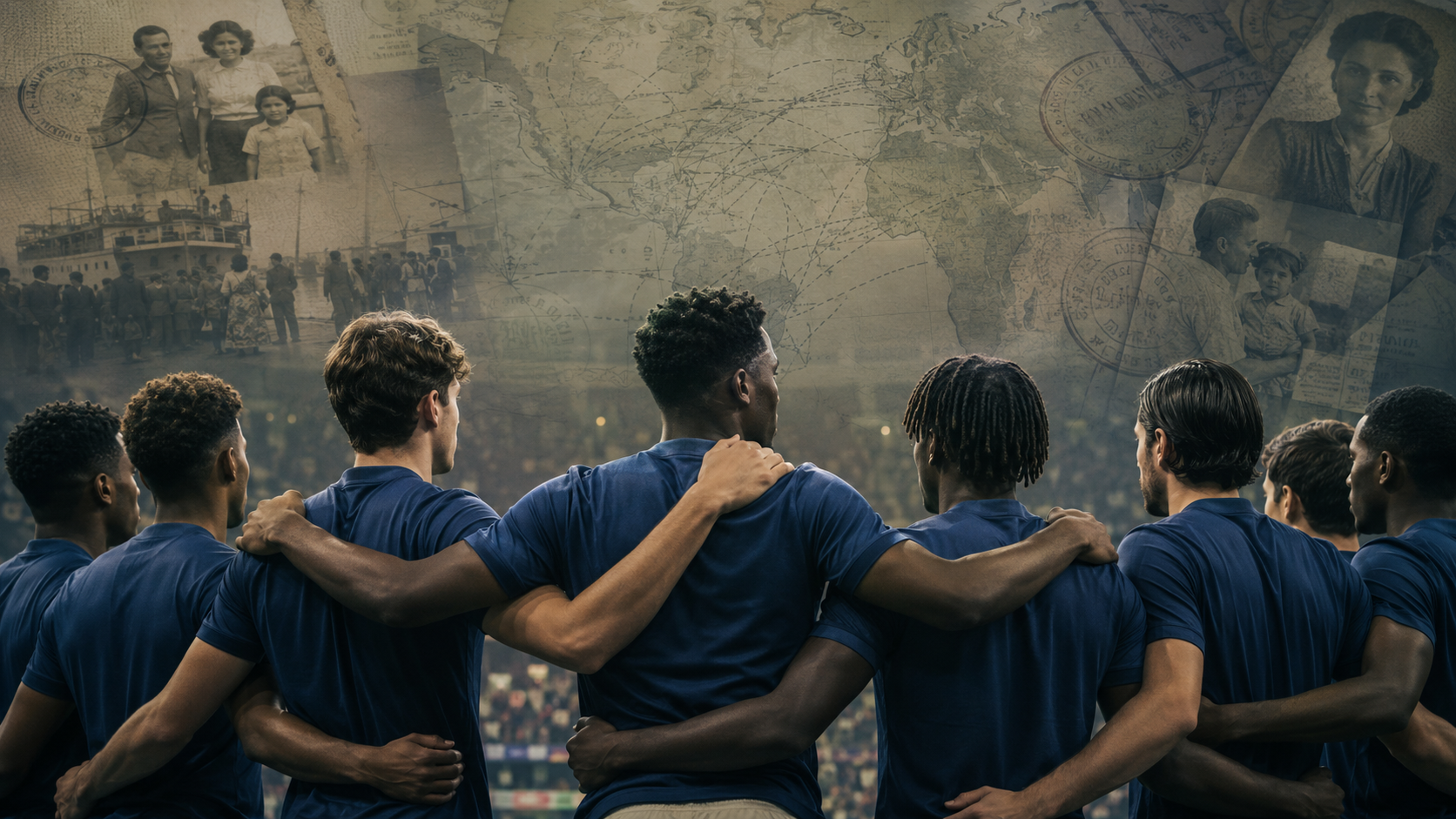
Eleven players gather closely enough to form a single shape. For the camera, they become the nation. Yet each body has arrived through a different sequence of family decisions, historical events, institutional investments and personal choices.
One may carry the memory of a parent who crossed the Mediterranean.
Another may descend from workers recruited during Europe’s postwar reconstruction.
Another may have grandparents displaced by war.
Another may have been born abroad by circumstance and raised almost entirely inside the country he represents.
Another may have chosen an ancestral team after being welcomed by one federation and ignored by another.
Another may come from a family that has lived inside the national territory for generations while still being treated as insufficiently national by its dominant racial imagination.
For the anthem, these differences are not erased.
They are temporarily organised.
That is what the national team does. It turns routes into a line-up, histories into positions and multiple attachments into one shirt.
The nation has not disappeared under globalisation. Migration has not simply weakened it. Migration has become one of the principal materials from which the nation is now publicly made.
This is the paradox at the centre of the World Cup: a tournament built upon the separation of countries increasingly depends upon lives that connect them.
The teams remain national.
The lives composing them are transnational.
And perhaps this is what the World Cup has been showing us beneath all its ceremonial certainty: nations were never as still, sealed or homogeneous as their flags encouraged us to imagine.
They have always travelled through empire and commerce, labour and exile, aspiration and memory, departure and return.
Today, those movements stand before us in football boots.
The anthem ends.
The whistle blows.
The portable nation begins to run.
References
Aguiar, Ana Raquel Romeu. 2024. “‘Our Team Will Definitely Win the Cup’: The Keralan Support of Brazil and Argentina during Men’s World Cup 2022.” Soccer & Society 25 (4–6): 722–736. doi:10.1080/14660970.2024.2332095.
Anderson, Benedict. 2006 [1983]. Imagined Communities: Reflections on the Origin and Spread of Nationalism. Revised edition. London: Verso.
Arnold, Richard. 2021. “Nationalism and Sport: A Review of the Field.” Nationalities Papers 49 (1): 2–11. doi:10.1017/nps.2020.9.
Bairner, Alan. 2001. Sport, Nationalism, and Globalization: European and North American Perspectives. Albany: State University of New York Press.
Bhattacharya, Srutayu. 2025. “Love ‘Reciprocated’? The Curious Case of Argentina and Social Media Fandom of Bangladesh and India during FIFA World Cup 2022.” Soccer & Society 26 (5): 733–748. doi:10.1080/14660970.2025.2480054.
Billig, Michael. 1995. Banal Nationalism. London: Sage.
Brindle, Ben, and Adam Sawyer. 2026. “Has Migration Become an Ingredient of World Cup Success?” Centre on Migration, Policy and Society, University of Oxford, 4 June.
Brubaker, Rogers. 2005. “The ‘Diaspora’ Diaspora.” Ethnic and Racial Studies 28 (1): 1–19. doi:10.1080/0141987042000289997.
Cherti, Myriam. 2026. “Pride of Place: The Story behind Morocco’s World Cup Squad.” Centre on Migration, Policy and Society, University of Oxford, 1 June.
Darby, Paul, Gerard Akindes, and Matthew Kirwin. 2007. “Football Academies and the Migration of African Football Labor to Europe.” Journal of Sport and Social Issues 31 (2): 143–161. doi:10.1177/0193723507300481.
Dubois, Laurent. 2010. Soccer Empire: The World Cup and the Future of France. Berkeley: University of California Press.
FIFA. 2021. Commentary on the Rules Governing Eligibility to Play for Representative Teams. Zurich: Fédération Internationale de Football Association.
FIFA. 2025. “FIFA Launches Digital Platform Detailing Players Who Have Changed Association.” 17 February.
FIFA. 2026a. “FIFA World Cup 2026 Squads Confirmed: 1,248 Dreams and a Truly Global Cast of Players.” 2 June.
Giulianotti, Richard, and Roland Robertson. 2009. Globalization and Football. London: Sage.
Ismer, Sven. 2011. “Embodying the Nation: Football, Emotions and the Construction of Collective Identity.” Nationalities Papers 39 (4): 547–565. doi:10.1080/00905992.2011.582864.
Lehner, Alexander, and Giovanni Righetto. 2026. “Leg Drain: Quantifying the Global Redistribution of Football Talent through Multi-National Eligibility.” arXiv preprint arXiv:2603.17336.
Maguire, Joseph, and Mark Falcous, eds. 2011. Sport and Migration: Borders, Boundaries and Crossings. London: Routledge.
Metzger, Stefan, and Özgür Özvatan. 2020. “Games of Belonging: Football, Boundaries and Politics between Germany and Turkey.” Nationalities Papers 48 (4): 737–751. doi:10.1017/nps.2019.4.
Mudde, Cas, and Nicolas Roulier. 2026. “How ‘National’ Are National Teams? A Typology of National Teams.” Communication and Critical/Cultural Studies: 257–263. doi:10.1080/14791420.2026.2663290.
Ong, Aihwa. 1999. Flexible Citizenship: The Cultural Logics of Transnationality. Durham, NC: Duke University Press.
Reuters. 2026a. “World Cup’s Foreign-Born Recruitment Doesn’t Guarantee Success.” 26 June.
Reuters. 2026b. “World Cup 2026: Data, Graphics and Key Insights.” Updated June–July 2026.
Reuters. 2026c. “Tuchel and Garcia Test World Cup’s Last Frontier as National Identity Gives Way to a Global Game.” 8 July.
Seiberth, Klaus, Ansgar Thiel, Reinhard H. Stamm, and Ramón Spaaij. 2022. “‘It’s My Country I’m Playing For’: A Biographical Study on National Identity Development in German Youth Elite Football.” Frontiers in Sports and Active Living 4: 779311. doi:10.3389/fspor.2022.779311.
Van Campenhout, Gijs, Jacco van Sterkenburg, and Gijsbert Oonk. 2019a. “Who Counts as a Migrant Footballer? A Critical Reflection and Alternative Approach to Migrant Football Players on National Teams at the World Cup, 1930–2018.” International Journal of the History of Sport 35 (11): 1071–1090. doi:10.1080/09523367.2019.1581769.
Van Campenhout, Gijs, Jacco van Sterkenburg, and Gijsbert Oonk. 2019b. “Has the World Cup Become More Migratory? A Comparative History of Foreign-Born Players in National Football Teams, c. 1930–2018.” Comparative Migration Studies 7: Article 22. doi:10.1186/s40878-019-0118-6.
Van Campenhout, Gijs, and Jacco van Sterkenburg. 2021. “The Diversification of National Football Teams: Using the Idea of Migration Corridors to Explore the Underlying Structures of Nationality Changes amongst Foreign-Born Players at the Football World Cup.” International Review for the Sociology of Sport 56 (1): 36–61. doi:10.1177/1012690219892849.
Van Campenhout, Gijs, and Henk van Houtum. 2021. “‘I Am German When We Win, but I Am an Immigrant When We Lose’: Theorising Deservedness of Migrants in International Football Using the Case of Mesut Özil.” Sport in Society. doi:10.1080/17430437.2020.1865314.
Van Campenhout, Gijs, Arne van Lienden, and Jacco van Sterkenburg. 2023. “Meanings Given to (Super-)Diversity in the Dutch National Team by Dutch Football Commentators: A Historical Approach.” International Review for the Sociology of Sport 58 (4): 647–665. doi:10.1177/10126902221146032.
Wimmer, Andreas, and Nina Glick Schiller. 2002. “Methodological Nationalism and Beyond: Nation-State Building, Migration and the Social Sciences.” Global Networks 2 (4): 301–334. doi:10.1111/1471-0374.00043.
Yuval-Davis, Nira. 1997. Gender and Nation. London: Sage.
Yuval-Davis, Nira. 2006. “Belonging and the Politics of Belonging.” Patterns of Prejudice 40 (3): 197–214. doi:10.1080/00313220600769331.