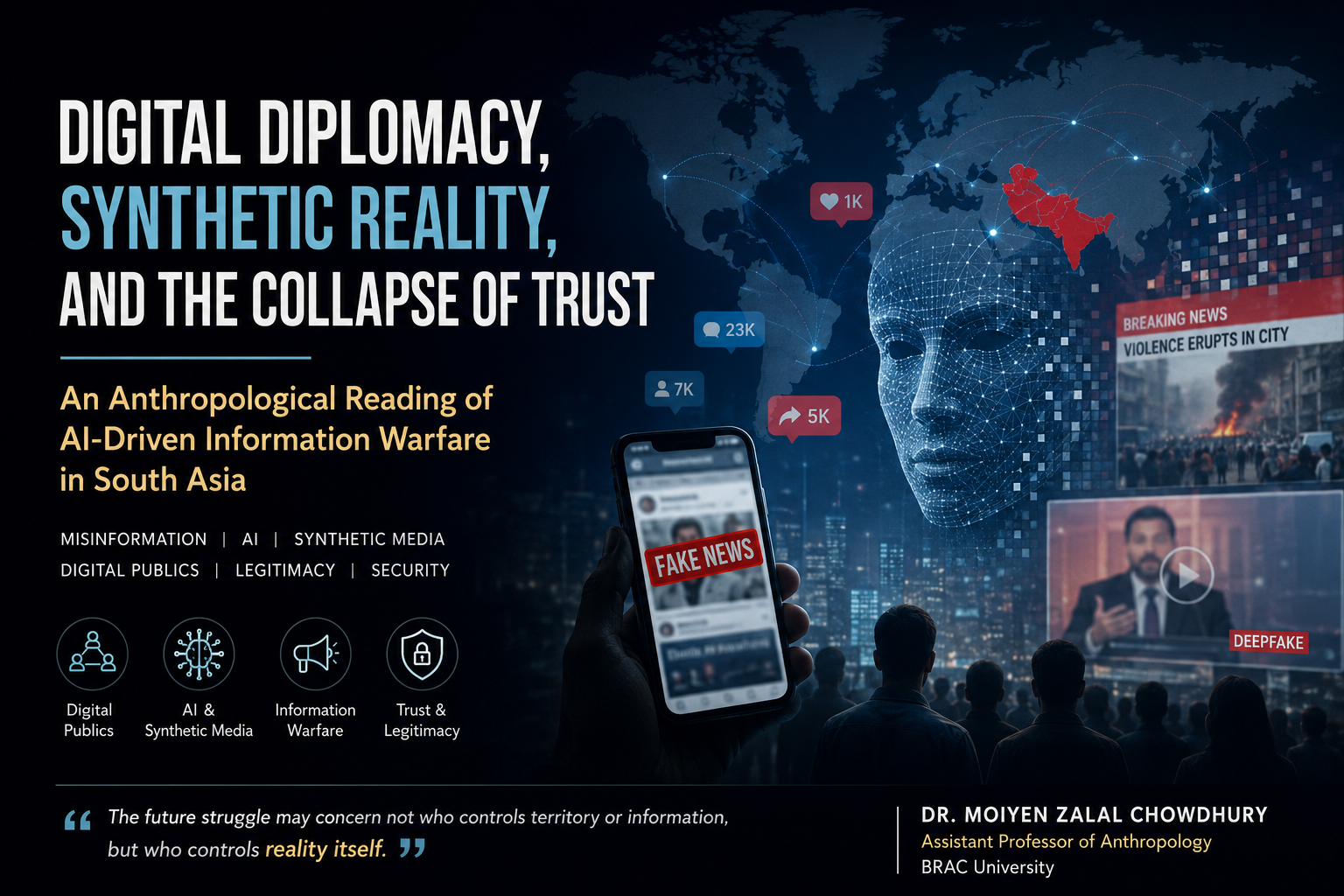
Digital Diplomacy, Synthetic Reality, and the Collapse of Trust: An Anthropological Reading of AI-Driven Information Warfare in South Asia
Introduction: When Reality Itself Becomes a Battlefield
There was a time when political conflict seemed easier to imagine. Security had visible geography. Borders separated inside from outside. Armies occupied territories. Governments monitored physical boundaries. Threats crossed mountains, rivers, oceans, and national frontiers. Security possessed material coordinates and recognizable actors.
The state largely imagined danger as external. Enemies existed beyond territorial boundaries, and sovereignty depended upon maintaining control over physical space. National security frameworks consequently concentrated on military capability, strategic alliances, territorial defense, and conventional geopolitical calculations.
The contemporary world increasingly destabilizes this imagination.
Today wars increasingly move through infrastructures that possess no obvious geography. Political conflict travels through timelines rather than territories, through recommendation systems rather than roads, through hashtags rather than checkpoints, and through algorithmic architectures rather than conventional battlefields. Communication systems themselves increasingly function as strategic environments where legitimacy, influence, and power are negotiated.
A manipulated image may travel globally within minutes. A fabricated speech attributed to a political leader may circulate across millions of screens before verification systems begin operating. Artificial intelligence systems can generate convincing voices, produce realistic video footage, synthesize political statements, and construct visual events that never occurred. Individuals increasingly encounter realities whose authenticity becomes difficult to determine.
The emerging problem therefore extends beyond the simple circulation of false information.
The larger concern involves uncertainty regarding reality itself.
The contemporary crisis increasingly concerns the conditions under which citizens decide what counts as true, credible, and trustworthy. Shared understandings of reality historically functioned as an important foundation for social cohesion and democratic life. Public institutions, news systems, educational structures, and everyday social relationships collectively helped establish relatively stable frameworks through which societies interpreted events.
Digital environments increasingly complicate such frameworks.
The challenge emerges partly because digital technologies do not merely transmit information. Digital technologies organize attention. They structure visibility. They shape social relationships. They influence emotional reactions and determine which narratives acquire legitimacy.
Consequently, contemporary communication environments increasingly transform information into a strategic resource.
Political actors, states, corporations, social movements, and networked communities increasingly compete to shape perception itself. Control over information increasingly becomes intertwined with control over political legitimacy. Information no longer functions merely as communication; it increasingly functions as infrastructure.
South Asia represents a particularly important region for examining these transformations because multiple conditions intersect simultaneously.
The region contains rapidly expanding digital populations and large numbers of young users whose everyday social interactions increasingly occur through online environments. Mobile connectivity continues expanding rapidly while institutional trust frequently remains uneven. Political polarization increasingly shapes public discourse, and emotional narratives surrounding nationalism, religion, identity, and belonging frequently acquire significant social force.
Consequently, digital environments within South Asia often become spaces where political contestation, moral claims, and collective anxieties converge.
Understanding misinformation and AI-generated disinformation therefore requires moving beyond narrow technological explanations. False information does not circulate simply because technologies malfunction or because individuals fail to verify facts. Such explanations frequently overlook the social environments through which information acquires meaning.
Anthropological approaches provide an important intervention here.
Information rarely circulates solely because it is true or false. Information circulates because it resonates with existing emotional worlds, social relationships, moral commitments, and collective identities. Rumors, narratives, images, and symbolic claims often acquire power because they connect with broader social experiences and cultural understandings.
This essay therefore argues that misinformation and AI-driven disinformation should not be understood merely as technological failures or communication problems. Rather, they should be understood as socio-political processes embedded within digital sociality, platform infrastructures, and struggles over legitimacy.
The future security crisis of South Asia may therefore involve not only territorial disputes or conventional geopolitical tensions but also a gradual erosion of trust itself.
In the age of artificial intelligence, the question increasingly becomes not simply who controls territory, but who controls reality.
From Propaganda to Platform Society: The Changing Geography of Power
For much of the twentieth century, political communication largely operated through relatively centralized structures. Governments, newspapers, radio stations, and television networks functioned as major institutions responsible for producing and distributing information. Communication generally followed a recognizable pattern: a limited number of actors generated messages while large populations consumed them.
Authority largely moved in one direction.
States spoke.
Citizens listened.
Political legitimacy frequently depended upon controlling institutional channels of communication. Propaganda therefore generally involved centralized attempts to shape public opinion through controlled information environments.
Classical propaganda systems relied upon several assumptions.
First, information moved vertically rather than horizontally.
Second, audiences were primarily imagined as receivers rather than active participants.
Third, institutions maintained relatively strong authority regarding what counted as legitimate information.
Even where political disagreement existed, there generally remained recognizable gatekeepers responsible for validating knowledge.
The expansion of digital technologies fundamentally disrupted these assumptions.
Social media platforms increasingly transformed communication environments by dissolving distinctions between producers and consumers of information. Individuals increasingly became content creators, distributors, interpreters, commentators, and amplifiers simultaneously.
The ordinary user increasingly became a media institution.
A university student with a smartphone may produce content reaching hundreds of thousands of viewers. A political influencer can shape narratives that compete directly with traditional media organizations. Anonymous users may initiate discussions capable of influencing public opinion, generating controversy, or producing political mobilization.
The result is not merely technological change.
The result is structural transformation.
Communication increasingly moves horizontally through networks rather than vertically through institutions.
Manuel Castells (2015) argues that contemporary power increasingly operates through communication networks. Networks themselves increasingly determine who becomes visible, whose narratives circulate, and which voices acquire legitimacy.
Power therefore increasingly depends upon the ability to shape communication flows.
Control over communication increasingly becomes control over visibility itself.
This transformation has significant implications for security and politics because communication platforms do not simply transmit information neutrally.
Platforms actively organize social life.
Algorithms determine what users see.
Recommendation systems prioritize particular forms of engagement.
Visibility increasingly emerges through computational decisions rather than solely through editorial judgments.
Consequently, communication environments increasingly operate according to platform logics rather than purely public logics.
Van Dijck (2013) describes social media platforms as ecosystems that increasingly shape social interaction itself. Platforms influence how people communicate, form communities, express emotions, and participate politically.
Political communication increasingly becomes inseparable from platform architecture.
This creates important consequences.
Traditional propaganda sought to persuade populations.
Contemporary platform environments increasingly seek to maximize engagement.
Engagement frequently privileges emotional intensity.
Outrage attracts attention.
Fear attracts attention.
Conflict attracts attention.
Humor attracts attention.
Polarization attracts attention.
The platform economy frequently rewards visibility rather than accuracy.
Consequently, contemporary information systems increasingly create environments where emotionally charged narratives travel rapidly regardless of factual reliability.
Information warfare therefore increasingly differs from older propaganda models.
Political influence no longer depends exclusively upon producing persuasive messages.
Political influence increasingly depends upon generating circulation.
Memes increasingly function as political symbols.
Short videos increasingly become ideological instruments.
Hashtags increasingly create collective identities.
Comment sections increasingly become sites where legitimacy is negotiated.
Ordinary users increasingly become participants within broader systems of informational struggle.
Papacharissi (2016) argues that digital environments increasingly produce affective publics—networked formations organized through emotional expression and connectivity.
This concept becomes particularly useful because it demonstrates that contemporary communication does not merely involve rational exchanges of information.
Digital communication increasingly involves feelings.
Individuals participate because they are angry.
Individuals participate because they are fearful.
Individuals participate because they feel solidarity.
Individuals participate because they seek belonging.
Emotion increasingly becomes informational infrastructure.
The consequence is significant.
Traditional information warfare often imagined society as the target of influence operations.
Contemporary digital environments increasingly transform society itself into the infrastructure through which influence operates.
The battlefield increasingly moves inside everyday life.
The distinction between communication and conflict therefore becomes increasingly difficult to maintain.
Political struggle increasingly unfolds through ordinary acts:
sharing a post,
liking a video,
forwarding a message,
participating in a hashtag,
commenting on a news story.
Small everyday actions increasingly become components of larger informational systems.
Security therefore acquires a different geography.
Threats no longer necessarily arrive from outside territorial boundaries.
Threats increasingly emerge within the ordinary social infrastructures of digital life itself.
Digital Sociality and Why False Information Feels True
One of the most common assumptions surrounding misinformation is that false information spreads because individuals lack knowledge or because they fail to distinguish between accurate and inaccurate content. Such explanations often imply that misinformation is primarily a problem of ignorance and that providing correct information should therefore solve the problem.
However, reality frequently appears more complicated.
People often continue sharing information even after encountering correction. Fact-checking initiatives frequently produce limited outcomes. Rumors repeatedly survive despite contradictory evidence. Certain narratives persist even when substantial evidence demonstrates their inaccuracies.
If misinformation were merely an informational deficit, factual correction alone would often be sufficient.
Yet this frequently does not occur.
Anthropological approaches suggest a different perspective.
Individuals rarely encounter information as isolated rational actors detached from social environments. Information enters preexisting worlds of emotion, memory, identity, morality, and social relationships. Information therefore does not simply circulate as neutral content. It acquires meaning through social life.
Consequently, the important question may not simply be:
“Is this information true?”
The more important question increasingly becomes:
“What does this information do socially?”
This shift matters because information frequently performs functions beyond transmitting facts.
Information may:
- create solidarity;
- signal group loyalty;
- strengthen collective identities;
- express moral positions;
- reinforce existing worldviews;
- establish belonging.
Sharing information increasingly becomes a social act rather than merely a communicative act.
A forwarded message in a family group may communicate care.
A political meme may communicate ideological identification.
A hashtag may signal solidarity.
A shared image may function as symbolic participation within a collective event.
Digital communication increasingly becomes embedded within everyday social practices.
My earlier work on Resistance Sociality emerged from observing how digital spaces increasingly facilitate social relationships through which collective action and shared identities become possible (Chowdhury, 2019). Rather than understanding political activity solely through organized structures or ideological commitments, Resistance Sociality suggested that digital interactions themselves increasingly generate forms of social connection that sustain collective engagement.
People participated not simply because they possessed identical political beliefs.
People participated because they felt socially connected.
Interactions themselves became meaningful.
Friendships emerged.
Shared emotions developed.
Collective experiences formed.
Political participation increasingly became inseparable from sociality itself.
The same logic becomes relevant for understanding misinformation.
If social media can create solidarities around resistance, it can also create solidarities around fear, suspicion, hostility, and misinformation.
Digital sociality itself remains politically open.
It does not possess predetermined moral direction.
Communities may organize around democratic aspirations.
Communities may organize around exclusionary narratives.
Communities may organize around conspiracy theories.
Communities may organize around misinformation.
The mechanisms of social attachment frequently remain similar even when outcomes differ.
This partly explains why certain forms of misinformation appear emotionally persuasive even when factual evidence remains weak.
False information often succeeds not because it is objectively convincing but because it becomes socially meaningful.
Individuals frequently accept narratives that resonate with existing experiences, anxieties, and moral assumptions.
For example, rumors concerning national identity, religion, morality, political betrayal, or external threats frequently gain force because they intersect with broader social concerns already present within everyday life.
Emotion therefore becomes central.
Papacharissi (2016) describes digital formations as affective publics because emotional intensity increasingly shapes communication patterns.
Fear travels quickly.
Outrage travels quickly.
Humiliation travels quickly.
Anger travels quickly.
Humor travels quickly.
Emotion itself increasingly becomes informational infrastructure.
Digital platforms frequently amplify this process because algorithmic systems prioritize engagement. Content that produces strong emotional reactions often receives greater visibility.
Consequently, the architecture of contemporary communication increasingly aligns technological systems with emotional dynamics.
This creates environments where emotionally charged narratives may travel faster than careful deliberation.
Importantly, this does not necessarily imply that users are irrational.
Rather, it suggests that human beings remain social beings.
People rarely evaluate information solely through detached calculation.
People interpret information through relationships, identities, and everyday experiences.
Understanding misinformation therefore requires moving beyond narrow questions of factual accuracy toward broader questions regarding meaning, belonging, and social life.
From an anthropological perspective, false information frequently feels true not because individuals abandon reason, but because information increasingly becomes embedded within emotionally meaningful worlds.
The challenge of misinformation therefore concerns not simply correcting facts.
The challenge increasingly concerns understanding the social conditions under which facts themselves acquire meaning.
Artificial Intelligence and the Production of Synthetic Reality
Artificial intelligence introduces a qualitatively different challenge into contemporary information environments because it changes not simply the speed or scale of misinformation but the very conditions through which reality becomes recognizable.
Historically, misinformation and propaganda certainly existed. Governments manipulated narratives. Political actors circulated rumors. Edited photographs and fabricated stories occasionally influenced public opinion. However, such processes often required substantial labor, institutional resources, technical expertise, and coordinated infrastructures.
Manipulating reality was costly.
Creating convincing deception demanded effort.
Artificial intelligence increasingly transforms these conditions.
Today large language models can generate persuasive political texts within seconds. Image-generation systems can produce realistic photographs of events that never occurred. Voice synthesis technologies can imitate public figures with remarkable precision. Deepfake systems can create videos showing individuals speaking words they never uttered or participating in actions that never happened.
The significance of these developments extends beyond technological novelty.
Artificial intelligence increasingly changes the ontology of information itself.
Information no longer merely represents reality.
Increasingly, information produces reality.
The distinction may initially appear subtle, but its implications are profound.
Historically, photographs often functioned as evidence because they maintained a relatively stable relationship with material events. Although manipulation was always possible, visual media nevertheless possessed important evidentiary authority.
People frequently assumed:
“I saw it with my own eyes.”
Visual perception often functioned as a form of social verification.
Artificial intelligence increasingly destabilizes this assumption.
Today one may see images of political violence that never occurred.
One may hear speeches never delivered.
One may encounter videos of public figures expressing positions they never held.
Reality increasingly becomes reproducible independent of actual events.
Chesney and Citron (2019) argue that deepfake technologies create significant risks because they undermine informational trust itself. The problem extends beyond isolated instances of false content. The broader concern involves what might be described as epistemic instability—conditions under which societies lose confidence in their ability to distinguish authentic reality from synthetic construction.
The challenge therefore becomes larger than misinformation.
The issue increasingly concerns uncertainty regarding reality itself.
Individuals may increasingly ask:
Did this event actually happen?
Is this image real?
Did this politician actually say this?
Can this video be trusted?
Yet a second problem emerges that may prove even more dangerous.
The issue is not only that individuals may believe fabricated realities.
The issue is also that individuals may reject authentic realities.
Deepfake technologies create what scholars increasingly describe as the liar’s dividend (Chesney & Citron, 2019). The existence of synthetic media allows individuals to dismiss genuine evidence by claiming manipulation.
Authentic recordings may be rejected.
Verified documentation may be questioned.
Political accountability may weaken.
Reality itself becomes contestable.
The result creates a paradoxical condition.
Societies increasingly risk moving toward environments characterized simultaneously by excessive information and insufficient certainty.
Citizens encounter unprecedented quantities of content while possessing decreasing confidence regarding what should be trusted.
The challenge therefore becomes one of abundance rather than scarcity.
There is not too little information.
There is too much information.
And increasingly there may be too little trust.
Artificial intelligence also transforms the scale of influence operations.
Woolley and Howard (2018) demonstrate that computational propaganda increasingly employs automation, algorithmic systems, and coordinated digital infrastructures to shape political communication. Automated accounts, targeted messaging systems, and algorithmically optimized persuasion mechanisms increasingly allow actors to influence large populations rapidly and efficiently.
Artificial intelligence accelerates such capacities.
Rather than requiring large institutional infrastructures, smaller actors increasingly gain access to sophisticated systems of content generation and amplification.
The consequences become particularly important within digitally saturated societies.
In South Asia, where mobile connectivity continues expanding rapidly and digital platforms increasingly structure everyday communication, synthetic media may intersect with preexisting political polarization, religious tensions, and institutional vulnerabilities.
A manipulated video circulated during periods of political uncertainty may intensify conflict.
A fabricated speech may generate unrest.
AI-generated narratives may amplify existing social anxieties.
Technological systems therefore increasingly interact with social conditions.
Artificial intelligence alone does not create instability.
Rather, artificial intelligence often amplifies social conditions already present within society.
This distinction remains important.
Technology does not operate independently from culture, politics, and history.
Artificial intelligence enters worlds already shaped by inequality, memory, fear, identity, and power.
Consequently, understanding AI-generated misinformation requires more than technical literacy.
It requires understanding the social life of synthetic realities.
The deeper challenge of artificial intelligence therefore concerns not merely whether machines can imitate humans.
The deeper challenge increasingly concerns whether societies can sustain shared realities in environments where reality itself becomes reproducible.
Future information conflicts may therefore involve more than battles over facts.
They may increasingly become struggles over the conditions under which truth itself becomes possible.
Digital Diplomacy and Narrative Power: Competing for Visibility in South Asia
Diplomacy historically referred to interactions among states conducted through relatively formal institutions and procedures. Negotiations occurred through embassies, bilateral meetings, treaties, and official communication channels. Diplomats functioned as intermediaries responsible for managing relations between political entities.
Communication certainly mattered within such systems, but communication largely remained embedded within institutional structures.
Digital technologies increasingly reshape these arrangements.
Diplomatic practice no longer unfolds exclusively through ministries, official meetings, or state documents. Increasingly, diplomacy occurs through timelines, social media platforms, online campaigns, digital public engagements, and rapidly circulating narratives.
States increasingly communicate directly with populations rather than solely with other states.
Governments maintain social media accounts followed by millions of users. Political leaders increasingly communicate through platforms without relying upon traditional intermediaries. International organizations employ digital communication strategies to shape public opinion. Foreign ministries increasingly invest resources in online visibility and narrative management.
Diplomacy increasingly becomes public.
More importantly, diplomacy increasingly becomes visible.
Bjola and Holmes (2015) describe digital diplomacy as a transformation in which communication technologies alter both the practice and logic of international relations. Digital environments increasingly change not only how diplomacy is conducted but also what diplomacy itself seeks to achieve.
Traditional diplomacy frequently focused upon negotiating interests.
Digital diplomacy increasingly focuses upon shaping perception.
This distinction matters because contemporary power increasingly depends not merely upon material capability but also upon symbolic legitimacy.
Political actors increasingly compete over:
- attention;
- visibility;
- emotional alignment;
- credibility;
- narrative authority.
Power increasingly involves determining whose interpretation of reality becomes socially accepted.
Narratives increasingly function as strategic resources.
The struggle therefore concerns more than information itself.
The struggle concerns meaning.
Who defines a crisis?
Who defines a threat?
Who defines legitimacy?
Who defines national identity?
Increasingly, these questions unfold within digital spaces.
South Asia provides a particularly important context for examining these developments because the region contains multiple intersecting geopolitical tensions, historical conflicts, and competing national narratives.
Relations among states within the region frequently involve long histories of territorial disputes, nationalism, migration debates, security concerns, and ideological differences.
Digital communication increasingly becomes entangled within these dynamics.
Narratives concerning national identity, sovereignty, religion, and historical memory increasingly circulate across borders.
Hashtags cross national boundaries.
Political content moves rapidly across platforms.
Images, rumors, and symbolic narratives increasingly become transnational actors.
Consequently, information infrastructures increasingly become geopolitical infrastructures.
States increasingly engage in efforts to influence not only external actors but also public sentiment itself.
Digital environments therefore become spaces where geopolitical competition intersects with everyday social life.
The significance of this transformation becomes clearer when considering the role of emotional publics.
Papacharissi (2016) argues that networked publics increasingly organize around affective intensities rather than solely around rational deliberation.
Digital diplomacy increasingly operates within such conditions.
States do not merely seek to persuade populations through facts.
States increasingly seek to mobilize emotions.
Fear may become politically useful.
National pride may become politically useful.
Victimhood narratives may become politically useful.
Historical grievances may become politically useful.
The politics of emotion increasingly intersects with the politics of visibility.
Digital diplomacy therefore becomes inseparable from broader struggles over affect and legitimacy.
Importantly, the actors involved increasingly extend beyond states themselves.
Technology companies increasingly shape information infrastructures through platform governance systems and algorithmic designs.
Influencers increasingly function as informal diplomatic actors.
Online communities increasingly participate in constructing geopolitical narratives.
Ordinary users increasingly become participants in wider systems of symbolic contestation.
The distinction between international politics and everyday communication therefore becomes increasingly blurred.
A shared post, a political meme, or a viral video may appear insignificant in isolation.
Yet collectively these everyday interactions increasingly contribute to broader systems through which legitimacy and influence are negotiated.
The consequences become particularly important within South Asia because public trust frequently remains uneven and digital environments increasingly shape political participation.
Under such conditions, misinformation and AI-generated narratives do not simply produce communication problems.
They may increasingly generate diplomatic consequences, intensify political tensions, and reshape public understandings of security itself.
Digital diplomacy therefore increasingly concerns more than technological adaptation.
Increasingly, it concerns struggles over reality, legitimacy, and social imagination.
Power today may no longer depend solely upon controlling territory.
Power increasingly depends upon controlling visibility.
Bangladesh, Digital Publics, and the Politics of Legitimacy
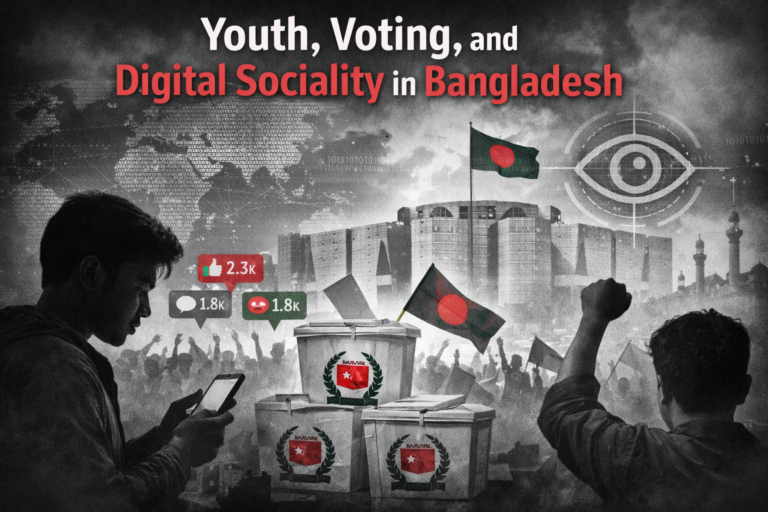
Bangladesh provides an important site for understanding how digital technologies increasingly reshape political communication, public life, and struggles over legitimacy. Over the past two decades, the rapid expansion of mobile connectivity, social media platforms, and digital participation has transformed how citizens communicate, mobilize, and imagine collective life.
Digital platforms increasingly function not merely as communication tools but as environments through which social and political realities are experienced.
Public life increasingly unfolds simultaneously across online and offline spaces.
Political debates move through Facebook timelines.
Collective emotions emerge through hashtags.
National events become digitally narrated experiences.
Ordinary users increasingly participate in constructing public discourse.
The significance of these transformations becomes particularly visible when examining changing forms of political participation.
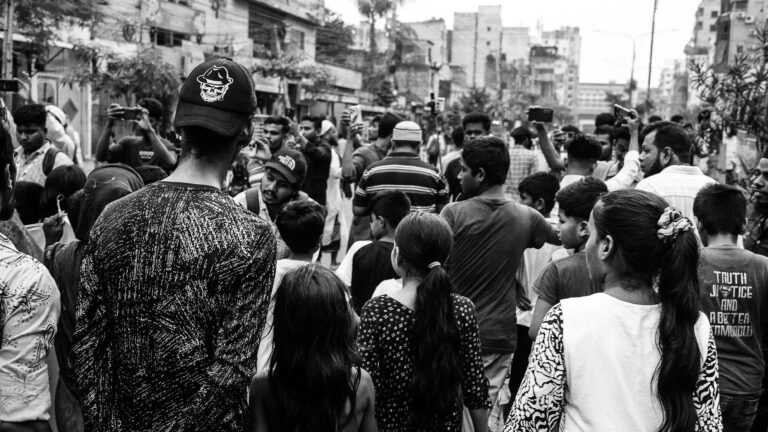
The Shahbag movement represented one important moment in this trajectory. Digital communication technologies enabled forms of participation and collective engagement that exceeded conventional organizational structures. Individuals who had never physically met nevertheless developed forms of emotional and political connection through interaction within digital spaces.
Digital environments facilitated not simply communication but sociality.
Collective presence increasingly emerged through networks of interaction.
Participation involved not only ideological commitment but also shared experiences, emotional intensities, and everyday digital practices.
My earlier work conceptualized this phenomenon through the framework of Resistance Sociality, emphasizing how digital interactions increasingly generate social relations capable of sustaining collective action (Chowdhury, 2019).
Importantly, the significance of digital sociality extends beyond moments of resistance.
The same infrastructures capable of producing solidarity may also facilitate fragmentation, polarization, exclusion, and misinformation.
Digital spaces do not possess predetermined political direction.
The architecture itself remains politically open.
Social media platforms may facilitate democratic participation.
They may also facilitate hostility.
They may generate solidarity.
They may generate suspicion.
They may create spaces of inclusion.
They may create spaces of exclusion.
The mechanisms often remain similar even when political outcomes differ.
Subsequent developments within Bangladesh increasingly demonstrated these complexities.
Digital platforms gradually became environments where competing actors struggled over legitimacy itself.
Questions increasingly emerged concerning:
Who represents the nation?
Who possesses moral authority?
Who belongs?
Who threatens collective identity?
Who speaks legitimately?
Such struggles frequently unfolded through highly emotional digital environments.
Political disagreement increasingly merged with symbolic conflict.
Competing narratives circulated through images, videos, memes, short texts, and emotionally charged claims.
Digital publics increasingly became arenas where visibility itself carried political significance.
Visibility increasingly became legitimacy.
Silence increasingly became suspicion.
Participation increasingly became performative.
The July 2024 uprising and its aftermath further revealed the complexities of contemporary digital publics in Bangladesh. Digital platforms functioned not only as spaces of communication but also as environments where narratives, emotions, symbolic claims, and political meanings were continuously negotiated.
Competing actors attempted to establish legitimacy through visibility.
Different groups sought to define events through competing narratives.
Images acquired symbolic significance.
Memes became political language.
Digital environments increasingly became spaces where struggles over interpretation unfolded in real time.
Importantly, such developments demonstrate that digital spaces should not be understood merely as neutral technologies facilitating communication.
Platforms increasingly shape social relations themselves.
Van Dijck (2013) argues that digital platforms increasingly organize everyday social life through particular technological and economic logics.
Algorithms influence what becomes visible.
Engagement systems prioritize particular forms of content.
Attention increasingly becomes structured computationally.
Consequently, political realities increasingly emerge through interactions among technological infrastructures, emotional dynamics, and social practices.
The issue therefore extends beyond misinformation alone.
The broader question concerns how digital publics increasingly produce conditions under which legitimacy itself becomes contested.
Legitimacy historically depended upon institutions such as governments, educational systems, media organizations, and public authorities.
Digital environments increasingly redistribute these processes.
Authority increasingly becomes fragmented.
Competing actors increasingly claim credibility.
Verification increasingly becomes difficult.
Symbolic struggles increasingly intensify.
Under such conditions, public trust may become increasingly fragile.
The implications for security become significant.
Traditional security frameworks often assume that institutions possess relatively stable authority and that information systems operate through identifiable channels.
Digital publics increasingly complicate such assumptions.
Political instability may emerge not only through institutional breakdown but also through the gradual erosion of shared understandings necessary for collective life.
Bangladesh therefore illustrates an important lesson regarding contemporary digital societies.
The challenge is not merely that social media changes politics.
The deeper challenge increasingly concerns how social media changes the social conditions through which politics itself becomes possible.
In digital environments, the struggle increasingly concerns not simply control over information but control over legitimacy itself.
Security Without Freedom? AI Governance, Surveillance, and the Ethics of Protection
As misinformation and AI-generated disinformation increasingly become framed as security concerns, governments and institutions understandably seek mechanisms capable of reducing potential harm. Concerns regarding social instability, electoral manipulation, public disorder, and foreign influence operations frequently generate pressure for stronger forms of intervention.
The problem appears straightforward.
If misinformation creates social risks, governments should regulate it.
If digital platforms amplify harmful content, platforms should remove it.
If artificial intelligence produces synthetic media capable of destabilizing societies, stronger monitoring systems should be implemented.
Such responses initially appear reasonable.
However, the issue becomes more complicated once one asks a different question:
Who decides what should be protected, and from whom?
Security frameworks often emerge from legitimate concerns regarding stability and public safety. Yet security interventions have historically carried an important paradox.
Systems designed to protect populations frequently also expand mechanisms of observation, classification, and control.
Michel Foucault’s work on governmentality provides an important perspective here. Foucault (1991) argued that modern systems of power increasingly function not simply through direct coercion but through subtle forms of administration, surveillance, categorization, and behavioral management. Power increasingly operates through techniques that appear normal, rational, and protective.
Security therefore does not merely respond to threats.
Security also produces particular ways of governing populations.
Digital environments intensify these dynamics.
Efforts to counter misinformation increasingly involve:
- content moderation systems;
- algorithmic detection tools;
- automated filtering mechanisms;
- surveillance infrastructures;
- predictive analytics;
- AI-assisted monitoring systems.
Such systems may help identify harmful content and coordinated influence campaigns. They may reduce certain forms of manipulation and improve public safety.
However, they may also generate significant ethical concerns.
First, automated systems themselves remain imperfect.
Artificial intelligence systems frequently reproduce biases embedded within training data and existing social structures. Decisions regarding harmful content often depend upon complex cultural, political, and contextual factors that computational systems may struggle to interpret.
Humor may be interpreted as hate speech.
Political satire may be interpreted as misinformation.
Dissent may be interpreted as instability.
Context frequently becomes difficult for machines to understand.
Second, extensive moderation infrastructures may create concerns regarding transparency and accountability.
Platform companies increasingly function as powerful actors governing public communication environments. Yet the mechanisms through which algorithmic decisions occur often remain opaque.
Citizens frequently encounter decisions without understanding how or why such decisions emerged.
Visibility increasingly becomes algorithmically managed.
Invisible systems increasingly shape public realities.
Third, interventions intended to combat misinformation may create broader risks for democratic participation.
Governments may invoke security concerns to justify restrictions extending beyond misinformation itself.
Legal categories surrounding false information often remain difficult to define precisely.
Under such conditions, distinctions between misinformation, criticism, dissent, and political opposition may become increasingly uncertain.
The issue therefore becomes larger than misinformation alone.
The issue increasingly concerns power.
Who determines truth?
Who determines legitimacy?
Who determines acceptable speech?
Who determines harmful content?
These questions possess significant implications because they concern the relationship between citizens and authority itself.
Anthropological approaches become particularly useful here because they remind us that technologies never operate independently from social values and political contexts.
Artificial intelligence itself does not possess political neutrality.
Algorithms emerge through human decisions.
Governance systems emerge through institutions.
Moderation practices emerge through particular assumptions regarding order, risk, and acceptable behavior.
Technology therefore reflects broader social arrangements.
The challenge consequently involves avoiding simplistic solutions.
Technological problems alone rarely solve social problems.
More surveillance does not automatically create trust.
More moderation does not automatically create legitimacy.
More regulation does not automatically create democratic stability.
Instead, effective responses increasingly require broader forms of social engagement.
Universities, governments, civil society organizations, researchers, and technology companies increasingly require collaborative approaches emphasizing:
- critical digital literacy;
- algorithmic transparency;
- ethical AI governance;
- institutional accountability;
- public participation.
Universities possess especially important responsibilities within this environment.
Higher education institutions should not merely train individuals to use technologies.
They should cultivate critical capacities capable of questioning how technologies shape social life itself.
Students increasingly require more than technical skills.
They increasingly require the ability to examine power, ethics, and legitimacy within digital environments.
Ultimately, societies face a difficult balance.
The challenge is not choosing between security and freedom.
The challenge increasingly involves constructing forms of security capable of protecting freedom itself.
Otherwise, attempts to defend democratic societies may gradually reproduce conditions that weaken the very principles they seek to protect.
Conclusion: Protecting Trust in the Age of Synthetic Reality
Contemporary discussions surrounding misinformation frequently begin with concerns regarding false content. Public debates often focus on fabricated news stories, manipulated videos, conspiracy narratives, or misleading political communication. Such concerns are important and increasingly urgent.
Yet this essay has argued that the emerging challenge extends beyond misinformation itself.
The deeper issue increasingly concerns transformations in the social conditions through which reality becomes collectively recognized.
Digital environments have altered not only how information travels but also how trust itself is organized. Communication increasingly unfolds through platform infrastructures that shape visibility, emotional intensity, and social interaction. Artificial intelligence increasingly produces synthetic forms of reality capable of complicating distinctions between authentic and fabricated experience. Public life increasingly emerges through digitally mediated environments where narratives compete for legitimacy and attention.
The resulting problem therefore concerns more than technology.
The challenge concerns sociality.
Throughout this essay I have argued that misinformation should not be understood solely as technological malfunction or informational deficiency. Anthropological perspectives suggest that information acquires significance through social life itself. Narratives gain force because they intersect with emotions, identities, collective memories, and structures of belonging.
People rarely share information simply because it appears objectively convincing.
People frequently share information because it feels meaningful.
Digital environments increasingly transform such meaning into infrastructure.
Consequently, contemporary information conflicts increasingly become struggles over social realities rather than merely struggles over facts.
This challenge becomes particularly significant in South Asia.
The region contains rapidly expanding digital populations alongside complex political histories, uneven institutional trust, emotionally charged public cultures, and competing narratives of identity and belonging. Under such conditions, misinformation and AI-generated synthetic media may intersect with existing social tensions and vulnerabilities in powerful ways.
Digital platforms increasingly become environments where legitimacy itself becomes contested.
Political authority increasingly competes with influencer authority.
Institutional credibility increasingly competes with networked credibility.
Facts increasingly compete with affect.
Visibility increasingly competes with deliberation.
The question therefore becomes larger than whether misinformation can be eliminated.
Complete elimination remains unlikely.
Rumors, symbolic narratives, and forms of uncertainty have always existed within human societies.
The challenge instead concerns sustaining shared conditions under which democratic life remains possible.
Historically, societies depended upon common frameworks of trust.
Institutions, educational systems, media structures, and social relationships collectively contributed to relatively stable understandings of reality.
Digital environments increasingly destabilize these arrangements.
Artificial intelligence further intensifies these uncertainties because reality itself increasingly becomes reproducible independent of actual events.
The consequences extend beyond politics.
The consequences concern the foundations of collective life.
When trust weakens, democratic deliberation becomes difficult.
When trust weakens, institutions lose legitimacy.
When trust weakens, social fragmentation intensifies.
When trust weakens, shared futures become increasingly difficult to imagine.
Future security crises in South Asia may therefore not emerge solely from borders, military conflicts, or conventional geopolitical tensions.
They may emerge through the gradual erosion of epistemic trust itself.
Protecting national security increasingly means protecting the conditions under which societies can continue recognizing shared realities.
This does not imply returning nostalgically to earlier communication systems or assuming that technological innovation itself represents danger.
Digital technologies also create possibilities for democratic participation, collective solidarity, and new forms of public engagement.
The challenge therefore is not rejecting technological transformation.
The challenge increasingly involves shaping technological systems ethically and politically.
Security in the age of artificial intelligence increasingly requires more than surveillance infrastructures and content moderation systems.
It increasingly requires:
- critical digital literacy;
- transparent technological governance;
- accountable institutions;
- ethical AI systems;
- democratic participation;
- stronger cultures of public trust.
Ultimately, the future struggle may not concern merely who controls territory, resources, or information.
The future struggle may increasingly concern who controls reality itself.
And perhaps the most important political question of the coming decades may not simply be:
“Can artificial intelligence imitate humans?”
The more difficult question may become:
“Can societies preserve trust in worlds where reality itself becomes endlessly reproducible?”
The answer to that question may determine not only the future of communication but also the future of democracy, public life, and social cohesion itself.
References
Abu-Lughod, L. (1990). The romance of resistance: Tracing transformations of power through Bedouin women. American Ethnologist, 17(1), 41–55.
Bjola, C., & Holmes, M. (2015). Digital diplomacy: Theory and practice. Routledge.
Castells, M. (2015). Networks of outrage and hope: Social movements in the Internet age (2nd ed.). Polity Press.
Chesney, R., & Citron, D. K. (2019). Deepfakes and the new disinformation war. Foreign Affairs, 98(1), 147–155.
Chowdhury, M. Z. (2019). Resistance sociality in the Shahbag movement: A critical understanding of social media, sociality and resistance in Bangladesh (Doctoral dissertation, Hiroshima University).
Foucault, M. (1991). Governmentality. In G. Burchell, C. Gordon, & P. Miller (Eds.), The Foucault effect: Studies in governmentality (pp. 87–104). University of Chicago Press.
Papacharissi, Z. (2016). Affective publics and structures of storytelling: Sentiment, events and mediality. Information, Communication & Society, 19(3), 307–324.
Tufekci, Z. (2017). Twitter and tear gas: The power and fragility of networked protest. Yale University Press.
Van Dijck, J. (2013). The culture of connectivity: A critical history of social media. Oxford University Press.
Woolley, S. C., & Howard, P. N. (2018). Computational propaganda: Political parties, politicians, and political manipulation on social media. Oxford University Press.
Zuboff, S. (2019). The age of surveillance capitalism: The fight for a human future at the new frontier of power. PublicAffairs.