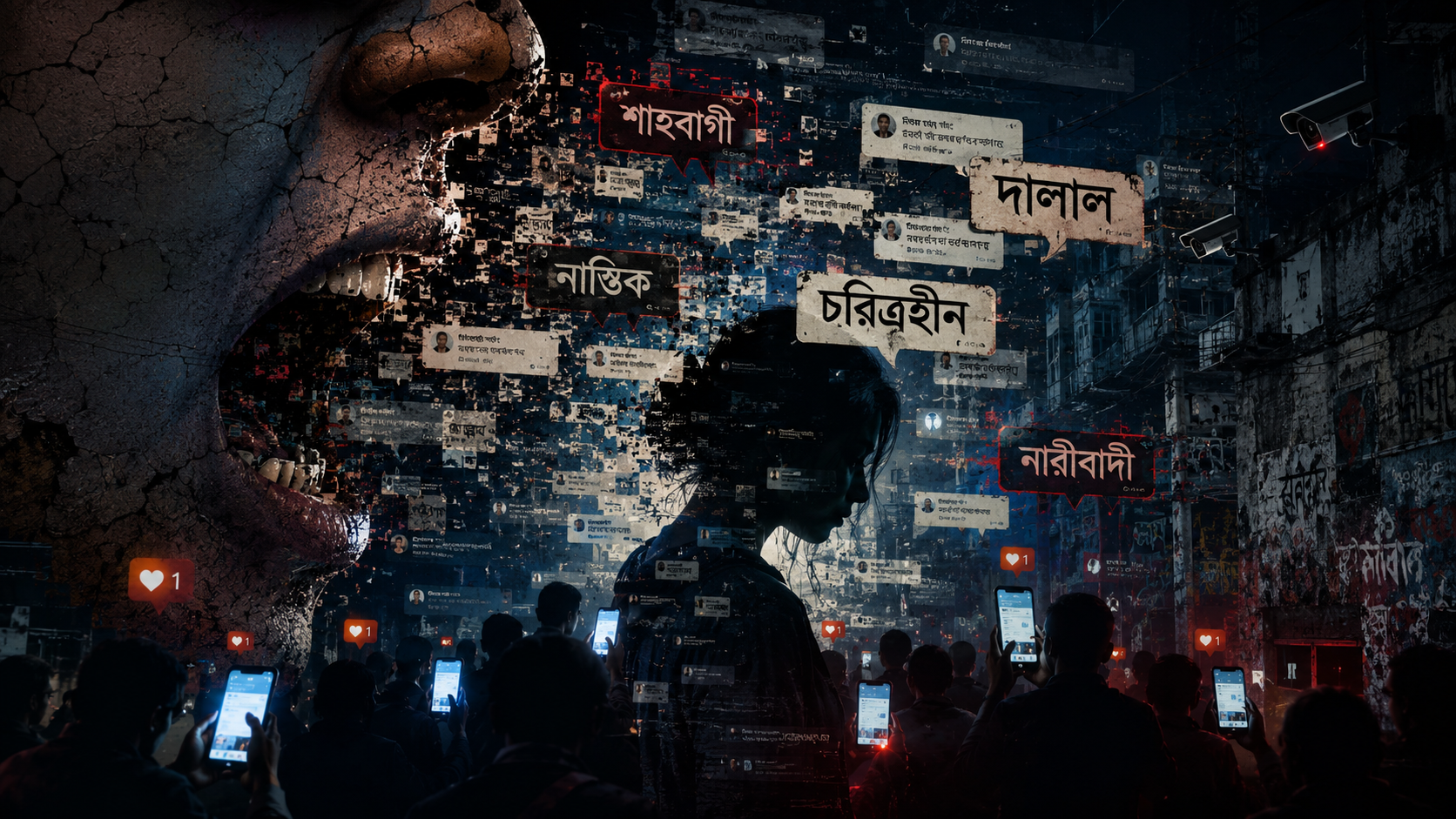
Language as Violence in Bangladesh: Social Media, Misogyny, and Digital Mob Culture
Introduction: When Language Becomes Violence
Language is often imagined as the opposite of violence. Violence is thought to begin where language ends: when dialogue fails, when coercion replaces speech, when bodies are attacked. Yet in contemporary digital societies, especially in deeply polarized and morally surveilled environments, language itself increasingly functions as violence. It wounds, disciplines, exposes, humiliates, sexualizes, mobilizes, and expels. In Bangladesh’s contemporary social media ecology, words do not merely describe women, dissidents, minorities, or political opponents; they make them available for collective punishment.
This essay argues that in Bangladesh’s contemporary digital public sphere, language has become one of the primary technologies through which misogynistic mob politics operates. Through jokes, slurs, memes, screenshots, slang, labels, accusations, comment threads, and moral insinuations, social media transforms everyday prejudice into collective public force. The violence here is not only physical. It is reputational, symbolic, emotional, algorithmic, and social. It disciplines visibility before physical violence even begins.
The essay develops this argument by critically engaging with Professor Shaila Sultana’s important article “Language Crossing of Young Adults in Bangladesh” (2019). Sultana demonstrates that young adults use stylized linguistic practices—exaggerated pronunciation, colloquial Bangla, slang, swear words, parody, and Facebook orthography—to negotiate social marginalization, class insecurity, masculinity, and belonging. Yet she also shows that this language crossing often reproduces misogyny, abuse, hyper-masculinity, nationalism, and inequality. Crossing therefore becomes deeply ambivalent: empowering for some while degrading others.
This essay extends Sultana’s intervention by asking what happens when these stylized linguistic performances move from localized peer-group interaction into Bangladesh’s broader social media ecology. My argument is that digital platforms transform stylized misogynistic and nationalist language into infrastructural violence. Social media gives language a longer life, a larger audience, and a greater capacity to assemble mobs.
The argument developed here does not claim that all offensive language is violence, nor that disagreement itself should be equated with harm. Rather, it argues that language becomes violent when it participates in patterned systems of humiliation, sexualization, dehumanization, exposure, moral policing, and collective punishment directed toward socially vulnerable subjects. In Bangladesh’s contemporary public sphere, these patterned systems increasingly operate through digital language.
Language Crossing and the Ambivalence of Empowerment
Sultana’s article begins from the concept of “language crossing,” a term developed most prominently by Ben Rampton to describe situations in which speakers use linguistic styles associated with other groups or communities. Crossing is not merely linguistic switching; it is a social act through which speakers negotiate identity, legitimacy, power, and belonging.
What makes Sultana’s intervention particularly important is her insistence that crossing in Bangladesh cannot be understood simply as playful hybridity or cosmopolitan creativity. The article demonstrates that marginalized young adults—especially those from rural, lower-middle-class, or non-elite educational backgrounds—use stylized linguistic practices to negotiate displacement within elite urban university environments. Colloquial Bangla, exaggerated pronunciation, slang, swear words, and verbal aggression become resources through which these students reclaim dignity against the perceived superiority of Standard Colloquial Bangla and English.
The ethnographic material reveals a profound classed linguistic hierarchy. Standard Bangla and English function as forms of symbolic and cultural capital associated with elite education, sophistication, and urban privilege. By contrast, Colloquial Bangla, regional accents, and rural speech styles are often perceived as backward, unsophisticated, or socially inferior. Students who arrive from provincial districts into elite Dhaka universities therefore experience linguistic insecurity alongside class displacement.
Language crossing allows these students to temporarily resist that insecurity. Through stylized speech they create what may be called a second social space within the university—a masculine peer world where elite linguistic norms are mocked, inverted, or suspended. Aggressive colloquial speech becomes a form of class resistance.
Yet this resistance is deeply ambivalent.
Sultana demonstrates that the same linguistic practices that help young men negotiate marginalization also frequently reproduce misogyny, hyper-masculinity, sexual aggression, and exclusion. In one of the article’s most important insights, language crossing is shown to function simultaneously as empowerment and domination. The socially insecure subject may become patriarchally powerful through language.
This insight is crucial because it complicates simplistic theories of resistance. Marginalized subjects do not automatically produce emancipatory politics. A person may be disadvantaged within one structure while dominant within another. Young men marginalized by class and linguistic hierarchy may nevertheless reproduce patriarchal violence against women. Thus crossing does not automatically destabilize hierarchy; it may reorganize hierarchy.
The Linguistic Anthropology of Violence
To understand why language can become violent, a linguistic anthropological framework is necessary.
Language is not simply a transparent medium of communication. It is social action. J. L. Austin’s theory of speech acts demonstrated that words do not merely describe reality; they perform actions. Judith Butler later extended this insight by arguing that gender itself is constituted through repeated acts, gestures, signs, and linguistic performances. Pierre Bourdieu showed how language reproduces symbolic domination by naturalizing unequal social hierarchies.
From this perspective, misogynistic language is not merely a reflection of patriarchy; it is one of the everyday practices through which patriarchy renews itself.
A label such as “চরিত্রহীন” (characterless), “বেশ্যা” (whore), “নারীবাদী” (feminist used pejoratively), or “নাস্তিক” (atheist) does not merely describe someone. It positions the person within a moral order. It marks them as socially suspect, morally dangerous, sexually available, politically deviant, or punishable.
Language therefore becomes violent not simply because it offends, but because it reorganizes social relations. It produces vulnerability.
This is especially visible in what linguistic anthropologists call indexicality. Words point beyond themselves. A woman’s accent, slang, English use, confidence, laughter, political speech, or online tone may index class aspiration, urbanity, sexual freedom, arrogance, modernity, or moral corruption depending on who is listening.
In Bangladesh, language is deeply moralized.
Bangla, English, Banglish, regional accents, Islamic expressions, slang, swear words, and digital orthography are never neutral. They are interpreted through wider ideologies of class, gender, religion, and respectability. A woman speaking assertively may be judged differently from a man using the same tone. A man’s vulgarity may be interpreted as confidence or humor; a woman’s vulgarity may be interpreted as moral failure.
Thus language is not evaluated linguistically alone. It is evaluated through gender ideology.
Misogyny as Everyday Speech Practice
One of the most important contributions of Sultana’s work is that misogyny appears not only through explicit hatred, but through ordinary speech practices.
The male students in her ethnography use parody, mock-feminine voicing, sexualized joking, swear words, colloquial aggression, and peer laughter to construct masculine solidarity. Misogyny emerges not simply through individual hostility toward women, but through shared performance.
This is important because misogyny in Bangladesh often survives through normalization.
It appears through:
- casual joking
- teasing
- meme culture
- masculine bonding
- slang
- romantic possessiveness
- moral advice
- public commentary on women’s behavior
- tone-policing
- body-shaming
- “just joking” discourse
The danger of ordinary misogyny is precisely that it does not always appear violent. It appears humorous, intimate, familiar, or culturally normal.
When challenged, misogynistic language often retreats into innocence:
“We were joking.”
“Why are you so sensitive?”
“This is our culture.”
“She brought it on herself.”
“Everyone says this.”
The issue here is not simply intention. A speaker may not consciously intend violence, but language has effects beyond intention. In unequal societies, ordinary language may activate older structures of domination.
Misogyny therefore survives not only through hatred, but through habits that refuse to recognize themselves as harm.
From Language Crossing to Digital Mobbing
Sultana’s article primarily studies localized interactions among young adults and selected Facebook exchanges. However, contemporary Bangladesh requires us to extend this discussion into the wider digital public sphere.
The critical transformation occurs when stylized language moves from peer-group performance into platformed circulation.
Social media fundamentally alters the conditions of language.
A face-to-face conversation is relatively bounded by time, context, and audience. A Facebook comment is searchable, screenshot-able, shareable, archivable, remixable, and algorithmically amplified. A linguistic act that might once have remained temporary now becomes persistent and mobile.
Social media intensifies violence through several mechanisms:
First, it collapses context. Statements, jokes, or images can be detached from their original setting and circulated before hostile audiences.
Second, it expands audience. A local interaction may suddenly become national.
Third, it accelerates repetition. Labels and insults can spread rapidly through shares, reposts, memes, and comment threads.
Fourth, it rewards affect. Outrage, humiliation, sarcasm, and anger travel faster than careful dialogue.
Fifth, it archives speech permanently. Even deleted speech survives through screenshots and reposting.
This is why digital misogyny in Bangladesh increasingly operates through mob formation.
The mob is not merely a crowd of bodies. In digital culture, the mob first emerges as a formation of language.
It begins through naming.
Someone becomes:
- শাহবাগী
- দালাল
- নাস্তিক
- নারীবাদী
- চরিত্রহীন
- সুশীল
- দেশদ্রোহী
- পশ্চিমা এজেন্ট
These labels do more than insult.
They perform three social functions:
- They rename the person.
- They reduce the person to a suspect category.
- They authorize collective judgment and punishment.
This movement from digital labeling to digital mobbing is one of the defining characteristics of Bangladesh’s contemporary online public sphere.
The mob first gives a name. Then it assigns guilt. Then it invites participation.
Facebook, Surveillance, and Metapragmatic Policing
Bangladesh’s social media culture is intensely metapragmatic. People do not only speak online; they constantly judge how others speak.
This includes judgments about:
- tone
- accent
- clothing
- humor
- sexuality
- gender performance
- political vocabulary
- emotional style
- English use
- religiosity
- feminism
- nationalism
Comments such as:
“মেয়ে মানুষ হয়ে এভাবে কথা বলে?”
“ওর ভাষা দেখেন।”
“স্ক্রিনশট রাখেন।”
“চিনে রাখেন।”
“এই নারীবাদীরা সমাজ নষ্ট করছে।”
are not merely reactions to content. They are forms of linguistic policing.
The mob therefore operates through metapragmatic violence: the regulation of how people are allowed to speak, appear, joke, protest, or express themselves.
Women are particularly vulnerable to this.
A woman’s speech online is often evaluated not simply politically, but morally and sexually. Her confidence may become arrogance. Her anger may become hysteria. Her visibility may become shamelessness. Her humor may become vulgarity.
The same linguistic act is interpreted differently depending on gender.
This double standard reveals that digital speech in Bangladesh remains deeply structured by patriarchal norms.
Nationalism, Religion, and the Production of Enemies
Sultana’s article also demonstrates how language crossing becomes tied to nationalism and religious identity. Her analysis of Facebook reactions to the perceived disrespect of the Bangladeshi flag reveals how stylized orthography, capitalization, punctuation, slang, and abusive language intensify nationalistic emotion.
This section is particularly important because it shows that digital language crossing is not limited to gender.
It also produces:
- xenophobia
- religious antagonism
- hyper-nationalism
- us-versus-them politics
The article demonstrates how references to India, Pakistan, Hindu-Muslim differences, and national history become woven into everyday online language.
This reveals another important feature of digital violence in Bangladesh: language does not only attack individuals; it constructs enemies.
The digital public sphere increasingly operates through moral binaries:
- patriotic / traitor
- Muslim / anti-Islamic
- nationalist / foreign agent
- moral / immoral
- traditional / Westernized
Social media therefore becomes a site where historical trauma, political anxiety, and religious identity are constantly reactivated through language.
The Moral Economy of Misogynistic Speech
Misogynistic language circulates because it produces social reward.
Online abuse is not random.
People gain:
- attention
- visibility
- masculine approval
- peer recognition
- political legitimacy
- religious credibility
- algorithmic engagement
through gendered humiliation.
A man mocking a feminist woman may gain approval from male peers.
A troll sexualizing a female activist may receive likes and shares.
A political commentator attacking women may present himself as defending culture or religion.
Thus misogynistic language functions within a moral economy.
It pays.
It pays in attention. It pays in masculine belonging. It pays in outrage. It pays in digital visibility.
This is why online misogyny persists even when publicly criticized.
Digital Normalization and the Affective Life of Violence
The survey findings on digital sexual violence, online threats, and mob culture in Bangladesh provide important empirical support for the arguments developed in this essay. Although exploratory in scale, the responses reveal recurring perceptions regarding the normalization of misogynistic language, victim-blaming, trolling, meme culture, and the intensification of public outrage through social media.
One of the most striking findings is the widespread perception that online misogynistic violence has become normalized through repetition. A respondent notes that threats and abusive speech “happen so regularly that people normalised it and they just make jokes, memes about it rather than taking it seriously as a threat.” This insight is theoretically crucial. Violence does not disappear through normalization; normalization becomes the mechanism through which violence survives socially.
This reveals the affective dimension of digital misogyny. Violence increasingly circulates not only through anger, but also through humour, irony, sarcasm, and entertainment. Meme culture transforms humiliation into spectacle. Trolling converts injury into amusement. The victim becomes content.
Humour therefore functions as one of the most effective social shelters of violence because it allows harm to appear unserious. Once violence becomes meme material, moral seriousness dissolves into circulation, virality, and affective consumption.
The survey responses also repeatedly identify victim-blaming as a dominant feature of online reactions to sexual violence. Participants referred to moral judgment, trolling, and attacks on victims rather than perpetrators. This demonstrates that digital publics in Bangladesh frequently evaluate not only the violence itself, but also the morality, visibility, speech, clothing, and legitimacy of women.
Social media therefore becomes a metapragmatic arena where women are judged not simply for what happened to them, but for how they occupied public space.
Another important finding concerns the role of public outrage. Respondents overwhelmingly perceived social media as intensifying public anger surrounding incidents of sexual violence. Yet this outrage appears deeply ambivalent. On the one hand, digital visibility may generate pressure for accountability and collective solidarity. On the other hand, it often accelerates trolling, moral panic, humiliation, and mob participation.
Digital outrage therefore oscillates between justice-seeking and punitive spectacle.
The survey also indicates widespread distrust in institutional responses to online violence. Many respondents expressed low confidence in law enforcement and formal justice mechanisms. This distrust is significant because weak institutions often intensify reliance on digital publics for symbolic justice, exposure, and punishment.
In such conditions, social media increasingly functions as an informal court where accusation, humiliation, and collective outrage substitute for institutional accountability.
Perhaps the most theoretically important finding is that respondents overwhelmingly believed repeated exposure to violent online language gradually makes such speech appear normal. Violence therefore operates not only through intensity, but through repetition.
Repeated misogynistic speech gradually loses its shock value and becomes absorbed into everyday digital habit. Violence survives because familiarity weakens moral interruption.
These findings reinforce the central argument of this essay: digital violence in Bangladesh is not simply episodic. It is infrastructural, affective, repetitive, and socially normalized. Social media platforms do not merely host misogynistic violence; they circulate, aestheticize, reward, archive, and collectivize it.
Women, Counter-Speech, and Refusal
However, women are not merely passive victims of linguistic violence.
Bangladeshi digital culture has also produced important forms of feminist counter-speech.
Women respond through:
- irony
- screenshot archiving
- public exposure
- solidarity comments
- feminist humor
- refusal to apologize
- alternative publics
- support networks
- collective documentation of abuse
This counter-speech is politically significant because it disrupts the assumption that misogynistic language should remain normal or invisible.
Women increasingly expose how ordinary language functions as violence.
This matters because patriarchal power often depends on normalization. Once misogyny becomes visible as a structure rather than isolated incidents, its legitimacy weakens.
Crisis of the Public Sphere
The rise of misogynistic digital mobbing also reflects a broader crisis of public life in Bangladesh.
A democratic public sphere requires disagreement without annihilation.
Yet contemporary social media increasingly transforms disagreement into accusation.
Difference becomes betrayal. Criticism becomes conspiracy. Women’s speech becomes provocation. Feminist language becomes foreign influence. Human rights language becomes “সুশীলতা.”
This produces a deeply unstable public culture in which many people—especially women, minorities, queer individuals, and dissidents—must constantly calculate the risks of visibility.
The public sphere becomes formally open but practically unequal.
Conclusion: Toward an Ethics of Linguistic Responsibility
Language is not the opposite of violence.
In contemporary Bangladesh, language has become one of violence’s most ordinary forms.
It prepares the ground for exclusion before physical punishment begins. It names, shames, sexualizes, humiliates, exposes, disciplines, and mobilizes crowds.
Social media did not invent misogyny, nationalism, or moral policing. But it scaled them, archived them, accelerated them, and made them participatory.
Professor Shaila Sultana’s work is important because it reveals how language crossing among young adults is deeply entangled with social stratification, class insecurity, masculinity, nationalism, and digital culture. Her work demonstrates that crossing is not inherently liberatory. It is ambivalent. It may challenge hierarchy while simultaneously reproducing hierarchy.
This essay has extended that argument by showing how stylized linguistic practices become infrastructural violence within Bangladesh’s digital public sphere. The movement from peer-group speech to social media circulation transforms ordinary language into mob technology.
The challenge before Bangladesh is therefore not simply to regulate speech, nor to moralize language into silence. The challenge is to develop an ethics of linguistic responsibility.
An ethics that asks:
What does my language authorize?
Whom does it expose?
Whom does it silence?
What forms of masculinity does it reward?
What kind of public does it create?
The task is not to purify language.
The task is to build forms of public life where disagreement does not depend on humiliation, visibility does not invite mob punishment, and empowerment does not require the degradation of others.
Only then can language become not a machinery of violence, but a space for ethical and democratic coexistence.
References
Austin, J. L. (1962). How to do things with words. Harvard University Press.
Bakhtin, M. (1981). The dialogic imagination. University of Texas Press.
Bourdieu, P. (1991). Language and symbolic power. Harvard University Press.
Bucholtz, M., & Hall, K. (2005). Identity and interaction: A sociocultural linguistic approach. Discourse Studies, 7(4–5), 585–614.
Butler, J. (1990). Gender trouble: Feminism and the subversion of identity. Routledge.
Butler, J. (1997). Excitable speech: A politics of the performative. Routledge.
Citron, D. K. (2014). Hate crimes in cyberspace. Harvard University Press.
Fraser, N. (1990). Rethinking the public sphere: A contribution to the critique of actually existing democracy. Social Text, 25/26, 56–80.
Irvine, J. T., & Gal, S. (2000). Language ideology and linguistic differentiation. In P. V. Kroskrity (Ed.), Regimes of language (pp. 35–84). School of American Research Press.
Jane, E. A. (2017). Misogyny online: A short—and brutish—history. SAGE.
Kroskrity, P. V. (Ed.). (2000). Regimes of language: Ideologies, polities, and identities. School of American Research Press.
Pennycook, A. (2007). Global Englishes and transcultural flows. Routledge.
Rampton, B. (1995). Crossing: Language and ethnicity among adolescents. Longman.
Silverstein, M. (2003). Indexical order and the dialectics of sociolinguistic life. Language & Communication, 23(3–4), 193–229.
Sultana, S. (2019). Language crossing of young adults in Bangladesh. Journal of Multicultural Discourses. https://doi.org/10.1080/17447143.2019.1657123