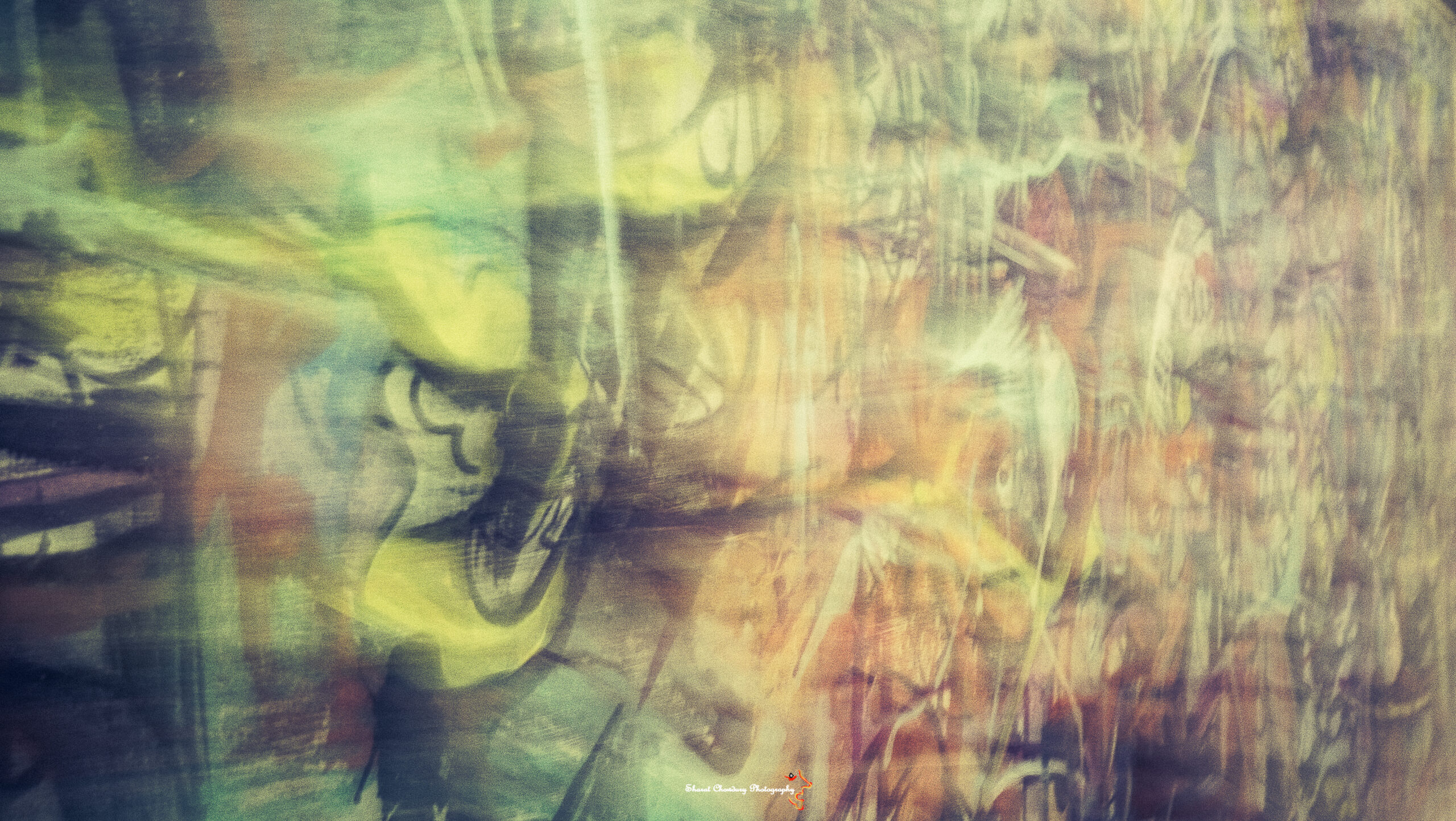
Not So Shared Condition
Shared Exposure Without Shared Interiority in Mubtasim Alvee’s A Shared Condition
A critical visual essay on Mubtasim Alvee’s debut exhibition A Shared Condition, exploring atmosphere, spectatorship, abstraction, and emotional distance in contemporary Bangladesh.
Mubtasim Alvee’s debut solo exhibition A Shared Condition, inaugurated on May 8 at La Galerie, Alliance Française de Dhaka, presents nearly one hundred works exploring memory, identity, emotional fragmentation, and collective psychological experience. Curated by Mustafa Zaman, the exhibition draws from abstraction, pareidolia, gesture, and emotional atmospheres to examine what the artist describes as the unstable territory between personal and collective emotional life. The exhibition remains open until May 16 and deserves careful viewing not only for its ambitious emotional language, but also for the important questions it raises about contemporary spectatorship, emotional visibility, and collective vulnerability in urban Bangladesh. UNB coverage of A Shared Condition The Daily Star feature on identity, memory, and emotion The Daily Star report on collective trauma through art
I had the opportunity to visit the exhibition today, and what struck me immediately was not only the emotional density of Mubtasim Alvee’s work, but the way the exhibition gradually invited intervention through looking, movement, and perception itself. As someone working between anthropology, photography, and visual culture, I found myself responding instinctively through the camera. The works did not remain isolated objects on gallery walls; they began generating an atmosphere that pushed me toward my own visual engagement. My photographs therefore emerged not as external documentation alone, but as an attempt to intervene within the emotional and perceptual space the exhibition was already constructing.
There are exhibitions that ask to be viewed, and there are exhibitions that ask to be inhabited emotionally. A Shared Condition belongs to the latter category. Rather than offering viewers stable narratives or representational certainty, the exhibition constructs an atmosphere: dense, unstable, emotionally saturated, and psychologically unsettled. Entering the gallery feels less like entering a conventional exhibition space and more like moving through an interior landscape where memory, anxiety, vulnerability, fragmentation, and emotional residue circulate through abstraction, gesture, texture, performance, and light.
The exhibition statement explains that A Shared Condition explores “the territory in-between the personal and the collective,” questioning the idea that emotional and psychological states belong solely to the individual. This is an ambitious and deeply contemporary proposition. In a world increasingly shaped by social media exposure, emotional oversharing, public grief, digital exhaustion, and collective crisis, emotional life rarely remains fully private anymore. Feelings circulate publicly. Anxiety becomes atmospheric. Vulnerability becomes visible. Under such conditions, Alvee’s attempt to visualize emotional states beyond isolated individuality becomes historically significant.
Yet while moving through the exhibition with my camera, I found myself encountering a different but related tension. The exhibition undoubtedly creates a powerful emotional atmosphere, but the experience of spectatorship within that atmosphere repeatedly revealed distance alongside proximity. Bodies gathered together without fully arriving at one another. People occupied the same emotional space while remaining psychologically inaccessible. Gradually, my photographs stopped functioning as documentation alone. They became visual arguments.
This is where the title of this essay emerges: Not So Shared Condition.
The title is not intended as a dismissal of Alvee’s exhibition. On the contrary, it emerges from taking the exhibition’s central proposition seriously. The exhibition asks whether emotional life can become collective. My experience inside the gallery suggested a more fragile possibility: perhaps what contemporary society increasingly produces is not shared interiority, but shared exposure without shared interiority.
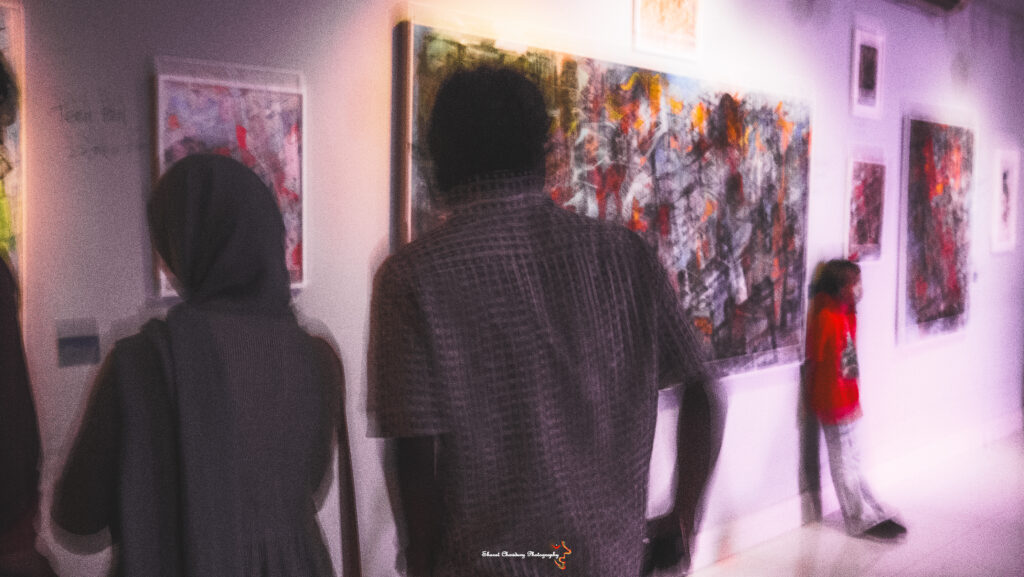
Spectators moving through the emotional architecture of A Shared Condition.
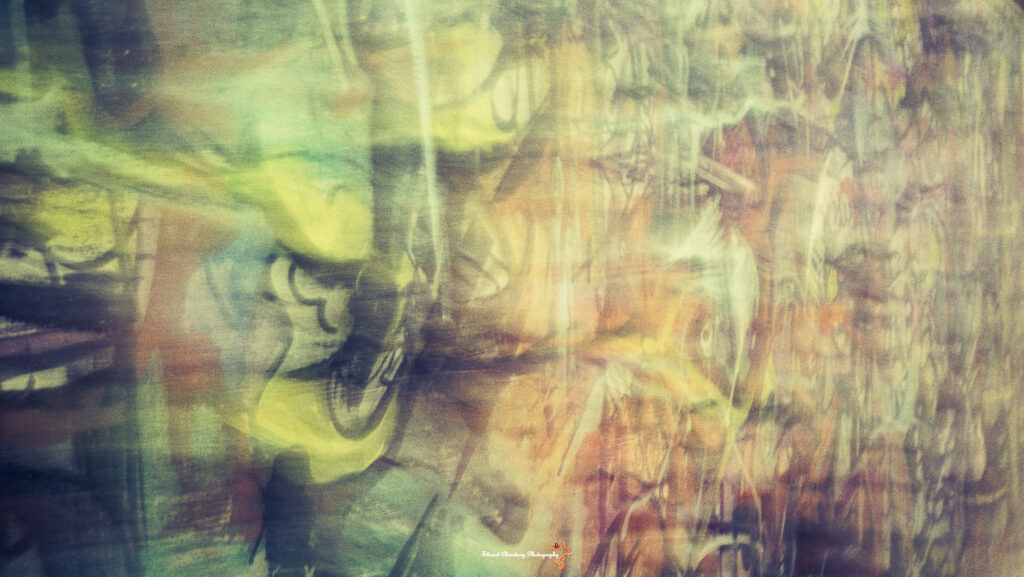
Alvee’s paintings operate through emotional accumulation rather than symbolic clarity. Human forms repeatedly emerge and dissolve within layered surfaces. Gesture overwhelms representation. Figures appear trapped between formation and disappearance. Several works resist narrative interpretation altogether, functioning instead through pressure, mood, tension, and emotional density. This unresolved quality becomes one of the exhibition’s strengths. The paintings do not attempt to stabilize feeling into singular meaning. Instead, they allow emotional ambiguity to remain open, unsettled, and psychologically mobile.
What becomes especially important, however, is the relationship between these paintings and the viewers moving around them. The exhibition does not end with the canvas. It extends outward into bodies, movement, spectatorship, atmosphere, and perception itself. In this sense, the exhibition creates what Gernot Böhme (1993) calls an “atmosphere”: not merely an object before the viewer, but a felt spatial condition surrounding perception itself.
Through my photographs, the audience gradually became inseparable from the artworks. Yet viewers rarely appeared fully present. Long exposure transformed bodies into blurred silhouettes, fragmented traces, unstable shadows, and partial disappearances. Faces dissolved into darkness. Figures drifted through red light and grain. The crowd appeared together physically while remaining emotionally isolated from one another.
The blur within these photographs is therefore not technical accident. It becomes an argument about contemporary emotional life itself.
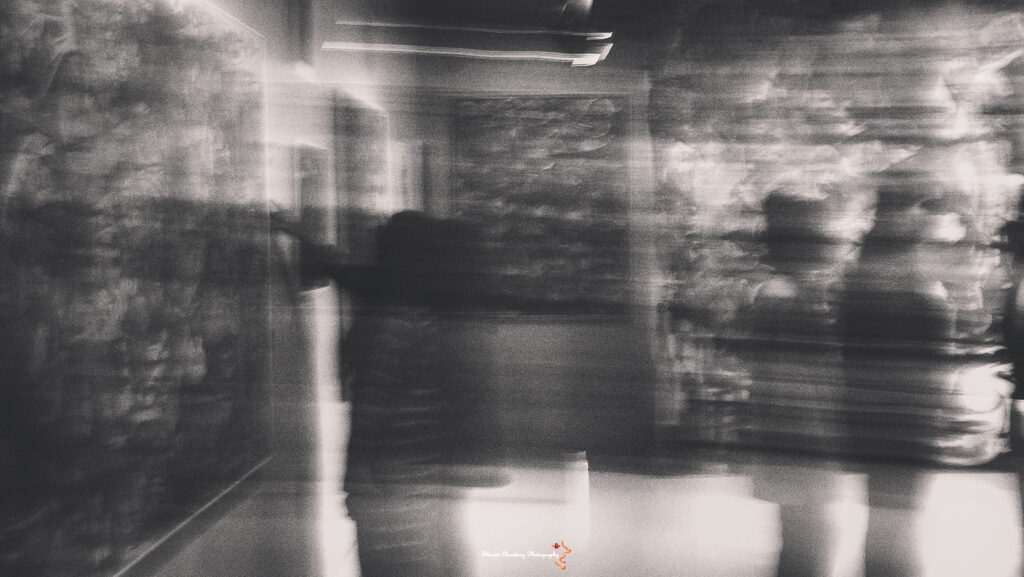
Bodies gathered together, yet unable to fully arrive within shared emotional space.
In many ways, these photographs emerged less from conscious aesthetic strategy than from embodied response. The instability of the images reflected the instability of perception inside the exhibition itself. The camera stopped functioning as a neutral recording device and became part of the atmosphere it was attempting to observe. Darkness, blur, grain, overexposure, and motion became forms of sensory registration rather than stylistic embellishment.
In this sense, the photographs operate ethnographically. They do not document objective reality. Instead, they register the instability of emotional atmosphere and the difficulty of collective feeling within contemporary urban life. My photographic encounter with the exhibition aligns closely with what Sarah Pink (2015) describes as sensory ethnography: a form of knowing grounded not in detached observation, but in embodied and affective experience.
This is where A Shared Condition becomes culturally important beyond the gallery itself.
Contemporary Bangladesh increasingly exists within conditions of emotional saturation. Political polarization, digital hostility, public outrage, economic exhaustion, loneliness within urban density, and the relentless exposure of social media have transformed emotional life into something simultaneously hyper-visible and deeply inaccessible. People witness one another constantly without necessarily understanding one another more deeply. Visibility has increased. Emotional access has not.
Under such conditions, abstraction no longer appears merely formal. It becomes psychological evidence.
Collective spectatorship under conditions of emotional saturation.
One of the most compelling moments within the exhibition occurs during the performative gathering before the paintings, where spectators face illuminated figures emerging from darkness and abstraction. The atmosphere becomes almost ritualistic. Red light saturates the room. The audience recedes into shadow while performance and painting merge into a single emotional field. Yet even here, collective presence remains fragile. The spectators become anonymous silhouettes rather than a coherent public.
This tension may ultimately constitute the exhibition’s deepest achievement.
The exhibition does not fully succeed in transforming emotional life into a genuinely shared condition—and this incompleteness should not be read as failure in a negative sense. Rather, it reveals the structural difficulty of emotional collectivity within contemporary life itself. The exhibition becomes powerful precisely because it cannot completely resolve the contradiction it stages.
People stand near one another emotionally while remaining internally distant.
Perhaps this is the defining emotional structure of the present moment.
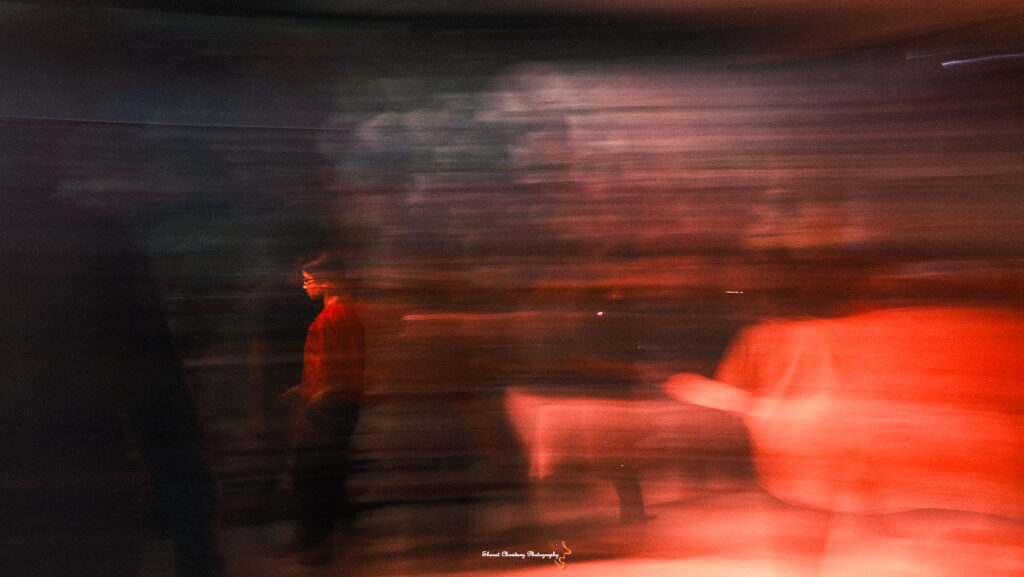
Shared atmosphere without fully shared interiority.
At one point while photographing the audience, I realized I could no longer distinguish whether I was documenting spectators or becoming absorbed into the same emotional field myself. The camera ceased functioning as distance and instead became implicated within the exhibition’s atmosphere. This moment altered my understanding of the entire experience. I was no longer photographing paintings alone. I was photographing the fragile and unstable space between artwork, viewer, projection, memory, movement, and emotional expectation.
The gallery itself became the subject.
This is perhaps where Alvee’s exhibition becomes most intellectually productive. A Shared Condition ultimately exceeds individual artworks and transforms into an ecology of looking: paintings observing viewers, viewers observing paintings, cameras observing spectators, emotional states circulating without ever fully settling into collective certainty. Here, Jacques Rancière’s (2009) understanding of spectatorship becomes relevant: viewers are not passive receivers of meaning but active interpreters who remake the work through their own trajectories of perception and experience.
My photographs emerged from this unstable ecology.
They should therefore not be understood merely as exhibition documentation, but as a parallel visual essay produced through encounter with the exhibition itself. If Alvee’s paintings explore emotional interiors, these photographs explore the instability of emotional spectatorship surrounding them.
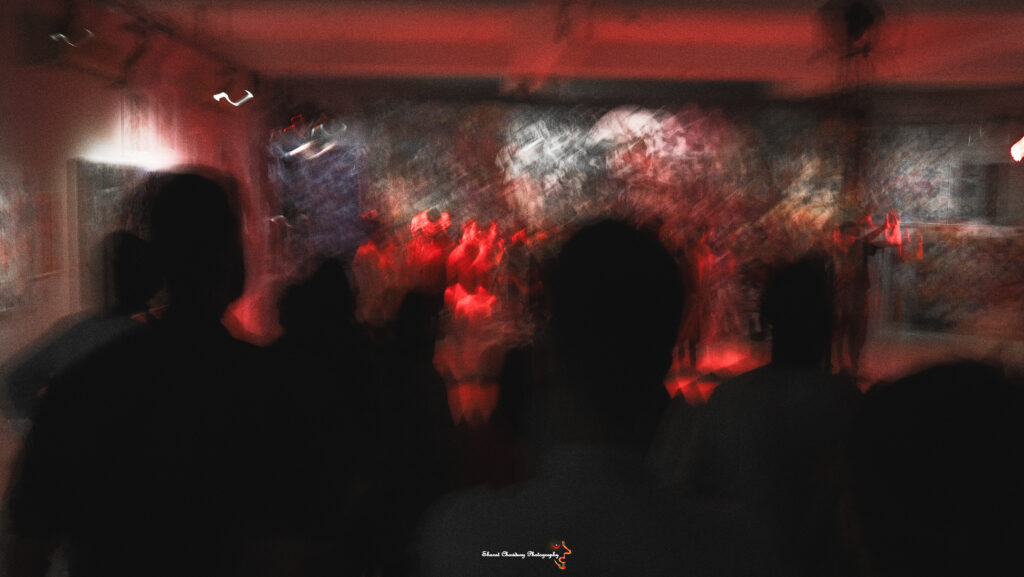
The exhibition statement becomes both proposition and question.
Perhaps emotional life was never entirely shareable to begin with. Perhaps what contemporary art can offer is not full emotional communion, but temporary recognition of parallel isolation. In this sense, A Shared Condition becomes most powerful not when it succeeds in making emotion collective, but when it reveals how difficult collectivity itself has become.
The exhibition leaves behind not certainty, but atmosphere.
Not resolution, but residue.
Not emotional unity, but fragile proximity.
And perhaps that is the condition we now most genuinely share: the experience of standing beside one another within common emotional environments while remaining partially unknowable to each other.
Blurred figures moving through the same darkness.
The exhibition continues at Alliance Française de Dhaka until May 16. Visitors interested in contemporary abstraction, affective atmospheres, performance, and the relationship between emotional life and public spectatorship should experience the exhibition in person—not only to observe the artworks, but to inhabit the unstable emotional space they create.
References
Ahmed, S. (2004). The cultural politics of emotion. Edinburgh University Press.
Böhme, G. (1993). Atmosphere as the fundamental concept of a new aesthetics. Thesis Eleven, 36(1), 113–126.
Pink, S. (2015). Doing sensory ethnography (2nd ed.). SAGE.
Rancière, J. (2009). The emancipated spectator (G. Elliott, Trans.). Verso.