From Rupture to Settlement
Gendered Erasure, Moral Governance, and the Post-July Political Order in Bangladesh
An analysis of how women generate legitimacy during uprisings but are sidelined during political settlement through moral governance, symbolism, and digital discipline.
This argument does not diminish the July uprising, nor does it question the sincerity of its participants. Rather, it treats July seriously—as a historical rupture whose aftermath deserves analysis. To examine gendered settlement is not to accuse individuals, but to trace how political orders reassert themselves after moments of collective possibility.
Introduction: July and the production of legitimacy
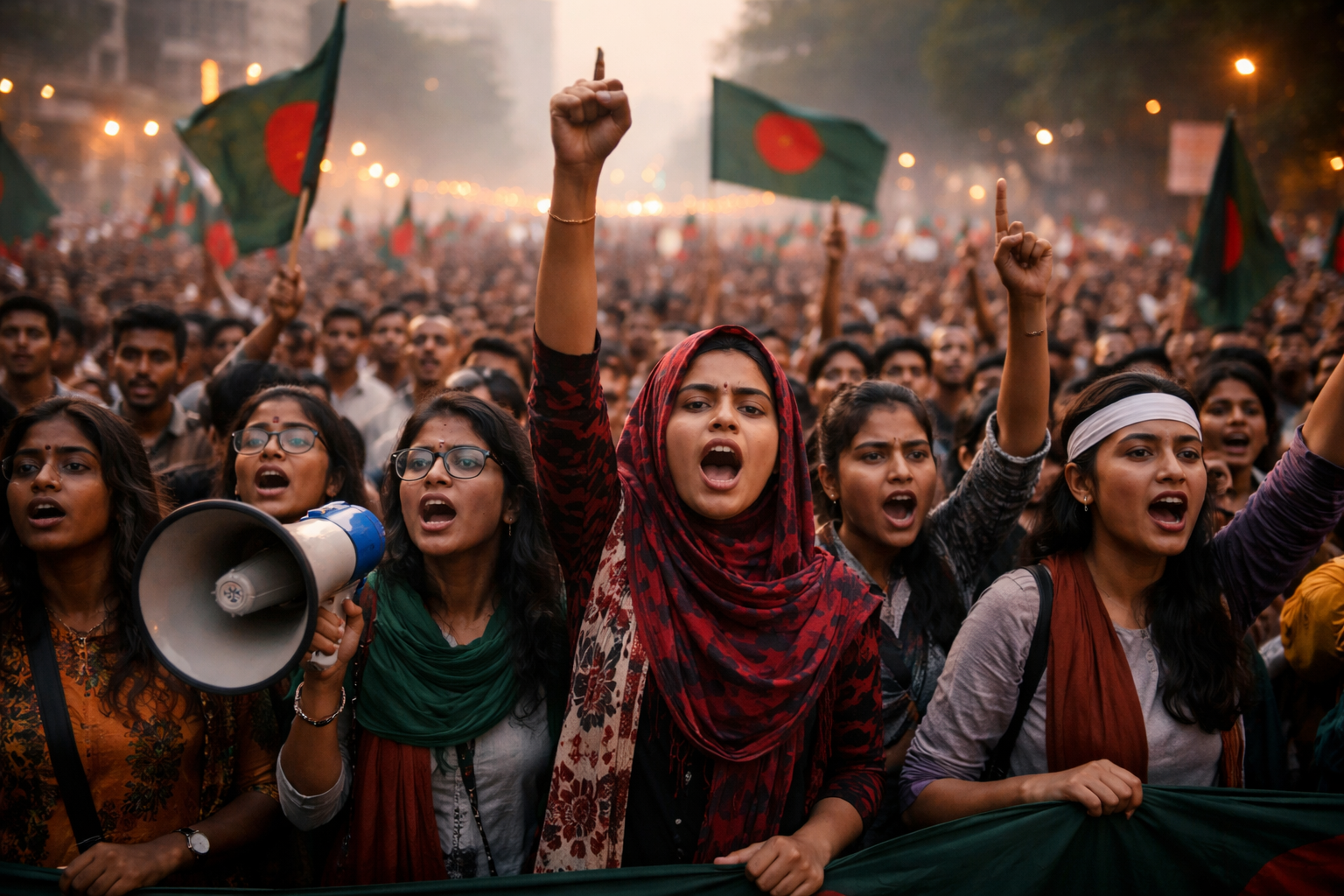
The July 2024 uprising in Bangladesh was unimaginable without women. They were present in the streets, at the frontlines of confrontation, in care and logistics, in digital documentation, and in shaping the moral narrative of resistance. Women’s visibility did not merely accompany the uprising; it produced its legitimacy. Images of women occupying public space, enduring repression, and articulating dissent helped frame the movement as collective rather than factional, ethical rather than opportunistic.
Yet within months of the uprising’s crest, women largely disappeared from the arenas where political futures were negotiated. Leadership forums, electoral nominations, consensus commissions, and post-uprising political arrangements became overwhelmingly male. Women were praised symbolically, thanked rhetorically, and excluded institutionally.
This essay argues that this outcome is not accidental, nor the result of ideological inconsistency or individual betrayal. Rather, it reflects a structural feature of post-uprising political settlement, long observed in social-movement theory but rarely examined through a gendered lens. Drawing on scholarship on cycles of contention, feminist political theory on legitimacy and exclusion, and anthropological work on moral governance, the essay advances a central claim: women are indispensable during moments of political rupture because they generate moral legitimacy, but are sidelined during consolidation because their continued visibility destabilizes restored hierarchies.
To name this process, I propose the concept of gendered settlement—the systematic removal of women from authority following mass mobilization, achieved not primarily through repression, but through moral language, institutional closure, and digital discipline. The aftermath of July thus represents not democratic deepening, but a familiar restoration: the reassertion of patriarchal order in the name of stability.
July as a gendered rupture
Uprisings operate according to a political logic distinct from institutions. In moments of rupture, legitimacy is generated through visibility, participation, and risk rather than procedure. Feminist political theorists have long shown that women’s bodies often function as carriers of collective morality in such moments. Their presence signals ethical urgency, constrains repression, and broadens the symbolic reach of resistance.
In July, women were not marginal participants; they were legitimacy producers. Their participation temporarily suspended entrenched gender norms—not because patriarchy was dismantled, but because the uprising required their visibility to claim national scope and moral authority. This suspension, however, was always conditional.
From rupture to settlement: when legitimacy becomes liability
Social-movement scholarship distinguishes between moments of rupture, where power is challenged through disruption, and moments of settlement, where authority is reconstituted through institutions. During rupture, inclusion expands; during settlement, access narrows. What remains under-theorized is how gender structures this transition.
As politics shifts from streets to negotiation tables, the attributes that once generated legitimacy are reinterpreted as liabilities. Women’s continued visibility unsettles the restoration of gender order, complicates elite bargaining, and signals that the rupture remains unresolved. Settlement demands closure, and women’s leadership keeps the political moment open.
Here, patriarchal bargaining reasserts itself. Women are offered symbolic recognition, moral praise, and narratives of protection in exchange for withdrawal from authority. This is exclusion through care rather than coercion. Benevolent patriarchy reframes removal as relief and absence as virtue.
Crucially, this mechanism is not partisan. Islamist, nationalist, liberal, and reformist actors converge on the same outcome through different justifications—moral order, strategic patience, electoral realism. Patriarchy proves more stable than ideology.
Moral governance and the post-uprising appeal of order
The renewed salience of moral language in post-July politics must be understood less as ideological revival and more as settlement technology. Moral governance offers order after chaos, certainty after disruption, and hierarchy after egalitarian participation.
Within this framework, women’s visibility becomes a problem to be managed. Protection replaces participation; dignity substitutes for authority. Reduced working hours, symbolic concern, and reverential rhetoric are extended without corresponding power, pay, or representation. Women are governed through care, not included through rights.
This language travels easily across political divides. Vocabulary changes; outcomes do not.
Affective stabilization: anxiety, hope, and the deferral of women’s authority
The post-election moment is increasingly framed through a familiar affective split: anxiety about the possible rise of Islamist forces such as Bangladesh Jamaat‑e‑Islami, and hope that a more “moderate” victory by actors like the Bangladesh Nationalist Party might protect women’s public presence. Analytically, however, these are not opposing political diagnoses; they are parallel responses to the same structural condition.
Anxiety externalizes patriarchy, locating danger in overt moral governance. Hope internalizes it, trusting moderation to manage women’s exclusion gently. In both cases, women’s political futures are imagined as contingent on which male-dominated power bloc prevails, rather than on women’s own institutional authority. Fear and hope thus perform the same stabilizing function: they defer the question of structural inclusion in the name of order, patience, and “realism.” Gendered settlement thrives precisely in this affective terrain, where women are asked to wait.
Nostalgic paternalism: the illusion of safety under past power
A related illusion circulates widely in post-July discourse: the belief that women would have been safer had the Awami League remained in power. Analytically, this is not a claim about women’s authority, but about paternal containment. Safety here is imagined as a function of centralized masculine power capable of suppressing threats on women’s behalf.
While such governance may have limited overt moral policing and projected a secular-nationalist vocabulary, it did not dismantle gendered settlement; it managed it. Women were symbolically included and selectively protected, not institutionally empowered. This nostalgic paternalism reframes repression as security and silence as safety, reinforcing the assumption that women’s political futures depend on which men rule rather than on women’s own autonomous authority.
Digital discipline and pre-legal exclusion
The removal of women from post-July leadership is not accomplished by institutions alone. It is preceded and reinforced through digital discipline—informal practices that regulate political visibility before law, before party rules, and before leadership selection.
Power here operates not through prohibition, but through surveillance, normalization, and self-regulation. Social media platforms, with their algorithmic amplification of outrage and moral judgment, provide ideal infrastructure for such governance. Visibility becomes unavoidable; punishment becomes ambient.
For women, digital space functions as a site of pre-emptive political regulation. Slut-shaming, character assassination, sexualized scrutiny, and moral panic are not episodic abuses but patterned mechanisms of control. In the post-uprising moment, these attacks intensify precisely when women appear likely to convert visibility into leadership.
This is pre-legal governance. By raising the personal cost of ambition, digital misogyny ensures that many women withdraw voluntarily—calculating safety, family pressure, professional survival, and psychological toll. Institutions thus benefit from women’s absence without having to formally exclude them.
From Political Agents to Moral Symbols: How Women Are Contained After Rupture
A defining feature of post-uprising gendered settlement is the transformation of women from political agents into moral symbols. This shift is neither rhetorical accident nor cultural residue; it is a political mechanism. When women can no longer be easily excluded through silence or intimidation, they are absorbed into symbolism—praised, honored, and emotionally elevated in ways that strip them of authority.
Feminist political theorists have long noted that women are often incorporated into national narratives not as decision-makers but as bearers of virtue, sacrifice, and continuity. In Bangladesh’s post-July moment, this pattern re-emerged with striking clarity.
Case 1: Women of July as “faces of courage,” not architects of power
In the immediate aftermath of the July uprising, women who had been visibly present in protests, digital documentation, and organizational labor were widely celebrated in public discourse. Media narratives, political speeches, and social media posts repeatedly invoked women as symbols of courage, resilience, and moral clarity—shongrami bon, shohid-er maa, embodiments of national conscience.
What is crucial here is the temporal limit of this recognition.
Praise was abundant precisely when decisions were not yet being made.
As negotiations began—around electoral arrangements, party alignments, and leadership structures—these same women were no longer visible. Their earlier political labor did not translate into representation at the table. Symbolic elevation substituted for institutional inclusion.
Case 2: Party politics and the gendered economy of loyalty
Across ideological lines, women who defended parties during moments of crisis—absorbing harassment, legitimizing positions online, mobilizing support—found themselves sidelined when candidacies and leadership positions were allocated. Women’s loyalty is valued; their autonomy is threatening. They become moral guarantors of party credibility, not strategic actors.
Case 3: Islamism and the sanctification of withdrawal
In Islamist discourse, women are framed as bearers of dignity and moral order while being excluded from authority. Withdrawal from power is sanctified; absence becomes virtue. Authority is recast as a burden from which women must be protected. Women are not silenced; they are elevated out of politics through moral regulation.
Case 4: Digital afterlives and curated remembrance
Women’s images from July continue to circulate widely, but largely as retrospective icons. At the same time, women who remain politically vocal face intensified scrutiny and harassment. The digital public sphere preserves women as symbols of a past moment while disciplining those who refuse to remain in that past—creating a temporal trap.
The political function of symbolism
Symbolic elevation serves to neutralize critique, preserve patriarchal authority, stabilize settlement, and prepare repetition. In this sense, symbolism is not consolation—it is containment.
Analytical conclusion
The movement of women from political agents to moral symbols marks the final consolidation of gendered settlement. Women are not erased from the narrative; they are fixed within it.
They are remembered so that they do not return.
Conclusion: restoration, not transition
The sidelining of women after July is not a secondary gender issue. It is an early indicator of democratic contraction. A political order that cannot carry women from mobilization into leadership does not deepen democracy; it stabilizes hierarchy.
Uprisings require women because legitimacy demands it.
Settlements remove them because power does not.
That is not transition.
It is restoration.
References
Talal Asad (2003). Formations of the Secular: Christianity, Islam, Modernity. Stanford University Press.
→ Grounding for moral governance and ethical subject formation.
Saba Mahmood (2005). Politics of Piety: The Islamic Revival and the Feminist Subject. Princeton University Press.
→ Key framework for non-coercive discipline, virtue, and agency.
Carole Pateman (1988). The Sexual Contract. Stanford University Press.
→ Foundational text for symbolic inclusion vs political authority.
Nira Yuval-Davis (1997). Gender and Nation. Sage.
→ Women as symbols of national continuity rather than political actors.
Sidney Tarrow (2011). Power in Movement: Social Movements and Contentious Politics (3rd ed.). Cambridge University Press.
→ Rupture, contention, and settlement cycles.
Charles Tilly (2004). Social Movements, 1768–2004. Paradigm Publishers.
→ Structural logic of mobilization and consolidation.
Deniz Kandiyoti (1988). Bargaining with Patriarchy. Gender & Society, 2(3), 274–290.
→ Patriarchal bargaining as adaptive, not static.
Judith Butler (2004). Undoing Gender. Routledge.
→ Gender norms, vulnerability, and recognition.
Nancy Fraser (2013). Fortunes of Feminism. Verso.
→ Recognition vs redistribution; symbolic inclusion.
Zeynep Tufekci (2017). Twitter and Tear Gas: The Power and Fragility of Networked Protest. Yale University Press.
→ Digital visibility, legitimacy, and post-movement fragility.
Sarah Banet-Weiser (2018). Empowered: Popular Feminism and Popular Misogyny. Duke University Press.
→ Symbolic feminism, affect, and backlash.
Lila Abu-Lughod (2013). Do Muslim Women Need Saving? Harvard University Press.
→ Critique of protection discourse and gendered paternalism.
Asef Bayat (2017). Revolution without Revolutionaries: Making Sense of the Arab Spring. Stanford University Press.
→ Post-uprising consolidation and demobilization.
Author’s Note
This essay is a diagnostic analysis, not a manifesto, prediction, or policy brief. It does not evaluate political actors by moral virtue or electoral success, nor does it offer prescriptions for reform. Its purpose is to identify a structural mechanism—here termed gendered settlement—through which women’s political labor and legitimacy are mobilized during moments of rupture and systematically neutralized during consolidation.
The argument is intentionally non-partisan and non-predictive. Islamist anxiety, liberal moderation, and secular-nationalist nostalgia are treated not as competing political truths, but as affective responses to the same structural condition: the persistent absence of women as autonomous political authorities.
All examples are used analytically rather than polemically. Cultural, institutional, and digital practices are examined as political technologies, not as individual intentions. Critique here is directed at systems and logics, not persons.
The analysis is grounded in Bangladesh’s post-July context but is intended to travel beyond it. The mechanism described—symbolic elevation followed by institutional exclusion—is characteristic of post-rupture settlements across political systems and historical moments.