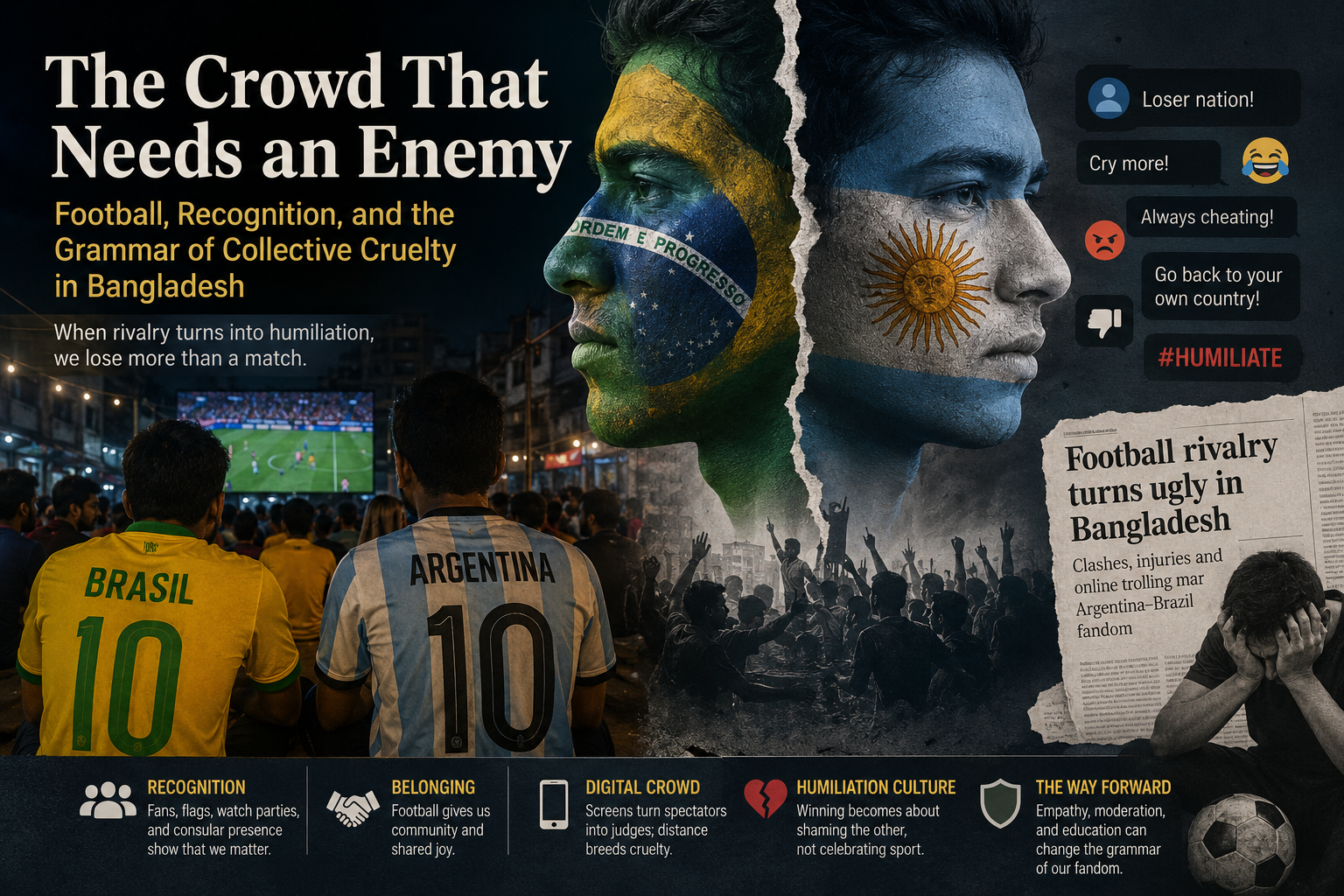
The Crowd That Needs an Enemy: Football, Recognition, and the Grammar of Collective Cruelty in Bangladesh
A critical essay on Brazil–Argentina fandom in Bangladesh, football recognition, online humiliation, collective cruelty, and why sporting rivalry can become socially dangerous.
Brazil lost a football match, and Bangladesh erupted in laughter.
There is nothing unusual about sporting ridicule. Football has always generated jokes, taunts, exaggerated loyalties, wounded pride, and the temporary pleasure of seeing a rival fail. To condemn all of this would be to misunderstand sport itself. Rivalry is part of the game. Mockery can be affectionate. Friends torment friends. Supporters remember old defeats with archaeological precision.
Yet there are moments when laughter changes character.
After Brazil’s defeats, as after Argentina’s defeats, Bangladeshi social media fills not merely with jokes about tactics, players, coaches, or missed chances, but with something more socially revealing. Individuals are summoned by name. Old posts are excavated. Screenshots are displayed as evidence. Supporters are ordered to disappear. Their grief is demanded, measured, and mocked. Defeat becomes feminisation; disappointment becomes emasculation. Fathers, children, bloodlines, and “জাত” enter the language of ridicule. Funeral metaphors circulate. Coffins, burials, mourning rituals, and mock condolences become meme templates. A supporter is no longer simply wrong in sporting judgment. He belongs to a category that deserves humiliation.
The question, then, is not whether Bangladeshis take football “too seriously.” That explanation is too easy.
The more difficult question is:
When does a joke become a crowd?
And, more troublingly:
Why does collective pleasure so often appear to require a humiliated Other?
I. Crowd, Public, and Collective Cruelty
The words must first be separated.
A crowd is not necessarily violent. A public need not occupy the same physical space. A riot is not simply an angry crowd. A mass gathering may be emancipatory, devotional, festive, commercial, or political. Nor should every digital pile-on be called a “mob.” The term can prematurely criminalise behaviour and reproduce an old elite habit of treating collective action as irrational disorder.
I therefore use collective cruelty as the broader category.
Collective cruelty emerges when the humiliation of a target becomes socially shared, when participation distributes responsibility, and when another person’s discomfort becomes a resource for producing group cohesion. The participants need not share a location. They need not obey a leader. They need not even regard themselves as cruel. Each may contribute only a joke, an emoji, a tag, a screenshot, or a repost.
Yet the target encounters the aggregate.
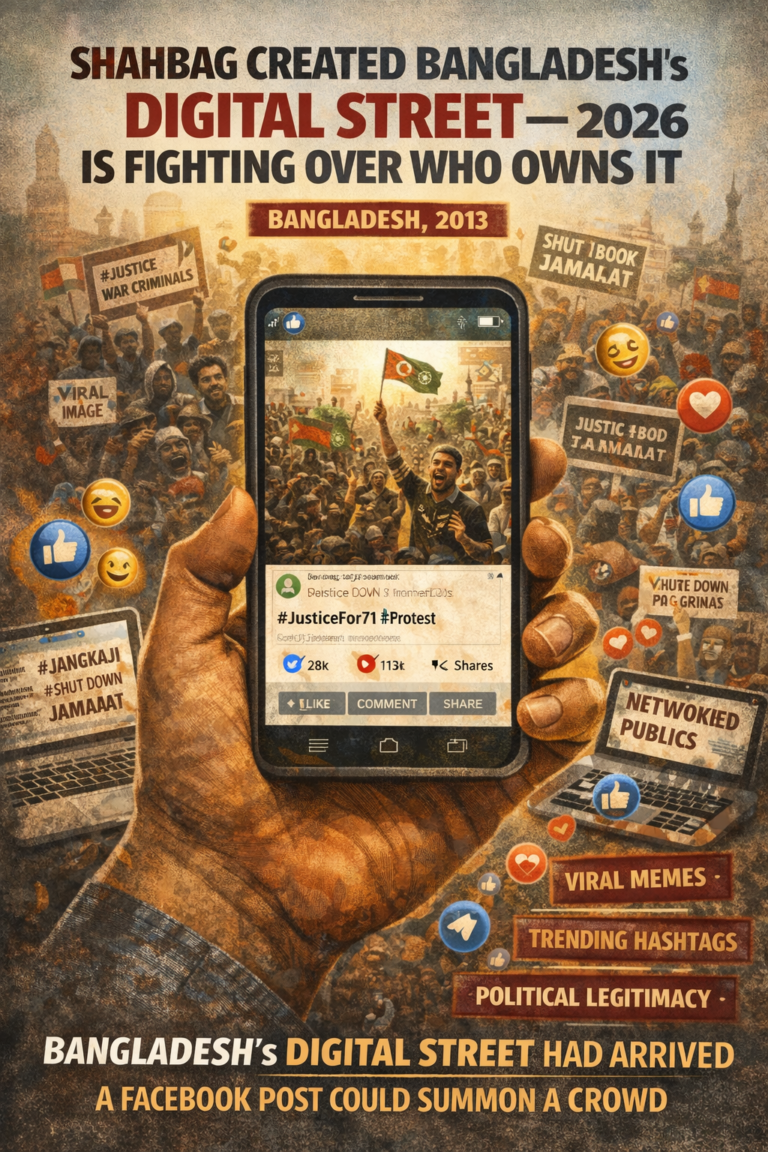
This matters acutely in Bangladesh, a country whose political history cannot be narrated without collective assembly. The Language Movement, the mass uprising of 1969, the popular mobilisation surrounding the Liberation War, anti-autocratic struggles, Shahbag, student movements, and the mass mobilisations of July 2024 remind us that crowds can enlarge political possibility. A people denied effective institutional voice may become politically visible precisely by gathering.
The argument, therefore, cannot be: crowd bad, individual good.
The question is about thresholds.
When does a crowd become a moral community? When does a moral community discover a target? When does the humiliation of that target become evidence of belonging?
II. Football Is Not a Communal Riot
A second distinction must remain absolute.
Brazil–Argentina trolling is not equivalent to Hindu–Muslim violence, a pogrom, ethnic persecution, or communal rioting. To collapse these phenomena into one category would erase histories of unequal power, dispossession, targeted killing, forced displacement, and minority vulnerability.
But non-equivalence does not mean non-comparability.
The argument of this essay is not that football rivalry is communal violence. It is that apparently trivial rivalries can reveal elements of the social grammar through which collective hostility becomes thinkable.
That grammar may include categorical naming, homogenisation, inherited blame, masculine honour, symbolic pollution, public shaming, retaliatory obligation, demands for silence, and the transformation of another person’s pain into collective entertainment.
The object changes.
The grammar may travel.
A Hindu, a Muslim, an atheist, a “Razakar,” an Awami Leaguer, a BNP supporter, a woman deemed insufficiently modest, a dissenter, a Brazil fan, and an Argentina fan are historically and morally incomparable categories. Yet a critical question remains legitimate:
Under what conditions does a person cease to appear as a person and become merely an instance of “ওরা”—them?
The pronoun may be one of the smallest technologies of collective cruelty.
III. The Archive Is Not Trivial
Bangladesh’s attachment to Brazil and Argentina has been visible for decades: giant flags, painted houses, neighbourhood camps, intergenerational loyalties, public screenings, and rivalries that periodically become violent.
The empirical record demands precision.
A 2024 peer-reviewed study based on Bangladeshi online newspaper reporting around the 2022 World Cup identified 23 World Cup-related deaths, 35 hospitalisations, and 45 injuries in the material analysed. These figures must not be misrepresented as 23 killings in Brazil–Argentina clashes. The reported deaths arose through different mechanisms, including accidents associated with World Cup practices. Other reporting has separately documented confrontations, serious injuries, flag-related accidents, police interventions, and episodes of severe distress associated in public narratives with defeat and rivalry.
The distinction matters.
Sensationalism is itself a form of intellectual failure.
Yet once exaggeration is removed, recurrence remains.
The newspaper archive suggests a dispersed but persistent chronology. Across multiple tournaments, Bangladeshi and international media have reported confrontations involving rival supporters. In June 2026, reporting from Habiganj described dozens injured after a confrontation between groups identified with Argentina and Brazil. Yet police accounts located the immediate dispute in the outcome of a local friendly match between teams carrying those names. This qualification is essential.
A fan identity may provide the boundary without providing the entire cause.
Neighbourhood rivalries, prior disputes, masculine honour, interpersonal histories, local politics, and immediate provocations may all enter the event. The category “Brazil versus Argentina” can organise a confrontation without independently producing it.
The archive therefore does not establish a simple causal law:
football fandom → violence
It establishes something subtler:
football affiliation can become a recurrent social vocabulary through which existing tensions are organised, dramatised, and sometimes escalated.
We are not dealing with one viral anecdote.
We are looking at a repeated social possibility.
The World Cup may therefore operate in Bangladesh through what I call tournament temporality. Every four years, dormant affiliations become publicly intensified. Flags return. Neighbourhoods acquire colours. Historical defeats are reactivated. Old scores become present tense. Children inherit loyalties they did not originate. A sporting calendar periodically reactivates a local infrastructure of distinction.
The tournament does not create all antagonism from nothing.
It gives antagonism a season.
IV. Why Brazil? Why Argentina?
Any serious argument must resist the temptation to treat the choice of teams as arbitrary.
Bangladeshis did not randomly select two foreign flags and become irrational. The history of this attachment matters.
Recent historical reporting traces Brazil fandom partly to the global visibility of Pelé and later generations of Brazilian football. Argentina’s extraordinary hold is frequently connected to the expansion of televised World Cup football in Bangladesh, the 1986 tournament, Diego Maradona, the symbolic resonance some Bangladeshis attached to Argentina’s victory over England, and later devotion to Lionel Messi. These accounts should not be converted into a single deterministic origin story. Fan genealogies differ by generation, family, class, region, and media access.
But they establish something fundamental:
fandom has a history.
This is not simply imitation.
For many supporters, South American football offers an imaginative geography of beauty, struggle, improvisation, and ascent. Brazil and Argentina are powerful football nations without occupying the same position as the former imperial centres that dominate much of the postcolonial world’s political imagination. Their victories can therefore become emotionally available triumphs.
A distant nation becomes intimate.
A child inherits a team from a father, mother, sibling, neighbourhood, school friend, or television memory. What began as spectatorship becomes biography. What began as preference becomes inheritance.
This is why I propose the concept portable antagonism.
A distant sporting rivalry travels into local social life. It is carried into kinship, friendship, neighbourhood, class performance, masculinity, memory, and digital networks. Once localised, it can become socially actionable.
The supporter says:
“We won.”
Who is this we?
Eleven foreign players win thousands of kilometres away, and a Bangladeshi supporter experiences an enlargement of self. Eleven foreign players lose, and another Bangladeshi is required to account for the defeat.
This is vicarious sovereignty: the temporary borrowing of triumph, prestige, masculinity, beauty, and historical grandeur from a distant collective.
But borrowed sovereignty produces borrowed vulnerability.
If the distant team loses, the supporter’s symbolic self becomes available for attack.
V. Recognition: When the Imagined Relation Answers Back
Yet the contemporary relationship contains a development that older theories of distant fandom cannot fully explain.
The relation is no longer entirely one-way.
Bangladeshi supporters once projected extraordinary emotional investment toward distant teams that might never know they existed. Increasingly, however, the object of attachment has begun to recognise the attaching subject.
This recognition is clearest in the Argentine case. Bangladesh’s mass support for Argentina during the 2022 World Cup became internationally visible. Images of enormous crowds circulated globally. Argentine public attention followed. In 2023, Argentina reopened its embassy in Dhaka after more than four decades, and football affection became part of the public language through which renewed proximity was understood.
Football did not alone cause the reopening.
It would be simplistic to reduce diplomacy to fandom.
But fandom became diplomatically legible.
The relationship has since become embodied. Argentine diplomatic representatives have appeared within Bangladeshi football-viewing culture. During the 2026 World Cup, Argentina’s ambassador joined supporters at public screenings in Dhaka. Argentine football figures, including Emiliano Martínez, have publicly acknowledged Bangladeshi affection.
The Brazilian case is equally important. During the 2026 World Cup, goalkeeper Alisson Becker directly thanked supporters in Bangladesh after saying that he had seen videos of their support.
These moments should not be dismissed as public relations.
Nor should they be romanticised as proof of deep geopolitical reciprocity.
They matter because recognition changes the phenomenology of fandom.
The Bangladeshi supporter no longer merely says:
“We love them.”
The distant object sometimes replies:
“We see you.”
Recognition converts fantasy into partial social confirmation. It tells supporters that their passion is visible beyond the neighbourhood, beyond Bangladesh, perhaps even inside the symbolic world of the team itself. A fan base becomes an audience recognised by diplomats, players, journalists, and transnational media. A watch party becomes an event of soft power. A jersey becomes a diplomatic sign.
This produces what I call recognised vicarious sovereignty.
The supporter still borrows prestige from a distant team. But the borrowing is no longer entirely imaginary or unilateral. It has received partial acknowledgement.
The imagined relation answers back.
Recognition theory helps clarify why this matters. From Hegelian traditions to later theorists such as Axel Honneth and Nancy Fraser, recognition has been treated not simply as private affirmation but as a social relation through which identities acquire intelligibility, standing, and sometimes institutional form. One need not force football fandom into a grand philosophical system to see the relevance. Recognition can stabilise an attachment. The supporter becomes more secure in saying “we” because the distant “they” has, however briefly and asymmetrically, acknowledged the relationship.
But recognition has a double edge.
It can deepen cosmopolitan affection, transnational curiosity, diplomacy, tourism, and genuine human connection. Yet it may also intensify the stakes of rivalry. Once an affiliation is publicly recognised, defeat may feel more intimate, allegiance more legitimate, and the opposing camp more consequential.
Recognition enlarges joy.
It may also enlarge humiliation.
VI. Recursive Fandom: Seeing Ourselves Being Seen
Recognition introduces a further mechanism:
recursion.
Bangladeshi fans gather.
Their gathering is filmed.
The images circulate internationally.
Players, diplomats, or foreign media encounter the images.
Bangladesh is acknowledged.
Bangladeshi media report the acknowledgement.
Fans see themselves being seen.
The next gathering becomes more self-conscious and potentially more performative.
This is not merely fandom.
It is a feedback loop.
The crowd becomes an image of itself. Supporters increasingly know that spectacular support may travel. Giant flags, mass screenings, chants, painted buildings, and emotionally intense reactions become not only expressions of fandom but potential media events.
The sequence is:
attachment → spectacle → circulation → recognition → intensified attachment → larger spectacle
This recursive structure may be one of the most important developments in contemporary Bangladeshi football culture.
It also complicates authenticity. A supporter may simultaneously feel genuine love, perform that love for peers, anticipate platform visibility, and participate in a spectacle capable of travelling abroad. None of these motives cancels the others.
The contemporary fan is not simply watching football.
The fan may also be watching Bangladesh being watched.
VII. Nirad’s Bengali: Diagnosis or Elite Anxiety?
At this point, Nirad C. Chaudhuri becomes both tempting and dangerous.
Tempting, because few modern Bengali intellectuals wrote with greater severity about Bengal, Bengali self-perception, imitation, provincialism, and the failures of public life. Dangerous, because Chaudhuri’s diagnoses were inseparable from his fraught relationship with empire, Western modernity, Bengali society, and his own cultivated position as dissenter.
A methodological warning is necessary.
One should not manufacture a Niradian theory of the crowd from scattered impressions. Nor should phrases such as “collective vanity,” “hujug,” or “mob-minded Bengali” be attributed to Chaudhuri unless they can be located precisely in his primary texts. The Autobiography of an Unknown Indian, The Continent of Circe, and his other writings must be read rather than used as a reservoir of convenient quotations.
The distinction between our analytical vocabulary and Nirad’s own vocabulary must remain explicit.
We should therefore resist the lazy conclusion:
“Nirad was right. Bengalis are emotional and crowd-minded.”
That is not analysis.
It is inherited contempt disguised as sociology.
The more productive question is whether Chaudhuri participated in a longer Bengali tradition of severe self-criticism while transforming that tradition through his own relation to empire, loss, and Western civilisation.
The question becomes:
What if Nirad saw recurring forms of collective self-dramatisation but explained them through categories that were themselves historically compromised?
To ask this is to use Nirad without becoming Nirad.
“Bengali character” cannot serve as explanation because it is precisely what requires explanation. Colonial rule did not merely govern populations; it classified, ranked, and typologised them. Colonial discourse masculinised some communities, feminised others, and produced recurring anxieties about the irrational native crowd. The educated bhadralok, too, fashioned respectability partly against figures of disorder, vulgarity, and mass excess.
Any genealogy of collective behaviour in Bengal must therefore study two things at once:
the crowd,
and the elite gaze that names the crowd.
Nirad is valuable precisely at this intersection. He may be read not simply as an analyst of Bengali society but also as evidence of a historically situated elite anxiety about Bengali collective life.
The diagnosis itself becomes part of the archive.
VIII. Before Nirad: The Colonial Production of the Excitable Native
Nirad did not invent anxiety about the Bengali crowd.
The colonial archive had already made collective behaviour a problem of governance. Processions, religious gatherings, political meetings, strikes, bazaars, rumours, festivals, and urban assemblies were observed through administrative categories concerned with order and disorder. Colonial knowledge repeatedly transformed fluid populations into governable types.
This history matters because the “excitable Bengali” was never merely an innocent description.
It belonged to a wider colonial politics of classification.
The nineteenth-century stereotype of the effeminate Bengali coexisted uneasily with later anxieties about politically mobilised Bengalis. A population could be represented as weak, emotional, imitative, conspiratorial, excitable, or dangerous depending on the requirements of rule.
The crowd therefore entered modern Bengali history already interpreted.
This complicates every later claim about “Bengali mentality.”
When a Bengali intellectual describes Bengalis as excessively emotional, factional, imitative, or carried away by collective excitement, we must ask not only whether the observation contains empirical insight but also which historical vocabulary makes the observation possible.
The problem is not solved by reversing the stereotype and declaring every crowd emancipatory.
It is solved by historicising the act of classification itself.
IX. Hujug: Toward a Vernacular Theory
European crowd theory is not enough.
Bengali social life possesses its own vocabulary: hujug, doladoli, bhir, janata, gan, lok, matamati. These words are not interchangeable. Each carries a different moral and political imagination.
Janata can possess sovereignty.
Gan can become the people.
Bhir may be merely an aggregation.
Doladoli suggests factional alignment.
Matamati suggests excess.
And hujug names something especially interesting: contagious excitement, sudden collective enthusiasm, mimetic participation, action undertaken partly because others are acting.
Yet the familiar phrase “হুজুগে বাঙালি” should not be accepted as folk truth.
It requires genealogy.
Who used it?
When?
Against whom?
Did the word appear in nineteenth-century satire, newspaper commentary, colonial translation, bhadralok social criticism, popular fiction, political polemic, or twentieth-century middle-class complaint? Did it describe peasants, urban crowds, consumers, religious gatherings, political activists, or fashionable elites? Did it diagnose collective behaviour, express class contempt, or perform both functions simultaneously?
These questions cannot be answered by intuition.
They require archival work.
A serious genealogy would examine historical Bengali dictionaries, digitised newspapers, periodicals, satire, memoir, political essays, and literary usage. It would track not only hujug but neighbouring terms: matamati, doladoli, bhir, janata, gan, lok, hangama, and danga.
Until that genealogy is established, “হুজুগে বাঙালি” must remain an object of inquiry rather than an explanation.
But precisely here lies a larger theoretical possibility.
Perhaps the task is not to ask whether the Bengali crowd resembles the European theory of contagion.
Perhaps we should ask what a Bengali history of hujug can contribute to crowd theory.
X. From Le Bon to Tambiah
The classical temptation is Gustave Le Bon: individuals enter a crowd, lose rationality, become suggestible, contagious, primitive.
This model remains culturally powerful because it is convenient. It absolves institutions, histories, leaders, media systems, and political entrepreneurs. If crowds are simply irrational, there is little left to explain.
Later crowd research has substantially complicated this picture. Crowds do not necessarily erase identity. They may reorganise identity around a newly salient “we.” People can act collectively because shared norms become more powerful, not because all norms disappear.
This distinction is fundamental.
The danger is not necessarily that people in crowds become meaningless to one another.
The danger may be that they become too meaningful to one another under a punitive shared identity.
Here Stanley Jeyaraja Tambiah is indispensable. His analysis of South Asian collective violence directs attention to processes through which local incidents become larger categorical antagonisms. Through focalisation and transvaluation, the particular can be detached from context and inserted into a wider moral drama.
Brazil loses a match.
That is an event.
Then something else begins:
Brazil supporters are frauds.
They never understood football.
They are a “জাত.”
They deserve this.
Where are they now?
Tag them.
Find their old posts.
Do not let them hide.
Make them answer.
The match has ended.
The social prosecution begins.
XI. Masculinity, Shame, and Retaliatory Obligation
The language of rivalry cannot be understood without masculinity.
Football defeat is repeatedly translated into emasculation. The defeated supporter is feminised, infantilised, or represented as sexually subordinated. Crying becomes proof of failed manhood. Submission becomes bodily. Victory becomes domination.
This is not decorative vulgarity.
It reveals a mechanism.
Where masculinity is organised around public honour, humiliation can create retaliatory obligation. The injured person is not merely hurt; he may feel required to answer because others have witnessed the injury. A private insult can be ignored. A public insult threatens status before an audience.
Digital platforms intensify this structure because humiliation is persistent and measurable. Likes, shares, comments, views, and screenshots create an audience whose size can often be seen. The insult remains searchable. Friends can summon the target. Silence itself can be interpreted as defeat.
The relevant sequence may therefore be:
affiliation → provocation → public humiliation → witnessed shame → retaliatory obligation → group mobilisation
This does not explain every clash.
It is a hypothesis requiring empirical testing.
But it directs us beyond the empty statement that “fans became emotional.”
XII. The Grammar of Collective Cruelty
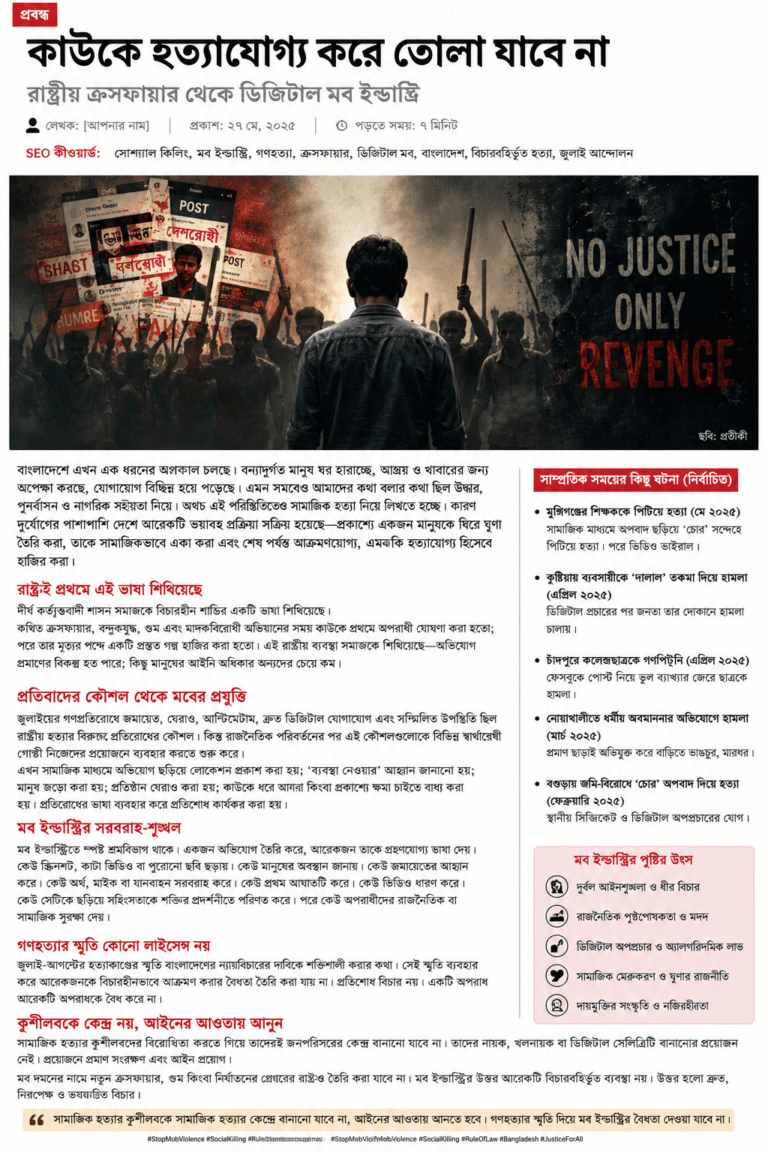
A crowd is not constituted only by physical proximity. Nor does collective cruelty begin only when the first blow is struck. Before collective aggression there may be a linguistic preparation of the target.
Bangladeshi digital hostility appears to draw from a broad repertoire.
Dehumanisation: the opponent becomes animal, dirt, waste, or disease.
Feminisation and emasculation: defeat becomes loss of manhood.
Sexualised domination: sporting hierarchy is translated into bodily submission.
Genealogical insult: “বাপ,” ancestry, children, bloodline, and “জাত” transform individual affiliation into inherited inferiority.
Purity and pollution: the opponent becomes something dirty from which a space must be cleansed.
Funeralisation: defeat becomes symbolic death; memes stage burial, coffin, mourning, obituary, and mock prayer.
Judicial language: “deserved,” “justice,” “lesson,” “punishment,” “karma.” The troll becomes judge.
Expulsion: disappear, leave Facebook, hide your face, do not speak.
Infantilisation: go to sleep, drink milk, stop crying.
Weaponised sympathy: “আহারে,” “কষ্ট পেয়ো না,” “পানি খাও”—care performed as domination.
Historical prosecution: an old defeat is retrieved to punish a present supporter.
Numerical weaponisation: scores and trophy counts cease to be statistics and become portable instruments of humiliation.
Screenshot justice: platform memory becomes evidentiary court.
Tagging as summoning: the target is called into a hostile public.
Emoji synchronisation: hundreds of laughing symbols create a coordinated jeering crowd.
Pre-emptive retaliation: “They would have done the same to us.”
Reverse victimhood: the aggressor narrates aggression as defensive justice.
Plausible deniability: after humiliation comes innocence—“It was only a joke.”
This final move is essential.
The speaker wants both powers:
the power to wound,
and the innocence of play.
Yet a methodological boundary must be stated clearly.
These categories are presently a theoretical codebook, not the findings of a completed systematic corpus analysis. They arise from observation of recurrent digital forms and from comparative literature on humiliation, hostile discourse, gendered abuse, and collective antagonism. To claim prevalence, distribution, or causal significance would require a systematically sampled corpus.
That corpus should be built.
A serious study might compare public comments from Brazil-defeat posts, Argentina-defeat posts, political pile-ons, gendered trolling, and religiously polarised controversies. The unit of analysis should include not only words but images, emojis, tagging practices, screenshots, temporal sequences, and reply structures.
The question would no longer be merely:
What insults appear?
It would be:
Which linguistic repertoires travel across otherwise different conflicts?
If the same structures recur across football, politics, religion, and gendered harassment, then the proposition that Bangladesh possesses a travelling grammar of collective cruelty would move from critical interpretation toward empirical demonstration.
XIII. From Rumour to Repetition
Collective hostility is not sustained by insult alone.
It requires circulation.
South Asian histories of collective violence repeatedly demonstrate the importance of rumour, repetition, exemplary incidents, and stories that travel beyond their original context. The football case is not equivalent to communal violence, but a comparable communicative question can still be asked.
How does one incident become evidence about an entire category?
A supporter behaves badly. The screenshot circulates. The individual becomes representative.
“See how they are.”
An old incident is attached. Another image is added. A rumour appears. Repetition produces familiarity; familiarity begins to resemble truth.
The key movement is:
person → example → category → moral verdict
Tambiah helps explain the enlargement of incidents into collective antagonisms. Paul Brass adds another warning: what appears spontaneous may involve recurrent roles, infrastructures, interpreters, and retrospective narratives.
This does not mean a football meme network is an institutionalised riot system.
It means spontaneity should not be accepted as explanation.
XIV. The Distributed Crowd
Elias Canetti wrote about density and discharge. But the platform age presents a formation in which people need not share a street, stadium, or square.
The contemporary crowd may be distributed.
One person posts a meme. Another tags a target. A third retrieves a screenshot. Fifty add laughing emojis. Someone introduces a sexual insult. Another escalates it. A page with a large following republishes the material. The platform detects engagement. Visibility expands. Repetition creates legitimacy.
No central commander may exist.
No participant needs to feel individually responsible.
Yet a target experiences the accumulated force of a crowd.
This is the crowd without co-presence.
Its power comes partly from aggregation. Each act may appear minor: one emoji, one tag, one joke, one repost.
But the target encounters the totality.
The distributed crowd therefore creates an asymmetry of perception:
each participant sees a contribution;
the target experiences a crowd.
XV. The Platform Is Not a Neutral Stage
To stop at “social media amplifies conflict” would be insufficient.
Platforms organise visibility through systems that reward engagement. Outrage, rivalry, emotionally legible conflict, and repeat interaction can generate circulation. Pages and creators may gain attention from escalation. Meme production can become a small economy of reach. The architecture does not need to “hate” anyone. It needs only to discover that antagonism keeps people interacting.
This introduces a political economy of humiliation.
The relevant question is no longer merely:
Why are people cruel?
It is also:
Who gains visibility when cruelty becomes engagement?
Bangladesh-specific research has already treated Facebook-mediated incidents as relevant to real-world violence, while computational work has explored ways of identifying sectarian or communal-violence markers in Bangla social-media interactions. Such work does not prove that football trolling causes physical violence.
It establishes something more modest but important:
Bangla digital discourse can be studied systematically as a field in which hostile expressions circulate, aggregate, and interact with offline relations.
The distributed crowd is therefore not only psychological or cultural.
It is infrastructural.
XVI. Recognition and the Political Economy of Visibility
Recognition must now be returned to the platform.
Why did Argentine football figures discover Bangladesh’s devotion?
Why did Brazilian players see videos of Bangladeshi supporters?
Because fandom became visible.
And visibility is not neutral.
A spectacular crowd is more likely to be photographed than a quiet household. A giant flag travels farther than ordinary affection. Thousands watching a screen become international news. Extreme emotion is more legible to media than moderate attachment.
This creates a selection effect.
The world may recognise Bangladesh precisely through its most spectacular performances of fandom.
Once supporters understand this, spectacle can become self-reinforcing.
The same infrastructure that distributes mockery also distributes love.
The same platform environment can amplify solidarity and humiliation.
The same crowd can be recognised as beautiful from afar and experienced as coercive from within.
This is why recognition cannot be treated as simply positive.
The politics of being seen always raises another question:
Which performances become visible enough to receive recognition?
XVII. The Pleasure of the Other’s Pain
Perhaps the darkest feature of football trolling is not anger.
It is pleasure.
“Come online.”
“Where are you hiding?”
“More tears.”
These expressions reveal what I call punitive spectatorship. Victory itself is insufficient. The rival must be seen suffering. More precisely, the rival must know that others are watching the suffering.
This creates a second-order spectacle.
One watches football.
Then one watches the loser.
Then one watches others watching the loser.
Humiliation becomes socially productive because it synchronises the victorious group.
The football case becomes more important, not less, because the stakes are ostensibly trivial. No territory is being contested. No scripture is under attack. No election is being decided. No material resource is being distributed.
Yet categorical hostility appears anyway.
This removes some of our usual explanations.
If feminisation, inherited blame, expulsion, forced visibility, and punitive laughter reappear where little material is at stake, perhaps collective cruelty should not be understood only as an emergency formation.
Perhaps it is also an everyday cultural possibility.
XVIII. Against Bengali Essence
At this point the essay must refuse its most seductive conclusion.
There is no adequate basis for claiming that Bengalis possess an eternal cultural essence that makes them uniquely irrational, violent, or crowd-prone. Such a conclusion would reproduce precisely the colonial typologies a critical genealogy should interrogate.
The historical record suggests a different analytical path.
Collective behaviour emerges through institutions, political habits, media forms, masculinities, neighbourhood structures, memories, inequalities, infrastructures, and opportunities for mobilisation. The same society can produce emancipatory crowds and punitive collectivities. The same individual can participate in solidaristic assembly in one context and a humiliating pile-on in another.
The analytical task is therefore not to diagnose a people.
It is to identify transformations.
How does preference become identity?
How does identity become camp?
How does camp become moral hierarchy?
How does hierarchy become humiliation?
How does humiliation become entertainment?
How does entertainment become obligation?
How does recognition intensify identity?
How does visibility reward spectacle?
How does obligation become mobilisation?
And under what conditions does mobilisation become violence?
These are historical questions.
Not racial ones.
Not civilisational ones.
Not questions of national character.
XIX. What the Evidence Can—and Cannot—Show
A critical essay on collective cruelty must not reproduce the epistemology it criticises.
It cannot take repetition as proof.
It cannot transform every reported incident into confirmation of a predetermined national pathology.
It cannot treat a reported death or an alleged self-harm case as scientifically established evidence that football defeat or trolling caused the outcome merely because family members, neighbours, or newspapers narrate the event that way. It cannot infer causation from temporal sequence. It cannot assume that every Brazil–Argentina clash began because of football simply because participants carried those identities.
The archive is heterogeneous.
Newspaper reports vary in quality.
Police accounts may be partial.
Family narratives may be sincere without establishing causation.
Opinion columns may repeat earlier claims.
International reports may exoticise Bangladeshi fandom.
Social-media posts may be deleted, manipulated, or stripped of context.
These limitations do not destroy the argument.
They discipline it.
The available record supports the claim that World Cup fandom in Bangladesh has repeatedly intersected with injury, confrontation, public-order concern, intense humiliation, and reported episodes of severe distress. It supports the claim that Brazil and Argentina identities can become socially consequential. It supports the need for further research.
It does not support an essentialist claim that football fandom mechanically causes violence.
Nor does it support the claim that Bengalis are uniquely pathological.
The essay’s argument is therefore genealogical and interpretive:
a recurring repertoire deserves explanation even when no single cause explains every event.
XX. After the Final Whistle
Bangladesh does not suffer from an excess of crowds.
Its history has repeatedly depended on them.
The deeper problem is that we have not sufficiently distinguished the crowd that demands justice from the crowd that demands a victim; the crowd that expands political voice from the crowd that silences; the crowd that confronts power from the crowd that borrows power by humiliating someone weaker or temporarily defeated.
Brazil’s defeat is not a communal riot.
A cruel meme is not a pogrom.
A Facebook pile-on is not a street killing.
These distinctions must remain absolute.
But critical thought begins where equivalence ends and comparison becomes possible.
The football rivalry reveals a recurring temptation: to transform preference into identity, identity into camp, camp into moral hierarchy, hierarchy into humiliation, and humiliation into collective pleasure.
Recognition makes the process still more complex.
The Bangladeshi fan is no longer merely imagining Brazil or Argentina.
Brazil and Argentina sometimes look back.
Diplomats attend gatherings. Players acknowledge supporters. International media circulate images of Bangladeshi crowds. Fans discover themselves inside the gaze of the distant football world.
The imagined relation answers back.
And once it does, the “we” becomes harder to dismiss as fantasy.
This is why the most important question after the final whistle is not who won.
It is what kind of “we” was created by someone else’s defeat.
Nirad C. Chaudhuri may return here—not as prophet, not as authority, and certainly not as proof of an eternal Bengali defect. He returns as an uncomfortable interlocutor. His severity toward Bengali collective self-perception may still provoke us, provided we turn that severity back upon its own colonial, elitist, and civilisational assumptions.
The question is not:
What is wrong with the Bengali?
The question is:
What histories, institutions, masculinities, political habits, vernacular categories, media forms, structures of recognition, and algorithmic incentives repeatedly make the humiliated Other so useful to collective belonging?
A society should be judged not only by whom it loves.
It may also be judged by how much cruelty it permits when it believes it is only joking.
References
Arafat, S. M. Yasir, et al. 2024. “Deaths and Clashes Induced by Rivalry among Fans during the FIFA World Cup 2022 in Bangladesh.” Journal of Interpersonal Violence Research.
Brass, Paul R. 2003. The Production of Hindu-Muslim Violence in Contemporary India. Seattle: University of Washington Press.
Canetti, Elias. 1962. Crowds and Power. Translated by Carol Stewart. New York: Viking Press.
Chaudhuri, Nirad C. 1951. The Autobiography of an Unknown Indian. London: Macmillan.
Chaudhuri, Nirad C. 1965. The Continent of Circe: An Essay on the Peoples of India. London: Chatto & Windus.
Fraser, Nancy. 2000. “Rethinking Recognition.” New Left Review 3: 107–120.
Honneth, Axel. 1995. The Struggle for Recognition: The Moral Grammar of Social Conflicts. Cambridge: Polity Press.
Le Bon, Gustave. 1895/1896. The Crowd: A Study of the Popular Mind.
Minar, Matiur Rahman, and Jibon Naher. 2018. “Violence Originated from Facebook: A Case Study in Bangladesh.”
Reicher, Stephen D. 1984. “The St Pauls’ Riot: An Explanation of the Limits of Crowd Action in Terms of a Social Identity Model.” European Journal of Social Psychology 14(1): 1–21.
Reicher, Stephen D. 2001. “The Psychology of Crowd Dynamics.” In Blackwell Handbook of Social Psychology: Group Processes.
Tambiah, Stanley Jeyaraja. 1996. Leveling Crowds: Ethnonationalist Conflicts and Collective Violence in South Asia. Berkeley: University of California Press.
Turner, Victor. 1969. The Ritual Process: Structure and Anti-Structure. Chicago: Aldine.
Contemporary empirical and documentary sources
Arafat et al.’s 2024 study provides the principal systematic incident dataset used in this essay.
The Daily Star, June 2026, reporting on injuries in the Habiganj confrontation involving Argentina- and Brazil-identified groups.
The Guardian, June 2026, long-form reporting on the historical and intergenerational development of Brazil and Argentina fandom among Bangladeshis.
Al Jazeera, July 2026, reporting on Argentina fandom in Bangladesh, public screenings, and ambassadorial participation.
The Daily Star and Prothom Alo English, June 2026, reporting on Alisson Becker’s acknowledgement of Bangladeshi Brazil supporters.
Additional Bangladeshi newspaper archives are used as documentary evidence of reported clashes, police interventions, fan-related accidents, and public-order concerns. Individual reports should be treated according to their evidentiary status rather than as interchangeable proof of causation.