Beyond Self-Regulation: AI, Media Power, and Public Accountability in Bangladesh the Podcast
Anthropologist Dr. Moiyen Zalal Chowdhury discusses AI, media power, digital ethics, and public accountability in Bangladesh, exploring how technological systems increasingly shape society and public life.
Artificial Intelligence is no longer merely a technological issue. Increasingly, it has become a social question, a political question, and perhaps most importantly, a question of public power.
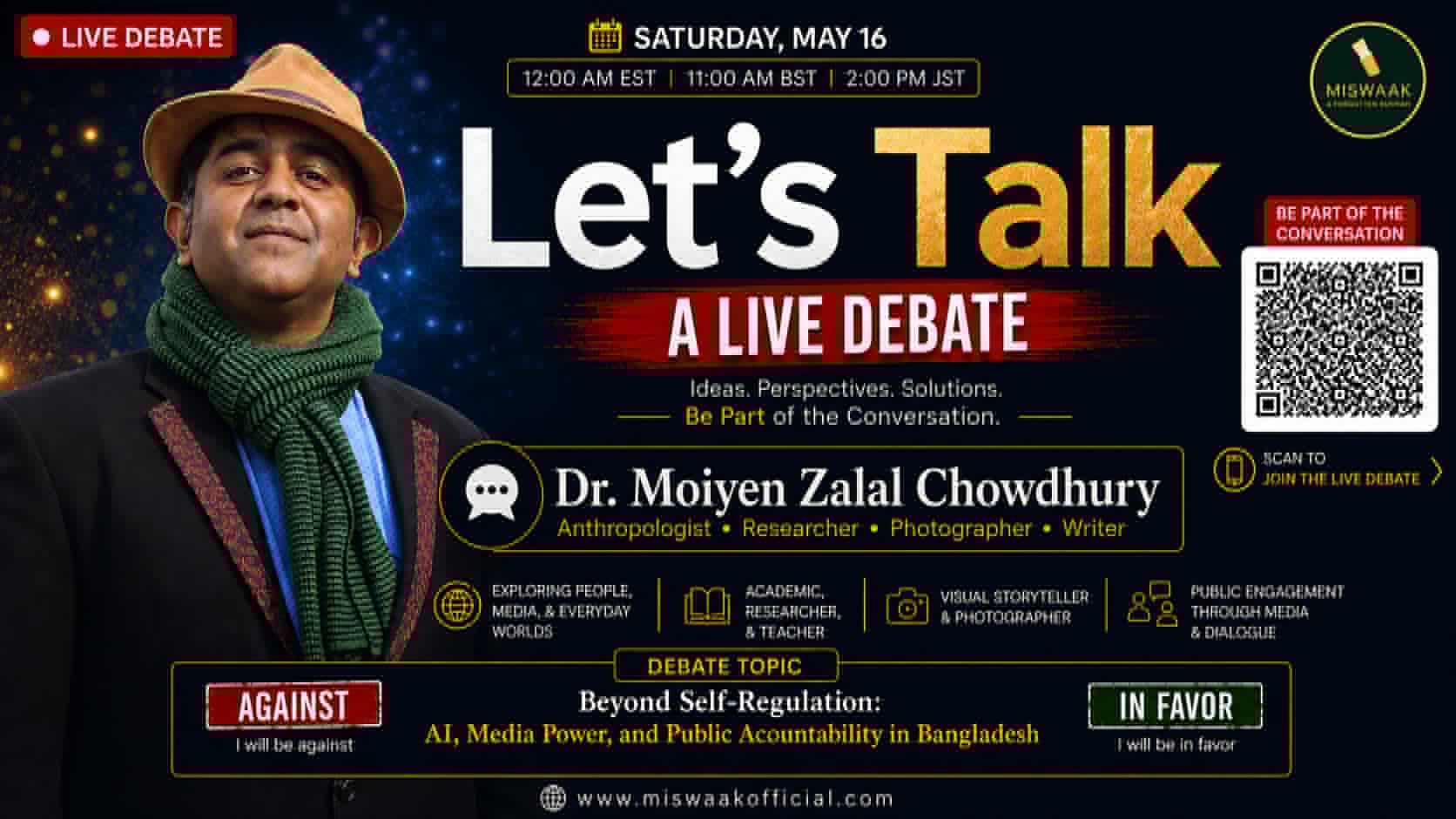
I recently had the opportunity to participate in a public discussion titled “Beyond Self-Regulation: AI, Media Power, and Public Accountability in Bangladesh.” (link to that article (https://moiyenzalal.com/beyond-self-regulation-ai-media-power-public-accountability-bangladesh/) The conversation moved beyond familiar debates surrounding whether AI is “good” or “bad,” and instead attempted to address deeper questions concerning the relationship between technology, institutions, and society.
Throughout the discussion, I approached the topic from an anthropological perspective. Anthropology reminds us that technologies never enter an empty space. Technologies enter histories, cultures, inequalities, aspirations, anxieties, and everyday practices. Consequently, AI systems do not simply operate in technical environments; they operate within social worlds.
Some of the key questions explored included:
- Can self-regulation alone ensure accountability in AI-driven media environments?
- How do algorithms shape visibility and invisibility?
- Who benefits from systems of recommendation, amplification, and prediction?
- How might AI interact with existing inequalities and social structures in Bangladesh?
- What responsibilities should media institutions, policymakers, academics, and citizens collectively share?
One of the central arguments discussed was that AI increasingly functions not only as a tool but also as an infrastructure of social organization. Recommendation systems, algorithmic ranking, and automated forms of visibility increasingly influence what people encounter, trust, remember, and discuss.
This raises an important question:
When intelligence becomes increasingly automated, who becomes accountable?
Bangladesh is entering a period of accelerated digital transformation. As discussions around AI governance, digital rights, public trust, and media ethics continue to evolve, broader public dialogue becomes increasingly necessary.
The challenge before us is therefore not only technological innovation, but also creating ethical and democratic structures capable of governing technological power responsibly.
Watch the full discussion below.