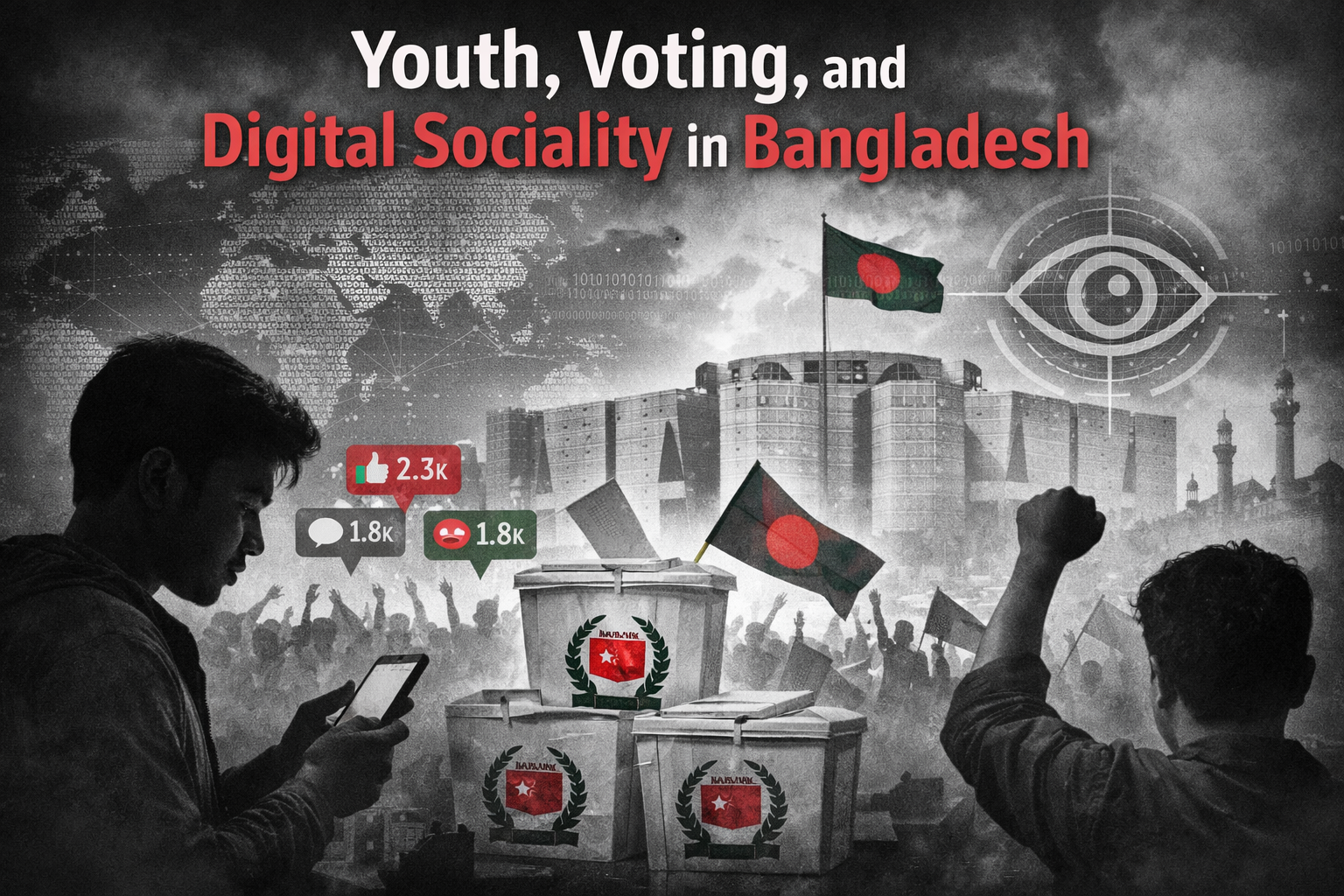
Youth, Voting, and Digital Sociality in Bangladesh: A Critical Essay
Resistance, Reform, and Electoral Uncertainty in a Platformized Political Order
A critical analysis of youth voting behavior, digital sociality, meme warfare, and political reform in Bangladesh’s post-movement electoral landscape.
“This essay is a theoretically driven critical analysis grounded in secondary data, institutional reports, and longitudinal observation of digital political practices in Bangladesh (2013–2026).”
Author’s note:
This essay is part of a longer theoretical project on resistance-sociality, digital public spheres, and youth politics in Bangladesh. A revised version is in preparation for journal submission.
Introduction: Elections After Resistance
The thirteenth national parliamentary election in Bangladesh arrives not as a routine democratic event, but as a moment saturated with unresolved histories. For a generation of young citizens, voting is no longer an inherited civic habit or a predictable ritual of party loyalty. Instead, it is experienced as a negotiated encounter with power, shaped by more than a decade of movements, digital mobilization, repression, and deferred reform.
At the center of this election stands a demographic fact with profound political implications: between 30 and 35 percent of Bangladesh’s electorate now consists of young voters, most of whom are participating in a national election for the first time. Estimates based on Election Commission data suggest that approximately 4 to 4.5 crore voters fall between the ages of 18 and the early thirties, depending on definitional thresholds. Numerically, this cohort alone is capable of altering electoral outcomes. Politically, however, their significance lies not only in numbers, but in how their political subjectivity has been formed.
This generation did not grow up within a stable electoral order. Their political coming-of-age unfolded amid contested elections, street movements, digital activism, internet shutdowns, platform surveillance, and repeated crises of institutional legitimacy. From the Shahbag movement in 2013, through the quota reform and road safety movements of 2018, to the July uprising of 2024, youth participation in Bangladesh has been shaped less by ballots than by bodies in the street and voices online. Voting, for many, now appears not as the foundation of political agency, but as one possible—and uncertain—continuation of resistance.
This essay argues that conventional frameworks of voter behavior, political communication, or democratic transition are insufficient to understand youth participation in the current Bangladeshi election. Approaches that treat elections as discrete institutional events, or voters as rational preference-maximizers, fail to capture the affective, historical, and digital conditions under which young people now encounter electoral politics. Instead, this study proposes that youth voting in Bangladesh must be understood through the lens of digital election sociality, an extension of the concept of resistance-sociality developed to analyze social media–mediated movements.
Resistance-sociality conceptualizes political action not as episodic protest alone, but as a dynamic relational field produced through the interaction of power, technology, affect, and sociality across online and offline spaces. When extended to elections, this framework allows us to see voting not as the opposite of resistance, but as a conditional, negotiated, and often ambivalent act—one shaped by memories of repression, expectations of reform, and the risks of visibility in digital environments.
For Bangladeshi youth, electoral participation unfolds within integrated digital sociality, where cognition, communication, and cooperation collapse into single platforms; where personal, political, and economic roles converge within one profile; and where surveillance—state, platform, and social—conditions expression. In this environment, political engagement often takes indirect forms: memes instead of manifestos, influencers instead of party cadres, irony instead of slogans. These are not signs of apathy. They are adaptive political strategies developed under constraint.
The essay traces how youth voting behavior emerges at the intersection of four interrelated dynamics:
(1) a decade-long genealogy of movements from 2013 to 2024;
(2) the rise of affective publics, meme warfare, and influencer mediation in digital spaces;
(3) reformist expectations shaped by economic precarity, justice claims, and institutional distrust; and
(4) the persistent risks of radicalization, withdrawal, or cynicism when elections fail to absorb accumulated grievances.
By situating elections within the longer arc of resistance rather than outside it, this study reframes the thirteenth national election as a test of translation: a moment when digitally mediated resistance either finds partial institutional expression or re-enters a cycle of deferral and rupture. Youth voters, in this sense, are not merely kingmakers. They are diagnosticians of power, whose conditional participation reveals the limits and possibilities of electoral politics in post-movement Bangladesh.
The central question, therefore, is not simply how young people will vote, but what voting has come to mean after resistance—and whether elections can function as sites of transformation rather than containment.
1. Macro Youth Demography and Global Authoritative Predictions on Bangladeshi Youth
1.1 Bangladesh’s youth demography as a structural political condition
Bangladesh’s contemporary political moment is inseparable from its demographic structure. Youth in Bangladesh do not constitute a marginal or transitional category; they form a structurally decisive population bloc whose size, age composition, and socio-economic positioning shape the trajectory of politics, governance, and legitimacy.
According to the most recent population data released by the Bangladesh Bureau of Statistics (BBS) following the Population and Housing Census, Bangladesh’s population stands at approximately 169.8 million. Within this population, age composition reveals a striking concentration in younger cohorts. International demographic datasets aligned with United Nations Population Division estimates consistently show that Bangladesh retains a comparatively young median age and a large working-age population, with youth forming a substantial share of both current and future electorates.
UNICEF’s Bangladesh country data highlights that over one-third of the population is under 18, amounting to roughly 56.9 million children, indicating a continuous pipeline of future youth entrants into political and economic life. This demographic momentum ensures that youth influence will not be episodic or temporary, but structurally persistent across multiple electoral cycles.
UNFPA and UN Population Division data situate Bangladesh firmly within what demographic economists describe as a late-stage demographic transition: fertility rates have declined, life expectancy has increased, and the proportion of the population in working ages (15–64) has expanded significantly. This configuration produces what global institutions term a demographic dividend—a time-bound window during which economic growth, social mobility, and political stability are possible if youth are productively integrated into employment, governance, and civic life.
Crucially, this dividend is not automatic. UNFPA’s Bangladesh analyses emphasize that without adequate job creation, skills development, health access, and civic inclusion, the same demographic structure can generate systemic stress rather than growth. Youth abundance, in this sense, is not inherently stabilizing; it becomes stabilizing only through institutional absorption.
For electoral politics, this demographic reality has two immediate implications. First, youth voters represent a numerically decisive electoral force, capable of altering outcomes even in fragmented or competitive contests. Second, their political behavior cannot be reduced to conventional models of voter socialization, as their lived experience is shaped by structural precarity rather than institutional continuity.
1.2 Global authoritative expectations: opportunity, risk, and conditional futures
Global development institutions do not predict political behavior in narrow electoral terms. Instead, they project structural outcomes based on how states manage youth integration. Across reports from the World Bank, UNDP, UNFPA, ILO, and related bodies, four consistent expectations emerge regarding Bangladeshi youth.
1.2.1 Youth as a time-bound economic and political opportunity
The World Bank’s Bangladesh youth diagnostics underline that youth will comprise roughly half of the country’s working-age population by the late 2020s, making their employment outcomes decisive for long-term economic sustainability. These reports stress that Bangladesh’s labor market remains heavily informal, with young workers disproportionately concentrated in low-wage, insecure, and non-protected sectors.
UNFPA reinforces this framing by explicitly warning that the demographic dividend window will narrow over time as population aging gradually accelerates. In this view, the coming decade represents a final opportunity to translate youth numbers into durable institutional stability. Failure to do so risks locking in cycles of frustration, underemployment, and political volatility.
1.2.2 Youth political participation without institutional trust
UNDP’s Bangladesh-focused analyses following the July 2024 uprising emphasize a paradoxical trend: youth political engagement is rising, but institutional trust remains fragile. Young people demonstrate high levels of political interest, willingness to mobilize, and desire for participation, yet they encounter barriers related to electoral credibility, administrative transparency, and perceived responsiveness of political actors.
This gap between participation and trust is critical. Global governance literature increasingly recognizes that youth engagement does not automatically translate into institutional loyalty. Where participatory energy is not absorbed into credible political processes, it often reappears in extra-institutional forms, including protest cycles, digital activism, and affect-driven public discourse.
1.2.3 Employment exclusion, NEET risk, and gendered precarity
The International Labour Organization (ILO) identifies youth employment transitions as a key vulnerability point in developing economies. In Bangladesh, global labor frameworks highlight NEET (Not in Education, Employment, or Training) rates and informal employment as indicators of structural exclusion. Young women are particularly affected, facing compounded barriers related to care responsibilities, mobility constraints, and labor-market discrimination.
From a political perspective, these patterns matter because economic exclusion shapes risk tolerance, visibility, and modes of participation. Youth who lack stable employment often engage politically through low-cost, digitally mediated channels rather than sustained organizational involvement, reinforcing the centrality of online spaces in contemporary political life.
1.2.4 Climate, urban stress, and future insecurity
Recent global assessments increasingly link youth futures to climate stress and urban productivity. World Bank-linked analyses of Bangladesh highlight rising economic losses due to heat stress, environmental degradation, and urban congestion—factors that disproportionately affect working-age populations concentrated in cities.
For youth, these pressures translate into future insecurity rather than abstract environmental concern. As a result, global institutions increasingly frame youth demands around livelihood resilience, urban services, and survival infrastructures—issues that readily enter digital political narratives and electoral discourse.
1.3 Implications for electoral politics and digital sociality
Taken together, macro youth demography and global authoritative projections position Bangladeshi youth not as a demographic “background,” but as a structural political class whose expectations, frustrations, and aspirations shape the conditions of electoral legitimacy.
From the perspective of Resistance-Sociality, this demographic configuration explains why elections are no longer experienced by youth as neutral civic rituals. Voting occurs within a landscape already saturated by protest memories, digital surveillance, economic precarity, and unmet reform promises. Youth electoral behavior thus emerges as conditional participation—informed by past resistance, mediated through digital sociality, and oriented toward future credibility rather than inherited loyalty.
This demographic groundwork is essential for understanding subsequent sections of the essay. Youth voting behavior, meme and influencer warfare, reformist demands, and risks of radicalization are not discrete phenomena; they are expressions of a deeper demographic-structural condition interacting with digital political infrastructures.
2. Youth Voting Behaviour as Conditional Participation
2.1 Voting after rupture: a generation without electoral continuity
Youth voting behaviour in Bangladesh must be situated within a historical rupture rather than a linear democratic trajectory. For a significant portion of young voters, participation in a national election does not follow from accumulated civic habit, partisan inheritance, or ideological socialization. Instead, it emerges after a prolonged experience of electoral suspension, where voting was either structurally foreclosed or symbolically emptied of choice.
Young citizens who became eligible to vote after 2008 entered political adulthood during a sequence of elections widely perceived as contested or non-competitive. The 2014 election, marked by widespread uncontested victories; the 2018 election, remembered through the vernacular of “night-time voting”; and the 2024 election, conducted amid extensive opposition absence, collectively produced a generational memory in which elections appeared detached from accountability and outcome. As a result, youth political subjectivity was shaped outside electoral institutions, primarily through movements, protests, and digitally mediated publics.
This absence of electoral continuity is critical. Voting, for this cohort, is not an inherited democratic norm but an unfamiliar political technology whose credibility remains under evaluation. Youth voters approach elections not as an automatic civic duty but as a contingent opportunity—one whose legitimacy must be demonstrated rather than presumed.
2.2 Conditionality as a political rationality
Empirical surveys, media interviews, and qualitative accounts consistently indicate that a large proportion of young voters remain undecided well into the electoral cycle. Rather than interpreting this undecidedness as apathy or confusion, it is more analytically accurate to read it as conditional participation.
Conditional participation reflects a deliberate withholding of commitment. Young voters do not reject voting outright; instead, they postpone decision-making until parties and candidates demonstrate credibility on issues that resonate with lived experience. Employment security, transparent recruitment, freedom of expression, protection from arbitrary repression, internet access, and reform of governance institutions recur as core evaluative criteria.
From the perspective of resistance-sociality, this conditionality is not indecision but political judgment shaped by experience. Youth participation has already occurred—through street mobilization, digital activism, and moral claims-making. Voting becomes a secondary act that must align with the ethical expectations forged in resistance.
This helps explain why youth voting behaviour frequently defies conventional electoral models. The same cohort may mobilize intensely for protests while remaining skeptical of parties. They may consume political content daily without formal affiliation. They may articulate strong normative positions while delaying ballot commitment. These are not contradictions; they are features of a post-movement political rationality.
2.3 From partisan inheritance to performance-based evaluation
A defining shift in youth voting behaviour is the erosion of partisan inheritance. Older models of Bangladeshi electoral politics assumed that party affiliation flowed through family, locality, or liberation-era narratives. For many young voters, these affiliations lack affective resonance.
Instead, youth voting behaviour is increasingly performance-oriented. Candidates and parties are evaluated based on perceived integrity, responsiveness, reform intent, and alignment with movement-era values. Credibility is not derived from historical legacy but from present positioning—especially in relation to July 2024 and earlier protest cycles.
This evaluative mode aligns with broader global trends in post-ideological politics, where trust is provisional and constantly renegotiated. However, in Bangladesh, this shift is intensified by the experience of repression, surveillance, and institutional opacity. Youth voters scrutinize not only what parties promise, but how they behaved during moments of crisis: silence, complicity, or solidarity during movements become lasting political markers.
2.4 Digital sociality and the reconfiguration of electoral judgment
Youth voting behaviour today is inseparable from digital sociality. Political judgment is formed less through party manifestos or traditional media and more through fragmented, affective, and networked encounters: short videos, live streams, memes, testimonies, and influencer commentary.
Within this environment, cognition, communication, and cooperation collapse into integrated sociality. Evaluation becomes rapid, comparative, and socially embedded. Political trust is extended tentatively and withdrawn quickly. A single clip, post, or viral narrative can significantly reshape perception, especially when it resonates with prior affective investments formed during movements.
Importantly, digital sociality also alters the risk calculus of participation. For youth accustomed to platform surveillance, legal repercussions, and social backlash, overt party alignment can feel costly. Voting, unlike protest, is secret—but political expression surrounding voting is not. As a result, many young voters remain publicly ambiguous while privately evaluative, reinforcing patterns of late decision-making.
2.5 Voting as a diagnostic of legitimacy
From the analytical lens of resistance-sociality, youth voting behaviour functions less as a measure of party strength and more as a diagnostic of legitimacy. Choices are shaped by whether electoral politics appears capable of absorbing the moral claims articulated through resistance.
When parties signal reform, accountability, and respect for dissent, youth conditionality may resolve into participation. When elections appear to reproduce exclusion or compromise movement demands, youth disengagement or protest-oriented politics may re-emerge. Voting thus becomes a test of translation: can resistance be institutionally recognized without being neutralized?
This diagnostic function explains why youth voting behaviour remains volatile and difficult to predict. It is not anchored in ideology alone, but in ongoing assessments of credibility, risk, and future possibility.
2.6 Risks embedded in conditional participation
While conditional participation is politically rational, it carries inherent risks. Persistent postponement can slide into withdrawal if repeated elections fail to deliver substantive change. Undecidedness may be exploited by affective mobilization, misinformation, or charismatic intermediaries operating in digital spaces.
Moreover, when institutional politics consistently fails to absorb youth expectations, conditionality may transform into cynicism or radicalization. The same digital infrastructures that enable critical evaluation can also facilitate polarization, moral absolutism, and narrative warfare. These dynamics become particularly visible in the domain of memes, influencers, and symbolic politics, which now occupy a central position in youth electoral experience.
2.7 From resistance to ballots, without closure
Youth voting behaviour in Bangladesh should be understood neither as apathy nor as enthusiasm. It represents post-movement electoral subjectivity: cautious, evaluative, digitally mediated, and shaped by a decade of resistance.
Voting is not the origin of political agency for this generation; it is one possible continuation of it. Whether ballots become instruments of transformation or mere pauses between ruptures depends on how electoral politics responds to the ethical, economic, and political claims that youth have already articulated—online, on the streets, and through refusal.
This sets the stage for the next analytical layer: meme warfare, influencers, and affective electoral politics, where youth political judgment is increasingly shaped not through policy debates but through symbolic, emotional, and algorithmic contestation.
3. Digital Sociality: Meme and Influencer Warfare in Electoral Politics
3.1 From organizational politics to platformed sociality
Electoral politics in Bangladesh has undergone a structural shift in its communicative infrastructure. Where party offices, rallies, and print media once served as primary sites of political persuasion, platformed digital sociality now functions as a parallel—often dominant—arena of political contestation. For youth in particular, political meaning is increasingly produced, circulated, and evaluated within digital environments rather than through formal party channels.
This shift does not simply represent a change in media. It marks a transformation in how political sociality itself is organized. Drawing from the resistance-sociality framework, digital platforms collapse cognition, communication, and cooperation into a single integrated space. Political judgment is formed through continuous exposure to content that is affective, personalized, algorithmically curated, and socially validated.
Platforms such as Facebook, YouTube, and TikTok are not neutral conduits of political information. They actively structure visibility, amplify certain forms of expression, and reward engagement patterns that privilege emotion, immediacy, and shareability over deliberation. Within this environment, youth political engagement becomes ambient rather than episodic—a constant background of scrolling, reacting, forwarding, and interpreting.
Digital election sociality thus differs fundamentally from earlier forms of online campaigning. It is not merely about “using social media for elections.” It is about elections being reconstituted within digital sociality, where political meaning is produced through everyday interactions rather than formal persuasion.
3.2 Memes as affective political infrastructure
Memes have emerged as a central instrument of youth political communication, not because they trivialize politics, but because they translate complex political claims into affective, shareable forms. A meme condenses critique, irony, anger, humor, and moral judgment into a format that travels quickly across networks and platforms.
From the standpoint of resistance-sociality, memes function as micro-acts of resistance and alignment. They allow users to participate politically without assuming the risks associated with overt ideological positioning. Sharing a meme is often safer than sharing a manifesto, yet it signals belonging, judgment, and stance.
In electoral contexts, memes operate as a form of narrative warfare. Competing political actors deploy humor, satire, and symbolic shorthand to delegitimize opponents and frame themselves as authentic or aligned with youth sentiment. These memes do not require factual completeness to be effective; they rely on resonance with shared experiences of injustice, frustration, or betrayal.
Importantly, meme politics is not random. It is patterned by platform affordances and algorithmic incentives. Content that provokes laughter, outrage, or recognition is more likely to circulate, reinforcing affective intensity. As a result, political debate becomes compressed into symbolic gestures, where complex histories are reduced to punchlines—but those punchlines carry moral force.
Memes also enable plausible deniability. When challenged, creators can retreat into humor: “It’s just a joke.” This ambiguity is politically useful in environments marked by surveillance, legal risk, and social backlash. Memes allow youth to remain politically expressive while avoiding direct confrontation.
3.3 Influencers as intermediaries of political legitimacy
Alongside memes, influencers have become powerful mediators of political meaning. Unlike traditional party elites or intellectuals, influencers derive authority from visibility, relatability, and perceived authenticity rather than institutional position. Their credibility rests on intimacy: followers feel they “know” them.
In digital election sociality, influencers function as interpretive nodes. They translate political events into digestible narratives, frame controversies, and signal how followers should feel about unfolding developments. This role is especially significant for youth voters who distrust formal political communication but remain intensely engaged with digital content.
Influencers are not uniform. Some explicitly align with parties or movements; others maintain strategic ambiguity. What unites them is their capacity to shape affective orientation rather than policy preference. A short video expressing disappointment, hope, or outrage can influence political mood more effectively than detailed programmatic statements.
From the resistance-sociality perspective, influencers occupy an ambivalent position. On one hand, they expand the range of voices participating in political discourse, challenging elite monopolies over narrative production. On the other hand, they introduce new hierarchies based on algorithmic visibility, follower count, and platform favor.
This creates a new form of symbolic power. Influencers can legitimize or delegitimize parties, candidates, and movements without formal accountability. Their interventions often appear spontaneous, but they are embedded in platform economies that reward engagement and controversy.
3.4 Affective publics and emotional mobilization
Digital election sociality is driven less by ideology than by affective publics—loosely networked collectives formed around shared emotions rather than organizational membership. Hashtags, viral clips, and trending topics create temporary publics bound by feeling: anger at injustice, hope for change, disgust at corruption.
These affective publics are particularly salient for youth who have experienced repeated political disappointment. Emotional alignment often precedes rational evaluation. Before asking “What is the policy?” youth may ask “Does this feel right?” or “Does this resonate with what we lived through?”
Meme and influencer warfare thrives in this environment because it operates directly on affect. Rather than persuading through argument, it mobilizes through recognition and emotional contagion. This does not mean youth are irrational; it means political judgment is being formed within a communicative ecology that privileges affective intensity.
Crucially, affective publics are unstable. They can mobilize rapidly but dissipate just as quickly. Electoral campaigns that rely solely on digital enthusiasm risk misreading visibility as commitment. A viral moment does not guarantee a vote—but it can reshape the conditions under which voting decisions are made.
3.5 Risks: manipulation, polarization, and radical drift
While digital sociality expands participation, it also introduces significant risks. Meme warfare and influencer politics can blur the line between critique and disinformation. Simplification can slide into distortion. Irony can mask incitement. Emotional mobilization can harden into polarization.
For youth operating in environments of uncertainty and frustration, affective politics can become a gateway to radical simplification: clear enemies, moral absolutes, and zero-sum narratives. When electoral processes fail to absorb reformist expectations, digital spaces may amplify grievance rather than channel it.
From the resistance-sociality lens, this represents a pathological resolution of conditional participation. When legitimacy remains elusive, digital resistance may intensify without institutional outlet, increasing the appeal of uncompromising positions or charismatic figures who promise certainty.
These risks are compounded by surveillance and platform governance. Content moderation, shadow banning, and algorithmic opacity shape what youth can see and say, often without transparency. This reinforces distrust and fuels perceptions of manipulation, further destabilizing electoral confidence.
3.6 Digital election sociality as a contested field
Digital sociality in elections is neither emancipatory nor inherently corrosive. It is a contested field where power, resistance, creativity, and control coexist. Memes and influencers do not replace traditional politics; they reconfigure how political legitimacy is produced and challenged.
For Bangladeshi youth, digital election sociality offers a way to remain politically present without full institutional trust. It allows for expression under constraint, judgment without premature commitment, and solidarity without formal alignment.
At the same time, it exposes youth to new forms of manipulation and symbolic domination. Understanding youth electoral behavior today therefore requires taking digital sociality seriously—not as noise or distraction, but as a central terrain of political struggle.
4. Reformist Demands, Deferred Promises, and the Risk of Radicalization
4.1 Reform as a generational demand, not a policy checklist
For Bangladeshi youth, “reform” is not a technocratic vocabulary borrowed from policy circles; it is a generational moral demand forged through repeated encounters with institutional failure. Reform emerges less as a discrete set of proposals and more as a shared expectation that politics should finally respond to lived injustice.
This expectation did not originate in the electoral arena. It was articulated through movements—first digitally, then bodily—where young people confronted the limits of existing governance structures. As a result, reform demands carry an affective weight that exceeds conventional policy debates. They are anchored in questions of dignity, fairness, and recognition, not merely efficiency or growth.
From the perspective of resistance-sociality, reform operates as a bridge concept: it connects moments of resistance to aspirations for institutional transformation. When youth speak of reform, they are not asking only what the state will do, but whether the state is capable of ethical self-correction.
4.2 A genealogy of reform claims: from 2013 to 2024
Youth reform demands must be understood through a longitudinal lens. Beginning with the 2013 Shahbag movement, young participants articulated claims around justice, accountability, and moral legitimacy. Although Shahbag was framed around a specific historical issue, it generated a broader expectation: that collective action could compel institutional response.
Subsequent movements expanded and diversified these demands. The quota reform movement and the road safety protests of 2018 foregrounded meritocracy, transparency, and everyday governance failures. These were not revolutionary demands; they were reformist in the classical sense—calls to fix what was broken rather than dismantle the state.
The July 2024 uprising marked a qualitative shift. Youth participation intensified not only in scale but in existential tone. The language of reform merged with questions of regime legitimacy, freedom of expression, and the right to dissent. The movement exposed the limits of incremental reform within existing political arrangements and heightened expectations for structural change.
By the time of the thirteenth national election, reform had become a non-negotiable horizon for youth political judgment. Electoral actors were evaluated not on promises alone, but on whether they appeared capable of translating movement-era demands into institutional reality.
4.3 Reform in digital election sociality
Within digital election sociality, reform demands circulate through fragmented and affective channels. Short videos, memes, influencer commentary, and personal testimonies transform reform into a narrative resource rather than a policy blueprint. Parties and candidates selectively invoke reform language, often without clear articulation of implementation.
This creates a paradox. Reform is omnipresent in digital discourse, yet rarely specified in institutional terms. Youth voters encounter reform as a mood—hope, urgency, impatience—rather than a program. From the resistance-sociality perspective, this reflects the collapse of cognition, communication, and cooperation within digital platforms: evaluation precedes deliberation.
Digital spaces amplify reformist sentiment while simultaneously exposing its fragility. Viral reform narratives can mobilize attention rapidly, but they are also vulnerable to dilution, co-optation, or symbolic exhaustion. When reform language is repeatedly invoked without credible follow-through, it loses integrative capacity and becomes a site of contestation.
4.4 Deferred reform and the politics of disappointment
A defining feature of youth political experience in Bangladesh is deferred reform. Each movement generated expectations that were partially acknowledged but structurally postponed. Over time, deferral accumulated into frustration, and frustration reshaped political judgment.
This history explains why youth voters approach reform promises with skepticism. Electoral manifestos are read against a backdrop of unfulfilled commitments. Institutional gestures—commissions, dialogues, announcements—are often interpreted as containment strategies rather than genuine transformation.
From the resistance-sociality lens, disappointment is not a passive emotional state. It is an active political condition that reorganizes participation. Disappointed youth do not necessarily withdraw; they recalibrate. They may withhold votes, delay decisions, or shift engagement to digital critique rather than institutional participation.
Deferred reform thus contributes directly to conditional voting behavior. Youth participation becomes contingent on whether elections appear capable of breaking the cycle of promise and postponement.
4.5 From reformism to radical drift
While reformist demands dominate youth discourse, persistent deferral carries risks. When institutional politics repeatedly fails to absorb reform expectations, youth political energy may drift toward radical simplification.
This drift does not necessarily manifest as organized extremism. More often, it appears as moral absolutism, polarization, or rejection of compromise. Digital environments intensify this tendency by rewarding clarity over complexity and certainty over negotiation.
In digital election sociality, radical drift can take several forms:
- The elevation of charismatic figures who promise decisive rupture without institutional pathways.
- The framing of politics as a battle between absolute good and absolute evil.
- The erosion of patience for incremental change or procedural negotiation.
From the resistance-sociality perspective, radical drift represents a pathological resolution of deferred reform. When resistance fails to translate into institutional change, and elections fail to restore credibility, the space between expectation and outcome becomes volatile.
4.6 Reform as the threshold of electoral legitimacy
The central analytical claim of this section is that reform functions as the threshold condition of electoral legitimacy for Bangladeshi youth. Voting is not primarily about choosing between parties; it is about judging whether the electoral process itself can deliver meaningful transformation.
If elections appear capable of institutionalizing reformist demands—however imperfectly—youth conditional participation may resolve into engagement. If elections reproduce deferral, symbolic accommodation, or exclusion, youth political energy is likely to reappear elsewhere: in digital critique, street mobilization, or disengagement.
This places extraordinary pressure on electoral actors. Reform cannot remain rhetorical. It must demonstrate procedural credibility, temporal commitment, and ethical seriousness. Without this, elections risk becoming another episode in a longer cycle of rupture and disappointment.
4.7 Transition to the next analytical problem
Reform demands and radical drift do not unfold in isolation. They are mediated by digital infrastructures, surveillance regimes, and affective politics. The same platforms that enable reformist articulation also shape how disappointment, anger, and certainty circulate.
This leads to the next critical question: what structural challenges do digital youth face within these platforms, and how do these challenges shape political outcomes?
5. Digital Constraints, Surveillance, and the Challenges Facing Youth Political Agency
5.1 Digital abundance, political constraint
For Bangladeshi youth, digital space is simultaneously the most accessible arena of political expression and the most tightly constrained. Social media platforms provide unprecedented opportunities for visibility, connection, and narrative circulation, yet these opportunities exist within a dense architecture of surveillance, moderation, and risk. Youth political agency today is therefore shaped by a paradox: never has it been easier to speak, and never has it been more consequential to be seen speaking.
This paradox fundamentally conditions digital election sociality. Youth engagement does not unfold in a neutral communicative environment; it is shaped by anticipatory self-censorship, strategic ambiguity, and tactical silence. Participation is calibrated not only to express political preference but to manage exposure.
From the resistance-sociality perspective, this marks a shift in how power operates. Power is no longer encountered only through overt repression or visible coercion. It is embedded in platform architectures, legal uncertainty, and the social consequences of digital traceability.
5.2 Integrated surveillance and the collapse of role separation
A defining feature of digital sociality is role convergence. A single social media profile often collapses multiple identities: student, worker, family member, activist, voter. This convergence has profound implications for youth political behavior.
Political expression is no longer compartmentalized. A post intended for peers may be visible to employers, institutions, relatives, or authorities. As a result, youth are acutely aware that political speech can generate economic, social, or legal repercussions beyond the immediate political context.
Surveillance in this environment is integrated and converging. It does not operate only through the state. Platforms monitor content for moderation; algorithms shape visibility; social networks observe and sanction through peer judgment. Together, these layers create a condition in which youth political agency is exercised under continuous observation.
This does not eliminate participation; it reshapes its form. Youth adopt indirect modes of expression—humor, irony, coded language, or meme sharing—that allow them to signal alignment without explicit declaration. Silence, too, becomes a political tactic rather than disengagement.
5.3 Legal ambiguity and anticipatory restraint
Digital political engagement in Bangladesh occurs within a context of legal ambiguity. Laws governing digital communication, cyber activity, and public order are often perceived as broad, selectively enforced, or unpredictably applied. For youth, this uncertainty translates into anticipatory restraint.
Rather than responding only to actual enforcement, young users often moderate their behavior based on what might happen. This anticipatory logic is powerful. It produces compliance without direct coercion and encourages self-discipline at scale.
From the resistance-sociality lens, anticipatory restraint represents a form of productive power. It does not silence resistance outright; it channels it into less confrontational, more symbolic forms. Digital election sociality thus becomes saturated with implication rather than declaration—what is suggested matters more than what is stated.
5.4 Algorithmic visibility and affective distortion
Another major challenge facing youth political agency is algorithmic mediation. Platform algorithms reward content that maximizes engagement, often privileging emotion, novelty, and polarization. This distorts political communication in several ways.
First, nuanced discussion is structurally disadvantaged. Long-form explanation, ambiguity, and complexity travel poorly in environments optimized for rapid reaction. Second, affectively charged content—anger, outrage, ridicule—circulates more widely, shaping political mood rather than deliberation.
For youth navigating elections through digital sociality, this creates a skewed informational environment. Political reality appears compressed into moments of crisis, scandal, or confrontation. Incremental reform, procedural detail, or institutional nuance struggle to gain traction.
This does not mean youth are manipulated in a simplistic sense. Rather, their political judgment is formed within an ecology that amplifies intensity and accelerates evaluation, reinforcing conditional participation and skepticism.
5.5 Economic precarity and unequal digital participation
Digital participation is often assumed to be egalitarian, but youth political agency is deeply stratified by economic conditions. Access to stable internet, time for engagement, digital literacy, and freedom from economic risk are unevenly distributed.
Young people facing employment insecurity, informal work, or family obligations may lack the capacity to engage consistently or visibly. For them, digital participation carries higher stakes. A controversial post may jeopardize employment prospects or social support networks.
As a result, youth digital election sociality is unevenly articulated. Those with greater economic security can afford louder, more explicit political positions. Others participate through low-risk gestures or remain observers. This stratification shapes whose voices dominate digital discourse and whose concerns are rendered invisible.
5.6 Gendered constraints and differential risk
Youth political agency is also structured by gender. Young women often face heightened scrutiny, harassment, and reputational risk in digital spaces. Political expression may invite moral policing, abuse, or social sanction.
These risks shape participation patterns. Young women may engage more cautiously, selectively, or anonymously. Their political labor—care work, organizing, information sharing—often remains less visible than confrontational forms of activism.
From the resistance-sociality perspective, these gendered dynamics highlight how power and resistance operate unevenly across bodies. Digital election sociality does not dissolve social hierarchies; it reproduces and transforms them.
5.7 Constraint as a generator of new political forms
Despite these challenges, constraint does not extinguish youth political agency. It reconfigures it. Digital sociality becomes a space of adaptation, where youth learn to navigate risk through creativity, humor, timing, and collective signaling.
Meme culture, influencer mediation, strategic silence, and late electoral decision-making are not symptoms of political weakness. They are adaptive responses to constrained conditions. Resistance persists, but in polymorphic forms—sometimes visible, sometimes diffuse, sometimes deferred.
This reinforces the central argument of resistance-sociality: power and resistance are co-produced. Where control intensifies, resistance mutates rather than disappears.
5.8 Transition: from constrained agency to political futures
Understanding these challenges is essential for interpreting youth electoral outcomes. Voting behavior, meme warfare, reformist demands, and radical drift are all shaped by the constraints under which youth political agency operates.
The final analytical task is therefore to bring these threads together and ask a forward-looking question: what political futures are being shaped through youth digital election sociality in Bangladesh?
6. From Resistance to Electoral Futures: Youth, Digital Sociality, and the Politics of Possibility
6.1 Elections after resistance: a transformed political terrain
Bangladesh’s thirteenth national election unfolds in a political terrain fundamentally altered by more than a decade of youth-led resistance. The question is no longer whether young people are political; that has been decisively answered through movements, digital mobilization, and collective risk-taking. The question now concerns translation: whether the energies, ethics, and expectations forged through resistance can be meaningfully absorbed into electoral politics.
Youth engagement has already reshaped the public sphere. It has destabilized inherited party narratives, challenged institutional legitimacy, and exposed the limits of procedural democracy without accountability. Elections now arrive after resistance, not before it. This sequencing matters. Voting is no longer the origin point of political agency but a possible—though uncertain—continuation of it.
From the perspective of resistance-sociality, this marks a shift from politics as participation to politics as evaluation. Youth do not approach elections seeking representation alone; they approach them seeking recognition of prior struggle.
6.2 Digital election sociality as a permanent condition
One of the essay’s central claims is that digital election sociality is not a temporary campaign phenomenon but a structural condition of contemporary politics. For youth, the boundaries between activism, commentary, judgment, and participation have collapsed into an integrated communicative field.
This field is characterized by:
- continuous exposure rather than episodic engagement,
- affective alignment rather than ideological commitment,
- symbolic action rather than organizational discipline, and
- conditional trust rather than inherited loyalty.
Digital sociality ensures that political meaning is constantly in flux. Electoral legitimacy is no longer secured on election day alone; it is negotiated daily through visibility, silence, narrative alignment, and perceived credibility. In this environment, political futures are shaped as much by how power is performed online as by formal institutional arrangements.
6.3 Three possible youth-driven electoral futures
Based on the analysis developed across this essay, three broad political futures emerge—not as predictions, but as structural possibilities shaped by how elections respond to youth expectations.
1. Institutional absorption and conditional stabilization
In this scenario, electoral politics succeeds—partially and imperfectly—in absorbing youth reformist demands. While not all expectations are met, credible signals of accountability, inclusion, and procedural integrity reduce the gap between resistance and institution.
Youth conditional participation resolves into cautious engagement. Digital critique persists, but it coexists with electoral investment. Elections regain some legitimacy as sites of negotiation rather than containment.
This future does not imply depoliticization. It implies institutionalized vigilance, where youth remain skeptical but participatory.
2. Deferred reform and cyclical contention
Here, elections reproduce symbolic accommodation without substantive transformation. Reform language circulates, but institutional practices remain unchanged. Youth participation remains conditional but increasingly fatigued.
Digital sociality intensifies as a site of critique, satire, and moral judgment. Voting becomes sporadic or tactical rather than expressive. Protest cycles re-emerge intermittently, punctuating electoral time rather than replacing it.
This future is marked by managed instability: elections continue, but legitimacy remains fragile and reversible.
3. Disillusionment and radical fragmentation
In the most destabilizing scenario, repeated deferral erodes youth belief in electoral efficacy altogether. Conditional participation collapses into withdrawal, cynicism, or moral absolutism. Digital spaces become polarized arenas of grievance rather than deliberation.
Charismatic figures, uncompromising narratives, or extra-institutional movements gain traction by promising clarity in place of negotiation. Electoral politics loses its integrative function.
This future does not require extremism to be violent; it only requires persistent disbelief in institutional repair.
4 Resistance-sociality as a diagnostic, not a prophecy
It is crucial to emphasize that resistance-sociality is not a theory of inevitable rupture. It is a diagnostic framework for understanding how power and resistance interact across digital and physical spaces. Where institutions adapt, resistance mutates into participation. Where institutions stagnate, resistance intensifies or disperses.
Youth digital election sociality reveals the ethical temperature of politics. It signals whether elections are experienced as meaningful or performative, risky or worthwhile, transformative or cyclical.
In this sense, youth are not merely voters or kingmakers. They are sentinels of legitimacy, whose engagement—or refusal—indicates the health of the political system.
6.5 The politics of possibility
The politics of possibility lies not in youth enthusiasm alone, but in the conditions under which youth are asked to trust again. Digital sociality ensures that this trust will never be unconditional. Visibility, memory, and critique cannot be undone.
What is at stake, therefore, is not whether youth will return to silence, but whether electoral politics can operate in dialogue with resistance rather than against it.
If elections can acknowledge prior struggle without neutralizing it, institutional politics may yet regain integrative capacity. If not, resistance will continue—diffuse, digital, embodied, and unresolved.
The future of Bangladeshi democracy thus hinges on a simple but demanding question:
Can electoral politics learn to speak the language of a generation shaped by resistance, without demanding that it forget?
7. Digital Space Before the Election: How Partisan Politics Are Playing the Game
7.1 The pre-electoral digital battlefield
In the period immediately preceding the election, Bangladesh’s digital space no longer functions as a neutral arena of debate. It becomes a strategically saturated battlefield, where political parties, aligned networks, and semi-autonomous actors compete to control visibility, affect, and narrative legitimacy. This is not simply “online campaigning.” It is an intensive phase of digital power consolidation, where partisan politics attempt to domesticate the unruly energies of youth digital sociality.
From the perspective of resistance-sociality, this moment represents a counter-mobilization by institutional actors against the disruptive potential of digitally networked youth. Where movements once used social media to unsettle hegemonic narratives, parties now seek to reverse that flow—absorbing, redirecting, or neutralizing digital dissent before it translates into electoral consequences.
7.2 Platformized partisanship and algorithmic opportunism
Partisan politics in the digital pre-election phase operates through what can be described as platformized partisanship. Political actors do not merely express ideology; they adapt their strategies to the affordances, incentives, and constraints of platforms such as Facebook, YouTube, TikTok, and X.
Key features include:
Algorithm-aware messaging: short, emotionally charged content optimized for reach rather than coherence.
Temporal flooding: sudden surges of coordinated posts around specific narratives, scandals, or symbolic events.
Narrative redundancy: repetition across pages, profiles, and influencers to manufacture a sense of consensus.
In resistance-sociality terms, this is an attempt to reassert control over integrated sociality—to dominate the collapsed space where cognition, communication, and cooperation converge. Parties seek not just to persuade, but to pre-structure what feels thinkable within youth digital environments.
7.3 Proxy actors, informal networks, and plausible deniability
One defining characteristic of pre-election digital politics is the reliance on proxy actors. These include:
unofficial pages claiming to represent “citizens,” “youth,” or “concerned patriots,”
influencers who maintain ideological ambiguity while amplifying partisan frames,
meme pages and satire accounts that attack opponents without formal accountability.
This structure allows parties to benefit from aggressive digital tactics while preserving plausible deniability. Official party pages remain sanitized and disciplined, while the messier work of affective mobilization happens in semi-autonomous digital peripheries.
From an anthropological standpoint, this mirrors Abu-Lughod’s insight that resistance—and power—often operates through indirect participation rather than overt command. Here, however, it is power that mimics resistance’s informality, decentralization, and ambiguity.
7.4 Youth targeting through affect rather than ideology
Unlike earlier eras of party politics, youth are not primarily addressed through ideological manifestos or programmatic arguments. Instead, partisan digital strategies rely on affective targeting.
This includes:
invoking pride, humiliation, betrayal, or revenge rather than policy positions,
framing political choice as moral alignment rather than rational evaluation,
personalizing politics through heroes, martyrs, traitors, and enemies.
This tactic draws directly on the logic of affective publics. Parties attempt to enter youth digital spaces not as institutions, but as emotional participants—often borrowing the language, humor, and aesthetics of resistance culture itself.
Yet this borrowing is unstable. Youth digital sociality is highly sensitive to performative inauthenticity. When affect is perceived as instrumental rather than experiential, backlash can be swift and viral.
7.5 Memory warfare: controlling the narrative of past resistance
Another critical pre-election strategy is memory management. Competing partisan actors seek to reinterpret, appropriate, or selectively erase youth-led movements from 2013 to 2024.
This includes:
rebranding past resistance as partisan achievement,
delegitimizing movements by framing them as manipulated or misguided,
elevating certain martyrs while silencing others,
collapsing complex histories into simplified loyalty tests.
In resistance-sociality terms, this is a struggle over diagnostic authority—who gets to define what resistance meant, who it belonged to, and what obligations it creates in the present.
For digitally literate youth, these attempts often deepen skepticism. The digital archive—screenshots, videos, posts, live streams—resists erasure. Memory becomes a contested but persistent presence, limiting the effectiveness of revisionist narratives.
7.6 Surveillance, fear, and anticipatory self-censorship
Pre-election digital politics is also shaped by anticipatory repression. Even in the absence of direct intervention, youth operate under the assumption that visibility carries risk.
This produces:
selective silence on sensitive issues,
coded language and humor to evade scrutiny,
migration between platforms or private groups,
strategic ambiguity in political expression.
Here, integrated and converging surveillance becomes a decisive force. The same digital sociality that enables participation also disciplines it. Parties benefit indirectly from this atmosphere, as fear fragments collective critique and narrows the scope of debate.
7.7 The unresolved tension: control versus volatility
Despite sophisticated digital strategies, partisan control over youth digital space remains incomplete. Digital election sociality is volatile by nature. Narratives can flip, symbols can be reclaimed, and satire can undermine authority faster than official messaging can respond.
This unresolved tension defines the pre-election moment:
parties seek stability and predictability,
youth digital sociality thrives on disruption and exposure.
Resistance-sociality suggests that this tension cannot be permanently resolved through technique alone. Digital spaces are not just tools; they are relational fields where power is constantly renegotiated.
7.8 Transition point
As the election approaches, digital space becomes a site of compressed political time—where past resistance, present anxiety, and future expectations collide. Whether this collision translates into participation, abstention, or renewed resistance depends on how convincingly partisan politics can respond to a generation that no longer accepts scripted politics at face value.
8. Interim Digital Governance and Its Unresolved Fault Lines
The interim period in Bangladesh produced visible shifts in the governance of digital space—most notably the formal rejection of internet shutdowns and the rhetorical embrace of connectivity as a civic and economic right. Yet these changes, while symbolically significant, did not resolve the deeper structural problems shaping youth digital sociality. Instead, they rearranged the architecture of control without dismantling it. From the perspective of resistance-sociality, this moment represents not a rupture, but a reconfiguration of power—one that leaves several critical fault lines intact.
8.1 The persistence of surveillance without shutdowns
The most celebrated interim reform—the prohibition of internet shutdowns—addressed the most visible and disruptive form of digital repression. However, it left untouched the everyday infrastructures of surveillance that discipline youth participation long before any shutdown becomes necessary.
Integrated and converging surveillance continues through:
- telecom metadata retention,
- platform-level monitoring and cooperation,
- informal intelligence practices,
- and legal ambiguity surrounding “lawful interception.”
In resistance-sociality terms, the state retreated from sovereign interruption (turning the internet off) but retained disciplinary visibility—the capacity to watch, map, and retrospectively punish. For digitally literate youth, this sustains an environment of anticipatory self-censorship, where silence is often chosen not because speech is illegal, but because risk is unpredictable. The interim reforms did not establish credible, independent oversight mechanisms capable of breaking this logic.
8.2 Legal reform without trust restoration
Efforts to revise or replace cyber laws during the interim period signaled acknowledgment of past excesses. Yet these reforms did not repair the trust deficit between youth and digital governance institutions.
Key unresolved issues include:
- the absence of retroactive relief for past speech-related cases,
- lack of transparency on how new provisions would be enforced,
- and the continued discretionary power of authorities to interpret “misinformation,” “security,” or “public order.”
Human rights organizations such as Amnesty International and Access Now consistently emphasized that law on paper does not equal safety in practice. For youth shaped by years of arbitrary enforcement, reform that does not include accountability mechanisms remains provisional and fragile.
8.3 Platform power left unregulated
Another unresolved problem is the unchecked authority of platforms in shaping political visibility. While the interim state distanced itself from overt repression, it did not meaningfully intervene in:
- algorithmic amplification of polarizing content,
- opaque moderation decisions affecting political speech,
- coordinated inauthentic behavior that distorts public perception.
This effectively outsourced parts of political regulation to private platforms whose incentives are driven by engagement rather than democratic integrity. For youth, this means political participation is filtered through algorithmic logics they cannot see, contest, or appeal—deepening the sense that digital space is neither neutral nor accountable.
8.4 Disinformation governance as a new control surface
The interim period also witnessed an intensified focus on misinformation. While the problem is real, the solution space remained dangerously ambiguous. Without clear safeguards, “disinformation control” risks becoming a legitimized substitute for censorship.
The unresolved problem here is definitional power:
Who decides what counts as misinformation?
On what evidence?
With what appeal process?
In resistance-sociality terms, this marks a shift from suppressing dissent to diagnosing dissent as pathology—a move that allows power to discipline participation while claiming neutrality. Youth, acutely aware of how narratives are weaponized, often respond by retreating into irony, memes, or private channels rather than open debate.
8.5 Economic precarity of digital youth remains unaddressed
Perhaps most critically, interim digital reforms did not address the material conditions of youth digital life. Connectivity without opportunity does not produce empowerment. Persistent issues include:
- platform precarity for content creators,
- unpaid or underpaid digital labor,
- algorithmic dependency without social protection,
- and the collapse of digital visibility into economic survival strategies.
This matters politically because economic precarity intensifies affective volatility. It makes youth more susceptible to populist narratives, moral outrage cycles, and opportunistic mobilization—conditions ripe for manipulation in pre-electoral digital spaces.
8.6 From reform moment to unresolved transition
Taken together, these unresolved problems reveal the limits of the interim moment. The state learned from resistance, but primarily at the level of tactics, not structure. Digital space became less abruptly coercive, but no more predictable, transparent, or participatory.
For youth digital sociality, this produces a paradoxical condition:
- more connectivity,
- slightly less overt repression,
- but continued uncertainty about safety, voice, and consequence.
This unresolved transition sets the stage for the next analytical move: Reform Demands. Youth reform discourse does not emerge in a vacuum; it is shaped by precisely these gaps—between symbolic change and lived digital reality.
8.7 From Unresolved Digital Governance to Electoral Volatility
These unresolved conditions in Bangladesh’s digital space directly shape the volatility of youth electoral behavior. When digital participation remains visible but insecure, expressive but punishable, youth do not simply disengage; they recalibrate. For some, this produces heightened political intensity—short bursts of affective mobilization, symbolic alignment, and reactive voting. For others, it generates skepticism toward electoral efficacy itself, translating into abstention, strategic silence, or protest voting. In resistance-sociality terms, digital space becomes a site where political agency is neither fully withdrawn nor fully institutionalized, but held in suspension. This suspended agency helps explain why youth voters appear simultaneously decisive and unpredictable: highly networked yet hesitant, emotionally invested yet institutionally distrustful. As the election approaches, turnout is therefore shaped less by party loyalty than by whether reform narratives convincingly address the everyday digital risks youth continue to navigate. It is within this fragile terrain—between participation and withdrawal—that youth reform demands take political form.
9. Reform Demands: Youth, Digital Sociality, and the Reconfiguration of Political Expectation
Youth reform demands in Bangladesh’s current electoral moment cannot be understood as a checklist of policy preferences. They emerge instead from prolonged exposure to compromised digital governance, disrupted electoral legitimacy, and repeated cycles of mobilization without institutional absorption. Reform, for digitally networked youth, is not simply about fixing institutions—it is about restoring political intelligibility: the ability to understand how power operates, how participation matters, and how consequences are distributed.
From the perspective of resistance-sociality, reform demands arise precisely where digital participation has expanded faster than political accountability. Youth are not asking for abstraction; they are responding to lived contradictions produced by digital sociality under conditions of partial reform.
9.1 Reform as a demand for predictability, not perfection
A central feature of youth reform discourse is the demand for predictability rather than idealized democracy. After years of arbitrary enforcement, opaque governance, and sudden rule changes, youth seek political environments where the rules of participation are stable, legible, and consistently applied.
This includes demands for:
- clear boundaries between lawful dissent and criminal offense,
- transparent electoral procedures and dispute mechanisms,
- and predictable consequences for both citizens and authorities.
In resistance-sociality terms, this reflects a shift from revolutionary aspiration toward institutional legibility. Youth are not abandoning resistance; they are seeking conditions under which resistance does not automatically escalate into personal risk.
9.2 Electoral reform as a credibility project
Youth engagement with elections is conditioned less by ideological alignment than by whether elections are perceived as credible processes. Credibility here is experiential, not declarative. It is shaped by:
- whether votes are counted transparently,
- whether outcomes are meaningfully contested,
- and whether participation produces observable political effects.
Institutions such as the Election Commission occupy a central symbolic role in this regard. Yet credibility is not produced through announcements alone. For digitally connected youth, credibility is crowdsourced—constructed through shared observation, documentation, and collective interpretation across platforms.
Failure to meet this threshold does not necessarily lead to disengagement. Instead, it often results in instrumental participation: voting as signal rather than trust, or abstention as critique rather than apathy.
9.3 Digital rights as political rights
Youth reform demands increasingly treat digital rights not as secondary civil liberties, but as foundational political rights. Access to platforms, protection from arbitrary surveillance, and freedom from retrospective punishment are understood as prerequisites for meaningful citizenship.
This reframing draws on years of experience where digital space functioned as:
- the primary site of political discussion,
- the archive of resistance memory,
- and the infrastructure of mobilization.
Youth reform discourse internalizes this link but radicalizes it: without digital safety, participation itself becomes asymmetrical and coercive.
9.4 Reform beyond leadership replacement
A notable feature of youth reform narratives is skepticism toward elite turnover as sufficient change. While leadership renewal matters symbolically, youth discourse increasingly targets systemic arrangements:
- patronage-driven candidate selection,
- dynastic control of party structures,
- and the absence of internal party democracy.
This skepticism is historically grounded. Youth who have witnessed multiple electoral cycles without substantive alternation do not equate new faces with new politics. Reform, in this sense, is not about generational replacement alone, but about altering the rules of political reproduction.
9.5 Reform as protection from moral exhaustion
Another underexamined dimension of reform demand is emotional and moral fatigue. Continuous mobilization—2013, 2018, 2020, 2024—has produced a generation that is politically alert but psychologically strained.
Reform, here, functions as a demand for:
- relief from constant vigilance,
- normalization of political participation,
- and the ability to disengage without surrendering rights.
In resistance-sociality terms, this reflects a desire to transition from permanent resistance to inhabitable politics—a political environment that does not require crisis-level engagement to remain meaningful.
9.6 The reform paradox
The reform moment is thus defined by a paradox. Youth demand deep structural change, yet remain uncertain whether existing institutions can deliver it. This produces a political stance that is simultaneously hopeful and suspicious, participatory and withholding.
Reform demands do not resolve this tension; they articulate it.
They mark the boundary between:
- resistance as exposure, and
- politics as construction.
Whether electoral politics can absorb these demands—or whether they will be displaced into renewed cycles of digital resistance—remains the central unresolved question shaping youth political behavior in Bangladesh.
10. From Screens to Streets: How Digital Space Actively Shapes Offline Political Life
The relationship between digital space and offline politics in Bangladesh is no longer supplementary or representational. Digital space does not merely reflect political realities; it actively reorganizes offline behavior, expectations, and risk calculations. For youth in particular, digital sociality has become a primary arena where political meaning is produced, tested, and circulated before it materializes in physical space. Elections, protests, abstention, and even silence are increasingly prefigured online.
From the perspective of resistance-sociality, this is not a simple causal chain but a recursive process: online actions reshape offline possibilities, which in turn feed back into digital interpretation and strategy.
10.1 Digital prefiguration of offline action
Youth political action today is rarely spontaneous in the traditional sense. Digital platforms function as prefigurative spaces, where:
- political moods are sensed,
- risks are assessed,
- alliances are tested,
- and thresholds of participation are negotiated.
Before attending a rally, voting, boycotting, or disengaging, youth observe:
- who else is speaking,
- how authorities are responding,
- what kinds of speech are punished or rewarded,
- and whether participation appears collective or isolated.
In resistance-sociality terms, digital space operates as a distributed rehearsal zone. Offline action becomes thinkable only after it has been socially validated online.
10.2 Affective amplification and bodily mobilization
Digital space intensifies affect—anger, hope, grief, humiliation—and converts it into embodied readiness. Images, videos, live streams, and memes do not simply inform; they condition emotional states that lower or raise the threshold for physical participation.
This is visible in:
- sudden turnout surges following viral incidents,
- rapid escalation from online outrage to street presence,
- and moments where symbolic acts (graffiti, slogans, martyr images) move seamlessly between platforms and public space.
Following affective public theory, digital affect does not replace bodily politics; it activates it. The body enters the street already primed by digital circulation.
10.3 Digital visibility as protection and exposure
Offline participation is now inseparable from digital visibility. Being seen online can function simultaneously as:
- protection (through collective witnessing),
- amplification (through rapid dissemination),
- and exposure (through traceability and surveillance).
Youth weigh this ambivalence carefully. Large-scale participation often depends on whether digital space appears dense enough to distribute risk. When visibility feels collective, offline action expands. When it feels individualized, participation contracts.
This explains why:
- mass actions can erupt suddenly after long periods of apparent quiet,
- and why withdrawal often follows moments of selective punishment.
Digital space, in this sense, structures courage.
10.4 Electoral behavior as digitally mediated practice
Voting itself is increasingly shaped by digital interpretation. Youth do not approach the ballot box as isolated citizens but as members of networked publics who have already:
- debated legitimacy,
- questioned outcomes,
- anticipated fraud or futility,
- and assigned moral meaning to participation or abstention.
Turnout volatility among youth reflects this mediation. Digital discourse can:
- frame voting as resistance,
- recode abstention as protest,
- or delegitimize both through cynicism.
Thus, electoral behavior becomes an extension of digital sociality, not its alternative.
10.5 Offline silence as a digital outcome
One of the most consequential effects of digital space on offline politics is the production of strategic silence. When digital environments signal danger, fragmentation, or narrative capture, youth often choose not visible resistance, but calculated withdrawal.
This silence is not political absence. It is an outcome of:
- surveillance awareness,
- reform disappointment,
- and uncertainty about collective thresholds.
In resistance-sociality terms, silence itself becomes a diagnostic of power, revealing where participation has been rendered too costly or incoherent.
10.6 The circulation loop: online–offline–online
Crucially, offline events do not end in physical space. They are immediately:
- documented,
- reinterpreted,
- contested,
- and reabsorbed into digital circulation.
A rally becomes content. A vote becomes narrative. A clash becomes meme. Meaning is never fixed offline; it is stabilized—or destabilized—digitally.
This circulation loop explains why political outcomes in Bangladesh feel unresolved even after events conclude. Power is no longer settled at the site of action but remains open to continuous reinterpretation.
10.7 Implications for electoral futures
Because digital space actively shapes offline behavior, electoral outcomes cannot be predicted solely through demographics, party machinery, or campaign spending. They depend on:
- how digital sociality configures risk,
- whether affect is stabilized or fragmented,
- and whether youth perceive participation as consequential or symbolic.
Resistance-sociality suggests that unless digital conditions of participation become safer, more predictable, and more accountable, offline politics will remain volatile—oscillating between bursts of engagement and periods of withdrawal.
This dynamic forms the precondition for the next analytical concern: the risk of radicalization, polarization, and fragmentation when digital–offline feedback loops intensify without institutional containment.
11. Risk of Radicalization, Polarization, and the Fragmentation of Digital Youth Politics
The intensification of digital–offline feedback loops in Bangladesh’s political sphere carries a set of risks that extend beyond electoral volatility. When unresolved governance gaps, affective mobilization, and algorithmic amplification converge, youth digital sociality can fracture into polarized, radicalized, or atomized formations. This section examines how these risks emerge—not as deviations from digital politics, but as structural by-products of how digital election sociality currently operates.
11.1 From mobilization to hardening: the pathway to radicalization
Radicalization among digitally networked youth rarely begins with ideology alone. It often emerges through affective hardening—the repeated circulation of grievance, humiliation, betrayal, and moral urgency in compressed digital time. Short-form content, meme logics, and influencer cues accelerate this process by rewarding intensity over deliberation.
In resistance-sociality terms, radicalization occurs when:
- diagnostic critique of power collapses into totalizing narratives,
- opposition is framed as existential rather than contestable,
- and political identity becomes fused with moral purity.
This is not confined to any single ideological camp. Competing partisan ecosystems each produce their own versions of “unacceptable others,” turning disagreement into moral threat and making compromise appear as betrayal.
11.2 Algorithmic polarization and the narrowing of political imagination
Platform dynamics amplify polarization by sorting users into affective clusters. Recommendation systems privilege content that sustains engagement—often content that confirms prior beliefs, intensifies outrage, or dramatizes conflict. Over time, youth experience politics through narrowed interpretive frames, encountering opponents primarily as caricatures.
The consequence is a shrinking political imagination:
- fewer shared reference points,
- reduced tolerance for ambiguity,
- and declining capacity to recognize overlapping grievances.
Within resistance-sociality, this represents a breakdown of contextual fellowship—the fragile sense of shared stake that allows heterogeneous actors to coexist within a political field.
11.3 Fragmentation without exit: micro-publics and political isolation
Alongside polarization, digital youth politics also fragments into micro-publics—small, semi-insulated communities organized around identity, grievance, humor, or tactical alignment. These spaces offer belonging and safety, but often at the cost of broader coordination.
This fragmentation produces a paradox:
- youth are hyper-connected digitally,
- yet politically isolated in practice.
Collective action becomes episodic and difficult to sustain. Mobilization surges quickly but dissipates just as fast, as groups lack durable bridges across ideological or social divides. Fragmentation thus weakens the capacity of youth politics to exert sustained pressure on institutions.
11.4 Cynicism, irony, and the politics of withdrawal
Not all responses to digital saturation lead toward radicalization. For many youth, the dominant outcome is cynicism—a defensive posture expressed through irony, satire, and strategic disengagement. Memes become tools not only of critique but of emotional insulation.
While irony can puncture authority, excessive ironic distance can also:
- erode commitment,
- flatten moral urgency,
- and normalize political paralysis.
From a resistance-sociality perspective, this is a form of low-intensity resistance that preserves individual autonomy but undermines collective capacity. Withdrawal becomes rational, but politically costly.
11.5 Gendered and classed dimensions of risk
The risks of radicalization and fragmentation are unevenly distributed. Young women, religious minorities, and working-class youth often experience:
- higher exposure to harassment,
- greater reputational risk,
- and fewer resources for digital recovery.
As a result, these groups are more likely to self-limit participation or retreat into closed networks. Digital youth politics thus risks reproducing existing inequalities under the guise of openness—where visibility is celebrated but unevenly survivable.
11.6 Electoral consequences: volatility without consolidation
In the electoral domain, these dynamics translate into:
- unpredictable turnout,
- rapid shifts in allegiance,
- protest voting or strategic abstention,
- and susceptibility to last-minute narrative shocks.
Youth voters may act decisively, but not consistently. Their participation is shaped less by long-term programmatic alignment than by short-term affective cues and trust assessments formed online. This makes youth both kingmakers and destabilizers—capable of reshaping outcomes without necessarily stabilizing democratic practice.
11.7 Resistance-sociality as analytic warning
Resistance-sociality offers a diagnostic warning rather than a deterministic prediction. Where digital spaces lack:
- institutional trust,
- accountability mechanisms,
- and protections against affective manipulation,
youth politics becomes vulnerable to extremes—whether radical intensity or quiet withdrawal. Neither outcome serves democratic consolidation.
The risk, then, is not simply radicalization, but political disintegration: a condition where energy persists, participation flickers, but collective futures remain unresolved.
This sets the stage for the essay’s concluding movement—toward the politics of possibility: whether and how youth digital sociality can be re-embedded into electoral and institutional forms without being neutralized, exploited, or fractured.
Comparative Interlude: Bangladesh in the Global Landscape of Youth Digital Electoral Politics
Bangladesh’s experience with youth-driven digital election sociality is not exceptional, but it is distinctive in its intensity and compression. Comparable patterns can be observed in post-uprising and post-crisis electoral contexts such as Tunisia after 2011, Chile following the 2019 social uprising, and India amid the rapid platformization of electoral campaigning. In each case, digitally networked youth emerged as agenda setters rather than stable vote banks—mobilizing affect, reframing legitimacy, and disrupting inherited party loyalties. Yet across these contexts, global institutions including UNDP and International IDEA have noted a recurring dilemma: while digital participation expands expressive capacity, it often outpaces institutional absorption. The result is a common trajectory where youth act as catalytic political forces without being structurally incorporated into durable democratic settlement. Bangladesh shares this global pattern, but differs in the density of its digital–offline feedback loops and the historical continuity of youth-led resistance from movement to movement. This places Bangladeshi youth at the frontier of a broader global question: whether digital election sociality can mature into institutional renewal, or whether it remains locked in cycles of mobilization without consolidation.
Conclusion: Youth, Digital Election Sociality, and the Politics of Possibility
This essay has argued that youth political participation in Bangladesh cannot be understood through conventional models of voter behavior, campaign persuasion, or democratic transition. What is unfolding instead is a historically specific configuration of digital election sociality—a political condition shaped by prolonged cycles of resistance (2013–2024), platformized communication, affective mobilization, and unresolved institutional reform. Youth are not entering elections as passive voters or ideological inheritors. They arrive as historically formed political subjects whose expectations, risks, and modes of participation have been decisively shaped by digital sociality.
Through the lens of resistance-sociality, this analysis has shown that social media in Bangladesh has never been a neutral public sphere. It has functioned simultaneously as an infrastructure of mobilization, a site of affective intensification, a mechanism of surveillance, and a contested archive of political memory. Youth learned politics not primarily through parties or institutions, but through participation in digitally mediated struggles—Shahbag, quota movements, road safety protests, pandemic-era dissent, and the July 2024 uprising. These experiences reconfigured how power is diagnosed, how legitimacy is judged, and how political action is imagined.
The electoral moment, therefore, does not mark a clean transition from resistance to normal politics. Instead, it represents a collision of temporalities: past resistance, present uncertainty, and future aspiration converge in digital space before translating—unevenly—into offline behavior. Voting, abstention, protest voting, and silence all emerge as politically meaningful acts within this terrain. Youth volatility is not irrational; it is diagnostic. It reflects a generation negotiating participation under conditions where digital expression is visible but risky, reforms are promised but incomplete, and institutions remain only partially trustworthy.
This essay has also demonstrated that partisan actors have adapted aggressively to this environment. Through platformized partisanship, proxy networks, affective targeting, and memory warfare, political parties attempt to domesticate youth digital sociality. Yet these strategies remain fundamentally unstable. Digital space resists full capture. Algorithms amplify unpredictably, archives refuse erasure, and youth quickly detect performative authenticity. As a result, partisan politics can shape but not fully control the digital terrain.
The interim period further clarified this instability. While overt digital repression receded, deeper structural issues—surveillance, platform power, legal ambiguity, and economic precarity—remained unresolved. This produced a political condition best described as suspended agency: youth are connected, alert, and expressive, yet uncertain whether participation will yield protection or punishment, change or exhaustion. Reform demands emerge precisely from this suspension—not as utopian blueprints, but as claims for predictability, credibility, and inhabitable politics.
The risks identified—radicalization, polarization, fragmentation, and withdrawal—are not moral failures of youth politics. They are systemic outcomes of a political environment where digital intensity outpaces institutional capacity. Resistance-sociality helps us see these risks not as deviations from democracy, but as warnings about what happens when expressive power expands without corresponding mechanisms of accountability and inclusion.
Comparatively, Bangladesh stands alongside other youth-led digital electoral contexts where young people function as catalytic forces without being structurally incorporated into durable political settlement. Yet Bangladesh is distinctive in the continuity and density of its resistance cycles and in the tight coupling between digital space and offline action. This makes Bangladeshi youth politics not merely reactive, but historically cumulative.
The central question, then, is not whether youth will shape electoral outcomes—they already do. The question is whether digital election sociality can be transformed into institutional renewal without being neutralized, exploited, or fractured. Resistance-sociality suggests that this depends less on technical fixes than on relational change: rebuilding trust, reducing asymmetrical risk, and creating political institutions capable of absorbing dissent without criminalizing it.
The politics of possibility lies here. Youth digital sociality contains both the memory of resistance and the imagination of futures not yet stabilized. Whether these futures take the form of democratic consolidation, cyclical unrest, or strategic withdrawal will depend on how power responds—not to youth’s visibility alone, but to the structural conditions that have shaped it.
References
Theoretical Foundations: Public Sphere, Power, Resistance, Sociality
Abu-Lughod, L. (1990). The romance of resistance: Tracing transformations of power through Bedouin women. American Ethnologist, 17(1), 41–55. https://doi.org/10.1525/ae.1990.17.1.02a00030
Amit, V. (2015). Introduction: Thinking through sociality. In V. Amit (Ed.), Thinking through sociality: An anthropological interrogation of key concepts (pp. 1–14). Berghahn Books.
Amit, V., & Rapport, N. (2002). The trouble with community: Anthropological reflections on movement, identity and collectivity. Pluto Press.
Bayat, A. (2015). Plebeians of the Arab Spring. Current Anthropology, 56(S11), S33–S43. https://doi.org/10.1086/681540
Calhoun, C. (Ed.). (1992). Habermas and the public sphere. MIT Press.
Castells, M. (2008). The new public sphere: Global civil society, communication networks, and global governance. The ANNALS of the American Academy of Political and Social Science, 616(1), 78–93. https://doi.org/10.1177/0002716207311877
Castells, M. (2015). Networks of outrage and hope: Social movements in the Internet age (2nd ed.). Polity Press.
Cooper, F. (1992). Conflict and connection: Rethinking colonial African history. The American Historical Review, 99(5), 1516–1545.
Dahlberg, L. (2007). Rethinking the fragmentation of the cyberpublic: From consensus to contestation. New Media & Society, 9(5), 827–847. https://doi.org/10.1177/1461444807081228
Fraser, N. (1992). Rethinking the public sphere: A contribution to the critique of actually existing democracy. In C. Calhoun (Ed.), Habermas and the public sphere (pp. 109–142). MIT Press.
Habermas, J. (1989). The structural transformation of the public sphere (T. Burger, Trans.). MIT Press. (Original work published 1962)
Hindman, M. (2008). The myth of digital democracy. Princeton University Press.
Ortner, S. B. (1995). Resistance and the problem of ethnographic refusal. Comparative Studies in Society and History, 37(1), 173–193. https://doi.org/10.1017/S001041750001958X
Postill, J. (2008). Localizing the Internet beyond communities and networks. New Media & Society, 10(3), 413–431. https://doi.org/10.1177/1461444808089416
Scott, J. C. (1985). Weapons of the weak: Everyday forms of peasant resistance. Yale University Press.
Stoler, A. L. (1986). Plantation politics and protest on Sumatra’s East Coast. The Journal of Asian Studies, 45(3), 491–519.
Wright, S. (2016). The anthropology of protest and resistance. Annual Review of Anthropology, 45, 1–18. https://doi.org/10.1146/annurev-anthro-102215-100205
Digital Sociality, Platforms, Surveillance, Political Communication
Castro, A. (2016). Social media and the neoliberal subject. Journal of Communication Inquiry, 40(3), 229–247.
Dijck, J. van. (2012). Facebook as a tool for producing sociality and connectivity. Television & New Media, 13(2), 160–176. https://doi.org/10.1177/1527476411415291
Dijck, J. van. (2013). The culture of connectivity: A critical history of social media. Oxford University Press.
Fuchs, C. (2010). Labor in informational capitalism and on the Internet. The Information Society, 26(3), 179–196.
Fuchs, C. (2012). Social media, riots, and revolutions. Capital & Class, 36(3), 383–391.
Trottier, D., & Fuchs, C. (2015). Social media, politics and the state. Routledge.
Zuboff, S. (2019). The age of surveillance capitalism. PublicAffairs.
Affective Publics, Digital Activism, Memes, Mobilization
Arda, Z. (2015). Social media as a space for political struggle. New Media & Society, 17(9), 1482–1498.
Bonilla, Y., & Rosa, J. (2015). #Ferguson: Digital protest, hashtag ethnography, and the racial politics of social media. American Ethnologist, 42(1), 4–17.
Denisova, A. (2016). Democracy, protest and public sphere in Russia after the 2011–2012 protests. Media, Culture & Society, 38(7), 976–994.
Denisova, A. (2017). Internet memes and society. Routledge.
Gerbaudo, P. (2016). Tweets and the streets: Social media and contemporary activism. Pluto Press.
Hong, S., & Huang, E. (2017). Networked collective actions in the digital age. Information, Communication & Society, 20(6), 892–908.
Kluitenberg, E. (2017). Legacies of tactical media. Open! Platform for Art, Culture & the Public Domain.
Lee, F. L. F., & Chan, J. M. (2016). Digital media activities and participation in social movements. Journal of Computer-Mediated Communication, 21(1), 1–18.
Neumayer, C., & Svensson, J. (2016). Activism and radical politics in the digital age. Convergence, 22(2), 131–146.
Papacharissi, Z. (2002). The virtual sphere. New Media & Society, 4(1), 9–27.
Papacharissi, Z. (2016). Affective publics and structures of storytelling. Information, Communication & Society, 19(3), 307–324.
Poell, T., Abdulla, R., Rieder, B., Woltering, R., & Zack, L. (2016). Protest leadership in the age of social media. Information, Communication & Society, 19(7), 994–1014.
Velasquez, A., & LaRose, R. (2015). Youth collective activism through social media. Journal of Broadcasting & Electronic Media, 59(3), 456–474.
Bangladesh: Youth, Elections, Digital Governance
Bangladesh Election Commission. (2024–2026). Voter statistics and age-disaggregated electoral data. Dhaka.
BRAC Institute of Governance and Development. (2024). Pulse Survey 3: Political trust, youth participation and electoral expectations. Dhaka.
Freedom House. (2024). Freedom on the Net: Bangladesh. Washington, DC.
Access Now. (2023–2025). Internet shutdowns and digital rights in Bangladesh. https://www.accessnow.org
Amnesty International. (2023–2025). Bangladesh: Digital repression and civic space. https://www.amnesty.org
Alam, M., & Saffu, S. (2019). Digital surveillance and freedom of expression in Bangladesh. Journal of Asian Public Policy, 12(3), 331–348.
Global & Comparative Democracy, Youth Participation
International IDEA. (2023). Youth participation in electoral processes. Stockholm.
United Nations Development Programme. (2023). Youth political participation and civic engagement in South Asia. New York.
Global Political Economy, Youth, and Structural Constraints (IMF & World Bank)
International Monetary Fund. (2023). Bangladesh: 2023 Article IV consultation—Staff report. IMF Country Report. Washington, DC.
International Monetary Fund. (2024). South Asia regional economic outlook: Navigating uncertainty. Washington, DC.
International Monetary Fund. (2024). Fiscal consolidation, subsidy reform, and social protection in emerging economies. Washington, DC.
World Bank. (2022). Bangladesh development update: Recovery and resilience amid global uncertainty. Washington, DC.
World Bank. (2023). Jobs diagnostic Bangladesh: Pathways to inclusive youth employment. Washington, DC.
World Bank. (2024). Digital Bangladesh: Connectivity, skills, and the future of work. Washington, DC.
World Bank. (2024). South Asia economic focus: Vulnerabilities and growth. Washington, DC.
About the author
Moiyen Zalal Chowdhury is an anthropologist and Assistant Professor of Anthropology at BRAC University. His research focuses on digital sociality, youth politics, and resistance in Bangladesh.