Who Owns Public Culture After an Uprising?
Moral Policing and Cultural Politics in Bangladesh
A critical analysis of post-uprising Bangladesh, examining how culture, morality, and public space become battlegrounds amid unresolved political accountability.
Introduction: when politics retreats, culture pays the price
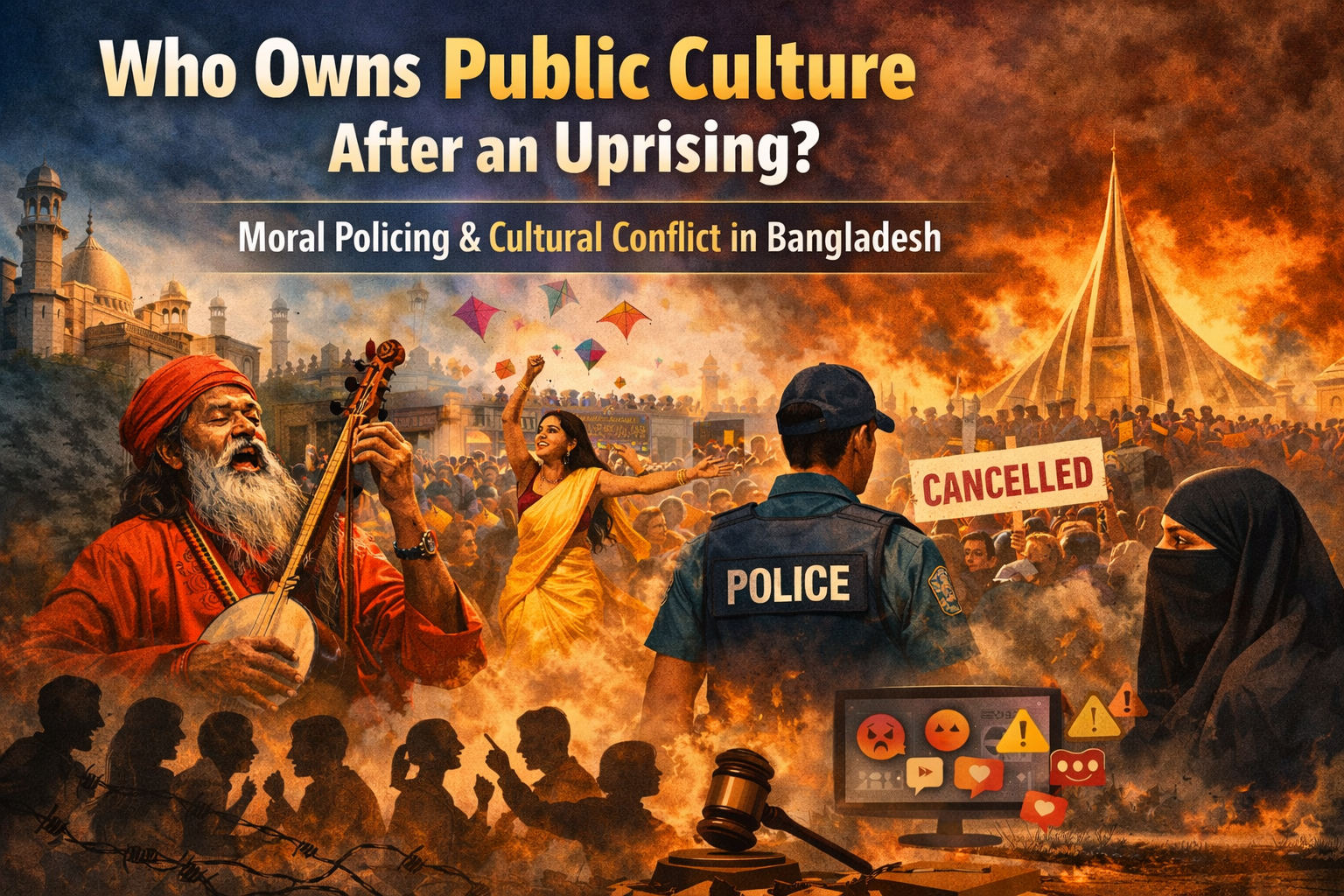
In the aftermath of a mass uprising, Bangladesh’s public debate has undergone a quiet but consequential shift. Political disagreements are no longer argued primarily through institutions, policy, or formal accountability. Instead, they are increasingly fought through culture—music, festivals, clothing, memory, belief, and everyday public practices.
Moral labels circulate faster than arguments. Suspicion replaces disagreement. Cultural events are halted, performers attacked, celebrations restricted, and women’s appearance in public cultural spaces intensely scrutinized. These developments are often dismissed as isolated incidents or framed as a culture war limited to the capital.
Read together, however, they reveal a deeper pattern:
Bangladesh is experiencing a post-uprising cultural contestation in which unresolved political trauma, weakened institutions, and competitive moral projects displace conflict onto culture and public space.
This is not simply repression, nor merely chaos. It is a struggle over who may appear, celebrate, believe, dissent, and belong in public—and under what moral conditions.
1. From political disagreement to moral sorting
Soon after the uprising, political disagreement ceased to be treated as difference and began to be read as moral alignment.
Support increasingly signified virtue.
Critique increasingly signified suspicion.
Once disagreement became ethical rather than political, labels replaced arguments. People were judged less by what they did than by what they were assumed to feel. This moralization narrowed the space for plural debate and rendered ambiguity dangerous.
Politics did not disappear; it relocated—from institutions to bodies, symbols, and everyday life.
2. Purity language as a technology of power
This shift was reinforced by the spread of purity-based vocabulary—terms that do not describe actions, evidence, or responsibility, but degrees of emotional correctness.
Such language functions as a disciplinary technology:
- insufficient anger becomes proof of hidden loyalty,
- hesitation becomes guilt by proximity,
- reflection becomes moral failure.
Rather than producing accountability, purity language produces conformity. It rewards certainty even when certainty rests on fear or rumor, gradually exhausting democratic debate and undermining the moral authority it claims to protect.
3. Culture as a historical political resource
The use of culture as a political instrument is not new. Since independence, political legitimacy in Bangladesh has relied heavily on symbols, rituals, commemorations, and moral storytelling.
Across the political spectrum, actors historically invested in:
- everyday symbols tied to land, livelihood, and survival,
- ritualized remembrance of sacrifice and struggle,
- narratives linking authority to national destiny.
These cultural tools produced emotional belonging, anchoring political identity in lived experience when institutional trust was fragile.
4. From cultural mobilization to cultural governance
Over time, symbolic politics evolved into something more regulatory. Culture was no longer only celebrated; it was increasingly managed.
Political actors and institutions began to:
- frame cultural practices as matters of order and discipline,
- translate moral conflict into administrative language,
- regulate culture indirectly through permissions, advisories, and silence.
This shift allowed power to operate without overt ideological confrontation. Culture could be restricted while appearing neutral.
5. The post-uprising moment: culture as the safest battlefield
After the uprising, direct political action became risky or unavailable. Elections were uncertain, institutions fragile, and public legitimacy unstable. In this environment, culture emerged as the lowest-risk arena.
Across political camps, similar techniques appeared:
- selective memory emphasizing stability or maturity while avoiding responsibility,
- moral positioning that frames one stance as reasonable and others as dangerous,
- informal veto power exercised through local pressure networks,
- administrative depoliticization presenting restriction as governance,
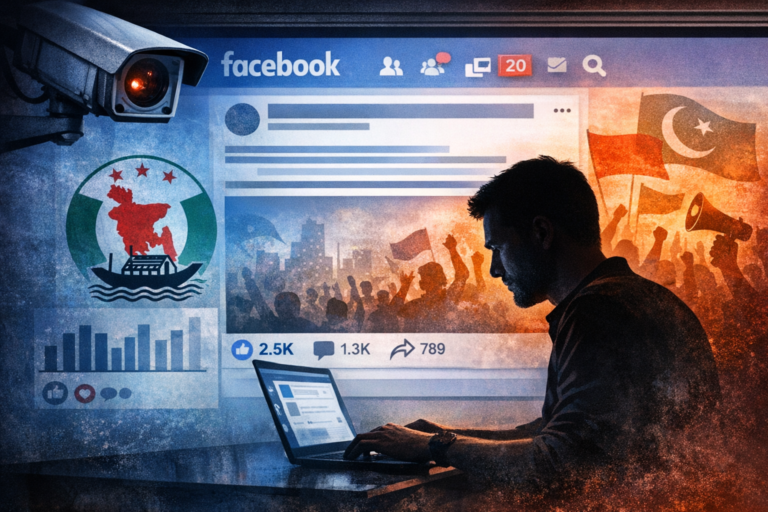
- digital symbolic warfare via outrage and reputational punishment.
No single actor monopolizes these techniques; they form a shared political repertoire in a fragmented post-authoritarian landscape.
6. The state as an uneven actor
The state is present in these conflicts, but unevenly. Its role appears through:
- selective enforcement of permissions and security,
- uneven protection of events and performers,
- informal advice and anticipatory compliance,
- silence that functions as permission.
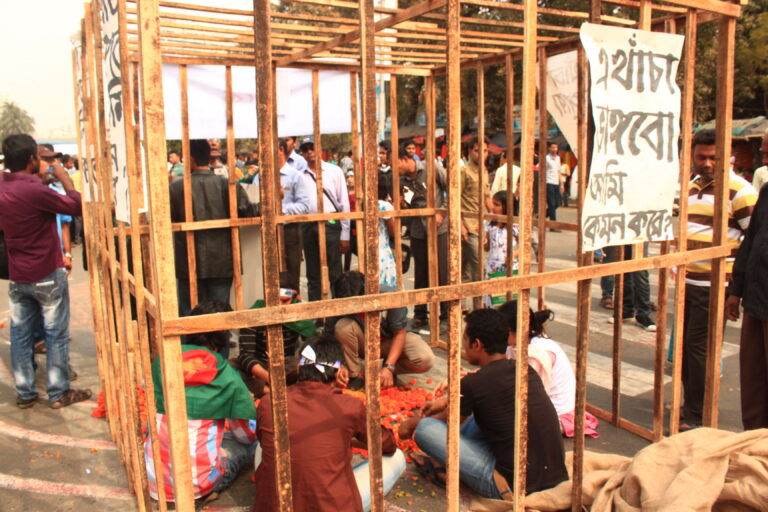
This unevenness teaches cultural actors that safety depends not on rights but on moral acceptability. Over time, self-censorship becomes policy.
7. When conflict moves from institutions to bodies
Unresolved tensions do not remain confined to elite debate. They travel downward, settling on embodied cultural practices.
This is why conflict crystallizes around:
- spiritual performers whose practices resist rigid moral boundaries,
- seasonal festivals involving collective joy and unruly public space,
- women’s dress and visibility in cultural settings.
These are not accidental targets; they are testing grounds for moral authority.
8. The political economy of cultural restriction
Cultural conflict is not only symbolic; it is economic.
When performances are cancelled and festivals restricted:
- performers lose income,
- vendors and event workers lose livelihoods,
- informal cultural economies collapse.
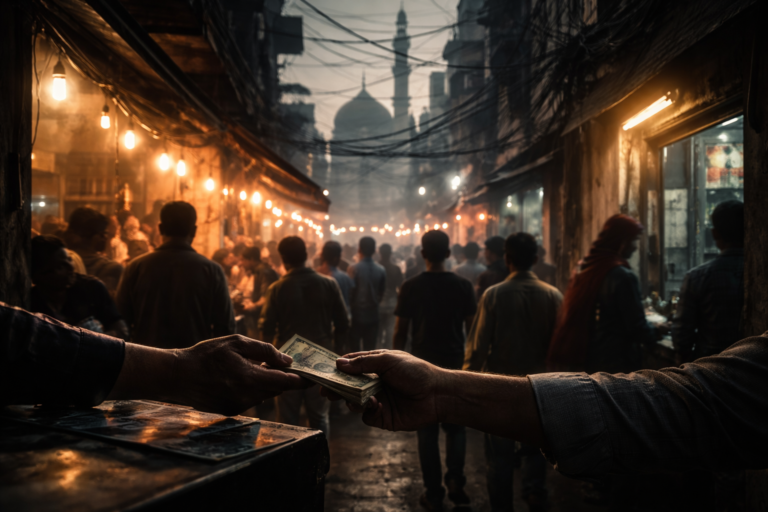
Elite cultural spaces can absorb loss; folk and street-based cultures cannot. Cultural restriction thus functions as class governance, disciplining those most dependent on public culture.
9. Geography of contestation
These dynamics operate across three overlapping zones:
- Urban centers: institutional theater and media amplification
- District towns: committee governance and rapid informal veto
- Digital spaces: moral sorting and reputational punishment
This is not a local anomaly but national diffusion with urban amplification.
10. Trauma and its strategic use
Culture attracts conflict because unresolved trauma seeks safe outlets. When there is no shared reckoning, anger migrates to symbols and fear attaches to difference.
But trauma is not only expressed; it is instrumentalized. Claims of hurt, offense, and disorder become tools for veto and control. Moral injury turns into political currency.
11. Agency of targeted cultural actors
Cultural actors are not passive. They adapt by:
- shifting venues and timing,
- modifying repertoires,
- negotiating protection networks,
- moving performances online,
- forming new solidarities.
These strategies ensure survival but also reshape culture—often toward caution and depoliticization.
12. Beyond religion versus secularism
These conflicts are often reduced to religion versus secularism. This binary obscures the deeper issue: who has the authority to define ethical life in public.
Ambiguity—spiritual, aesthetic, embodied—becomes the threat.
13. The soft exclusion of public life
Although rarely lethal, these dynamics are not harmless. They regulate:
- whose joy is acceptable,
- whose body is safe,
- whose tradition is expendable.
This produces a soft exclusion from public legitimacy, without overt violence.
Conclusion: why this will matter
At the level of emotion, post-uprising Bangladesh resembles a cultural war.
At the level of institutions, it involves negotiation.
Analytically, it is best understood as cultural contestation.
Bangladesh is renegotiating the moral terms of public life after an uprising whose political reckoning remains unfinished.
Until justice, memory, and accountability are addressed institutionally, culture will continue to absorb political failure—and public life will remain fragile.
A Note on Unfinishedness
This analysis does not end with a conclusion because the process it examines is still underway. The contours of cultural authority, moral legitimacy, and public belonging in Bangladesh remain unsettled. What appears here are patterns, tensions, and emerging logics—subject to revision as institutions respond, actors adapt, and new forms of public life take shape.
Any definitive judgment at this stage would risk mistaking movement for outcome.
Author’s Note
This essay was written in a moment of political uncertainty and cultural anxiety, where public debate risks collapsing into moral labeling and suspicion. It does not seek to defend or indict any individual, group, or political formation. Instead, it aims to understand how culture becomes a site of conflict when political accountability is unresolved.
The analysis draws on social theory, critical reading of news coverage, and observable patterns in public life. Specific names have been avoided deliberately to prevent personalization, scapegoating, or misinterpretation. The focus is on mechanisms, not personalities; on structures, not rumors.
This text should be read as an invitation to think more carefully about culture—not as a weapon, but as a shared public space that becomes fragile when institutions fail to carry the weight of justice, memory, and responsibility.
References
Alexander, J. C. (2012). Trauma: A social theory. Polity Press.
Arendt, H. (1963). On revolution. Viking Press.
Asad, T. (2003). Formations of the secular: Christianity, Islam, modernity. Stanford University Press.
Bourdieu, P. (1991). Language and symbolic power (J. B. Thompson, Ed.; G. Raymond & M. Adamson, Trans.). Harvard University Press.
Dhaka Tribune. (2024). 3-day ban on fireworks, lanterns, and cultural events in Dhaka. https://www.dhakatribune.com/
Gramsci, A. (1971). Selections from the prison notebooks (Q. Hoare & G. Nowell Smith, Eds. & Trans.). International Publishers.
Mbembe, A. (2003). Necropolitics. Public Culture, 15(1), 11–40. https://doi.org/10.1215/08992363-15-1-11
ResearchGate. (2023). Political culture of Bangladesh: Dynamics, challenges and democratic aspirations. https://www.researchgate.net/
Reuters. (2025). Bangladesh police use tear gas to disperse Islamist march in Dhaka. https://www.reuters.com/
The Business Standard. (2024). Who are opposing Sakrain? https://www.tbsnews.net/
The Business Standard. (2024). Old battle, new front: Attack on Bauls signals larger struggle over power and pluralism. https://www.tbsnews.net/
The Daily Star. (2024). Attack on Bauls a heinous act. https://www.thedailystar.net/
The Daily Star. (2025). Bangladesh Bank dress code suggestion sparks backlash. https://www.thedailystar.net/