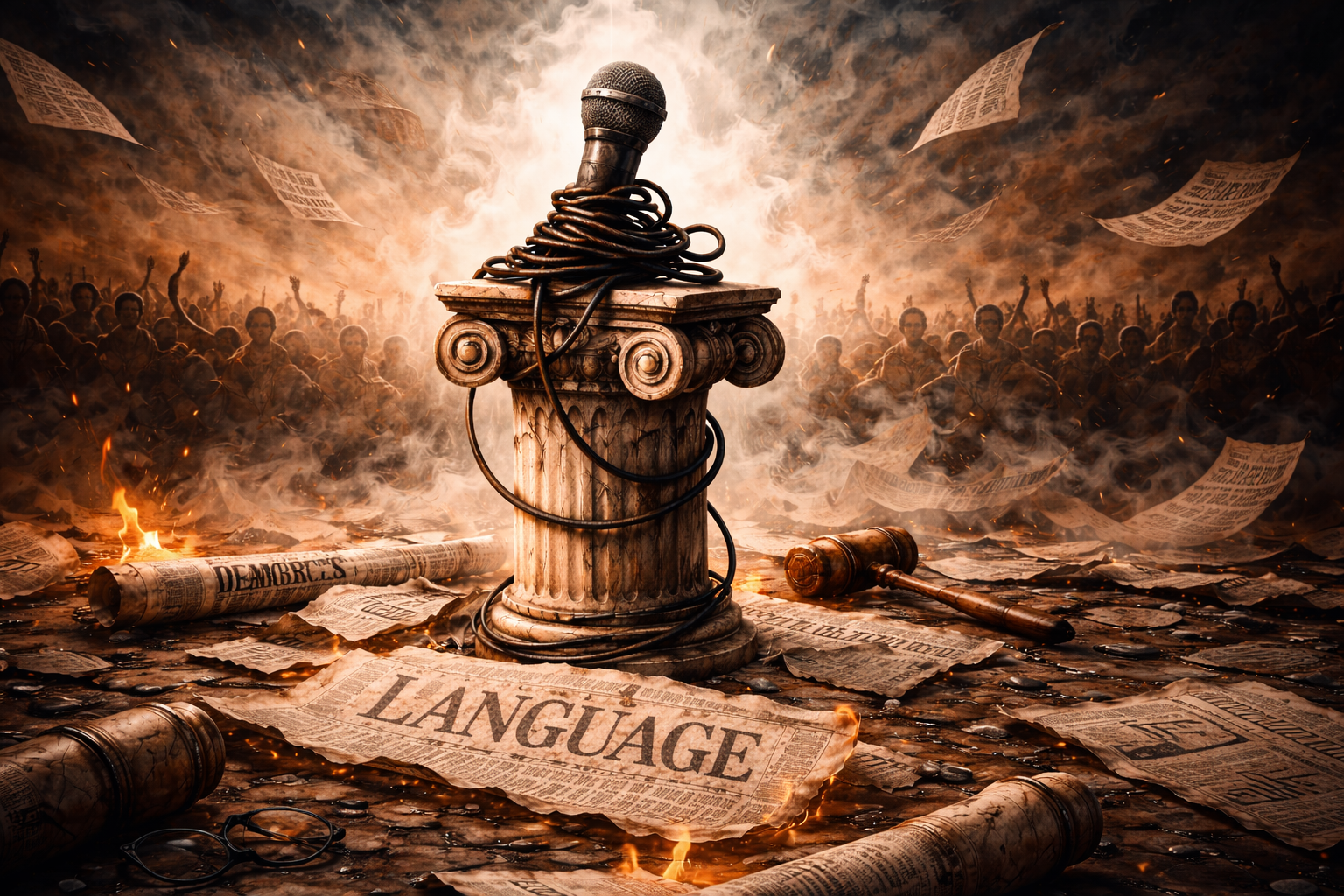
When Politics Loses Its Grammar
Moral Language, Platform Power, and the Crisis of Democratic Speech
A long-form critical essay on moral language, social media, global populism, Gaza, and the erosion of democratic political grammar in Bangladesh and beyond.
Introduction: Language as Political Infrastructure
Political crises are often explained through institutions: elections without credibility, weakened courts, compromised media, or authoritarian consolidation. At other times, they are framed ideologically—as conflicts between secularism and religion, liberalism and conservatism, left and right. While such explanations are not incorrect, they frequently overlook a deeper and more enduring transformation: the reorganization of political language itself.
Language is not merely a vehicle for political expression; it is the infrastructure that determines what can be said, who can speak, and what forms of disagreement remain intelligible. When the grammar of political speech changes, political outcomes tend to follow—even when formal actors and alliances appear to shift.
This essay is grounded in long-term ethnographic observation of public discourse, protest language, cultural production, and digital communication across more than a decade. Rather than responding to a single event or controversy, it traces a slow but decisive transformation: the delegitimation of liberal-democratic political grammar without the reconstruction of a viable democratic alternative. In the space created by this collapse, a moral-vernacular mode of politics has emerged—one that transforms critique into authority, authenticity into legitimacy, and moral conviction into a substitute for democratic mediation.
Any critique of moral certainty must remain alert to its own risks. The aim here is not to replace one authoritative language with another, but to understand how political speech itself has been reshaped under conditions of prolonged crisis.
I. The Delegitimation of Liberal Grammar
The erosion of liberal-democratic language did not occur primarily through intellectual debate. It emerged through lived experience. Elections that failed to inspire confidence, shrinking civic space, selective application of law, and the routinization of repression gradually hollowed out the credibility of institutional speech.
Over time, concepts such as rights, rule of law, pluralism, and civil society began to feel procedural, distant, or selectively deployed. These terms circulated fluently in policy spaces and elite commentary, but increasingly failed to resonate with everyday experiences of injustice, insecurity, and exclusion.
This delegitimation was not only symbolic; it was materially grounded. Economic precarity deepened, youth unemployment persisted, and social mobility narrowed. The promises embedded in institutional language no longer mapped onto lived life chances. Procedural assurances felt disconnected from structural vulnerability.
Critique of this failure was justified. Yet the dominant response was not reconstruction but rejection. Liberal grammar was treated not as historically compromised but as inherently deceptive—elitist, foreign, or morally hollow. The distinction between institutional failure and conceptual necessity collapsed.
What followed was not political silence, but linguistic displacement. People continued to speak politically, but no longer trusted institutional vocabularies to carry meaning or resolve conflict.
II. Why Democracy and Liberalism Now Appear Dated—or Anti-People
A decisive shift in contemporary political perception is that democracy and liberalism no longer merely appear insufficient; they increasingly appear out of time, and in some contexts actively anti-people.
This perception does not emerge from ignorance. It emerges from repeated encounters with contradiction. Liberal democratic states have spoken the language of human rights while enabling mass suffering, defended procedural legality while suspending moral accountability, and invoked freedom selectively along geopolitical lines.
As a result, democracy comes to be experienced less as collective self-rule and more as managed hypocrisy. Liberalism appears not as a promise of dignity, but as a grammar of postponement—capable of endless discussion yet incapable of decisive moral action.
In postcolonial and semi-authoritarian contexts, this perception is intensified. Democratic language often arrives already mediated through NGOs, donors, and international institutions whose authority appears externally anchored rather than socially rooted. Liberalism thus feels less like empowerment and more like regulation without responsibility.
Under such conditions, moral-vernacular politics presents itself as urgency, courage, and truth—while democratic procedure is reframed as delay, evasion, or betrayal.
III. Moral-Vernacular Politics: What Replaced Liberal Grammar
Political language does not remain empty for long. In the absence of credible institutional grammar, a different mode of political speech gained prominence: moral-vernacular politics.
This is not an ideology or a coherent doctrine. It is a form of political language characterized by recurring features:
- legitimacy derived from moral positioning rather than procedure
- authority claimed through authenticity, suffering, or proximity to “the people”
- suspicion of mediation, compromise, and institutional process
- preference for affective expression over argument
- binary moral framing that collapses complexity into virtue and betrayal
In this mode, political claims are not presented as contestable propositions but as moral truths. Disagreement appears not as a democratic condition but as evidence of bad faith.
Religious idioms have proven particularly effective carriers of this grammar, but the phenomenon is not theological. The deeper shift is the replacement of democratic mediation with moral sovereignty.
IV. From Critique to Moral Certainty
One of the most consequential transformations observable over time is the reconfiguration of critique itself.
Traditionally, critique functioned as a method: unsettling assumptions, exposing contradictions, and opening space for alternative futures. It demanded reflexivity, slowness, and a tolerance for uncertainty.
In contemporary discourse, critique increasingly functions as a position of authority. Exposure replaces explanation; denunciation replaces argument. The act of critique becomes self-legitimating.
Once critique becomes a position rather than a method, it no longer subjects itself to scrutiny. Disagreement is framed not as dissent, but as complicity. Critique ceases to destabilize power and begins to reproduce power in moral form.
V. Authenticity, Anti-Institutional Intimacy, and Political Authority
At the center of moral-vernacular politics lies the elevation of authenticity as legitimacy. Authenticity becomes an existential claim: some voices are inherently more valid because they speak from suffering or proximity to “real life.”
This produces anti-institutional intimacy—a preference for direct moral connection over mediated political processes. Institutions appear cold and morally suspect; intimate speech feels truthful and sovereign.
Experience is indispensable for understanding injustice, but it cannot adjudicate competing claims. When authenticity becomes sovereign, mediation appears as betrayal and institutions as obstacles rather than safeguards.
Democracy, however, exists precisely because experiences conflict and power must be constrained through procedure.
VI. A Situated Map: The Bangladeshi Linguistic Turn
In Bangladesh, these transformations have taken a particularly dense and accelerated form.
Following prolonged political crisis, institutional language lost credibility as a site of moral resolution. Courts, parliament, and media continued to function, but no longer commanded trust. Political speech migrated to streets, cultural spaces, and digital platforms.
Public discourse increasingly relied on moral keywords that condensed history, suffering, and judgment into single utterances. These circulated through protests, poetry, and online commentary as signals of moral alignment rather than analytical concepts.
A distinctive feature of the Bangladeshi case is the emergence of dual linguistic registers:
- moderated, liberal vocabulary in elite or protected spaces
- aggressive moral-vernacular language in mass public arenas
This is not merely hypocrisy. It is a functional division between legitimacy and mobilization.
Generationally, younger participants encounter politics primarily through slogans, moral narratives, and affective alignment rather than institutional histories or procedural literacy. Engagement is high, but structured around moral certainty rather than democratic practice.
VII. Global Right-Wing Populism and the Transnational Moral Turn
These dynamics unfold within a broader global conjuncture marked by the rise of right-wing populism in the United States, India, Europe, and beyond.
Across these contexts, shared patterns emerge:
- delegitimation of liberal institutions as elite and corrupt
- elevation of “the people” as a morally unified subject
- suspicion of expertise and pluralism
- politics framed as authenticity versus deception
Through digital platforms, these rhetorical styles travel rapidly. Bangladesh absorbs them not mechanically, but through resonance—as part of a transnational archive of moralized political language that normalizes moral sovereignty over institutional accountability.
VIII. Gaza, Global Panic, and the Collapse of Liberal Moral Authority
Few events have accelerated the crisis of liberal legitimacy as profoundly as the ongoing violence in Gaza and Palestine.
For large audiences—particularly in the Global South—this moment crystallized a long-standing realization: liberal democratic states apply moral principles selectively. Appeals to human rights and international law appear endlessly flexible when power is at stake.
The result is not only outrage but epistemic rupture. Liberalism no longer sounds merely hypocritical; it sounds structurally dishonest.
In the Global North, this rupture has produced panic. Protest is securitized, dissent is monitored, and solidarity is policed for ideological contamination. Moral uncertainty is managed through fear rather than reckoning.
Global solidarity fractures. The North retreats into securitization; the South retreats into moral certainty. Each move confirms the other.
IX. Platform Power: Facebook, YouTube, and the Mediated Intellectual
Digital platforms do not merely amplify political speech; they reorganize political authority.
Facebook privileges immediacy, visibility, and affective clarity. Political speech becomes moral signaling. A new figure emerges: the platform-mediated intellectual, whose authority rests on frequency, certainty, and audience resonance rather than sustained reasoning.
YouTube operates differently. It rewards duration, repetition, and narrative immersion. Long monologues replace dialogic reasoning. Moral confidence is mistaken for knowledge; repetition produces the illusion of depth.
For audiences with limited access to formal political education, platforms become primary sites of political pedagogy. Conviction substitutes for understanding.
The problem is not digital democratization. It is the collapse of norms that once distinguished argument from assertion, critique from certainty, and influence from authority.
X. Gender as the Site of Moral Enforcement
Moral-vernacular politics rarely remains abstract. Its most consistent site of enforcement is the gendered body.
Authenticity, purity, and betrayal are policed through women’s visibility, speech, sexuality, and presence. Moral language acquires force by becoming enforceable, and gender provides the terrain where enforcement becomes legible.
This is structural, not incidental. Moral sovereignty requires discipline, and gender becomes its most reliable medium.
XI. Aesthetic Intensity and the Authority of Affect
Political language increasingly takes aesthetic form—poetry, slogans, chants, symbolic gestures. These forms mobilize grief and resistance powerfully.
The danger arises when aesthetic intensity substitutes for political articulation. When affect becomes the primary criterion of legitimacy, disagreement loses its grammar. Politics becomes something to be felt rather than worked through.
XII. What Is Lost: Democratic Speech and Shared Vulnerability
The deepest loss in this transformation is democratic speech itself.
Democratic speech is slow, procedural, and unsatisfying. It requires disagreement without moral expulsion and vulnerability without securitization.
Moral-vernacular politics, reinforced by global panic, cannot tolerate this. It demands certainty where uncertainty is unavoidable and purity where compromise is necessary.
Conclusion: Relearning Political Grammar
This essay has argued that the contemporary crisis is not only institutional or ideological, but grammatical.
Moral-vernacular politics emerges from real suffering and real betrayal, but without a renewed democratic grammar it risks reproducing the authoritarian effects it claims to resist.
Relearning political grammar requires resisting both moral absolutism and securitized panic. It requires rebuilding a language capable of holding conviction without sovereignty, solidarity without purity, and disagreement without fear.
In an age where panic travels faster than thought, this may be the hardest—and most necessary—political task of our time.
Author’s Note
This essay emerges from long-term ethnographic observation rather than immediate political reaction. It draws on years of engagement with public discourse, protest language, cultural production, and digital political communication across Bangladesh and beyond. Rather than naming individuals or responding to specific controversies, the essay seeks to understand a deeper transformation: how political language itself has been reshaped under conditions of prolonged institutional crisis, global moral fracture, and platform-mediated communication.
The arguments presented here are not intended as a defense of existing liberal institutions, nor as a dismissal of moral anger or resistance. They are offered as an attempt to think carefully about what becomes possible—and what is lost—when democratic grammar collapses without being reconstructed. Any errors of interpretation remain mine alone, and the analysis is offered in the spirit of inquiry rather than verdict.
— Moiyen Zalal Chowdhury
Reference
Core Theory & Political Language
Arendt, H. (1963). On revolution. Viking Press.
Asad, T. (2003). Formations of the secular: Christianity, Islam, modernity. Stanford University Press.
Bourdieu, P. (1991). Language and symbolic power. Harvard University Press.
Butler, J. (2005). Giving an account of oneself. Fordham University Press.
Foucault, M. (1980). Power/knowledge: Selected interviews and other writings. Pantheon.
Habermas, J. (1996). Between facts and norms: Contributions to a discourse theory of law and democracy. MIT Press.
Mouffe, C. (2005). On the political. Routledge.
Taylor, C. (1994). The politics of recognition. Princeton University Press.
Populism, Democracy, and Moral Politics
Brown, W. (2015). Undoing the demos: Neoliberalism’s stealth revolution. Zone Books.
Fraser, N. (2019). The old is dying and the new cannot be born. Verso.
Judis, J. B. (2016). The populist explosion. Columbia Global Reports.
Moffitt, B. (2016). The global rise of populism. Stanford University Press.
Digital Media, Platforms, and Authority
Couldry, N., & Mejias, U. A. (2019). The costs of connection: How data is colonizing human life. Stanford University Press.
Zuboff, S. (2019). The age of surveillance capitalism. PublicAffairs.
Tufekci, Z. (2017). Twitter and tear gas: The power and fragility of networked protest. Yale University Press.
Vaidhyanathan, S. (2018). Antisocial media: How Facebook disconnects us and undermines democracy. Oxford University Press.
Global South, Islam, and Moral Authority
Bayat, A. (2017). Revolution without revolutionaries. Stanford University Press.
Mahmood, S. (2005). Politics of piety. Princeton University Press.
Roy, O. (2004). Globalized Islam. Columbia University Press.
Solidarity, Violence, and Global Moral Fracture
Mbembe, A. (2019). Necropolitics. Duke University Press.
Butler, J. (2009). Frames of war: When is life grievable? Verso.
Puar, J. K. (2017). The right to maim. Duke University Press.