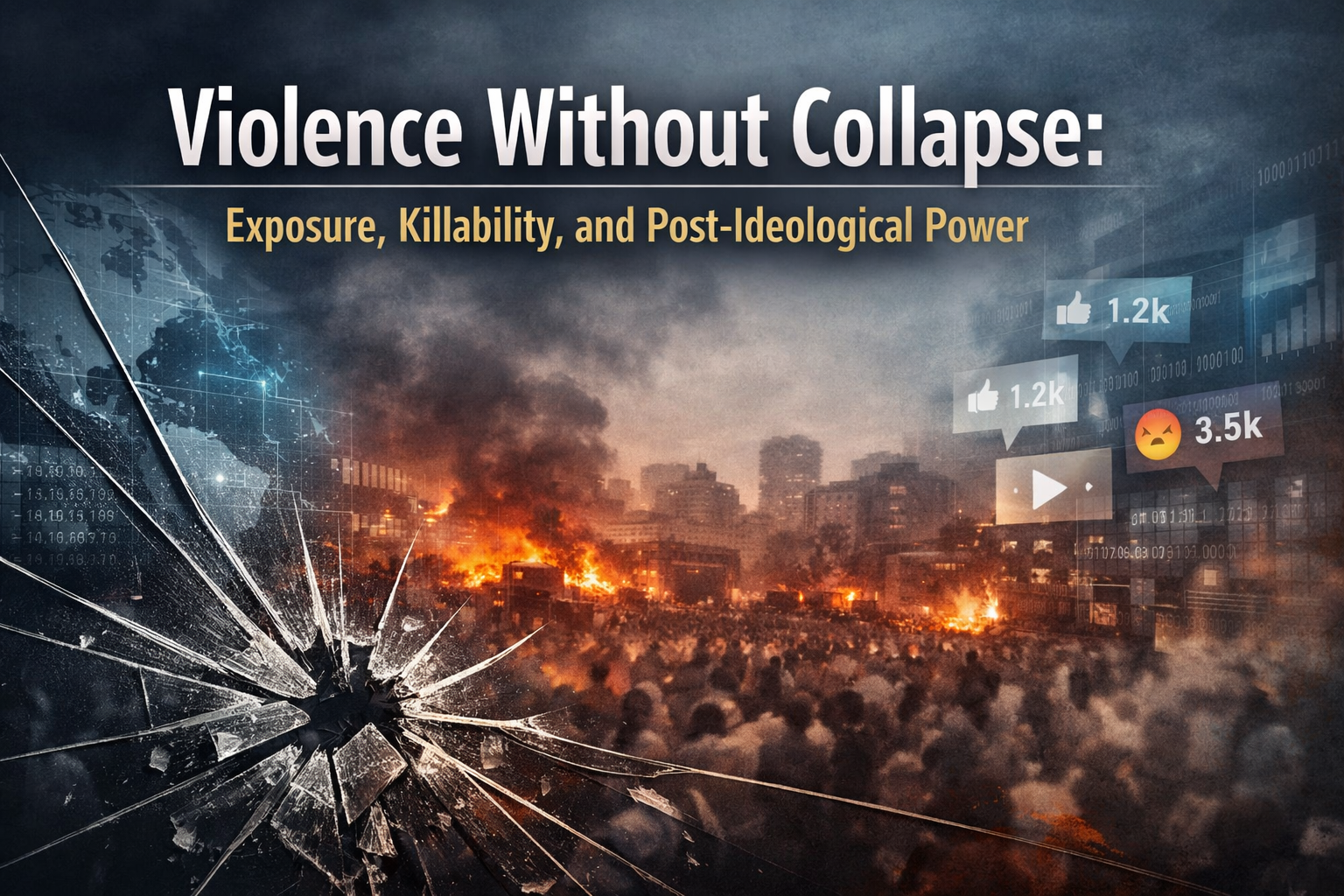
Violence Without Collapse: Exposure, Killability, and Post-Ideological Power(PINPF v1.1)
Exposure, Digital Killability, and Post-Ideological Power in Bangladesh
(PINPF v1.1)
Why extensive documentation of violence no longer guarantees accountability. An analytical framework (PINPF) examining exposure, digital killability, and power in Bangladesh.
(Applying the Post-Ideological Neoliberal Power Framework — PINPF)
This essay is part of the “Without Collapse” analytical series, developing the Post-Ideological Neoliberal Power Framework (PINPF).
Introduction
Violence has long been understood as a political liability. When state or organized violence becomes visible—through leaks, documentation, human-rights reporting, or investigative journalism—it is expected to undermine legitimacy, generate accountability, and force institutional change. In this view, exposure functions as a corrective: violence revealed is violence delegitimized.
Yet contemporary political realities increasingly contradict this assumption. Across diverse regimes, violence is now extensively documented without producing structural collapse. Archives expand, evidence accumulates, and international scrutiny intensifies, but power persists. Rather than delegitimization, exposure often produces turbulence followed by re-stabilization. Violence is condemned, investigated, and narrated—yet rarely resolved.
The political violence surrounding Bangladesh’s pre-July repression, the July–August 2024 rupture, and the post-July diffusion of mob and communal violence offers a particularly clear lens into this transformation. These phases involve distinct forms of violence—disciplinary, rupture-driven, and diffused—yet converge in a shared outcome: accountability fails to consolidate.
This pattern cannot be explained by brutality, scale, or visibility alone. Instead, it reflects a transformation in how power responds to violence after it has occurred. Drawing on United Nations documentation, international human-rights reporting, and domestic monitoring, this essay applies the Post-Ideological Neoliberal Power Framework (PINPF) to explain why violence today can be widely exposed without producing institutional collapse.
PINPF does not explain why violence occurs, nor does it equate different forms of harm. It explains how contemporary power absorbs violence after exposure—by diffusing responsibility, proceduralizing accountability, and allowing violence to fragment into deniable forms. In this sense, Bangladesh’s recent trajectory is not exceptional; it is diagnostic.
From Exposure to Absorption: Theoretical Grounding
Classical liberal models of accountability assume a linear sequence: exposure → outrage → reform. Transparency is imagined as corrosive to illegitimate power. However, critical theory has long questioned this logic.
Zygmunt Bauman’s concept of liquid modernity describes a political condition in which responsibility and authority become mobile rather than fixed (Bauman, 2000). Jean Baudrillard’s theory of simulation warns that representation can substitute for transformation, producing the appearance of accountability without structural change (Baudrillard, 1994). Slavoj Žižek argues that contemporary power increasingly operates after ideology, relying less on belief than on procedural normalization (Žižek, 1989). David Harvey situates these shifts within neoliberal governance, where institutions prioritize flexibility and crisis management over moral coherence (Harvey, 2005).
In postcolonial contexts, Achille Mbembe (2001) and Jean and John Comaroff (2006) show how violence, legality, and disorder coexist within governance systems that normalize exceptional harm. Zeynep Tufekci (2017) demonstrates how digital visibility can amplify protest while simultaneously weakening long-term political leverage.
Together, these perspectives point toward a contemporary paradox: violence is increasingly visible, yet power increasingly survives it.
The Post-Ideological Neoliberal Power Framework (PINPF)
PINPF begins from the observation that contemporary power no longer depends primarily on ideological coherence or moral legitimacy. Instead, it persists through operational mechanisms that manage exposure rather than prevent it.
The framework identifies six recurring mechanisms:
- Responsibility Diffusion – Accountability is dispersed across individuals, institutions, procedures, and time.
- Sacrificial Containment – Selective punishment stabilizes the larger structure.
- Narrative Displacement – Attention shifts from harm to authorship, intent, or provocation.
- Proceduralization – Investigations absorb exposure without resolution.
- Platform Mediation – Algorithmic systems shape visibility, mobilisation, and exhaustion.
- Coalition Liquidity – Ideological boundaries soften to preserve power alignments despite reputational damage.
PINPF does not claim that exposure is futile. It explains why exposure increasingly produces instability without transformation.
This analysis draws on publicly available documentation from United Nations bodies, international human-rights organizations, and domestic monitoring institutions. Rather than cataloguing individual incidents exhaustively, it synthesizes recurring patterns of violence, visibility, and accountability across three temporal phases: pre-July, July–August, and post-July. The aim is diagnostic rather than adjudicative.
Violence Across Phases: An Analytical Overview
| Phase | Dominant Form of Violence | Primary Actors | Visibility | Accountability Outcome | Dominant PINPF Mechanisms |
|---|---|---|---|---|---|
| Pre-July | Managed repression, custodial abuse | State agencies | Low–Medium | Rare, delayed | Diffusion, proceduralization |
| July–August | Lethal force, mass arrests | Security forces | Very high | Investigations without reform | Diffusion, sacrificial containment |
| Post-July | Mob, communal, retaliatory violence | Unidentified actors | Uneven | Responsibility unsettled | Narrative displacement, diffusion |
Pre-July: Managed Violence and Containment
Before July 2024, political violence largely followed a disciplinary logic. Human-rights organizations documented targeted repression, custodial deaths, enforced disappearances, and intimidation embedded within legal denial and bureaucratic delay. Visibility was limited, accountability rarely concentrated, and exposure—when it occurred—was absorbed through inquiries or administrative procedures.
Power during this phase still operated under the assumption that violence could contain dissent without provoking rupture.
July–August 2024: Rupture Violence and Archival Shock
July–August marked a qualitative break. Student-led protests escalated into mass mobilization, followed by a violent crackdown involving lethal force, mass arrests, allegations of torture, and digital restrictions. UN Special Rapporteurs, the OHCHR Fact-Finding Mission, and international media documented events in real time. Internet shutdowns were identified as part of the coercive environment.
Yet despite this archival density, accountability remained structurally elusive. Investigations multiplied, responsibility dispersed across agencies, and no comprehensive institutional reform followed. Exposure produced moral shock, but power survived through procedural absorption and diffusion.
Post-July: Diffused and Outsourced Violence
After July, violence did not disappear—it changed form. Reports documented a surge in mob violence, revenge attacks, communal assaults on minorities, and localized coercion. Unlike state repression, this violence was fragmented and horizontally organized. Perpetrators were often unidentified; accountability rarely materialized. Media narratives reframed incidents as spontaneous retaliation or law-and-order failures.
PINPF explains this shift as a movement from centralized repression to diffused coercion. Power no longer needed to directly enforce order; it survived by allowing responsibility to remain unsettled. Violence became politically useful not because it restored authority, but because it exhausted accountability.
Violence, however, is not new to Bangladesh. Political repression, custodial abuse, and episodic communal attacks have long marked the country’s post-independence history. What appears to be changing is not the existence of violence, but its social distribution and normalization. Prolonged authoritarian governance, repeated cycles of impunity, and the routinization of coercion have reshaped everyday political culture. Violence increasingly migrates from the state–citizen axis into citizen–citizen relations, manifesting as mob assaults, communal targeting, moral policing, and retaliatory harm.
In this context, violence becomes less exceptional and more relational: a mode of interaction rather than a discrete political act. The erosion of institutional trust and accountability does not merely leave violence unchecked; it teaches society how to be violent. PINPF helps explain this transition by showing how sustained exposure without consequence recalibrates social expectations. When violence is repeatedly documented but rarely resolved, coercion loses its shock value and acquires a tragic normality—reproduced not only by the state, but within society itself.
Digital Coercion, Platform Mediation, and the Production of Killability
Across all phases, digital infrastructure shaped violence and its interpretation. Internet shutdowns, platform moderation, and algorithmic visibility determined what could be seen, organized, and remembered. Visibility alone did not empower accountability; instead, it often fragmented attention and accelerated exhaustion. But digital space in Bangladesh has repeatedly operated as an operational pipeline through which accusation is converted into mobilisation, and mobilisation into attack—often faster than institutions can respond.
One axis of this pipeline is coercive restriction. During July 2024, nationwide shutdowns severed access to information, emergency coordination, and documentation while enabling tighter narrative control. In PINPF terms, shutdowns reshape the evidentiary field and reinforce responsibility diffusion.
The second axis is platform-driven mobilisation. Recurrent episodes show how manipulated online content—often framed as religious offence—circulates rapidly and triggers offline violence. Across incidents in Ramu (2012), Nasirnagar (2016), Rangpur (2017), Bhola (2019), and during the 2021 Durga Puja violence, a recurring sequence appears: provocation, amplification, crowd formation, attack, and post-hoc responsibility displacement.
This is where the concept of killability becomes analytically precise. Digital circulation produces killability not only by spreading hate, but by generating a felt legitimacy for immediate punitive action. Drawing on Judith Butler’s work on grievability, certain lives are framed as less worthy of protection or mourning, lowering the threshold for violence. Digital space manufactures imminence—the sense that action must occur now, outside institutions.
PINPF clarifies why this yields turbulence without collapse. Narrative displacement shifts attention from harm to authorship. Platform mediation amplifies outrage faster than verification. Proceduralization absorbs attention through inquiries without reform. Digital space thus becomes central to post-exposure governance: enabling evidence production while neutralizing consequence.
What PINPF Explains—and Its Limits
PINPF does not claim that exposure invariably fails. Where responsibility is clearly attributable, institutions are capable, and coalitions sustain pressure, exposure can produce change. The framework instead identifies conditions under which exposure is systematically absorbed rather than translated into structural transformation.
This analysis does not diminish the gravity of violence, nor does it equate distinct harms. It argues that without confronting how power absorbs exposure, accountability demands risk repeated neutralization—even amid extensive documentation.
Conclusion
Bangladesh’s trajectory—from managed repression, through rupture violence, to diffused post-rupture coercion—reveals a broader transformation in how power operates. Exposure no longer guarantees collapse. Instead, it becomes another condition to be managed.
The contribution of this essay lies not in documenting violence—already extensively recorded—but in showing why documentation itself has ceased to be politically transformative. By tracing how exposure is absorbed rather than resisted, the analysis shifts attention from revelation to the contemporary architecture of power.
Similar dynamics can be observed across regime types, suggesting that the problem is not ideology alone, but the post-ideological organization of authority itself.
References
Access Now. (2024). #KeepItOn: Bangladesh’s government must restore internet access during student protests.
Al Jazeera. (2012). How Facebook posts sparked Bangladeshi anger.
Amnesty International. (2022). The social atrocity: Meta and the right to remedy.
Amnesty International. (2024). Bangladesh: Unlawful use of force against protesters.
Association for Progressive Communications (APC). (n.d.). Hate content in Bangladesh’s online environment.
Baudrillard, J. (1994). Simulacra and simulation.
Bauman, Z. (2000). Liquid modernity.
Butler, J. (2004). Precarious life.
Butler, J. (2009). Frames of war.
Comaroff, J., & Comaroff, J. L. (2006). Law and disorder in the postcolony.
Harvey, D. (2005). A brief history of neoliberalism.
Human Rights Watch. (2024). Bangladesh: Security forces target protesters.
Mbembe, A. (2001). On the postcolony.
NetBlocks. (2024). Bangladesh internet disruption reports.
OHCHR. (2025). Fact-finding report on July–August 2024 protests in Bangladesh.
Reuters. (2024). Bangladesh shuts internet amid protests.
Tufekci, Z. (2017). Twitter and tear gas.
Žižek, S. (1989). The sublime object of ideology.