Universities After July:
Mob Power, Student Authority, and the Targeting of Critical Thought in Bangladesh
“The July uprising refers to the nationwide student-led protests and political upheaval that reshaped Bangladesh’s public life in mid-2024.”
Introduction: When Power Changes Form but Not Logic
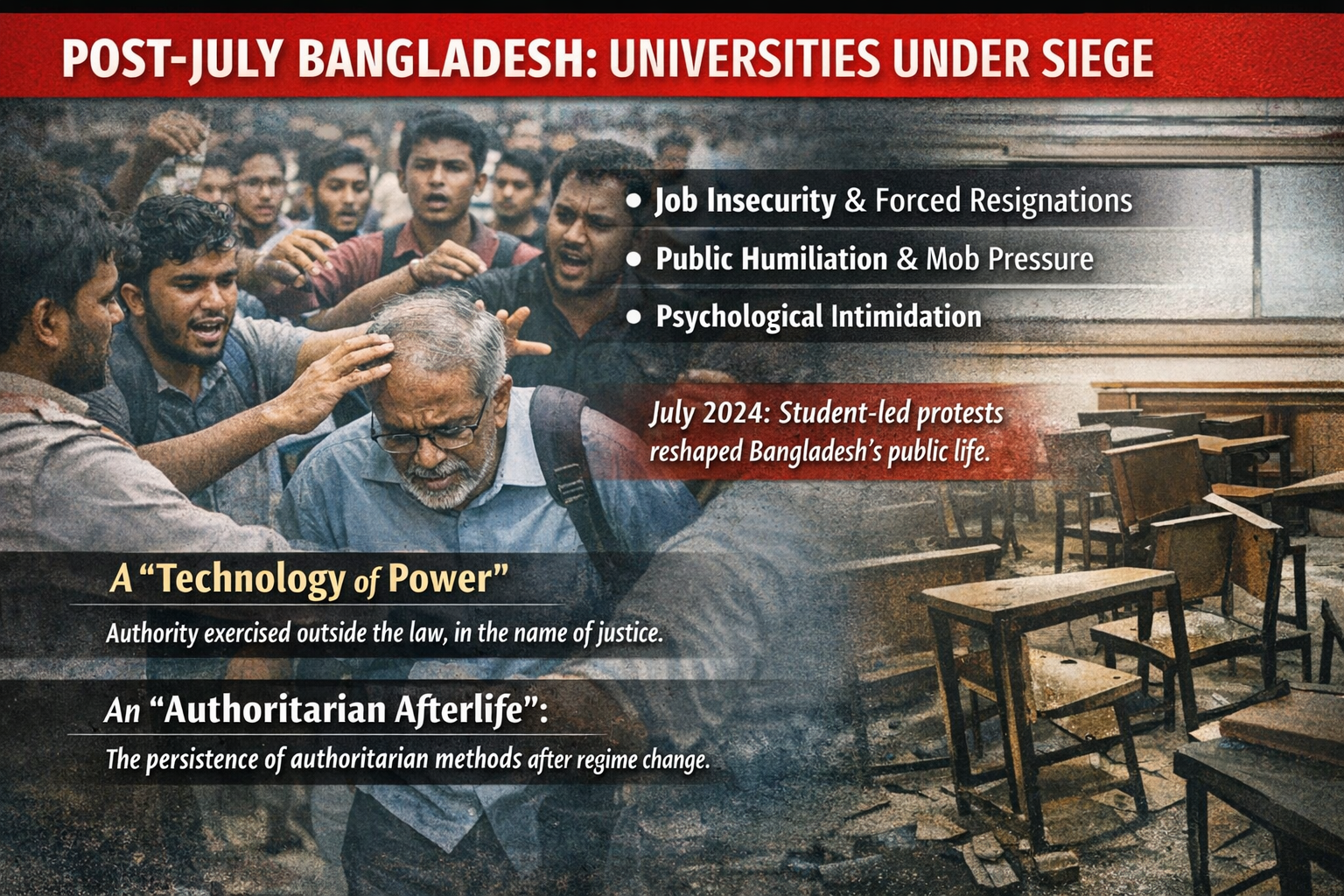
In post-July Bangladesh, universities have emerged as some of the most fragile institutional spaces. Across both public and private campuses, teachers now face converging risks: job insecurity, physical vulnerability, psychological intimidation, and reputational destruction. Since August 2024, credible national reporting has documented a sharp rise in forced resignations, public humiliation, and mob-driven pressure against teachers and administrators.
The July uprising refers to the nationwide student-led protests and political upheaval that reshaped Bangladesh’s public life in mid-2024.
This essay argues that these developments are not merely excesses of a revolutionary moment. They are better understood as a technology of power—a set of techniques through which authority is exercised outside formal legal frameworks, often in the name of justice, and frequently through students themselves.
What we are witnessing is an authoritarian afterlife: the persistence of authoritarian methods after an authoritarian regime has formally receded.
“Silence in the face of institutional harassment does not indicate stability; it signals fear.”
— University Teachers’ Network, January 19
Update (January 2026):
Since this essay was first drafted, the University Teachers’ Network has issued a formal statement documenting procedural violations and institutional failures in the UAP case. This update reinforces the broader argument about post-July governance, academic insecurity, and the authoritarian afterlife in Bangladesh’s universities.
What Is Documented: The Post-July Pattern
Following the July–August upheavals, national media reported that more than 150 teachers and education officials across schools, colleges, and universities were forced to resign or removed under pressure. In many cases, resignations occurred without formal disciplinary procedures, accompanied instead by intimidation or public shaming. Separate documentation by minority rights organisations identified at least 49 minority teachers affected in similar ways, with some later reinstated—indicating procedural irregularities rather than completed investigations.
These figures are aggregated from verified media reporting, not from a central government database. The real number is likely higher, as many exits occur silently through resignation, transfer, or non-renewal.
Technology of Power: From Due Process to Moral Force
Power does not operate only through the state or the law. As Discipline and Punish demonstrates, modern power often works through discipline, normalization, and punishment, exercised socially rather than legally.
Post-July campus dynamics reveal a recognizable technology of power:
- Moral accusation replaces legal charge
- Crowds replace courts
- Humiliation replaces investigation
- Resignation replaces verdict
This is not disorder. It is ordered coercion—a system of punishment that functions precisely because it avoids institutional accountability.
Students as Moral Agents—and as Instruments of Power
Students were central to the July uprising. Their legitimacy was earned through courage, resistance, and sacrifice. Yet legitimacy can be transformed into disciplinary authority when institutions weaken.
Across several post-July incidents, students acted not only as protesters but as enforcers:
- Surrounding offices
- Issuing ultimatums
- Demanding resignations
- Amplifying accusations through social media
This does not mean students are inherently authoritarian. Rather, it shows how youth moral authority can be instrumentalised when protest transitions into governance without procedural safeguards.
Historically, moments of upheaval often convert youth into moral shock forces—actors able to bypass institutional restraint (Traverso, 2019).
How Students Themselves Can Be Manipulated
(Analytical interpretation)
It is essential to recognise that students are not only actors but also subjects of power.
Several mechanisms are visible:
- Moral simplification
Complex institutional questions are reduced to binary narratives: collaborator or enemy, traitor or people. - Information asymmetry
Allegations circulate without access to evidence, records, or procedural context. - Delegated risk
Institutional actors remain invisible, while students bear the public burden of confrontation. - Symbolic reward
Participation in punitive actions is framed as civic virtue or revolutionary duty.
Political theorists describe this dynamic as populist punitive governance—punishment enacted “by the people,” while responsibility is diffused upward (Stanley, 2018).
In such conditions, students are encouraged to act as instruments of discipline, often without recognising how their actions serve longer-term power realignments.
The Authoritarian Afterlife (Hannah Arendt)
The Origins of Totalitarianism warned that authoritarianism does not disappear when regimes fall. Its methods survive, often in altered forms.
This authoritarian afterlife is visible when:
- Fear outlives repression
- Moral judgment replaces legal judgment
- Enemies are defined socially, not juridically
In post-July campuses:
- Teachers are labelled collaborators, enemies, or threats
- Allegation substitutes for proof
- Removal precedes investigation
This is not classical fascism. It is a post-authoritarian mode of rule—authoritarian logic without authoritarian institutions.
Revolutionary Moral Authoritarianism
Revolutionary moments often generate the belief that moral correctness justifies extraordinary measures. Scholars describe this as revolutionary moral authoritarianism—a condition where ethical certainty overrides procedural restraint.
In this climate, critical thinking itself becomes risky:
- Teaching religion historically becomes “offence”
- Gender or power analysis becomes “ideological attack”
- Intellectual distance becomes “betrayal”
Once morality becomes absolute, disagreement becomes danger.
Why Critical Thinkers Are Disproportionately Affected
There is no verified evidence of a centrally coordinated plan to purge critical thinkers from universities. However, the effects of post-July disciplinary practices disproportionately marginalise them.
Critical scholars are more likely to:
- Question dominant narratives
- Analyse religion, nationalism, gender, and power historically
- Resist automatic alignment with the post-uprising political moment
In a fear-based moral environment, these traits become liabilities.
As Exit, Voice, and Loyalty explains, when voice becomes costly, people exit quietly. The result is not a formal purge, but a de-facto narrowing of intellectual space.
Illiberal Civic Violence and the Campus
What distinguishes the current moment is that coercion is often civic, not state-led. It is carried out by citizens who believe they are acting in the name of justice.
But when intimidation and humiliation become normalized, civic action turns illiberal:
- Rights erode
- Trust collapses
- Institutions hollow out
Universities—dependent on trust, continuity, and debate—suffer first.
The Political Economy of Fear
There is also a structural logic:
- Public university jobs are difficult to terminate legally
- New recruitment requires vacancies
- Pressure-induced exits create openings
Over time:
- Independent or critical teachers self-exit
- Postdoctoral fellowships become escape routes
- Ideological homogenization follows
This is not conspiracy; it is institutional incentive.
Private universities are especially vulnerable, as governing bodies are easier to pressure and faculty protections weaker.
Long-Term Consequences: Hollowing Out the University
The cumulative consequences are profound:
- Self-censorship replaces inquiry
- Silence replaces debate
- Conformity replaces scholarship
A country may retain campuses, but lose its universities.
While rooted in Bangladesh, these dynamics echo wider global concerns about how post-authoritarian societies manage youth power, dissent, and institutional integrity.
An Institutional Warning: The University Teachers’ Network Speaks
A formal statement issued by the University Teachers’ Network (UTN) on 19 January 2026 adds institutional weight to these concerns. Drawing on the case of Laieka Begum at the University of Asia Pacific, UTN documents how a senior faculty member with seventeen years of service was pressured to resign without due process, subjected to a hostile environment, and denied the right to defend herself through a procedurally sound investigation.
Crucially, UTN places responsibility not only on campus-level dynamics but also on regulatory and state institutions—including university authorities, the University Grants Commission, and the Ministry of Education—for their silence and inaction. The statement warns that when such practices are normalised, academic freedom, job security, and democratic governance within universities are structurally undermined.
This intervention confirms that what is at stake is not a single dispute, but the future conditions under which teaching, research, and dissent remain possible in Bangladesh’s higher education system.
Conclusion: A Line That Must Not Be Crossed
This is not an argument against accountability.
It is an argument for procedure, pluralism, and restraint.
If teachers are guilty, investigate.
If institutions failed, reform them.
But when mobs replace methods, and students are turned into instruments of punishment, the revolution begins to consume its own future.
Universities are not territories to be conquered.
They are fragile shelters for disagreement.
Destroy that, and no movement—however just—escapes the damage.
Dr. Moiyen Zalal Chowdhury