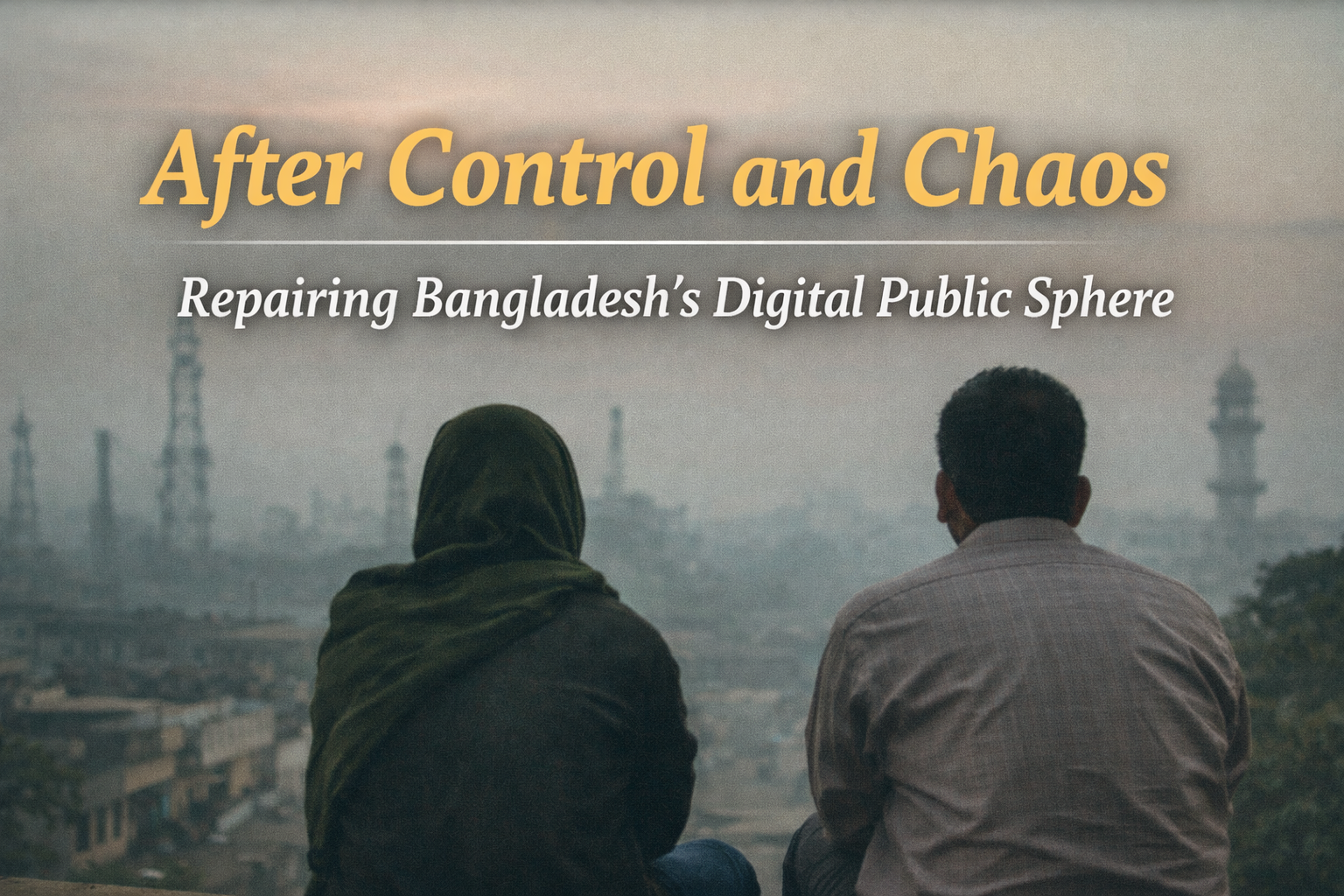
After Control and Chaos
What Repair Would Look Like for Bangladesh’s Digital Public Sphere
After years of internet censorship and speech chaos, what would real repair look like in Bangladesh’s digital public sphere? Law, trust, and care.
If the last two decades of internet regulation in Bangladesh teach us anything, it is this: removing repression does not automatically produce freedom. When censorship collapses without repair, the result is not liberal pluralism but volatility—what we now experience as contentious speech anarchy.
Bangladesh’s current digital condition must therefore be understood not as a moment of transition already completed, but as a repair crisis. The task ahead is not simply legal reform, but the reconstruction of a public sphere that has been governed through fear for nearly twenty years.
Why repeal alone cannot repair the damage
Years of governing digital life through vague laws, selective arrests, and infrastructural disruption have produced durable sociological effects. Research on repression consistently shows that fear becomes internalized, shaping behavior long after laws change (Hussain & Mostafa, 2016; Amnesty International, 2024).
In Bangladesh, this has meant:
- habitual self-censorship by ordinary users,
- defensive journalism and editorial caution,
- erosion of trust in legal neutrality,
- migration of political discussion into closed or hostile spaces.
Comparable patterns have been documented in Turkey after the Gezi Park protests, where speech increased in volume but became socially punitive and polarized (Yesil, 2016), and in Egypt, where fear persisted even during moments of apparent liberalization (Hamdy & Gomaa, 2012).
Repression, once normalized, outlives the law.
1. Legal repair: from discretionary power to predictable protection
The first layer of repair must be legal—but not cosmetic. Bangladesh’s core problem was never simply punishment; it was legal ambiguity.
The ICT Act (2006), its 2013 amendment, the Digital Security Act (2018), and the Cyber Security Act (2023) all relied on vague categories such as “hurting sentiment,” “propaganda,” or “deterioration of law and order” (ICJ, 2013; ARTICLE 19, 2019). Such language violates international standards of legality and proportionality (UN Human Rights Committee, 2011).
Repair would require:
- narrow, clearly defined speech offences,
- explicit protection for political speech, journalism, satire, and research,
- removal of arrest-without-warrant provisions for speech offences,
- mandatory judicial oversight for content takedown or access restriction.
Comparatively, Sri Lanka’s post-Aragalaya reform debates show that repeal without precision risks reproducing the same discretionary power under new names (Colombo Telegraph, 2023).
The goal of legal repair is predictability, not permissiveness.
2. Institutional repair: rebuilding trust, not just regulation
Law alone cannot repair a public sphere that has learned to distrust institutions.
In Bangladesh, regulatory bodies such as the BTRC and law-enforcement agencies were experienced as instruments of political discretion rather than neutral arbiters (Human Rights Watch, 2018). This mirrors findings from India, where speech law enforcement under the IT Act and UAPA has eroded institutional trust even among legally compliant users (Freedom House, 2023).
Institutional repair would therefore require:
- independent regulatory authorities insulated from executive pressure,
- transparent reporting on content removal, shutdowns, and surveillance,
- accessible complaint mechanisms for abuse of digital authority,
- legal protection for journalists, researchers, and whistleblowers.
Without institutional credibility, even well-written laws will be read as temporary tactics.
3. Social repair: making speech habitable again
The most neglected dimension of repair is social.
Bangladesh’s post-July digital space is not silenced; it is hostile. Harassment, moral policing, doxxing, and coordinated outrage now discipline speech more effectively than law ever did. This reflects what scholars describe as the privatization of censorship, where repression is crowdsourced (Roberts, 2018).
Similar dynamics have been documented in:
- Philippines under Duterte’s digital populism (Ong & Cabañes, 2019),
- Brazil during periods of extreme political polarization (Da Silva & Milan, 2020).
Social repair does not mean regulating opinion. It means restoring norms of disagreement.
This requires:
- platform-level enforcement against coordinated harassment,
- public recognition that dissent is not betrayal,
- support mechanisms for those targeted by digital intimidation,
- media literacy focused on responsibility and civic ethics, not only expression.
A public sphere cannot survive if participation requires emotional armor.
From fear-based governance to care-based infrastructure
For nearly two decades, Bangladesh’s digital space was governed through fear—fear of arrest, fear of cases, fear of visibility. When that system collapsed, fear did not disappear; it mutated.
Repair demands a different organizing principle: care.
Care-based public sphere design has been discussed in feminist and post-authoritarian scholarship as essential to sustaining participation under conditions of inequality (Fraser, 1990; Tronto, 2013). Care does not mean avoiding conflict. It means designing institutions and norms that recognize vulnerability and power asymmetry.
A cared-for public sphere protects participation not because speech is always right, but because participation itself is politically vital.
What repair is not
Repair does not mean:
- returning to silence,
- criminalizing “too much speech,”
- moral policing in the name of harmony,
- nostalgia for a pre-digital past.
These responses merely reintroduce repression under a different moral vocabulary.
Repair is about making disagreement sustainable.
A final warning—and a possibility
If repair does not occur, Bangladesh risks normalizing a politics where:
- only the loud survive,
- only the coordinated dominate,
- only the ruthless endure.
That is not democracy; it is attrition.
But if repair is taken seriously—across law, institutions, and social norms—Bangladesh has a rare opportunity to transform its digital public sphere from a battleground into a shared, if imperfect, civic space.
The streets may be open again.
Whether the public sphere becomes livable depends on what is rebuilt next.
References
Amnesty International. (2024). Bangladesh: Interim government must restore freedom of expression.
ARTICLE 19. (2019). Bangladesh: The Digital Security Act and freedom of expression.
Colombo Telegraph. (2023). Sri Lanka’s post-Aragalaya reform debates.
Da Silva, T., & Milan, S. (2020). Digital activism and political polarization in Brazil.
Freedom House. (2023). Freedom on the Net: India.
Hamdy, N., & Gomaa, E. (2012). Framing the Egyptian uprising in social media.
Human Rights Watch. (2018). Bangladesh: Crackdown on social media.
Hussain, M., & Mostafa, M. (2016). New media activism and state response in Bangladesh.
International Commission of Jurists. (2013). Bangladesh: ICT Act amendments.
Ong, J. C., & Cabañes, J. (2019). Architects of networked disinformation.
Roberts, S. T. (2018). Behind the screen: Content moderation in the shadows.
Tronto, J. (2013). Caring democracy.
UN Human Rights Committee. (2011). General Comment No. 34: Freedom of expression.