Poetics and Politics of AI
Originally published in New Age. Reposted for archival and academic use.
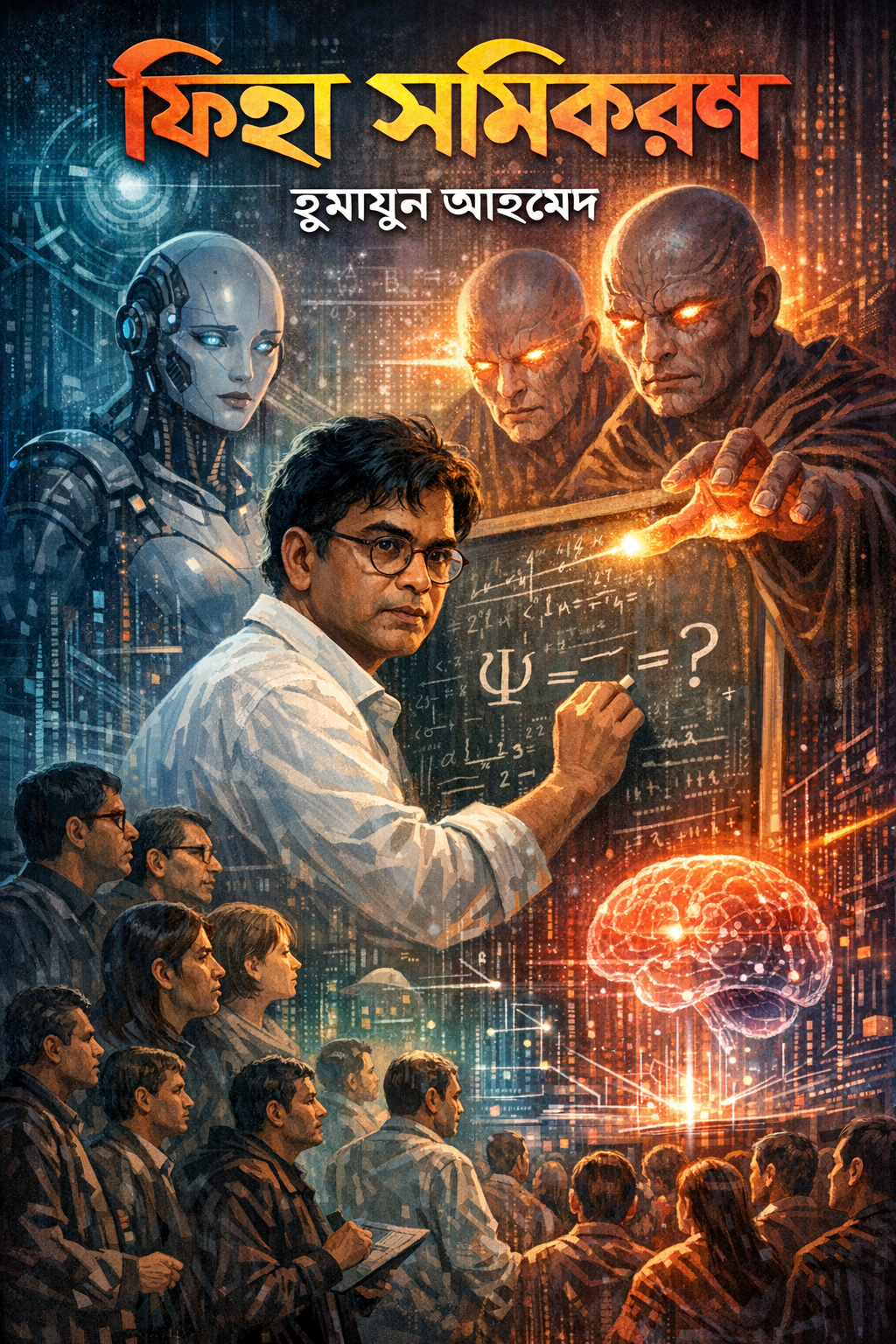
Our very own science fiction writer Humayun Ahmed (1992) wrote several stories hinting the development of artificial intelligence. Fiha Samikaron or Equation Fiha is a story about the complex relationship between humans and the highly developed Mentalist species. They can read people’s thoughts and can control them. They discretely use this power to manipulate humanity and innovation. The physicist Fiha is about to solve an equation that will change the Mentalist’s life and the timeline. Mentalists want him to solve this equation. However, Fiha realised that his equation will inevitably help the mentalist, not humanity. People feel threatened, curious and excited about artificial intelligence’s birth, causing an existential crisis. I wish the reality is less political than this story.
Traditionally, artificial intelligence is a branch of computer science and engineering. The primary goal is to create and develop machines and computer systems which usually require human intelligence. However, the impact of AI is for us all.
In the 1950s, researchers established the field of artificial intelligence. Early AI research was conducted during the 1950s and 1960s. The Dartmouth Conference (1956) brought together many leading AI researchers and served as a catalyst for further AI research and funding. AI research in the 1970s and 1980s was difficult because of high expectations, weak computers and the difficulty in making progress. The 1980s saw a resurgence of interest in AI with the development of expert systems. These systems used a knowledge base and inference rules to emulate human expertise in specific domains. Advancements in computing power and algorithms led to a renewed focus on machine learning techniques in the 1990s. With the proliferation of the internet and digital technologies, vast amounts of data became available, giving rise to BIG Data in the 2000s. This data explosion fuelled the development of more sophisticated machine learning algorithms and AI.
The 2010s marked a turning point for AI, driven largely by deep learning techniques. Neural networks with multiple layers have made deep learning successful in recognising images and understanding languages.
AI in the mainstream (2020s).
Artificial intelligence is more common in everyday life, from Siri and Alexa to social media recommendations. Industries like healthcare, finance and autonomous vehicles also saw significant AI adoption. For now, there are three categories of AI: (a) Narrow AI focuses on executing a single task, but it has limitations of interaction. Narrow AI includes tasks such as checking the weather, controlling smart home devices and answering general questions. (b) Scientists believe they are making progress towards general AI. It learns from experience and can understand the data and decide based on data. (c) Soon, AI may become intellectually superior to humans in every way. AI robots can solve problems, be self-aware and work without human intervention, possibly under the direction of another AI.
As an anthropologist I have a keen interest in the dynamic relationship between technology and society. Against popular belief, I have observed that ‘technology’ is not apolitical. There is a dominant trend of not recognising the localisation process of ‘technology’ as well. First, watch the localisation process closely and don’t assume technology will operate the same way in a new location. I have learned this hard. As a first generation of bloggers (since 2006) we believed digitalisation would give people power to take part in direct democracy. However, it is eminent that social media became a political public sphere.
On the one hand, important transformations in infrastructure for accessing the Internet helped the emergence of local social media (Bangla bologosphere), news portals, online platforms, cyber laws, and policies (2005–2010), on the other hand, it helped the rise of punitive digital laws (DSA, 2018), and dire applications. In the 2010s, we saw the emergence of global social media platforms, e-commerce, outsourcing, and digitalisation, which are in direct connection with BIG Data. In the past five to eight years, concepts such as machine learning and neural networks, rise of big data, deep learning have come into prominence. However, back in 2013, some of us clearly located the politics of algorithms. As Facebook was slowly but surely replacing/changing the Bangla blogosphere. The promotion of intense interaction through posts, videos, and images is gathering attention, without considering the impact on local culture and context. This leads to social and political unrest in the local context. You can relate to this phenomenon with the recent explosion of reels on Facebook, many of which I have observed contain profane content.
Social media platforms such as Facebook, Twitter and YouTube are mainly guided by a neoliberal impetus of profit-making and competition, promoting a particular form of entrepreneurship of attention economy. YouTube shorts and Facebook reels are the outcome of direct competition with TikTok. I agree that these platforms also helped create businesses and avenues through YouTube channels, Facebook pages, marketplaces and so on. However, with a catch. Every aspiring You-tuber, Tik-Toker, digital marketer knows that they must create, place and distribute their content according to the rules of the algorithm. For search engine optimisation and affiliated marketing, we are following the guidelines of tech giants and their platforms. Thus, knowingly, or unknowingly, we were guided by the algorithm and the philosophy behind that algorithm. We are providing the raw materials for Big Data, the chance of machines for Deep Learning is coming from us. All our personal and social profiles, socio-psychological makeup we gave to the servers/machines willingly.
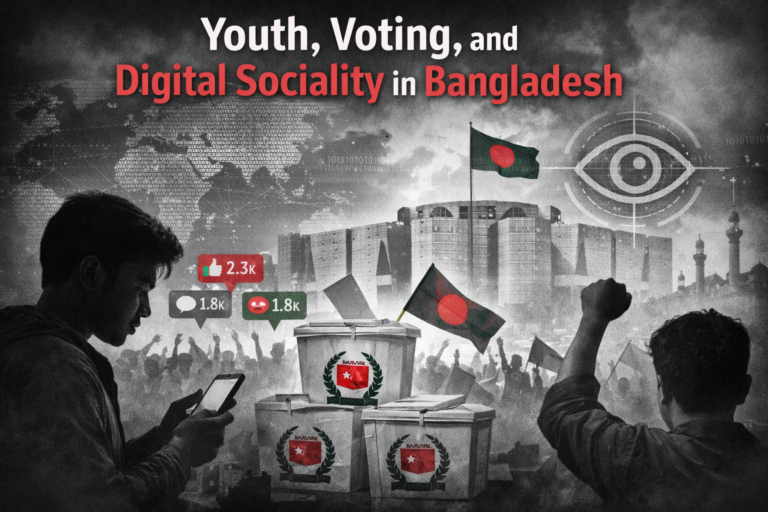
By 2023, social media has become so large and complex that it is necessary to conduct careful case-by-case studies on various issues such as democracy, gender, digital divide, religiosity, political participation, surveillance, news consumption, entertainment, entrepreneurship and e-commerce. Social mobilisation and social media have a dynamic relationship in a socio-political context.
Technology changes us. From the invention of the wheel to Gutenberg printing press! Google, Amazon, Daraz, Facebook, Twitter, Viber, TikTok none of it is free. Remember the day you suddenly realised that you were browsing something on the Internet and suddenly merchandise was showing up on your social feed, messages? Maybe now we can see ourselves that we are the ‘unpaid labour of Facebook’.
It would be unwise to think that AI is apolitical. Is Algorithm unbiased? Was the Internet unbiased? I think not. When the algorithm promotes neo-liberal motivation, then attention economy, surveillance economy will thrive. They will often ignore the human cost. The hybrid reality that we are living in, which comprises on-line and off-line spaces, affected us tremendously. How many influencers do you think consider the impact of their actions on social life rather than focusing on views, likes and shares?
Look at some of the undesirable outcomes of social media. Attention disorder, urge for immediate gratification, losing sight of human socialisation process, alienation, exposer to biased/fake news, views and content, changes in world view, to name a few. How much control and governance do we have over these giant corporations? How about the right of privacy, sense of community and freedom of expression? If we look at current Bangladeshi context, the DSA has become a punitive measure for freedom of speech and political activities. Are social media platforms taking any initiative to ensure freedom of expression or are they more focused on attention economy? Where are we putting our attention? Where can we negotiate? What is guiding that? Answers to these questions have deep socio-political and economic implications in our lives.
We often forget that tech giants compete to achieve the most state-of-the-art AI capabilities. This will affect most of us with no stake on it. This is another Oppenheimer moment. Because of our greed and competition, we gave little thought to releasing AI to the open Internet, we shouldn’t have taught AI to program DOAC.
Not only digital-divide or lack of infrastructure; we are in the realm of serious unpreparedness for AI. Technology transfer is a political issue and a major one. Unfortunately, we are in the periphery. As a publicity stunt, we may celebrate the AI news presenter but in the post-truth era people’s perception are more vulnerable to manipulation than ever. Compared to the global stream, we are already in the AI-divided world. We didn’t invest in AI like other powerful countries such as China and the USA.
There has been an extensive use of AI technologies, in Bangladesh in Ridesharing, natural language processing for Bengali, ChatBots, booking hotels, buying air tickets and real-time mapping, etc. One study claims that 34 per cent of youth are technology-driven in the country and the successful integration of AI technologies will lead Bangladesh towards a prosperous future. However, from this argument the distribution of socio-economic condition of 34 per cent of the youth is not clear. The proposed successful integration of AI technologies also provides a big question mark. Successful integration for whom?
One of the core economic strengths of our country is the RMG sector. The readymade garment sector in Bangladesh has been the prominent contributor to the country’s economy. It grew 12.17 per cent to $35.252 billion in the first nine months of the 2022–23 financial year. The sector is based on a cheap labour force. The two emerging phenomena related to this industry are automation (4th industrial revolution) and environmentally-friendly green factories. On the one hand, we are witnessing the dire condition of the workplace and wage gap; on the other hand, we can see the non-coherence in policy and implementation. No matter how shiny the automation proposition may look, we need to take long-term initiative regarding our context and wellbeing of the workers. The inherent competition will lure local companies to go for automation. However, only the bigger companies, among the many small-scale businesses, can afford to make these changes.
Based on a report by investment bank Goldman Sachs, BBC says that 300 million full-time jobs may be replaced by AI. According to the report of the Guardian, AI researcher-teacher Erin Ling said manufacturing and logistics jobs, jobs that involve repetitive data input and basic decision-making are at risk, so are customer services and healthcare industry. However, AI will also create many jobs and opportunities. The adoption of AI according to the socio-economic context is vital. One of the immediate steps would be up skilling. It looks like in the immediate future; many jobs will be replaced by skilled AI users. So, the question is in our context how many workers/employees can we up skill in a short period?
Some researchers, following World Economic Forum founder Klaus Schwab argues that fourth industrial revolution (4IR) might alter Wallerstein’s World Systems Theory (the unequal relationship between centre and periphery because 4IR introduces new production, management and governance system. Skill and innovation will determine a society’s place in the future, reducing dependence on capital. However, I have a rather sceptic position. The global south may lag behind in adopting AI, and different socio-economic groups will be impacted differently. Soon, we will see an increase in the importance of knowledge gaps, skill gaps, and infrastructural gaps. AI’s growth rate is exponential, surpassing other technologies. The emergency of immediate response is eminent. Developed economies will catch up to AI much faster than we will. AI is inevitable. The chances for low-skilled migrant workers losing their jobs abroad are a strong possibility. Bangladesh adopted an AI strategy in March 2020. The follow-up is not so promising. After three years of AI strategy adoption, there remains several shortcomings: (1) Limited infrastructure, (2) Data accessibility and quality, (3) Skilled workforce, (4) Ethical and legal frameworks, (5) Research and development.
AI will inevitably change our way of life. We are already in the phase of narrow AI and soon will reach general AI. Many experts also claim that super AI is less than a decade away. It needs not to be Terminator 2: The Judgment Day (1991), where in a near dystopian future, machines become self-aware and eliminate the remaining human resistance, led by the AI named SKYNET. However, it is a question of human agency. The Internet and social media changed our world drastically, our social relations, alienation, kinship pattern, economy, political mobilisation, values, sexuality, gender, sense of community and many more. We have a lot of human challenges to overcome; because this is the first ever in human history, we are dealing with intelligent species created by us but soon much smarter than we are.
It is an existential as well as a philosophical question. It is a question of ethics. What society do we aspire to? How will the workload be divided? How can we co-exist on a daily basis? Greed and mindless competition pushed us to nuclear proliferation. The same is happening with AI. The poetics of statistics and 4th industrial revolution or development lured us repeatedly. However, it remains as a utopia, a myth for the non-privileged all over the world.
Respecting the intelligence of AI, we may ask these questions instead, how AI can help us reduce poverty? How can we reduce disparity? How can we avoid climate catastrophe? How can we rebuild a soothing relationship with nature? Thus, in known human history, AI is a deeply political issue.