From Photography to Promptography:
Technology, Power, and the Future of Seeing
From Photography to Promptography: How AI Is Reshaping Images, Truth, and Power
From daguerreotypes to AI prompts, photography is transforming into promptography. This essay examines technology, visual anthropology, and political economy in Bangladesh and globally.
Photography was once anchored in light, presence, and material trace. Today, images can be generated through text prompts without a camera, a scene, or a witness. This essay traces photography’s technological evolution—from chemical capture to computational assembly to generative “promptography”—and examines how this shift reconfigures truth, labor, power, and visual culture. Drawing on visual anthropology and political economy, it focuses especially on Bangladesh, where high-speed image circulation, moral politics, and fragile trust ecosystems intensify the consequences of synthetic visuals. The argument is not that photography has ended, but that its social contract has fractured.
1. Photography as a Modern Epistemic Technology
Photography did not emerge merely as an art form. It emerged as a knowledge technology of modernity.
From its public announcement in 1839, photography reorganized how societies established:
- truth and evidence,
- memory and inheritance,
- authority and documentation.
Historians of photography argue that its early power lay in indexicality—the belief that photographs were causally connected to the world through light itself (Batchen, 1997). This belief made photography foundational to:
- colonial administration and ethnography,
- criminology and policing,
- anthropology and racial classification,
- family archives and bourgeois memory.
As The Burden of Representation demonstrates, photography’s authority was never natural; it was institutionally produced. Cameras worked alongside the state, science, and capital.
Thus photography has always been the instrument of political economy before it was aesthetics.
2. First Rupture: From Film to Digital (Light Becomes Data)
The invention of digital photography marked the first deep rupture. With CCD sensors, light was no longer chemically fixed but translated into numerical information.
What Changed Technologically
- Images became discrete data files
- Editing no longer required material intervention
- Copies became infinite and lossless
What Changed Socially
- Photographs detached from singular originals
- Circulation accelerated through screens and platforms
- Images became platform-native objects, not archival artifacts
According to media theorist Lev Manovich, digital images are optimized for circulation rather than duration.
A digital photo still originated in light and presence. The index weakened—but did not disappear.
3. Second Rupture: Computational Photography and Algorithmic Authorship
Computational photography transformed photography from capture to assembly.
Peer-reviewed research confirms that a single smartphone “photo” may combine:
- 5–15 frames,
- machine-learning-based reconstruction,
- algorithmic enhancement of color, depth, and noise (Hasinoff et al., 2016).
Night modes, HDR, portrait blur, and facial smoothing are not filters; they are automated interpretations of reality.
Anthropological Implication
Authorship becomes distributed across:
- the photographer,
- device manufacturers,
- software engineers,
- platform aesthetics.
Photography shifts from an artisanal act to an infrastructural process.
4. Third Rupture: Generative AI and the Rise of Promptography
Generative AI introduces a qualitatively new condition.
Images can now be produced from:
- text prompts,
- training datasets,
- probabilistic inference.
I use promptography not as a technical label, but as a critical concept:
photographic-looking images without photographic events.
Why This Is Different
- No camera is required
- No presence is necessary
- No moment needs to have occurred
The visual authority once tied to witnessing is replaced by plausibility.
Media theorists describe this as a move toward a post-indexical visual regime (Rubinstein & Sluis, 2013).
5. The Fractured Social Contract of Photography
Historically, photography rested on an implicit social contract:
“This happened. I was there. Light touched this scene.”
Promptography breaks that contract.
Today:
- seeing no longer guarantees believing,
- images require verification beyond visual inspection,
- trust shifts from images to systems (metadata, platforms, institutions).
This is not only a technical crisis.
It is a cultural and political crisis of belief.
6. Contemporary Artists Who Diagnose This Shift
Importantly, contemporary artists have been theorizing this condition long before generative AI went mainstream.
Hito Steyerl
In works like How Not to Be Seen and Duty Free Art, Steyerl shows how:
- resolution becomes power,
- circulation becomes violence,
- invisibility becomes resistance.
Her core argument: images gain force through speed and repetition, not truth.
Trevor Paglen
Paglen documents invisible infrastructures—satellites, data centers, facial-recognition datasets—demonstrating that photography now increasingly addresses machines rather than humans.
Forensic Architecture
Forensic Architecture exemplifies post-photographic evidence. Truth emerges not from single images, but from assemblages of satellite imagery, open-source visuals, and spatial modeling.
Jon Rafman
Through Nine Eyes of Google Street View, Rafman reveals how automated cameras produce accidental ethnographies and normalize surveillance.
Zach Blas
Blas critiques biometric visual regimes where images classify, predict, and exclude rather than represent.
Artists are not reacting to AI; they have been diagnosing promptographic conditions for over a decade.
7. Visual Anthropology After the Camera
Visual anthropology does not end with photography.
Its object of study shifts.
From:
- images as representations of culture
To:
- images as systems of production, circulation, and belief.
As argued by Sarah Pink, visual culture must be studied as process and practice, not artifact.
Promptography becomes an anthropological fieldsite because:
- prompts encode cultural assumptions,
- datasets reproduce social hierarchies,
- generated images circulate within moral economies.
8. Political Economy of Promptography
8.1 Labor
Industry surveys (Adobe, WEF) indicate:
- increased demand for visual content,
- declining unit prices,
- growth of AI-assisted creative labor.
This is not full automation, but labor intensification and precarity.
8.2 Platforms
Platforms benefit from:
- higher engagement,
- lower production costs,
- endless hybrid content.
Photographers increasingly function as content suppliers, not rights-holders.
8.3 Inequality
Those with access to:
- verification tools,
- institutional backing,
- legal protection
retain credibility.
Others face reputational vulnerability.
9. Why the Consequences Are Sharper in Bangladesh
Bangladesh offers a critical case because of three intersecting conditions.
9.1 High Visual Circulation
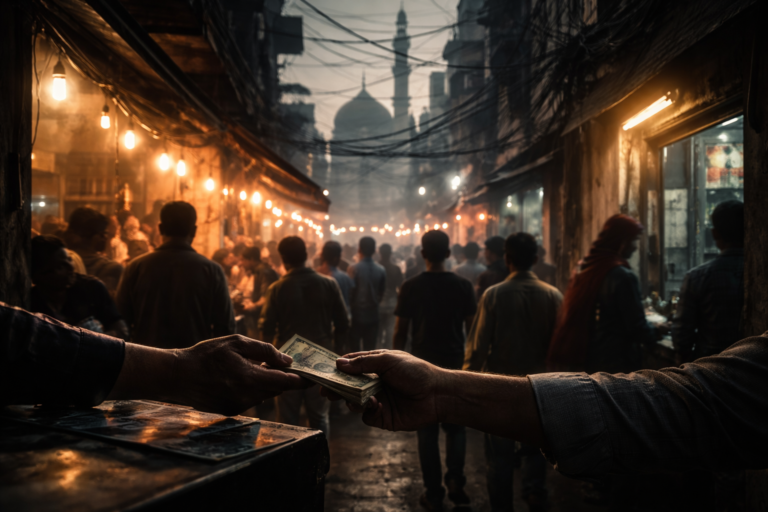
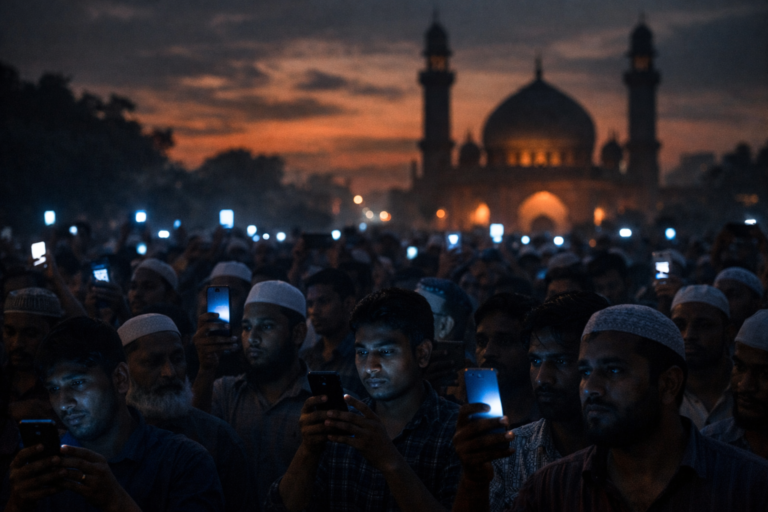
Mobile-first internet use and platform concentration mean images travel fast and detach quickly from context.
9.2 Moralized Public Culture
Accusations tied to religion, gender, or nationalism can trigger immediate social punishment. Fabricated images do not need proof to cause harm.
9.3 Fragile Trust Infrastructures
Slow legal remedies and politicized institutions amplify damage from synthetic visuals—during elections, campus politics, and personal disputes.
In Bangladesh, promptography does not merely distort reality; it reconfigures moral authority, deciding who is believable and who is disposable.
This is an interpretation grounded in observed media dynamics, not a statistically proven causal claim.
10. Where Photography Is Heading
I cannot confirm precise timelines. However, based on current trajectories:
- Hybrid workflows (camera + AI + generation) will dominate
- Provenance and verification will become central but unevenly accessible
- A split will widen between:
- photography as evidence (journalism, human rights),
- imagery as visual production (ads, propaganda, social media)
Photography will not disappear.
Its automatic claim to truth already has.
Conclusion: After the Image, Before Belief
The transition from photography to promptography marks a civilizational shift in how societies:
- establish truth,
- assign blame,
- remember events,
- and imagine the real.
For Bangladesh—and for the world—the task ahead is not nostalgia for “pure photography,” but the rebuilding of:
- visual literacy,
- institutional trust,
- and ethical restraint
in a world where images no longer need reality to look real.
Moiyen Zalal Chowdhury is an anthropologist and visual researcher based in Bangladesh. His work examines digital culture, visual media, social movements, and the political economy of platforms, with a particular focus on South Asia. He writes on photography, artificial intelligence, morality, and power in contemporary public life.
References (Selective, APA)
Batchen, G. (1997). Burning with desire: The conception of photography. MIT Press.
Tagg, J. (1988). The burden of representation. Macmillan.
Manovich, L. (2016). The language of new media. MIT Press.
Rubinstein, D., & Sluis, K. (2013). The digital image in photographic culture.
Hasinoff, S. et al. (2016). Computational photography. IEEE Signal Processing Magazine.
Steyerl, H. (2018). Duty free art. Verso.