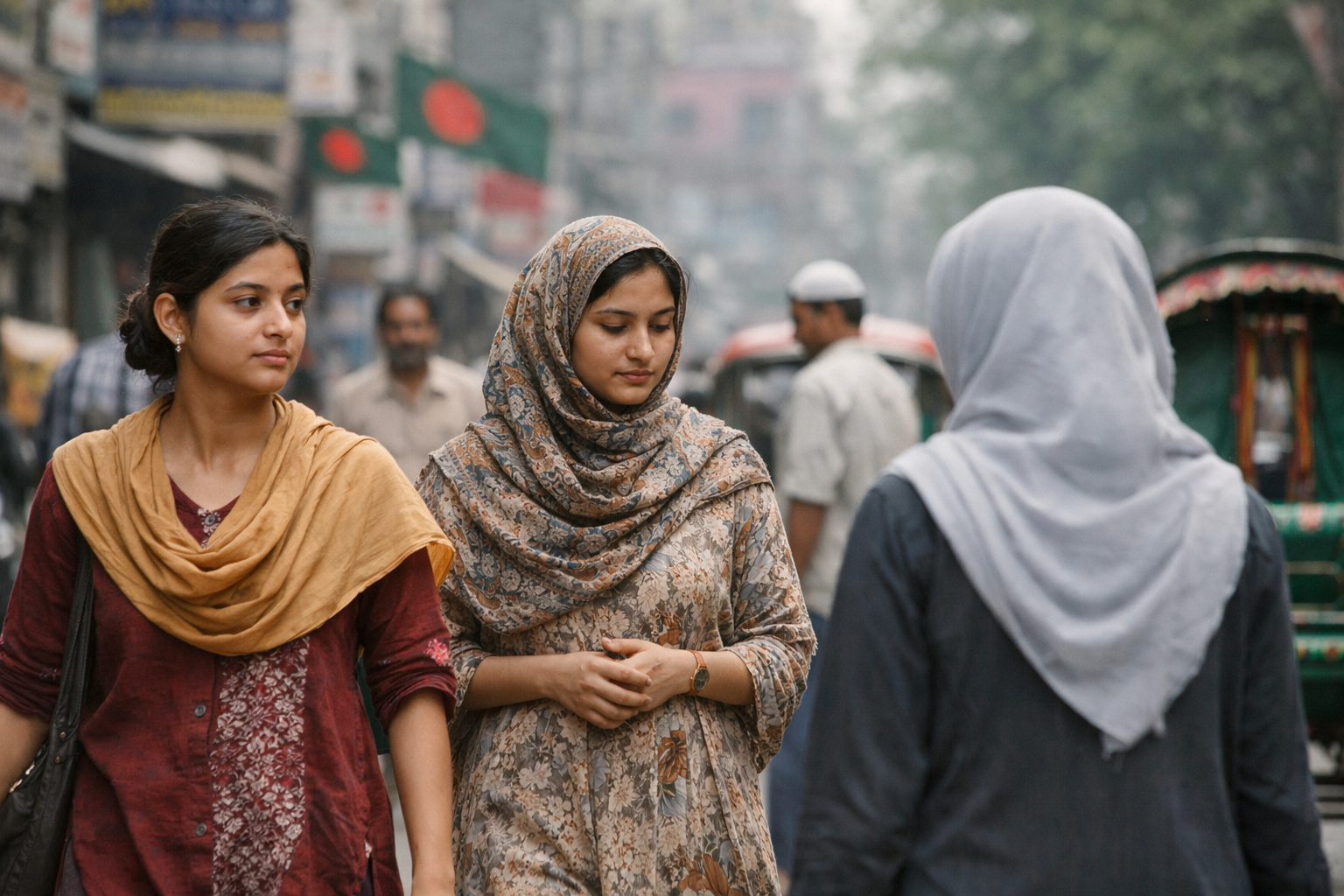
Gendered Religious Visibility and Power in Post–July 2024 Bangladesh
How victimhood narratives can harden into coercive moral governance
An anthropological analysis of post–July 2024 Bangladesh showing how women’s religious visibility becomes politicized, and why the “secular vs religious” divide is a patriarchal trap.
A note on scope and respect
This essay is not a judgment on faith, nor on women’s clothing. Women in Bangladesh inhabit religious, cultural, and ethical practices in diverse ways—sometimes visibly, sometimes privately, sometimes inconsistently, sometimes strategically. These choices are shaped by personal conviction, family history, class position, safety, and circumstance. All deserve equal respect.
The concern here is political instrumentalization: how, during moments of crisis, women’s visible markers of religious respectability can be pulled into struggles over power, legitimacy, and moral authority. The focus is not Islam, but how gendered visibility is used by political actors and social pressures, often at the expense of women’s autonomy and democratic debate.
Abstract
After the July 2024 rupture, Bangladesh entered a period of intense political contestation in which symbols began to travel faster than institutions. In this environment, women’s visible practices of religious modesty increasingly function as political interfaces—surfaces through which belonging, loyalty, and moral standing are negotiated. This essay argues that post–July politics has enabled a feedback loop in which external hostile framings and internal moral mobilization can reinforce each other. The result is a form of coercive moral governance that narrows dissent and relocates political conflict onto women’s bodies. Drawing on Saba Mahmood’s critique of liberal and religious patriarchies alike, the essay shows why forcing women to choose between “secular” and “religious” modes of visibility is itself a patriarchal political project.
1. July 2024 and the rise of symbolic politics
Political ruptures do not only destabilize governments; they destabilize meaning.
The July–August 2024 uprising and its violent aftermath fractured institutional legitimacy in Bangladesh and left unresolved questions about authority, representation, and moral ownership of “July.”
In such moments, symbols become shortcuts. When procedures are distrusted and law feels distant, visible markers—slogans, gestures, bodies, and forms of appearance—do the work institutions cannot. This is why post–July Bangladesh has become unusually sensitive to signs of respect, offense, loyalty, and betrayal.
Women’s visible religious practices entered this terrain not because they are new, but because they are legible, socially monitored, and emotionally charged.
2. Gendered religious visibility as a political interface
A social practice becomes a political interface when it is used to:
- Mark who properly belongs
- Measure moral worth
- Discipline disagreement
- Mobilize outrage faster than verification
In post–July Bangladesh, women’s visible markers of religious respectability are increasingly drawn into these functions—not by ordinary women themselves, but by political and social actors operating in a high-emotion, low-trust environment.
The practice itself does not do this work.
Power does.
3. The double instrumentalization: grievance and authority
3.1 External suspicion and internal grievance
Bangladesh’s post–July crisis has circulated through regional and global media ecosystems, sometimes framed primarily through fears of instability, religious extremism, or civilizational conflict. While political violence and minority insecurity are real and must be addressed seriously, selective or alarmist framings also circulate widely—especially online.
Inside Bangladesh, these framings are often reabsorbed as proof that a collective identity is under attack.
This is the first conversion: external suspicion becomes internal grievance.
The grievance does not need to be invented; it only needs to be framed as shared injury.
3.2 From grievance to moral authority
Once grievance is activated, a second conversion becomes possible:
- An allegation of disrespect
- Rapid moral outrage
- Assertion of collective victimhood
- Demand for discipline, silence, or punishment
At this stage, language meant to name discrimination can shift into a boundary-making device—deciding who may speak, criticize, question, or report.
This transformation does not require formal state power.
Digital amplification and crowd dynamics are often sufficient.
4. Saba Mahmood and the false choice imposed on Bangladeshi women
Why “secular vs religious visibility” is itself a patriarchal trap
Anthropologist Saba Mahmood, in Politics of Piety (2005), offers a critical intervention that is essential for understanding the current Bangladeshi fault line. Mahmood challenges a dominant liberal assumption: that women’s agency can only be recognized when it appears as resistance to religion or tradition.
Her argument is not that piety is liberatory in itself. Rather, she shows that agency does not have to look like secular rebellion to be real. Women may inhabit religious practices as ethical self-formation, not as submission or false consciousness.
This insight matters deeply for Bangladesh, because the current public debate repeatedly forces women into a false binary:
- Option A: Secular, visibly “modern” woman
- Option B: Religiously visible, “authentic” woman
Mahmood helps us see why this choice itself is patriarchal.
The patriarchal structure of the binary
Whether framed as “liberation” or “authenticity,” the binary performs the same political work:
- It reduces women to symbols
- It makes women’s bodies carry ideological conflict
- It denies women the right to be plural, contextual, contradictory
In Bangladesh, this binary is reproduced by multiple camps:
- Secular-nationalist discourse often treats visible religious practice as evidence of backwardness, coercion, or political regression.
- Religio-moral discourse often treats ambiguity, critique, or non-conformity as evidence of moral failure, foreign influence, or disrespect.
In both cases, women are not allowed to exist as thinking, ethical subjects. They become surfaces on which political anxieties are projected.
This is precisely the form of domination Mahmood warns against: a politics that claims to “save” women while refusing to listen to how women themselves understand their lives.
5. Bangladesh’s gender fault line after July
The Bangladeshi context sharpens Mahmood’s critique in three ways.
5.1 Weak feminist institutionalization
Gender discourse in Bangladesh is often mediated through party politics, NGO technocracy, or moral populism rather than through robust, autonomous feminist institutions. This makes women’s autonomy especially vulnerable to symbolic capture.
5.2 Post–July moral anxiety
After July 2024, politics became saturated with questions of loyalty, respect, purity, and betrayal. Women’s visibility became a low-cost site for resolving these anxieties because it is visible, discussable, and socially enforceable.
5.3 Misreading agency as resistance or submission
In Bangladesh:
- Visible religious practice is often read as political conservatism or coercion.
- Visible distance from it is often read as secular progress or moral deviance.
Both readings erase ethical self-understanding, class and generational difference, situational choice, and personal negotiation.
6. Why women’s bodies become sites of enforcement
Coercive moral politics—religious or secular—rarely begins with law.
It begins with visibility.
Women’s bodies become politically efficient enforcement sites because:
- They are immediately readable
- They can be regulated socially rather than legally
- Compliance can be monitored by peers
In post–July Bangladesh, gendered religious visibility increasingly operates as a moral signal—respectable versus suspect, loyal versus questionable. This displaces political disagreement onto appearance, where coercion is cheaper and dissent is riskier.
7. Shrinking the public sphere
The same outrage infrastructures that discipline individual behavior can scale outward. Intimidation of journalists, writers, and cultural actors illustrates how quickly moral accusation can replace debate.
When disagreement is reframed as disrespect:
- Volume replaces evidence
- Accusation replaces dialogue
- Fear replaces pluralism
The public sphere contracts—not by decree, but by pressure.
8. From moral outrage to regime imagination
In transitional periods, moral mobilization can evolve into broader political projects. When politics is framed primarily as a struggle between purity and corruption, compromise becomes betrayal and dissent becomes immorality.
In such contexts, regulating everyday life—speech, behavior, visibility—often precedes any formal change in governance. Gendered visibility then functions less as personal expression and more as an early indicator of a wider moral order being tested.
This is not theology.
It is method.
9. The Post–July Cycle (Bangladesh-specific): From rupture to coercive moral authority
The post–July political condition in Bangladesh is not best understood as a sequence of isolated events. It operates as a reinforcing cycle, where each stage intensifies the next, gradually shifting the terrain from institutional politics to moral governance. What follows is a step-by-step elaboration of how this cycle works.
9.1 From legitimacy rupture to coercive moral authority
1. Legitimacy rupture after July 2024
July 2024 marked not only a political uprising but a crisis of legitimacy. The rupture was not confined to a single regime or institution; it extended to the mechanisms through which authority had previously been justified—elections, law enforcement, courts, media credibility, and bureaucratic neutrality.
In such moments, legitimacy is no longer inherited through procedure. It must be performed, asserted, and constantly re-proven. This creates a vacuum in which symbolic gestures, moral claims, and affective alignment begin to matter more than institutional continuity.
Legitimacy rupture is the necessary precondition for everything that follows.
2. Circulation of hostile or suspicious framings
In the absence of stable legitimacy, political meaning becomes externally and digitally porous. Narratives circulate rapidly through regional media, diasporic networks, and social platforms—often framed through suspicion, alarm, or civilizational anxiety.
These framings do not need to be entirely false to be effective. Partial truths, selective emphasis, and moral exaggeration are sufficient. What matters is that Bangladesh’s internal conflicts are increasingly interpreted through hostile or anxious external lenses, which then re-enter domestic discourse.
At this stage, politics begins to feel surrounded—misunderstood, judged, or threatened from outside.
3. Conversion into internal grievance
External suspicion does not remain external for long. It is converted into internal grievance, often framed as collective injury rather than specific injustice.
The language shifts from institutional critique to identity-based harm:
- “They are misrepresenting us”
- “They are attacking our values”
- “They are disrespecting who we are”
At this point, grievance is no longer about accountability; it is about recognition and defense.
4. Mobilization of victimhood narratives
Once grievance is generalized, it becomes politically productive. Victimhood narratives offer a powerful form of legitimacy because they appear morally unassailable.
To claim victimhood is to claim:
- moral urgency,
- priority of voice,
- exemption from scrutiny.
Here, suffering begins to authorize power rather than limit it.
5. Use of women’s visibility as loyalty signals
As victimhood narratives expand, they require visible markers to distinguish loyalty from threat. Women’s visibility becomes a particularly efficient site for this work.
Everyday practices of appearance and comportment become signals of belonging. Compliance reads as respect; deviation reads as suspicion. This enforcement operates largely without formal rules—through gaze, rumor, online commentary, and social pressure.
Political conflict is relocated from institutions to bodies.
6. Reframing criticism as moral hostility
Once loyalty is read through visibility, criticism becomes dangerous. Disagreement is no longer political difference but moral hostility.
Questions are reframed as:
- disrespect,
- betrayal,
- alignment with hostile forces.
This reframing short-circuits debate. Moral hostility does not require rebuttal—it demands discipline or silence.
7. Shrinking space for dissent
As criticism is moralized, the public sphere contracts. This contraction occurs not primarily through law, but through:
- intimidation,
- anticipatory self-censorship,
- reputational risk,
- collective withdrawal.
Silence begins to look like prudence.
8. Expansion of coercive moral authority
The final stage is the emergence of coercive moral authority. Power is exercised less through institutions and more through moral claims demanding compliance.
Authority is justified not by mandate or law, but by:
- suffering endured,
- loyalty demonstrated,
- moral alignment displayed.
Because this authority appears ethical rather than political, it is difficult to challenge without appearing hostile—yet its effects are deeply political.
Why the cycle reinforces itself
Each stage strengthens the next:
- Legitimacy rupture makes symbols necessary
- Hostile framings intensify grievance
- Grievance authorizes victimhood
- Victimhood demands visible loyalty
- Loyalty tests criminalize critique
- Silenced critique deepens moral authority
The cycle does not end on its own. Without deliberate institutional rebuilding and ethical restraint, it feeds forward, not backward.
10. Why this cycle becomes crucial before elections—and why it persists after
The post–July cycle outlined above becomes particularly consequential in the period leading up to elections, but its significance does not end once ballots are cast. This is because the cycle is not primarily electoral in nature; it is about legitimacy production. Elections merely intensify processes that are already underway.
10.1 Pre-election: when legitimacy is scarce and symbolism accelerates
In pre-election periods, legitimacy is contested rather than assumed. Competing actors are not only asking for votes; they are asking to be recognized as the rightful moral representatives of the nation.
In such moments:
- Institutional trust is fragile.
- Policy differences are hard to communicate quickly.
- Electoral promises feel abstract and reversible.
As a result, symbolic shortcuts gain extraordinary power.
Victimhood narratives become attractive because they:
- establish moral urgency without policy detail,
- generate emotional alignment faster than programs,
- and frame opposition as morally suspect rather than politically different.
Within this environment, the post–July cycle intensifies:
- Legitimacy rupture makes moral claims necessary.
- Grievance narratives supply ethical authority.
- Visible loyalty signals provide quick markers of belonging.
Women’s visibility becomes especially salient here—not because women are central to electoral arithmetic, but because their visibility can be read instantly, without explanation. Moral signaling travels faster than manifestos.
Pre-election politics thus shifts from “What should we do?” to “Who truly represents us?”
10.2 Moral polarization replaces political competition
As elections approach, competition increasingly takes a moral form.
Instead of:
- competing policy visions,
- or institutional reform agendas,
the field narrows to:
- who is loyal,
- who is respectful,
- who belongs.
In this configuration:
- criticism is reframed as hostility,
- neutrality is read as betrayal,
- complexity becomes suspicious.
The cycle outlined in Section 9.1 becomes an electoral accelerant, not because it persuades undecided voters through argument, but because it disciplines the public sphere, reducing the range of permissible debate.
This is how elections can occur without expanding democratic deliberation.
10.3 Why the cycle does not end after elections
Crucially, the cycle does not dissolve once an election is held.
This is because elections do not automatically resolve:
- legitimacy deficits,
- moral grievances,
- or symbolic hierarchies.
If anything, post-election periods can intensify the cycle.
After elections:
- Winners may continue to rely on moral authority rather than institutional accountability.
- Losers may deepen victimhood narratives to contest outcomes.
- Supporters may treat criticism as an attack on the “people’s will.”
In all cases, moral legitimacy remains more flexible and harder to challenge than legal legitimacy.
Thus, the same mechanisms—grievance, victimhood, loyalty signaling, moral accusation—continue to operate after the vote, shaping governance, opposition, and public life.
10.4 Elections as moments of exposure, not resolution
Seen this way, elections function less as solutions and more as stress tests.
They expose:
- how legitimacy is being constructed,
- whether institutions can absorb disagreement,
- and whether moral authority is being used to limit power or to justify it.
If the post–July cycle remains unexamined, elections risk becoming rituals of confirmation rather than moments of democratic renewal.
10.5 Why this matters beyond any single election
The importance of this cycle extends beyond a particular electoral timeline because it shapes the conditions of political life itself.
When:
- victimhood becomes authority,
- visibility becomes loyalty,
- and critique becomes hostility,
politics does not disappear—it is replaced by moral governance.
This affects:
- how laws are interpreted,
- how dissent is treated,
- how women move through public space,
- and how future conflicts will be framed.
In this sense, the post–July cycle is not about who wins or loses an election.
It is about what kind of politics remains possible afterward.
10.6 Closing analytical note
Understanding this cycle before an election is urgent because it reveals how legitimacy is being manufactured. Understanding it after an election is essential because it explains why democratic exhaustion often follows democratic procedures.
The danger is not electoral competition itself.
The danger is when moral certainty replaces institutional restraint—and survives the ballot.
11. From মজলুম to moral entitlement: the problem of post-electoral governance
This essay has traced how, in post–July Bangladesh, a cycle of legitimacy rupture, grievance, victimhood, and moral signaling has reshaped the political field. To conclude, it is necessary to clarify the most consequential transformation within this cycle: how the figure of the মজলুম shifts from a claim for justice into a source of governing entitlement—and what that means after elections.
11. From মজলুম to moral entitlement: victimhood, empowerment, and post-electoral governance
This essay has traced how, in post–July Bangladesh, a cycle of legitimacy rupture, grievance, victimhood, and moral signaling has reshaped the political field. To conclude, it is necessary to clarify the most consequential transformation within this cycle: how the figure of the মজলুম shifts from a claim for justice into a source of governing entitlement, and how empowerment itself becomes morally reorganized after elections.
11.1 মজলুম as a political position, not a permanent identity
Historically, মজলুম names a relation to power, not a moral essence.
It refers to those who are structurally dominated, denied recourse, and subjected to arbitrary authority.
In this sense, মজলুম is:
- situational,
- historically specific,
- and ethically demanding.
It calls for:
- limitation of power,
- accountability,
- and repair.
The danger emerges when মজলুম is transformed from a descriptive position into a permanent identity—one that claims moral immunity rather than justice.
11.2 The critical transformation: suffering → moral entitlement
The decisive shift occurs when suffering is converted into entitlement.
The logic quietly changes from:
we suffered, therefore justice is owed
to:
we suffered, therefore authority is deserved.
At this point, victimhood no longer limits power; it licenses it.
This is the moment where:
- accountability begins to look like cruelty,
- criticism is framed as disrespect,
- and restraint is dismissed as betrayal.
Moral pain becomes political capital.
11.3 Victimhood and empowerment: a complex and unstable relationship
It is tempting to treat victimhood and empowerment as opposites—one as weakness, the other as strength. In post–July Bangladesh, the two are deeply entangled, and this entanglement explains much of the moral tension of the present.
Victimhood can be a source of empowerment.
It can also become a barrier to it.
11.4 Victimhood as a condition of political emergence
Historically, naming victimhood has often been the first step toward empowerment.
To be recognized as a victim is to:
- make harm visible,
- demand acknowledgment,
- and enter the political field as a claimant rather than a silent sufferer.
In this sense, victimhood:
- disrupts denial,
- mobilizes solidarity,
- and enables collective action.
At this stage, victimhood is politically productive.
It opens politics.
11.5 The threshold: when recognition turns into exemption
The relationship becomes unstable when recognition hardens into exemption.
The critical shift occurs when the claim
“we were harmed”
quietly transforms into
“we cannot be questioned.”
At this threshold, empowerment begins to change character.
Instead of expanding agency, victimhood starts to:
- monopolize moral authority,
- pre-empt critique,
- and redefine empowerment as control rather than capacity.
Empowerment is no longer about participation; it becomes about immunity.
11.6 Empowerment without reflexivity
Empowerment rooted exclusively in victimhood carries a structural risk: it becomes non-reflexive.
Because suffering is real, the power derived from it often appears self-justifying. This makes it difficult to ask:
- how that power is exercised,
- whom it excludes,
- and what new vulnerabilities it produces.
At this stage, empowerment ceases to be relational and becomes positional—something to be defended rather than shared.
Politics narrows.
11.7 Why this slippage intensifies after uprisings and elections
Post-uprising and post-electoral moments are especially vulnerable to this transformation because:
- trauma is widespread,
- institutions are weakened,
- justice is demanded but delayed.
Victimhood offers a fast route to legitimacy, while institutional empowerment is slow, procedural, and uncertain.
As a result:
- moral authority substitutes for institutional accountability,
- empowerment is measured through loyalty and visibility rather than capacity,
- and post-electoral governance becomes morally saturated.
Elections redistribute offices, but they do not automatically dissolve moral entitlement.
11.8 Gendered consequences of victimhood-based empowerment
This transformation has distinctly gendered effects.
Because moral entitlement requires continuous demonstration, it relies on everyday symbolic performance. Women’s visibility—how they appear, behave, and are read—remains one of the most efficient sites for confirming or withdrawing empowerment.
In this configuration:
- women are empowered as symbols,
- but constrained as subjects.
They carry the moral burden of empowerment without controlling its direction.
11.9 The central danger: justice replaced by moral certainty
The deepest risk in this trajectory is not instability, but moral closure.
When:
- suffering becomes unquestionable authority,
- and authority becomes immune to critique,
politics loses its capacity for correction.
Justice requires:
- distinguishing pain from power,
- memory from entitlement,
- recognition from rule.
Moral certainty, by contrast, demands obedience.
11.10 What remains possible
This analysis does not argue against remembering suffering or honoring the মজলুম. It insists instead that suffering must remain politically productive without becoming politically absolute.
A democratic future requires that:
- মজলুম remains a claim for justice, not a title to rule;
- empowerment expands capacity and participation, not moral immunity;
- elections reopen debate rather than close it.
Post–July Bangladesh stands at a critical threshold.
The question is not whether pain will be remembered.
It is what pain will be allowed to do.
If victimhood matures into entitlement, governance hardens.
If victimhood deepens into accountable empowerment, politics remains open.
The difference between the two is the difference between
justice after trauma
and
authority born from it.
This distinction—quiet, difficult, and easily lost—is what this essay has sought to keep in view.
Conclusion
Women’s visible religious practices did not become political because women changed.
They became political because power learned how to speak through visibility.
As Saba Mahmood reminds us, forcing women to choose between “secular liberation” and “religious authenticity” is not emancipation—it is a reconfiguration of patriarchy. In post–July Bangladesh, this false choice has become a convenient substitute for real political debate.
Defending women’s dignity today means refusing the binary altogether: refusing to let grievance become authority, morality become governance, and women’s bodies become borders.
That refusal is not anti-religious.
It is anti-coercion.
References
Core theoretical works
- Saba Mahmood. (2005). Politics of piety: The Islamic revival and the feminist subject. Princeton University Press.
→ Central to the argument on agency, piety, and the patriarchal false binary between “secular” and “religious” women. - Abu-Lughod, L. (2013). Do Muslim women need saving? Harvard University Press.
→ Critique of liberal “rescue” narratives and the reduction of Muslim women to symbols. - Asad, T. (2003). Formations of the secular: Christianity, Islam, modernity. Stanford University Press.
→ Foundational for understanding how religion, power, and governance intersect beyond belief. - Arendt, H. (1951). The origins of totalitarianism. Harcourt, Brace & Company.
→ Used comparatively for understanding how moral certainty and grievance can harden into coercive governance.
Gender, patriarchy, and moral politics
- Kandiyoti, D. (1988). Bargaining with patriarchy. Gender & Society, 2(3), 274–290.
→ Explains how women navigate power within patriarchal systems rather than simply resist or submit. - Kandiyoti, D. (2013). Fear and fury: Women and post-revolutionary violence. Open Democracy.
→ Useful for post-uprising contexts where women’s bodies become sites of political anxiety. - Yuval-Davis, N. (1997). Gender and nation. Sage.
→ Classic work on how women’s bodies are used as boundary markers of collective identity.