Bodies, Belief, and Power: Public Assemblies in Contemporary Bangladesh
In moments when institutions fail to speak convincingly, societies often turn to another language: the gathering of bodies. Since July 2024, Bangladesh has witnessed repeated large-scale public assemblies—mourning, anticipation, and rupture—whose significance exceeds slogans or demands. These gatherings are not simply expressions of anger or loyalty; they are social forms through which legitimacy, belief, and power are negotiated when institutional trust is fragile. This essay reads public assembly as a diagnostic practice—one that reveals what remains unresolved in contemporary political life.
Bodies, Belief, and Power: Public Assemblies in Contemporary Bangladesh
What do large public assemblies mean when trust in institutions is fragile?
INTRODUCTION — THE RETURN OF THE CROWD
In recent years, Bangladesh has witnessed a renewed visibility of large public assemblies. What began as occupation and protest in July 2024 expanded into demonstrations, demands, mourning rituals, and partisan gatherings whose afterlives continue to shape public life. In the wake of these events, trust in formal institutions appeared increasingly fragile—unable to absorb collective sentiment or translate social pressure into credible resolution.
Beyond the familiar relationship between party loyalty and organized supporter groups, these gatherings function as social signals. They communicate something that cannot be fully articulated through speeches, negotiations, or institutional procedures alone. Before reducing such assemblies to mobs, spectacles, or partisan showdowns, it is worth asking a more fundamental question: what do large public assemblies reveal about legitimacy, trust, and power at a moment when institutional authority is widely perceived as weak or unreliable?
PUBLIC ASSEMBLY AS A SOCIAL FORM
Public assembly is not merely physical presence; it is a form of communication. When bodies gather in space, they generate multiple layers of interaction—one-to-one, one-to-many, and many-to-many—creating a dense social field that exceeds formal channels of expression. In contexts where everyday communication among citizens is fragmented or muted, assembly temporarily compensates for this absence.
In moments of uncertainty, gathering becomes a language through which society speaks to itself. What is communicated is not always a unified demand or program, but a shared insistence on being seen, counted, and acknowledged. Bodies assembled in public space often carry more weight than speeches or statements, because presence itself becomes the message.
Assemblies address multiple audiences simultaneously. They speak outward, to institutions and political stakeholders, signaling that something remains unresolved. At the same time, they speak inward, among participants who seek moral coherence and collective recognition. In this sense, public assembly functions as a mechanism through which society attempts to translate diffuse sentiment into visible form.
To understand the scale of recent gatherings, it is therefore insufficient to focus only on numbers or visibility. What matters is what presence represents—a form of moral alignment that cannot be reduced to party affiliation or ideological belief. The repetition of such assemblies suggests a broader pattern: when a society feels that something is ethically right or socially necessary, it gathers.
ASSEMBLY BEYOND INSTITUTIONS
The decline of trust in formal institutions has been evident in Bangladesh for a considerable period. The July 2024 uprising intensified this condition, producing a complex mixture of hope and despair. The fall of an authoritarian regime, achieved at significant human cost, generated widespread expectations of stability and accountability. Yet the inability of institutions to consolidate that moment deepened uncertainty rather than resolving it.
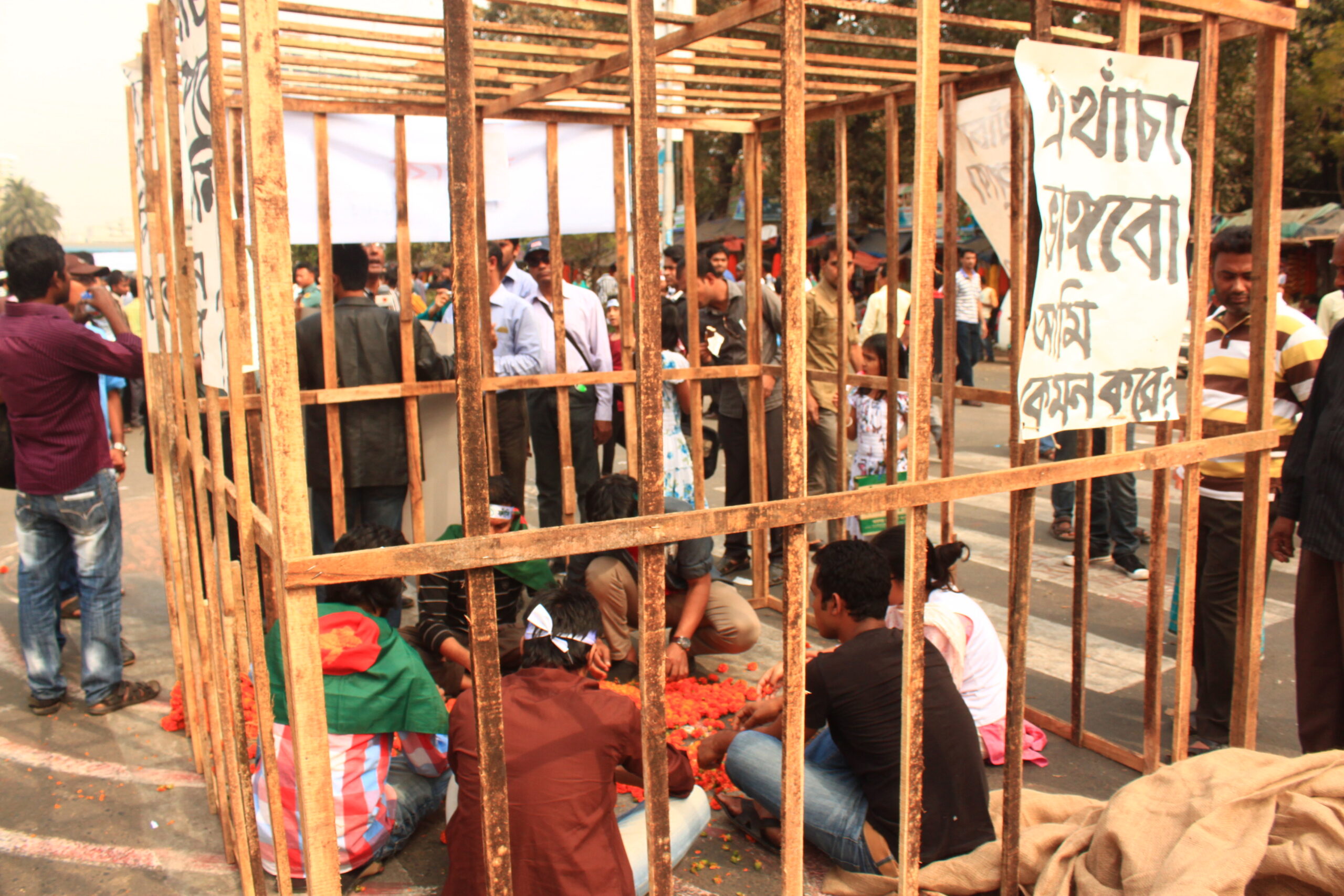
Within this context, public assemblies have increasingly operated as provisional substitutes for institutional credibility. The desire to hope remains visible, not through overt slogans or articulated programs, but through presence itself—through shared observation, conversation, silence, and restraint. Many of these gatherings have been largely peaceful, marked by collective grief and moral seriousness rather than indiscriminate disorder.
Even during moments when fears of mob violence circulated widely, assembly often functioned as moral witnessing. Collective presence signaled an attempt to hold space for dignity, justice, and accountability when institutional mechanisms appeared insufficient. This raises a critical question: what prevents assembly from becoming a mob? Is it institutional restraint, the moral framing of the event, shared discipline among participants, or some combination of these factors? The answer is not singular, but the persistence of restraint suggests that collective presence is governed by an internal moral economy rather than sheer impulse.
CASE SNAPSHOTS — MOURNING, ANTICIPATION, RUPTURE
Rather than treating recent gatherings as isolated events, it is more productive to read them as variations of public assembly, each organized around a distinct affective and political register. Mourning, anticipation, and rupture provide three such registers through which collective presence has been enacted in contemporary Bangladesh.
Assembly as Mourning
The janazas of Sharif Osman Hadi and Begum Khaleda Zia drew crowds that exceeded conventional expectations of religious ritual or partisan affiliation. While death rituals are familiar forms of gathering, the scale and repetition of these assemblies indicate that they functioned as more than ceremonial obligations.
Here, mourning operated as a moral language. Attendance signaled not only grief for individuals, but participation in shared ethical moments. Silence, restraint, and bodily presence carried meaning without the need for slogans or speeches. In these gatherings, collective presence became a way of affirming dignity, loss, and moral alignment at a time when institutional acknowledgment felt absent or inadequate.
Assembly as Anticipation
Public gatherings surrounding the welcoming of Tarique Rahman exhibited a different orientation. These assemblies were forward-looking, structured around expectation rather than closure. Presence here did not mark an ending, but a projection of possibility.
What mattered was not the articulation of specific demands, but the visible accumulation of bodies signaling readiness, patience, and belief in future transformation. Such assemblies functioned less as verdicts than as performances of anticipation, where legitimacy was imagined and rehearsed through collective presence rather than formal declaration.
Assembly as Rupture
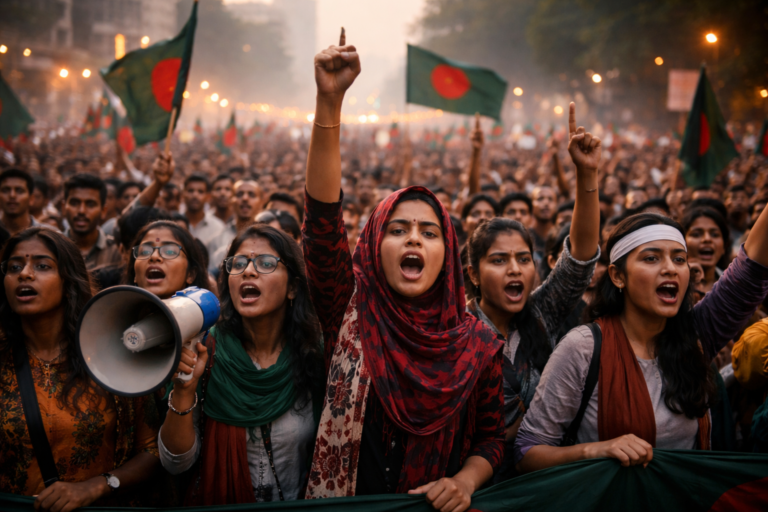
The mass gatherings associated with the July 2024 movement differed from both mourning and anticipation. These assemblies emerged as interruptions—ruptures in routine life, spatial order, and political normalcy. Bodies occupying streets and public spaces communicated refusal before articulating demands.
Here, assembly functioned as rupture. The intensity of presence mattered more than coherence of message. These gatherings exposed the limits of institutional mediation, revealing how collective action erupts when existing channels fail to absorb social pressure. Their significance lay not in resolution, but in their capacity to make uncertainty visible and unavoidable.
SHARED LOGICS OF PRESENCE, LEGITIMACY, AND SILENCE
Despite their differing orientations, these assemblies are structured by a shared set of logics that reveal how collective life is being reorganized under conditions of fragile institutional trust.
First, they operate through presence rather than articulation. Legitimacy is not argued or demanded; it is enacted—through scale, repetition, and restraint. Second, grief and hope coexist within the same gatherings, producing an affective ambiguity that reflects a society unable to withdraw from public life yet uncertain about resolution. Third, collective presence repeatedly substitutes for institutional mediation, not by replacing institutions outright, but by exposing their insufficiency.
These assemblies are also marked by discipline rather than disorder. Silence, restraint, and mutual regulation distinguish them from indiscriminate violence, even under heightened tension. Finally, repetition itself carries analytical weight. The recurrence of large-scale gatherings suggests that assembly has become a default social response to unresolved questions of legitimacy, authority, and belonging—registering crisis rather than resolving it.
THE DIGITAL–PHYSICAL LOOP
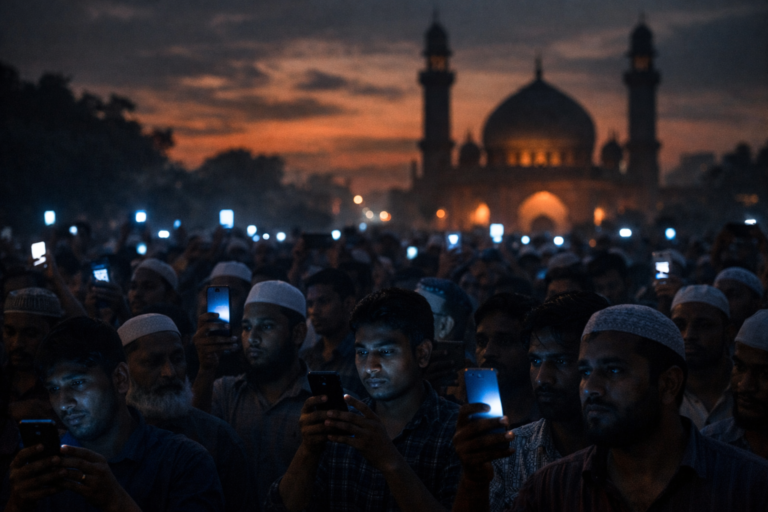
Contemporary public assemblies do not exist solely in physical space. They are recorded, circulated, archived, and re-encountered through digital platforms. Images, videos, and repetitions allow gatherings to extend beyond their immediate moment, producing a transnational afterlife of witnessing, solidarity, and memory.
This digital–physical loop gives assemblies additional force. Presence gains meaning through circulation, while digital repetition sustains affect and alignment across time and distance. Assemblies today exist simultaneously on streets and screens, shaping a hybrid public sphere where silence, visibility, and connectivity intertwine.
POWER, FRAGILITY, AND PERFORMANCE
Yet public assembly cannot resolve all uncertainty. The pursuit of state power often fractures collective solidarity soon after moments of unity. Assemblies provide temporary coherence, not lasting closure. Repeated gatherings signal unresolved questions rather than settled outcomes—questions surrounding justice, accountability, political transition, and institutional credibility.
Large public assemblies may not heal trauma or stabilize power, but they reveal where fragility resides. They make visible the tensions that institutions cannot yet contain. In this sense, assembly is not a solution, but a diagnostic social form—one through which society registers what remains unsettled, morally charged, and unresolved.
CONCLUSION
Large public assemblies in contemporary Bangladesh should not be read simply as spectacles, mobs, or partisan performances. They are complex social practices through which legitimacy, belief, and power are negotiated when institutional trust is fragile. Assemblies may not resolve uncertainty, but they reveal where it persists—and why bodies continue to gather where institutions fall short.
Dr. Moiyen Zalal Chowdhury