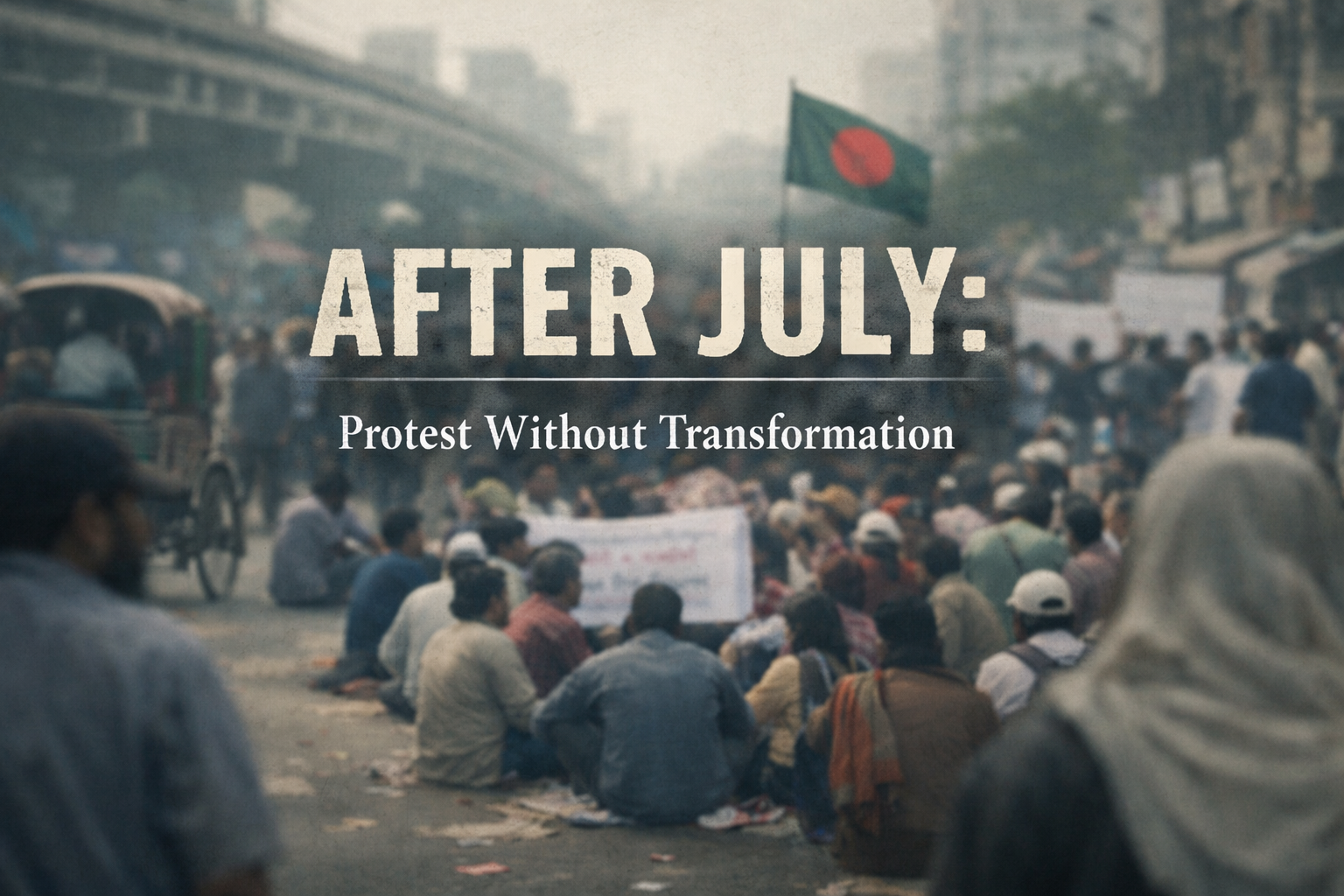
After July: Permanent Demand, Fragile Civil Society, and the Return of the Mob
Protest Without Transformation in Post-Uprising Bangladesh
After July: Why Bangladesh Is Trapped in Permanent Protest
After the July 2024 uprising, Bangladesh entered an era of permanent demand protests, weak civil society, and episodic mob formation. A political analysis.
Introduction: What July opened — and what it did not
The July 2024 uprising in Bangladesh marked a decisive rupture in the country’s political life. It shattered a decade-long regime of fear that had disciplined dissent through surveillance, repression, and institutional exhaustion. Streets reopened. Authority fractured. The fall of the Hasina government demonstrated that mass mobilisation was still possible under deeply entrenched authoritarian conditions.
Yet political ruptures do not automatically yield political futures. Revolutions are not judged by how regimes fall, but by whether rupture produces institutions, solidarities, and durable political capacity.
In Bangladesh, the post-July period has produced neither democratic consolidation nor revolutionary transformation. Instead, it has generated a distinct political condition: a society of permanent demand. Across sectors, citizens continue to mobilise — but without convergence, without leadership, and without a shared horizon of transformation.
This essay argues that post-July Bangladesh is characterised by three interlinked dynamics:
(1) permanent, low-intensity demand protests,
(2) a structurally weakened civil society, and
(3) episodic mob formation in moments of moral shock.
Together, these dynamics create a volatile yet non-transformative political landscape.
While grounded in Bangladesh, the dynamics discussed here are not unique. Similar patterns have emerged in post-uprising societies where fear has collapsed faster than institutions have formed.
Contention without capacity: a theoretical lens
Theories of contentious politics emphasise that protest becomes politically consequential when three elements converge:
mobilisation capacity, political opportunity, and collective framing (Tilly & Tarrow).
July 2024 decisively opened political opportunity. It partially generated collective framing through shared moral language — justice, dignity, merit. What it failed to generate was mobilisation capacity: organisational depth, intermediary institutions, and leadership capable of sustaining transformation beyond the moment of rupture.
As a result, post-July contention persists without political capacity. Protest does not disappear; it mutates into repetition.
This distinction is crucial. Where mobilisation exists without organisational depth, protest becomes routine rather than transformative.
Permanent demand as a post-uprising condition
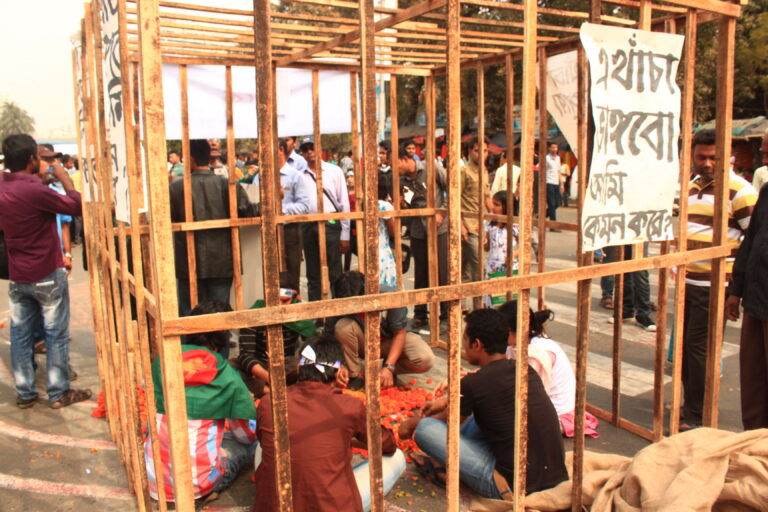
Since August 2024, Bangladesh has witnessed continuous demand-driven protests across nearly every social sector: primary and secondary teachers, university staff, auto-rickshaw pullers, mobile phone vendors, farmers, garment workers, health employees, Ansar members, informal traders, and families of July’s victims.
Despite their diversity, these mobilisations share four defining features:
- Narrow, material demands (pay scales, licensing, compensation, justice),
- Low-intensity tactics (sit-ins, short marches, limited road blockades),
- Moral restraint (careful avoidance of escalation),
- Administrative resolution loops (committees, promises, deferrals).
This pattern corresponds to what political anthropology describes as negotiated contention — protest oriented toward recognition rather than redistribution, acknowledgement rather than power.
In this sense, post-July Bangladesh resembles neither classic revolutionary transitions nor fully stabilised authoritarian systems. It is a highly mobilised but politically thin society.
Tactical restraint and the discipline of protest
One of the most striking features of the post-July landscape is the discipline of protest. Most movements consciously limit their tactics:
- Teachers withdraw boycott threats to avoid harming students.
- Informal workers frame protests as livelihood survival, not regime opposition.
- Vendors and transport workers emphasise legality and dignity over confrontation.
This restraint reflects political learning. July demonstrated that the street can work — but also revealed its costs. Escalation risks repression, delegitimisation, and moral backlash. As a result, protest becomes a calibrated performance, balancing visibility with survivability.
The street remains open, but it is no longer a space of rupture. It is a space of negotiation.
Legitimacy without leverage
Post-July protests often enjoy high moral legitimacy. Teachers, farmers, informal workers, and victims’ families command widespread sympathy. Yet legitimacy has not translated into leverage.
The dominant outcome pattern is familiar:
- dialogue without deadlines,
- committees without authority,
- temporary relief without structural change.
Grade discrimination persists. Informal transport remains criminalised. Vendor licensing remains arbitrary. Wage disputes recur cyclically.
The paradox is stark: the state listens, but does not resolve. Protest becomes a ritual of recognition rather than a mechanism of redistribution.
Why civil society remained weak
Why did July’s moral energy fail to crystallise into political capacity?
The weakness of post-July civil society is not accidental; it is structural.
1. NGO-isation and depoliticisation
For decades, Bangladeshi civil society has been shaped by donor-driven NGOs and professionalised advocacy groups. These actors excel at reports and visibility, but lack mass bases, risk-bearing capacity, and organising infrastructure.
When July erupted, many civil society figures either entered the interim government, accepted advisory roles, or retreated into commentary. This produced a representation vacuum at the street level.
2. Post-rupture co-optation
The incorporation of respected civil society figures into the state enhanced administrative legitimacy — but hollowed out autonomous mediation spaces. Civil society became vertically integrated into governance rather than horizontally connected to protestors.
3. Absence of intermediary institutions
Trade unions, student federations, professional associations, and neighbourhood committees — historically essential to democratic transitions — remain fragmented, politicised, or weakened. Without intermediaries, demands remain isolated.
The result is a society with high mobilisation and low mediation.
Mob formation: when structure collapses
The weakness of civil society has a more dangerous consequence: the re-emergence of mob dynamics.
Mobs are not simply crowds. They arise when:
- grievance intensifies,
- legitimacy is contested,
- institutional channels are absent,
- moral certainty replaces deliberation.
Post-July Bangladesh has exhibited intermittent mob formation, particularly around moral shocks: killings, blasphemy allegations, symbolic affronts, and unresolved historical trauma.
Unlike demand-based protests, mobs are:
- reactive rather than programmatic,
- affect-driven rather than strategic,
- capable of sudden escalation.
Where civil society is strong, anger is absorbed into negotiation. Where it is weak, anger spills into the street as unstructured force.
| Sector | Typical Demand | Dominant Tactic | Escalation Level |
|---|---|---|---|
| Teachers | Pay parity | Sit-in | Low |
| Auto-rickshaw pullers | Legal recognition | Road blockade | Medium |
| Mobile vendors | Stop eviction | Market shutdown | Low–Medium |
| Farmers | Price support | Highway sit-down | Medium |
| Garment workers | Wages | Factory gate protest | Medium–High |
| Victims’ families | Justice | Silent march | Low |
The state’s dual strategy
The post-July state has adopted a calibrated approach:
- Below: tolerate low-intensity, sectoral protests; absorb pressure through administrative delay.
- Above: rapidly consolidate control over security, media, telecom, education, culture, and regulation.
This produces stability without resolution. Protest is permitted but contained. Demands circulate, but power does not shift.
The strategy reduces immediate instability while postponing transformation.
Near-future trajectories (analytical projections)
Based on observable patterns, four trajectories are plausible:
- Normalisation of permanent demand (most likely): protests continue as routine governance inputs, producing fatigue rather than reform.
- Moral shock and episodic mob eruptions: sudden, intense mobilisations without leadership, followed by rapid dissipation.
- Selective authoritarian tightening: targeted repression if demands converge or threaten elite cohesion.
- Delayed recomposition (least likely): emergence of new intermediary institutions linking sectors into programmatic contention.
At present, there is no clear evidence that the fourth trajectory has begun.
Conclusion: awake, but unfinished
Bangladesh after July 2024 is neither dormant nor transformed. It is awake — vocal, unafraid, demanding — yet politically unfinished.
The danger is not the disappearance of protest. The danger is its permanent fragmentation, oscillating between disciplined demand and dangerous mob energy, while civil society lacks the strength to translate either into durable democratic form.
July broke fear.
It did not yet build a future.
References
Al Jazeera. (2024–2025). Bangladesh protests, political transition, and post-uprising developments. Al Jazeera English. https://www.aljazeera.com
Arendt, H. (1970). On violence. Harcourt, Brace & World.
Bangladesh Bureau of Statistics. (2024). Labour force survey of Bangladesh 2022–23. Government of Bangladesh. https://www.bbs.gov.bd
bdnews24.com. (2024–2025). Reports on labour unrest, education protests, and informal sector mobilisation. https://bdnews24.com
BSS News. (2024–2025). Government notifications, protests, and administrative responses. Bangladesh Sangbad Sangstha. https://www.bssnews.net
Chatterjee, P. (2004). The politics of the governed: Reflections on popular politics in most of the world. Columbia University Press.
Daily Star. (2024–2025). Coverage of the July uprising, teachers’ movements, labour protests, and governance changes. https://www.thedailystar.net
Dhaka Tribune. (2024–2025). Opinion and reporting on post-July protests and civil society. https://www.dhakatribune.com
Prothom Alo. (2024–2025). Bangla coverage of sectoral protests, informal labour, and political transition. https://www.prothomalo.com
Tarrow, S. (2011). Power in movement: Social movements and contentious politics (3rd ed.). Cambridge University Press.
Tilly, C., & Tarrow, S. (2015). Contentious politics (2nd ed.). Oxford University Press.
Wedeen, L. (2019). Authoritarian apprehensions: Ideology, judgment, and mourning in Syria. University of Chicago Press.
Media sources are used to document protest events and timelines; theoretical works are used for analytical framing.