Digital Youth Revolutions in South Asia: Bangladesh July Uprising vs Nepal Gen-Z Protests
A comparative analysis of Bangladesh’s July uprising and Nepal’s Gen-Z protests exploring digital activism, youth politics, and the future of protest movements in South Asia.
From Digital Street to Political Crisis: Youth Revolts in Bangladesh and Nepal (Working Paper Version)
Author
Dr. Moiyen Zalal Chowdhury
Assistant Professor of Anthropology
Department of Economics and Social Sciences (ESS)
BRAC University
Kha 224, Progoti Sharani, Merul Badda
Dhaka 1212, Bangladesh
ORCID: https://orcid.org/0000-0002-8350-3310
Email: moiyen.chowdhury@bracu.ac.bd
Working Paper Information
Working Paper / Preprint
This article is a working paper currently under preparation for journal submission.
Please cite only with permission of the author.
Author’s Note: Why This Essay Matters Now
Across South Asia, youth-led protest movements increasingly emerge through digital communication networks that enable grievances to circulate rapidly across social media platforms. Smartphones, messaging applications, and social networking sites have transformed how political dissatisfaction spreads and how citizens coordinate collective action. These developments have altered the relationship between digital communication, public political discourse, and street-level mobilization.
This essay examines two recent youth-driven protest movements in South Asia—the July uprising in Bangladesh and the Gen-Z protests in Nepal—in order to understand how digital communication infrastructures shape contemporary protest politics. Although both movements relied heavily on social media for mobilization, they produced different political outcomes. Nepal’s protests escalated rapidly into a national political crisis that resulted in leadership change, whereas Bangladesh’s uprising evolved into a more contested political process in which the meaning and consequences of the movement became subjects of political debate.
By comparing these two cases, the essay proposes the concept of the Networked Moral Economy of Protest, a framework that explains how moral grievances circulate through digital networks and generate affective publics capable of rapid collective mobilization. Understanding this process is essential for analyzing the evolving relationship between youth activism, digital communication, and political legitimacy in South Asia.
Abstract
Recent protest movements across South Asia increasingly emerge through digital communication networks rather than traditional political organizations. This essay provides a comparative analysis of two recent youth-led uprisings: the July protests in Bangladesh and the Gen-Z demonstrations in Nepal. Although both movements relied heavily on social media platforms for mobilization and were driven by digitally connected youth populations, their political outcomes diverged significantly. Nepal’s protests escalated rapidly and resulted in immediate institutional disruption, including leadership change and policy reversal. In contrast, Bangladesh’s uprising generated widespread mobilization but evolved into a prolonged and contested political process in which the movement’s meaning and consequences became politically disputed. Drawing on comparative protest analysis and digital ethnographic observations, the essay introduces the concept of the Networked Moral Economy of Protest to explain how moral grievances circulate through digital networks and intensify collective mobilization. The framework highlights the interaction between moral outrage, networked communication infrastructures, and political opportunity structures. The Bangladesh–Nepal comparison demonstrates that digital communication accelerates protest mobilization but does not determine political outcomes. Instead, institutional stability, leadership vulnerability, and protest framing play decisive roles in shaping the trajectories of contemporary uprisings in South Asia.
Keywords
digital protest, youth movements, Bangladesh politics, Nepal protests, digital ethnography, social media activism, South Asia politics, networked protest, political legitimacy, Gen-Z activism
Introduction
Over the past decade, the dynamics of political protest have undergone significant transformation as digital communication technologies have reshaped how grievances are articulated, circulated, and mobilized. Social media platforms now function as major infrastructures through which political narratives spread, enabling citizens to coordinate collective action outside traditional political institutions (Castells, 2015; Tufekci, 2017). As a result, protest movements increasingly emerge from networked communication environments rather than from hierarchical political organizations.
South Asia provides an important context for examining these developments. The region contains one of the world’s largest youth populations, and internet connectivity has expanded rapidly across urban and semi-urban areas. These conditions create fertile ground for digitally mediated political mobilization. In recent years, youth-led protest movements across the region have demonstrated how social media platforms can facilitate rapid mobilization, amplify political grievances, and generate large-scale demonstrations.
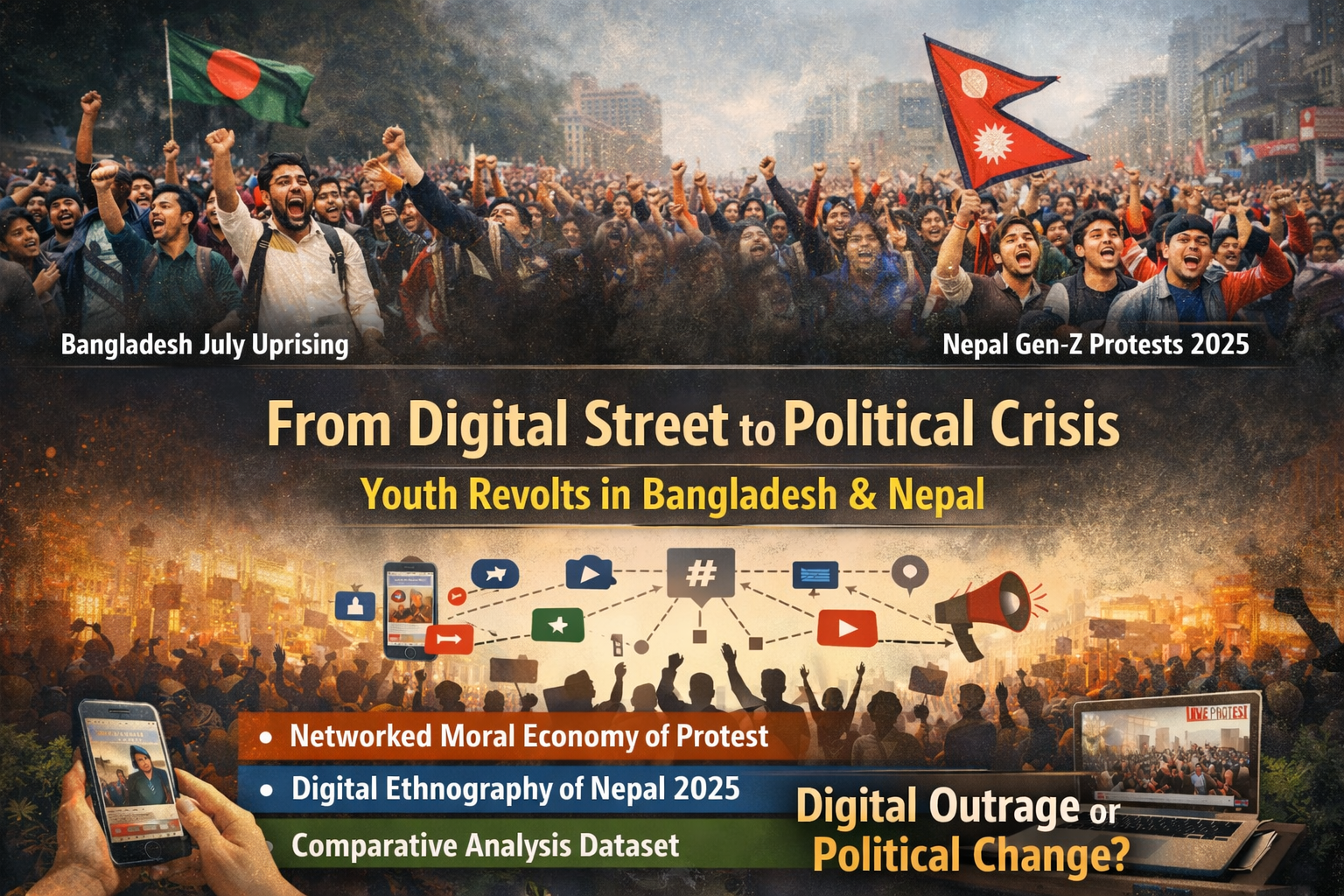
Two recent protest movements illustrate these dynamics particularly clearly: the July uprising in Bangladesh and the Gen-Z protests in Nepal. Both movements emerged from digitally connected youth networks and relied heavily on social media platforms to circulate protest narratives and coordinate demonstrations. Yet despite these similarities, their political outcomes differed significantly. In Nepal, protests escalated quickly and produced immediate institutional consequences, including leadership change and policy reversal. In Bangladesh, the July uprising mobilized a generation of students but later evolved into a contested political narrative rather than a single decisive institutional transformation.
This divergence raises an important analytical question: why do digitally mediated protest movements produce different political outcomes even when they share similar forms of mobilization?
This essay argues that the answer lies in the interaction between moral grievance formation, networked communication infrastructures, and political opportunity structures. Digital platforms accelerate protest mobilization by enabling grievances to circulate rapidly across networks of citizens. However, the political consequences of such mobilization depend largely on the institutional structure of political systems and the vulnerability of governing elites (Tilly & Tarrow, 2015).
By comparing the Bangladesh and Nepal cases, this essay proposes the concept of the Networked Moral Economy of Protest as a framework for understanding how moral grievances spread through digital networks and generate affective publics capable of rapid collective mobilization. While digital communication accelerates protest formation, the translation of digital outrage into institutional change remains shaped by political institutions and state responses.
Methodological Note: Digital Ethnography and Comparative Protest Analysis
This study employs a comparative qualitative methodology combining digital ethnography, discourse analysis, and secondary source analysis in order to examine how protest movements emerge and evolve within digitally connected societies.
Digital ethnography has become an increasingly important methodological approach for studying contemporary social movements because political mobilization often occurs simultaneously across online and offline environments (Pink et al., 2016). Protest narratives frequently develop within social media spaces where participants interpret political events, share emotional responses, and coordinate collective action. Observing these digital environments therefore provides insight into how protest narratives form and how collective identities emerge.
The analysis in this study draws on three main types of data.
First, the research examines digital protest discourse across major social media platforms, particularly Facebook, X (formerly Twitter), and YouTube. These platforms function as key arenas in which protest narratives, videos of demonstrations, and commentary about political events circulate rapidly. Public posts, protest slogans, and viral content related to the Bangladesh July uprising and the Nepal Gen-Z protests were observed in order to understand how grievances were framed and how protest narratives spread across digital networks.
Second, the study incorporates journalistic documentation and media reporting on protest events. International and regional media coverage provides chronological accounts of demonstrations, policy decisions, and political responses. These sources help contextualize digital discourse and provide information about protest escalation and institutional outcomes.
Third, the analysis draws on existing scholarly literature on digital activism, social movements, and South Asian politics. The theoretical framework integrates insights from research on networked protest movements (Castells, 2015), affective publics (Papacharissi, 2016), and contentious politics (Tilly & Tarrow, 2015).
Rather than attempting to measure protest participation quantitatively, the goal of this study is to analyze patterns of narrative formation, emotional mobilization, and political interpretation surrounding the two movements. The comparative design allows for examination of how similar forms of digital mobilization can produce different political consequences depending on institutional context.
Digital communication environments are therefore treated not simply as tools of coordination but as social spaces in which political meaning and collective identity are actively constructed and contested.
Digital Ethnography of the 2025 Nepal Gen-Z Protest Movement
Introduction: Digital Networks as the Primary Field Site
The 2025 protest movement in Nepal provides an instructive example of how contemporary youth mobilization unfolds across interconnected digital and physical spaces. Unlike earlier protest movements organized through political parties or student unions, the Nepal protests emerged through digitally mediated communication networks where grievances circulated rapidly among young users.
Digital ethnographic observation of online discourse surrounding the protests reveals how political grievances were articulated, amplified, and transformed into collective mobilization through social media platforms. These platforms functioned not merely as communication tools but as arenas of political meaning-making, where participants interpreted events, shared emotional responses, and coordinated protest actions.
Platforms most frequently used in the circulation of protest discourse included:
- X (formerly Twitter)
- YouTube
- Telegram and messaging applications used by activist groups
Within these spaces, narratives of injustice and political frustration circulated through posts, short video clips, protest memes, and live streams of demonstrations. The online environment therefore functioned as an extended field site, allowing observation of how digital interactions shaped the emergence and escalation of the protests.
Phase 1: Policy Trigger and Initial Digital Reactions
The initial trigger for the protests emerged from government decisions concerning regulation and restrictions affecting social media platforms. The announcement circulated widely through news outlets and digital networks, quickly becoming the focus of intense online discussion.
Digital discourse during the first phase was characterized by interpretive framing, as users attempted to understand the implications of the policy. Many posts framed the issue not simply as a regulatory measure but as a potential threat to freedom of expression.
Within hours of the policy announcement, hashtags and discussion threads began appearing across social media platforms. These early discussions revealed two dominant interpretive frames.
The first frame emphasized digital freedom as a democratic right. Users argued that access to digital communication platforms had become an essential part of political participation.
The second frame emphasized government accountability. Many users interpreted the restrictions as an attempt to limit criticism of political leaders.
These discussions rapidly produced a shared interpretive narrative: the policy was understood not as a technical regulatory decision but as a challenge to democratic communication.
Digital ethnographic observation shows that this interpretive shift occurred quickly, often within the first 24–48 hours following the policy announcement.
Phase 2: Circulation of Moral Narratives
As online discussions expanded, the tone of digital discourse shifted from interpretation toward moral evaluation. Posts increasingly framed the issue in terms of justice, rights, and generational identity.
A common narrative emphasized the symbolic importance of the internet for younger generations. Many users described digital platforms as the primary public space for political expression.
Statements circulating widely across social networks expressed sentiments such as:
The internet is the public square of our generation.
Although individual wording varied across posts, the core narrative was remarkably consistent: restricting digital communication was framed as restricting democracy itself.
Another widely circulated narrative focused on generational identity. Many users emphasized that young people had grown up in a digitally connected world and therefore viewed restrictions on digital communication as a direct challenge to their political voice.
Digital ethnographic observation shows that these narratives were reinforced through repetition across multiple platforms. The circulation of similar messages across different digital communities created a shared interpretive framework in which the protests acquired moral significance.
Phase 3: Affective Public Formation
As protest narratives circulated, emotional responses intensified across digital networks. Scholars describe such communication patterns as affective publics, in which shared emotional responses generate collective engagement (Papacharissi, 2016).
During this phase, online discourse became increasingly expressive and emotional. Posts frequently included expressions of frustration, anger, and solidarity.
Images and videos played a crucial role in shaping these emotional responses. Videos showing early demonstrations in urban centers circulated widely across social media platforms.
Many of these videos depicted groups of young protesters gathering in public spaces and chanting slogans related to freedom of expression. The visual circulation of these demonstrations reinforced the perception that the protests represented a collective movement rather than isolated incidents.
Digital ethnographic observation shows that these visual narratives were particularly effective in expanding the audience for the protests. Individuals who had not initially participated in online discussions became aware of the movement through viral video clips.
The circulation of visual protest narratives therefore played a central role in transforming online discourse into broader public attention.
Phase 4: Translation from Digital Discourse to Street Protest
A key moment in the escalation of the protests occurred when digital discussions began to include calls for physical mobilization. Posts increasingly contained logistical information about protest locations, meeting points, and demonstration times.
Messages circulated through social media networks encouraged participants to gather in specific public spaces in major urban areas such as Kathmandu.
These posts often combined practical information with symbolic messaging. For example, announcements about protest locations were frequently accompanied by statements emphasizing unity among young citizens.
Digital ethnographic observation shows that the transition from online discussion to street mobilization occurred rapidly. Within a short period, digital networks were functioning as coordination infrastructures for protest events.
Livestreaming also played an important role during this phase. Demonstrations were frequently broadcast in real time through social media platforms, allowing individuals outside protest locations to observe events as they unfolded.
These livestreams reinforced the perception that the protests represented a nationwide movement.
Phase 5: Escalation and Political Crisis
As demonstrations expanded, digital discourse began to focus increasingly on confrontations between protesters and security forces. Videos showing clashes circulated widely across social media platforms.
These visual narratives intensified emotional responses among online audiences. Posts accompanying such videos frequently emphasized themes of injustice and repression.
Captions shared alongside protest videos often framed the events as confrontations between peaceful protesters and state authority. These narratives reinforced the perception that the protests represented a struggle over democratic rights.
The rapid circulation of such images contributed to the escalation of the protests. Online discussions became increasingly polarized, with some users expressing strong support for the demonstrations while others criticized the protests as destabilizing political order.
Nevertheless, the overall tone of digital discourse during this phase suggested that the protests had acquired significant symbolic momentum.
Phase 6: Narrative Consolidation After Political Change
Following the political consequences of the protests—including leadership change and policy reversal—digital discourse shifted again.
Many posts framed the protests as a successful example of youth political agency. Online narratives emphasized the idea that collective action had forced political elites to respond to public pressure.
Celebratory messages circulated widely across social media platforms, highlighting the role of young protesters in shaping political outcomes.
At the same time, some discussions raised questions about the long-term implications of the protests. Users debated whether the movement represented a lasting transformation in Nepalese politics or a temporary moment of political disruption.
These discussions illustrate how digital networks function not only as arenas of protest mobilization but also as spaces in which the meaning and legacy of protest movements are negotiated.
Analytical Significance
The digital ethnographic observations presented here illustrate how contemporary protest movements unfold through the interaction between digital communication networks, moral narratives, and political institutions.
The Nepal protests demonstrate how digital platforms enable rapid circulation of grievances and emotional responses, creating conditions for large-scale mobilization. However, the political consequences of such mobilization depend on the institutional context in which protests occur.
In Nepal’s case, the combination of digitally mediated mobilization and fragile coalition politics produced rapid institutional disruption.
These dynamics provide an important illustration of the broader framework proposed in this essay: the Networked Moral Economy of Protest.
| Phase | Approximate Stage | Digital Dynamics | Offline Consequences |
|---|---|---|---|
| Phase 1 | Policy announcement | Online debate begins | Limited street activity |
| Phase 2 | Viral circulation | Hashtags and posts spread rapidly | First student demonstrations |
| Phase 3 | Affective amplification | Protest videos circulate widely | Demonstrations expand |
| Phase 4 | Mobilization coordination | Meeting points shared online | Large urban protests |
| Phase 5 | Confrontation | Videos of clashes spread online | Escalation of protests |
| Phase 6 | Political crisis | Narratives of victory circulate | Leadership change |
From Digital Counter-Publics to Networked Moral Economies
Early studies of online political communication emphasized the emergence of digital counter-publics, spaces in which marginalized voices could challenge dominant political narratives through networked communication (Fraser, 1992; Dahlberg, 2007). Social media platforms enabled citizens to bypass traditional gatekeepers such as state institutions and mainstream media.
Structural Grievances
(economic inequality, censorship, youth frustration)
↓
Moral Grievance Formation
(perceived injustice)
↓
Digital Circulation
(posts, videos, hashtags)
↓
Affective Public Formation
(shared outrage)
↓
Networked Mobilization
(protest coordination)
↓
Street Demonstrations
↓
Political Outcomes
(institutional change OR narrative contestation)
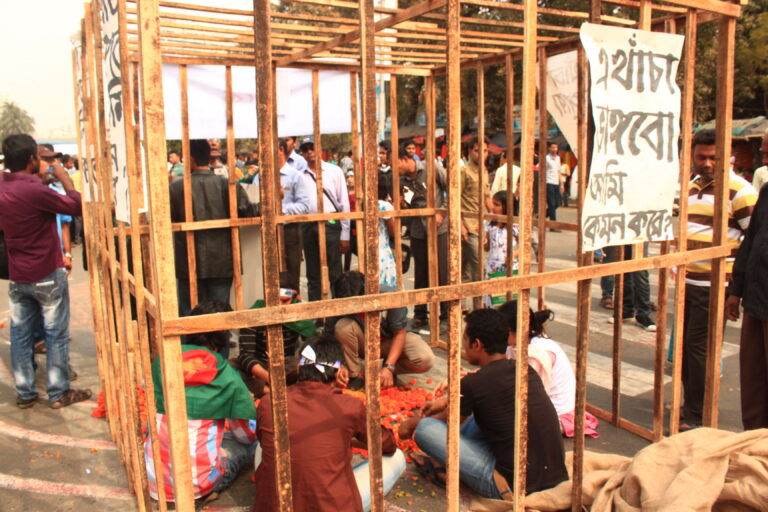
Research on the Shahbag movement in Bangladesh demonstrated how these digital spaces could generate what has been described as resistance sociality—forms of collective identification produced through shared emotional engagement and symbolic political expression in digital environments (Chowdhury, 2019). Through Facebook posts, images, and online discussions, participants constructed a sense of collective presence that extended beyond physical protest sites.
However, the Bangladesh and Nepal cases examined here suggest that digital counter-publics represent only the first stage of a broader process of political mobilization. While counter-publics enable alternative narratives to emerge, they do not fully explain how these narratives transform into large-scale protest movements.
To understand this transition, it is useful to consider the concept of a Networked Moral Economy of Protest.
The Networked Moral Economy of Protest
The Networked Moral Economy of Protest refers to the process through which perceived violations of fairness, dignity, or democratic rights are transformed into collective mobilization through digital communication networks. The concept builds on the classical notion of the moral economy, which describes how protest emerges when communities perceive that authorities have violated shared norms of justice (Thompson, 1971).
Structural Grievances
↓
Moral Grievance Formation
↓
Digital Circulation
↓
Affective Public Formation
↓
Networked Mobilization
↓
Street Protest
↓
Political Outcomes
In digitally connected societies, moral outrage does not remain confined to local communities. Instead, images, videos, and narratives of injustice circulate rapidly through social media platforms, generating what scholars describe as affective publics—networked groups bound together by shared emotional responses to political events (Papacharissi, 2016).
These affective publics allow dispersed individuals to recognize shared grievances and coordinate protest actions in physical spaces. However, the political consequences of such mobilization depend on institutional context and state response (Tilly & Tarrow, 2015).
| Narrative Frame | Description | Typical Theme |
|---|---|---|
| Digital Freedom | Internet access as democratic right | “Freedom of expression” |
| Youth Voice | Generational identity in politics | “Our future, our voice” |
| Anti-Censorship | Opposition to regulation of platforms | “Stop silencing the internet” |
| State Accountability | Criticism of political elites | “Government must answer citizens” |
| Protest Solidarity | Emotional identification with protesters | “Stand with the youth” |
The Rise of the Digital Street
Social media platforms increasingly function as what might be described as a digital street—a virtual space in which political grievances are debated, protest narratives are formed, and demonstrations are coordinated.
In Bangladesh, student protests initially focused on the civil service quota system, which many students viewed as limiting opportunities for graduates competing for public sector employment. Videos of demonstrations, speeches by activists, and images of confrontations with security forces circulated rapidly on social media.
These digital interactions allowed students from different universities to coordinate protests and amplify their grievances. What began as a policy dispute soon evolved into a broader conversation about fairness, meritocracy, and generational justice.
Nepal’s protests followed a similar trajectory but were triggered by restrictions on social media platforms. Many young citizens interpreted these restrictions as an attempt to suppress dissent. Within days, protest calls circulated across digital networks, drawing large numbers of demonstrators into public spaces.
Why Nepal Produced Immediate Change
Nepal’s protests quickly escalated into a political crisis that resulted in leadership change. Several structural factors contributed to this rapid outcome.
Nepal’s political system has experienced frequent leadership changes since the abolition of the monarchy in 2008. Coalition governments often depend on fragile alliances among multiple political parties (Lawoti & Pahari, 2010). Under such conditions, large-scale protests can quickly destabilize governing coalitions.
The framing of the protests also played an important role. Nepal’s demonstrations centered on the issue of digital freedom, a principle closely associated with democratic rights. This framing broadened the symbolic significance of the movement and intensified political pressure on the government.
Why Bangladesh Followed a Different Path
Bangladesh presents a different institutional context. Political institutions have historically demonstrated greater continuity, and governing parties possess stronger organizational structures (Riaz, 2016).
Although the July uprising mobilized large numbers of students and generated widespread public debate, the protests did not immediately produce leadership change. Instead, the political consequences of the movement unfolded gradually.
Over time, competing political actors offered different interpretations of the movement’s significance. Some framed it as a generational demand for fairness and meritocracy, while others interpreted it through partisan political narratives.
As a result, the legacy of the uprising became contested rather than producing a single clear institutional outcome.
Comparative Protest Dynamics
Table 1
Bangladesh–Nepal Protest Comparison
| Dimension | Bangladesh July Uprising | Nepal Gen-Z Protests |
|---|---|---|
| Primary grievance | Civil service quota policy | Social media restrictions |
| Core actors | University students | Urban Gen-Z youth |
| Protest framing | Meritocracy, generational justice | Freedom of expression |
| Mobilization infrastructure | Facebook networks | Social media activism |
| Institutional context | Consolidated political system | Fragile coalition politics |
| Immediate outcome | Narrative contestation | Leadership change |
The Paradox of Digital Revolutions
The Bangladesh and Nepal cases illustrate a broader paradox of contemporary protest movements. Digital communication networks enable movements to mobilize large numbers of participants quickly, but they do not necessarily provide the organizational structures required for sustained political change (Tufekci, 2017).
Digital networks accelerate protest formation, yet the translation of digital outrage into institutional transformation depends on political institutions, state responses, and the organizational capacity of protest movements.
Conclusion
The Bangladesh July uprising and Nepal’s Gen-Z protests reveal both the possibilities and the limitations of digitally mediated political mobilization. Digital networks enable citizens to organize collective action with unprecedented speed, transforming localized grievances into nationwide protest movements.
Yet the outcomes of such mobilization remain shaped by the institutional structure of political systems and the vulnerability of political leadership.
Nepal’s fragile coalition politics allowed protests to produce rapid leadership change. Bangladesh’s more stable political institutions transformed protest energy into a prolonged political contest over the meaning of the uprising.
Together, these cases demonstrate that digital revolutions do not simply overthrow political systems. Instead, they initiate complex political processes in which grievances, institutions, and narratives interact.
Understanding this interaction will remain essential for analyzing the future of democracy in South Asia.
References
Adhikari, J. (2013). Migration, remittances and development in Nepal. Migration and Development, 2(1), 1–18.
Ahmed, I. (2018). Youth activism and the Shahbag movement in Bangladesh. Contemporary South Asia, 26(4), 410–423.
Bayat, A. (2015). Revolution without revolutionaries. Stanford University Press.
Castells, M. (2015). Networks of outrage and hope. Polity Press.
Chowdhury, M. Z. (2019). Resistance sociality in the Shahbag movement. Hiroshima University.
Fraser, N. (1992). Rethinking the public sphere. Social Text, 25/26.
Gerbaudo, P. (2016). Tweets and the streets. Pluto Press.
Habermas, J. (1989). The structural transformation of the public sphere. MIT Press.
Jane, E. (2017). Misogyny online. Sage.
Lawoti, M., & Pahari, A. (2010). The Maoist insurgency in Nepal. Routledge.
Papacharissi, Z. (2016). Affective publics. Information, Communication & Society, 19(3).
Pink, S. et al. (2016). Digital ethnography. Sage.
Riaz, A. (2016). Bangladesh: A political history since independence. I.B. Tauris.
Thompson, E. P. (1971). Moral economy. Past & Present.
Tilly, C., & Tarrow, S. (2015). Contentious politics. Oxford University Press.
Trottier, D., & Fuchs, C. (2015). Social media, politics and the state. Routledge.
Tufekci, Z. (2017). Twitter and tear gas. Yale University Press.
Suggested Citation
Chowdhury, M. Z. (2026).
From Digital Street to Political Crisis: Youth Revolts in Bangladesh and Nepal.
Working Paper / Preprint. Department of Economics and Social Sciences, BRAC University.