Sacred Wars in the Age of Algorithms
Political Theology, Digital Apocalypticism, and the Global Circulation of the U.S.–Israel–Iran Conflict
A critical essay exploring how religious narratives, political theology, and social media algorithms shape global interpretations of the U.S.–Israel–Iran conflict. The article also examines how these narratives circulate through digital networks and influence political discourse in Bangladesh.
Dr. Moiyen Zalal Chowdhury is an anthropologist whose research explores digital activism, social media, and political publics in Bangladesh. His work examines how networked communication reshapes political imagination and resistance in contemporary societies.
Introduction: War Beyond Strategy
In the spring of the twenty-first century’s third decade, images of war move faster than missiles. A strike in the Middle East appears on smartphones in Dhaka within seconds. Videos circulate across feeds, accompanied by commentary invoking prophecy, justice, resistance, or apocalypse. In Washington, some religious commentators speak of biblical destiny. In Tehran, political rhetoric invokes martyrdom and resistance against imperial power. In Israel, historical narratives of survival frame the language of national defense.
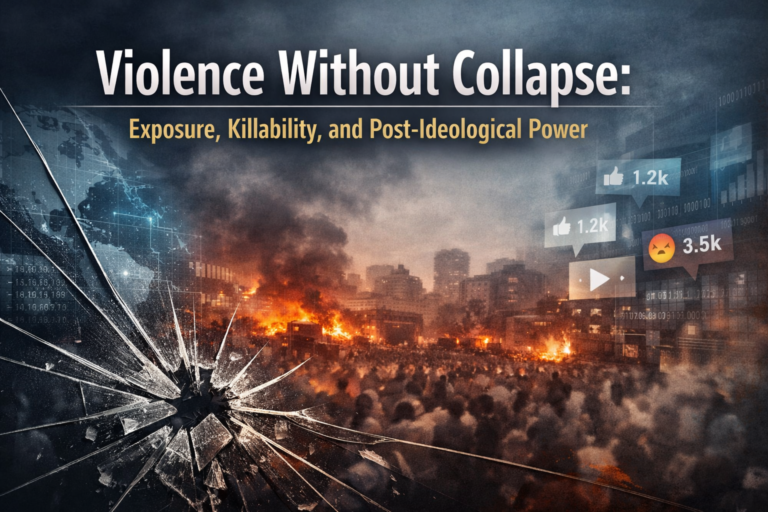
Yet the battlefield is no longer confined to geography. It extends into digital networks where religious imagination, political ideology, and algorithmic visibility converge. Wars today are fought not only through military strategy but also through competing narratives that circulate globally through social media infrastructures.
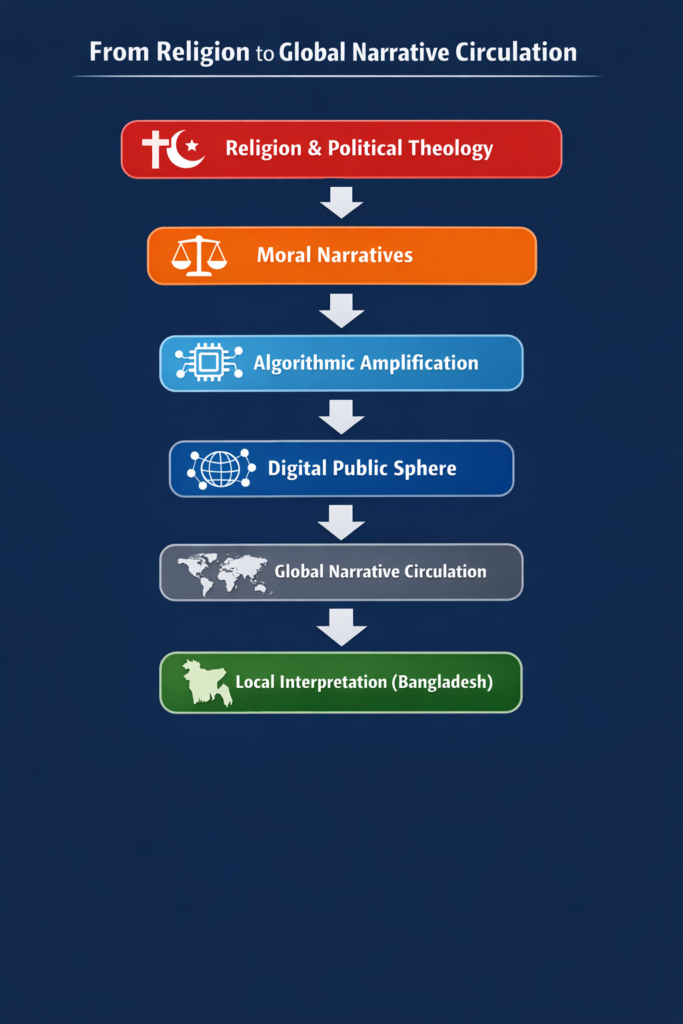
The confrontation involving the United States, Israel, and Iran therefore reveals something deeper than a geopolitical rivalry. It reveals how contemporary conflicts are increasingly interpreted through what might be called digital political theology—a space where religious narratives, moral emotions, and algorithmic amplification shape the global understanding of war.
These narratives do not remain confined to the Middle East. Through the infrastructures of the digital public sphere they travel rapidly across continents, entering the political imagination of societies far removed from the battlefield. Bangladesh offers a particularly revealing case. Here, global conflicts intersect with a history of digitally mediated political mobilization—from the Shahbag Movement to the circulation of protest imagery and graffiti during the July 2024 uprising.
In the networked age, wars become not only military confrontations but narrative events, interpreted, contested, and transformed through digital communication systems that reshape how societies imagine power, justice, and violence.Wars are never only military events. They are also interpretive events, moments in which societies attempt to understand violence and place it within broader narratives of meaning. Governments explain conflicts through the language of strategy—deterrence, alliances, national security—yet publics frequently interpret war through symbolic frameworks rooted in religion, morality, and historical identity.
The confrontation involving the United States, Israel, and Iran illustrates this dynamic vividly. The structural causes of the conflict remain geopolitical: regional power competition, nuclear deterrence, and long-standing strategic rivalries. Yet the language through which many people interpret the conflict often invokes religious prophecy, civilizational identity, and narratives of moral struggle.
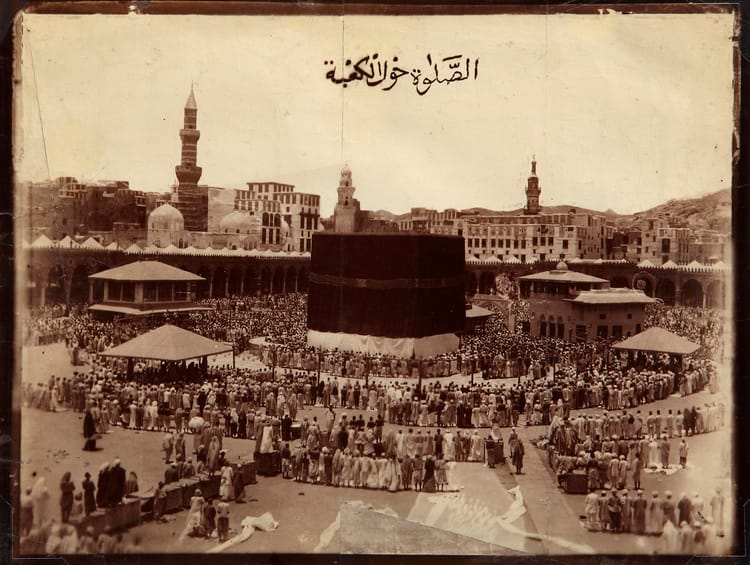
Among segments of American evangelical culture, geopolitical developments involving Israel are sometimes interpreted through biblical prophecy connected to the Book of Revelation. In Israel the conflict may be framed through historical narratives of Jewish survival and national identity. In Iran it is frequently described through the ideological language of the Islamic Revolution—resistance against oppression and imperial domination.
None of these narratives alone explains the conflict. Yet together they shape the moral imagination through which millions interpret geopolitical events.
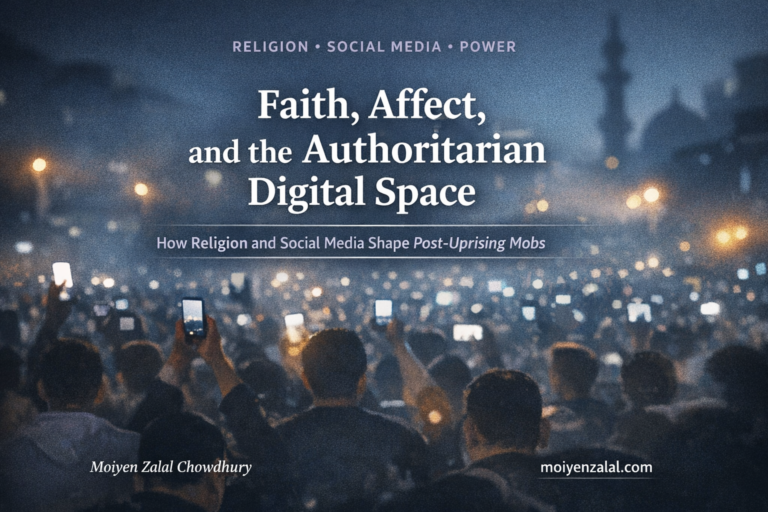
In earlier eras such narratives circulated through sermons, religious institutions, and printed texts. Today they move primarily through digital networks. Social media platforms amplify emotionally charged interpretations of conflict, allowing theological and civilizational narratives to travel rapidly across borders.
The result is a new interpretive environment that may be described as digital apocalypticism—a condition in which religious narratives, geopolitical events, and algorithmic communication systems interact to produce emotionally powerful interpretations of global conflict.
Understanding this phenomenon requires attention not only to the Middle East but also to distant societies such as Bangladesh, where global conflicts increasingly intersect with domestic digital politics.
To understand why geopolitical conflicts are interpreted through such symbolic frameworks, it is necessary to examine the deeper relationship between religion and political power.
Political Theology and the Moral Language of War
Political conflicts frequently adopt religious vocabulary because religion provides powerful symbolic frameworks for interpreting violence. Political theorists refer to this phenomenon as political theology, the process through which secular conflicts acquire sacred meanings.
Evangelical Apocalyptic Narratives in the United States
Among certain evangelical Christian communities in the United States, particularly those influenced by dispensational theology, geopolitical developments involving Israel are sometimes interpreted through biblical prophecy derived from the Book of Revelation. According to these interpretations, wars in the Middle East may represent signs preceding the final confrontation known as Armageddon, believed to occur before the return of Jesus Christ (Boyer, 1992; Spector, 2009).
Journalistic reporting in outlets such as The Guardian, BBC News, and The Atlantic has documented how prophetic interpretations occasionally shape public discourse within evangelical communities.
Typical social media narratives circulating during periods of escalation often resemble the following:
“Prophecy is unfolding before our eyes. Israel surrounded by enemies just like the Bible predicted.”
“Stand with Israel. The final battle between good and evil is approaching.”
Such narratives rarely originate from official state policy. Instead, they emerge from online communities where religious belief intersects with geopolitical interpretation.
Jewish Historical Narratives and Israeli Political Identity
Israeli political discourse also occasionally invokes historical and biblical symbolism linking contemporary security challenges to long narratives of Jewish survival.
International reporting from Reuters, The New York Times, and Israeli outlets such as Haaretz has noted how historical references sometimes appear in political rhetoric during periods of conflict.
Examples of narratives circulating in pro-Israel digital communities include:
“The Jewish people have survived thousands of years of persecution. We will survive this war as well.”
“Israel must defend itself just as our ancestors did.”
These narratives function primarily as expressions of historical identity and collective resilience rather than as formal policy frameworks.
Iranian Revolutionary Theology
Iranian political rhetoric reflects the ideological legacy of the 1979 Islamic Revolution. The Islamic Republic frequently frames geopolitical conflict through the language of resistance against oppression.
Concepts such as martyrdom, sacrifice, and justice play central roles within this ideological vocabulary (Nasr, 2006; Arjomand, 1988).
Social media narratives reflecting this discourse often appear in forms such as:
“Resistance against oppression is a sacred duty.”
“The oppressed will defeat the arrogant powers.”
Although Shiʿa theology contains eschatological beliefs regarding the eventual return of the Mahdi, mainstream Iranian political leadership generally refrains from presenting contemporary conflicts as the final apocalyptic confrontation.
Despite their differences, these narratives share a similar structure: they transform geopolitical conflict into moral dramas between justice and tyranny, good and evil, or faith and corruption.
Algorithmic Amplification and the Economy of Attention
Digital platforms dramatically accelerate the circulation of such narratives.
Platforms such as Facebook, YouTube, and X (Twitter) operate through algorithmic recommendation systems that prioritize engagement. Content generating strong emotional reactions—anger, fear, outrage, or moral conviction—receives greater visibility.
Research demonstrates that emotionally moralized content spreads significantly faster through social networks (Brady et al., 2017). Similarly, studies of information diffusion online show that sensational narratives frequently travel further than verified reporting (Vosoughi, Roy, & Aral, 2018).
This dynamic reflects the broader structure of the attention economy, in which online visibility functions as a scarce resource distributed through engagement metrics (Wu, 2016).
Within this environment geopolitical conflicts are frequently framed as civilizational struggles. Viral posts during regional escalation often resemble:
“This is not just politics. This is a war between civilizations.”
“The world is entering a prophetic moment.”
“Good and evil are confronting each other.”
Anthropologists describe this phenomenon as mythic compression, where complex geopolitical realities are reduced to simplified symbolic narratives.
Influencers, political commentators, and ideological entrepreneurs often gain visibility by producing emotionally intense interpretations of war. These narratives are not merely spontaneous expressions of belief; they function as attention-generating communication strategies.
Digital Apocalypticism as a Political Technology
Digital apocalyptic narratives should not be understood merely as religious beliefs circulating online. They function as a political technology of mobilization.
By framing geopolitical conflicts as civilizational or prophetic struggles, these narratives simplify complex political realities and generate emotionally cohesive publics. In algorithmically mediated environments such narratives gain visibility precisely because they produce strong engagement—fear, outrage, and moral certainty.
Digital apocalypticism therefore operates not only as a belief system but also as a communication strategy through which actors mobilize support, consolidate identity, and delegitimize compromise.
Through this process geopolitical conflicts acquire symbolic meanings that far exceed their immediate strategic contexts.
Platform Governance and the Politics of Moderation
Another dimension shaping digital war narratives is platform governance.
Technology companies attempt to regulate misinformation, propaganda, and incitement through moderation policies. Yet moderating political narratives during active conflicts presents significant challenges.
Journalistic investigations by outlets such as The New York Times, Reuters, and Al Jazeera have documented how social media platforms struggle to manage misinformation and propaganda during geopolitical crises.
Challenges include:
• distinguishing propaganda from political opinion
• identifying coordinated disinformation campaigns
• addressing state-sponsored information operations
• balancing free expression with harm prevention.
These tensions demonstrate that platform governance itself has become a central component of contemporary information warfare.
The global circulation of war narratives becomes particularly visible when examining how distant conflicts are interpreted within local political environments.
Bangladesh and the Global Circulation of War Narratives
Digital networks ensure that war narratives travel far beyond the regions where conflicts occur.
Bangladesh provides an instructive example of this phenomenon. Social media platforms frequently host intense commentary on Middle Eastern conflicts, where users interpret geopolitical developments through religious and moral frameworks rooted in local political culture.
Bangladeshi media outlets such as Prothom Alo, The Daily Star, and Dhaka Tribune have reported how international conflicts often provoke strong reactions within domestic online discourse.
Typical posts circulating during Middle Eastern escalation often resemble:
“The Muslim world is under attack again.”
“This war is not only about Iran. It is about justice.”
“Western powers always support Israel.”
These narratives connect distant geopolitical conflicts to local moral and political concerns.
Bangladesh, July 2024, and Vernacular Digital Archives
The connection between global war narratives and Bangladesh’s digital politics became particularly visible after the July 2024 uprising.
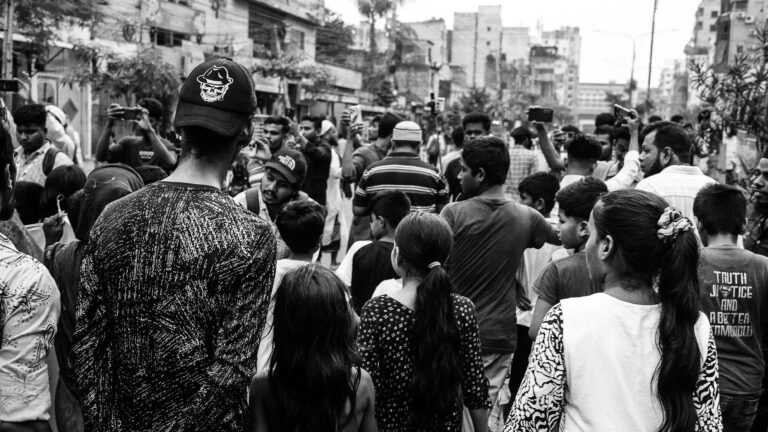
During the uprising, social media networks became central infrastructures of mobilization. Protesters circulated videos, eyewitness accounts, graffiti images, memes, and slogans that documented the unfolding events.
These materials formed what may be described as vernacular digital archives—decentralized collections of political expression produced by ordinary citizens rather than formal institutions.
Examples of narratives circulating during and after the uprising included posts such as:
“The streets belong to the people again.”
“The revolution is not over. It has only begun.”
“We will not return to silence.”
Images of protest graffiti circulated widely online, transforming physical urban spaces into digital political symbols. Photographs of slogans painted on city walls quickly became viral artifacts that traveled far beyond the streets where they were created.
In many cases these graffiti messages carried moral language similar to that found in global war narratives:
justice
resistance
betrayal
solidarity
freedom.
Such images illustrate how visual political expression becomes part of a broader digital archive of resistance.
The Global Circulation of Moral Economies
Global conflicts increasingly circulate through what may be described as transnational moral economies.
Digital media allow distant audiences to interpret geopolitical events through locally meaningful ethical frameworks. In Bangladesh, conflicts in the Middle East often appear in digital discourse as symbols of broader struggles over justice, imperial power, and religious solidarity.
These interpretations do not necessarily reflect direct geopolitical involvement. Rather, they demonstrate how global narratives become morally localized, interpreted through local expectations about fairness, oppression, and legitimacy.
Digital networks therefore create new forms of political identification in which individuals interpret distant wars as morally relevant to their own societies.
Vernacular Archives, Hidden Transcripts, and the Moral Economy of War
Anthropologists increasingly describe the symbolic artifacts circulating through digital networks—memes, protest images, graffiti, and viral slogans—as vernacular archives.
These archives function as informal repositories through which communities interpret political events.
The concept resonates with James Scott’s notion of hidden transcripts—informal narratives through which subordinate groups express political critique (Scott, 1990). In digital environments such narratives circulate publicly and rapidly, producing decentralized archives of political meaning.
Scholars such as Talal Asad and Saba Mahmood have also emphasized how modern political discourse intertwines religion, morality, and power (Asad, 2003; Mahmood, 2005).
Within these frameworks war becomes a moral economy, a field in which actors evaluate violence through shared ethical expectations.
Digital communication systems make this moral economy visible in everyday forms: memes, hashtags, viral posts, short videos, and graffiti images.
Visual Culture and the Digital Imagery of War
War narratives increasingly circulate not only through text but through visual culture.
Images of martyrdom, battlefield footage, symbolic graphics, and AI-generated war imagery circulate rapidly across platforms. These visual artifacts function as emotional anchors for ideological narratives.
Memes, protest posters, and viral videos compress complex geopolitical events into easily recognizable visual symbols. Such imagery often travels faster and further than textual analysis.
This visual circulation connects directly to the concept of vernacular archives. Graffiti walls, protest posters, and social media images all contribute to decentralized repositories of political meaning.
In digital environments these visual archives become central mechanisms through which communities interpret conflict.
Transformation of the Public Sphere
The circulation of war narratives through digital media reflects a broader transformation in the structure of the public sphere.
Classical theories of democratic communication assumed shared arenas for rational debate (Habermas, 1989). Contemporary digital platforms instead produce fragmented affective publics, where political discourse is organized around emotionally resonant narratives rather than deliberative argument (Papacharissi, 2015).
Within such environments geopolitical conflicts become symbolic resources through which communities construct identity and belonging.
War narratives therefore function not only as information about distant events but also as performative expressions of political affiliation.
From Shahbag to the Algorithmic Street: Bangladesh and the Global Moralization of War
To fully understand the circulation of war narratives in Bangladesh, it is necessary to situate contemporary digital discourse within a longer trajectory of political communication that began well before the July 2024 uprising. One of the most important turning points in this trajectory was the Shahbag Movement, a protest movement that demonstrated the transformative role of social media in shaping political mobilization in Bangladesh.
During the Shahbag protests, digital platforms functioned as what may be described as extensions of the street. Protest organizers used online networks to coordinate demonstrations, circulate images, produce slogans, and maintain a continuous flow of political communication between physical gatherings and digital audiences. Facebook pages, blogs, and online forums acted simultaneously as news channels, mobilization infrastructures, and arenas of ideological contestation.
Scholars studying digitally mediated protest movements have noted that such networked environments create what Manuel Castells describes as “networks of outrage and hope” (Castells, 2012). In these contexts, digital communication allows grievances, emotions, and symbolic narratives to circulate rapidly across dispersed publics.
In Bangladesh the Shahbag movement demonstrated how social media could generate a digitally mediated public sphere in which political narratives circulated outside traditional media institutions. Yet the same infrastructures that enabled mobilization also introduced new forms of political contestation.
In the years following Shahbag, digital platforms increasingly became sites of ideological polarization, moral contestation, and narrative warfare. Competing groups attempted to frame political events through moral narratives that mobilized identity, religion, and national history.
The July 2024 uprising intensified this process. Once again, digital platforms played a central role in circulating protest images, eyewitness documentation, and political slogans. Photographs of graffiti, protest posters, and handwritten messages rapidly spread across social networks, transforming urban walls into what may be called vernacular political archives.
Examples of viral graffiti and posts circulating online included messages such as:
“এই শহর আবার মানুষের।”
This city belongs to the people again.
“ভয় ভাঙলে রাষ্ট্র কাঁপে।”
When fear breaks, the state trembles.
“নীরবতা আর সম্ভব নয়।”
Silence is no longer possible.
These expressions illustrate how political meaning in contemporary Bangladesh increasingly emerges from decentralized forms of communication rather than centralized institutional discourse.
However, the digital infrastructures that enabled protest also facilitated the rapid circulation of global political narratives. Conflicts in Gaza, Iran, and the wider Middle East began appearing frequently within Bangladeshi digital debates. In many cases these conflicts were interpreted not merely as distant geopolitical events but as symbolic expressions of broader struggles between justice and oppression.
Typical posts circulating within Bangladeshi social media environments during periods of Middle Eastern escalation included:
“Palestine today, another Muslim country tomorrow.”
“The war in the Middle East shows how global power works.”
“Justice has no borders.”
Such narratives illustrate how geopolitical conflicts become embedded within local moral economies. Rather than remaining external events, they become symbolic resources through which citizens articulate ethical positions about power, injustice, and global hierarchy.
Digital platforms therefore create what might be described as an algorithmic street—a communication environment in which the symbolic energy of the physical street migrates into digital space. Protest slogans, graffiti, viral videos, and political commentary circulate through networks that blur the boundary between online and offline political life.
Within this algorithmic street, global conflicts such as the confrontation between the United States, Israel, and Iran acquire new meanings. They become part of the symbolic vocabulary through which citizens interpret political authority, legitimacy, and resistance within their own societies.
From an anthropological perspective, this phenomenon demonstrates that the contemporary experience of war is increasingly shaped not only by military strategy or diplomatic negotiation but also by networked infrastructures of meaning production.
In the digital age, wars do not remain geographically confined. They travel across platforms, languages, and political cultures, entering the moral imagination of societies far removed from the battlefield.
Bangladesh illustrates this transformation vividly. The same networks that once mobilized protest at Shahbag and circulated the visual archives of the July uprising now participate in a broader global circulation of narratives about justice, resistance, and geopolitical conflict.
The digital street, once a space of local mobilization, has become a global arena of political interpretation.
Taken together, these developments suggest that contemporary wars must be understood as both material conflicts and symbolic struggles over meaning.
These dynamics are not merely technological or geopolitical. They reflect deeper intellectual questions about how religion, morality, and political imagination interact in modern societies.
Theoretical Interventions: Religion, Moral Imagination, and the Networked Public
The global circulation of war narratives surrounding the United States, Israel, and Iran cannot be understood only through geopolitics or media studies. It also requires attention to the deeper intellectual traditions that explain how religion, morality, and public discourse interact in modern societies.
One of the most influential thinkers in this field is Talal Asad, whose work on political theology and secularism challenges the common assumption that modern politics operates independently from religion. Asad argues that the modern secular state does not eliminate religious reasoning; rather, it reorganizes how religious ideas circulate within public life (Asad, 2003). In contemporary conflicts this dynamic becomes visible when geopolitical events are interpreted through religious narratives, prophetic expectations, or moral cosmologies. The presence of such interpretations does not represent a return to premodern religious politics. Instead, it reflects the continuing entanglement of religion and power within modern political discourse.
A complementary perspective comes from Charles Taylor, whose concept of social imaginaries explains how societies construct shared frameworks for interpreting political reality (Taylor, 2004). Social imaginaries are not formal ideologies but collective ways of imagining the social world—shared narratives that make political events intelligible to ordinary citizens. In the context of global conflicts, religious and civilizational narratives function as elements of such imaginaries. When wars are interpreted as struggles between good and evil, justice and oppression, or civilization and barbarism, these narratives reflect deeper symbolic frameworks through which communities understand their place in the world.
The moral dimensions of war narratives have also been explored by Judith Butler through the concept of grievability (Butler, 2009). Butler argues that societies implicitly decide whose lives are publicly mourned and whose deaths remain invisible. In media representations of war, certain victims become symbols of moral outrage while others remain largely absent from public empathy. Digital media environments intensify this process by amplifying emotionally resonant images and narratives. Viral images of suffering, destruction, or martyrdom can transform particular lives into globally recognizable symbols of injustice.
This selective visibility plays a crucial role in shaping digital war narratives. Posts circulating on social media frequently frame particular casualties as evidence of moral truth while ignoring other forms of suffering. The result is not necessarily deliberate propaganda but rather the emergence of emotionally structured publics, where empathy and outrage become unevenly distributed across political communities.
A further dimension of these dynamics can be understood through the work of Asef Bayat, whose research on everyday politics in Muslim societies highlights the importance of informal political practices. Bayat’s concept of the politics of the ordinary emphasizes how everyday expressions—graffiti, street slogans, spontaneous protests, and small acts of resistance—can reshape political discourse (Bayat, 2013).
Digital environments extend these practices into new spaces of communication. Graffiti photographed on city walls, short protest videos, and viral memes become forms of everyday political expression circulating across networks. These materials form what might be called vernacular archives, decentralized repositories of political meaning produced outside formal institutions.
In Bangladesh this phenomenon became particularly visible during the Shahbag Movement and later during the July 2024 uprising, when protest graffiti, slogans, and social media posts created a continuous feedback loop between physical streets and digital networks. Walls, smartphones, and social media feeds became interconnected surfaces on which political meaning was written and rewritten.
Together, these theoretical perspectives illuminate how contemporary wars are interpreted within networked publics. Religious narratives, moral frameworks, and everyday political expressions combine with digital infrastructures to produce what may be described as a networked moral imagination.
In such environments, geopolitical conflicts no longer remain confined to diplomatic negotiations or military strategy. Instead they become part of a global symbolic field in which societies debate justice, identity, legitimacy, and the meaning of political violence.
If religious narratives provide the symbolic language through which wars are interpreted, digital platforms determine how widely those interpretations circulate.
Conclusion: War, Meaning, and the Algorithmic Public Sphere
The contemporary experience of war can no longer be understood solely through the frameworks of military strategy, diplomatic negotiation, or geopolitical rivalry. In the networked age, conflicts unfold simultaneously across battlefields and information infrastructures, where narratives travel through digital platforms at unprecedented speed.
The confrontation involving the United States, Israel, and Iran demonstrates how geopolitical conflict becomes embedded within broader symbolic frameworks that combine religion, ideology, historical memory, and digital media circulation. Evangelical prophecy narratives in the United States, historical survival narratives in Israel, and revolutionary resistance discourse in Iran all contribute to the interpretive environments through which war is understood.
These narratives do not operate in isolation. They interact with the architectures of digital platforms—recommendation algorithms, viral visibility, and network amplification—that reward emotionally charged interpretations of conflict. Within such environments, wars frequently appear not as strategic contests but as civilizational or moral struggles between good and evil.
Through global digital circulation these narratives travel far beyond the regions where conflicts occur. In Bangladesh, as in many other societies, geopolitical wars increasingly intersect with domestic debates about justice, power, and political legitimacy. Social media platforms allow distant conflicts to become symbolic resources through which citizens interpret their own political realities.
The history of digital mobilization in Bangladesh—from the Shahbag Movement to the networked circulation of protest imagery during the July 2024 uprising—demonstrates how digital infrastructures transform the relationship between political events and public interpretation. Graffiti walls, viral posts, memes, and short videos become components of decentralized archives through which societies record and interpret moments of political rupture.
Within this environment the digital public sphere no longer functions primarily as a space for deliberative debate. Instead it increasingly resembles what scholars describe as affective publics—networked communities organized around shared emotions, moral narratives, and symbolic identities.
Global wars therefore become narrative events, entering local moral economies through the infrastructures of digital communication.
Understanding contemporary conflicts requires attention not only to military power and diplomatic strategy but also to the politics of meaning production. Wars are fought with weapons, but they are interpreted through stories—stories that circulate through algorithms, images, and networks of belief.
In earlier eras wars were interpreted primarily by states, historians, and official media institutions. Today interpretation itself has become decentralized. Images, slogans, and narratives circulate through networks of ordinary users whose posts shape how conflicts are perceived around the world.
Within this networked environment religion, ideology, and algorithmic visibility intertwine to produce powerful narratives that transform geopolitical events into moral dramas. These narratives travel across continents, entering the political imagination of societies far removed from the battlefield.
The confrontation between the United States, Israel, and Iran therefore reveals a broader transformation in the nature of contemporary conflict. Wars are no longer fought only with weapons and diplomacy. They are also fought through the infrastructures of communication that determine whose suffering becomes visible, whose narratives gain authority, and how violence itself is understood.
In earlier eras wars were interpreted primarily by states, historians, and official media institutions. Today interpretation itself has become decentralized. Images, slogans, and narratives circulate through networks of ordinary users whose posts shape how conflicts are perceived around the world.
Within this networked environment religion, ideology, and algorithmic visibility intertwine to produce powerful narratives that transform geopolitical events into moral dramas. These narratives travel across continents, entering the political imagination of societies far removed from the battlefield.
The confrontation between the United States, Israel, and Iran therefore reveals a broader transformation in the nature of contemporary conflict. Wars are no longer fought only with weapons and diplomacy. They are also fought through the infrastructures of communication that determine whose suffering becomes visible, whose narratives gain authority, and how violence itself is understood.
In the digital age, the struggle over meaning may prove as consequential as the struggle over territory.
Author’s Intervention
This essay introduces the concept of digital apocalypticism to describe how contemporary conflicts circulate through networked communication systems. Rather than treating religious interpretations of war as marginal or irrational beliefs, the essay argues that such narratives operate as political technologies of mobilization within algorithmically mediated media environments. By transforming complex geopolitical conflicts into emotionally resonant moral dramas, digital apocalyptic narratives generate affective publics, consolidate ideological identity, and delegitimize compromise. Through transnational circulation these narratives travel far beyond the regions where conflicts occur, shaping political discourse in societies such as Bangladesh. The contemporary experience of war must therefore be understood not only through military and diplomatic analysis but also through the global infrastructures that produce and circulate meaning in the digital age.
References
Books
Arjomand, S. A. (1988). The turban for the crown: The Islamic revolution in Iran. Oxford University Press.
Asad, T. (2003). Formations of the secular: Christianity, Islam, modernity. Stanford University Press.
Bayat, A. (2013). Life as politics: How ordinary people change the Middle East (2nd ed.). Stanford University Press.
Benkler, Y., Faris, R., & Roberts, H. (2018). Network propaganda: Manipulation, disinformation, and radicalization in American politics. Oxford University Press.
Boyer, P. (1992). When time shall be no more: Prophecy belief in modern American culture. Harvard University Press.
Butler, J. (2009). Frames of war: When is life grievable? Verso.
Castells, M. (2012). Networks of outrage and hope: Social movements in the Internet age. Polity Press.
Habermas, J. (1989). The structural transformation of the public sphere: An inquiry into a category of bourgeois society. MIT Press.
Mahmood, S. (2005). Politics of piety: The Islamic revival and the feminist subject. Princeton University Press.
Nasr, V. (2006). The Shia revival: How conflicts within Islam will shape the future. W. W. Norton.
Papacharissi, Z. (2015). Affective publics: Sentiment, technology, and politics. Oxford University Press.
Scott, J. C. (1990). Domination and the arts of resistance: Hidden transcripts. Yale University Press.
Spector, S. (2009). Evangelicals and Israel: The story of American Christian Zionism. Oxford University Press.
Taylor, C. (2004). Modern social imaginaries. Duke University Press.
Wu, T. (2016). The attention merchants: The epic scramble to get inside our heads. Knopf.
Zuboff, S. (2019). The age of surveillance capitalism: The fight for a human future at the new frontier of power. PublicAffairs.
Academic Articles
Brady, W. J., Wills, J. A., Jost, J. T., Tucker, J. A., & Van Bavel, J. J. (2017). Emotion shapes the diffusion of moralized content in social networks. Proceedings of the National Academy of Sciences, 114(28), 7313–7318.
Vosoughi, S., Roy, D., & Aral, S. (2018). The spread of true and false news online. Science, 359(6380), 1146–1151.
Castells, M. (2008). The new public sphere: Global civil society, communication networks, and global governance. The ANNALS of the American Academy of Political and Social Science, 616(1), 78–93.
Dahlberg, L. (2007). Rethinking the fragmentation of the cyberpublic. New Media & Society, 9(5), 827–847.
Gerbaudo, P. (2016). Rousing the Facebook crowd: Digital enthusiasm and emotional contagion in the 2011 protests. New Media & Society, 18(11), 2545–2560.
Newspaper and Media Sources
Al Jazeera. (2024). Explainer: Rising tensions between Iran and Israel and the risk of regional war.
https://www.aljazeera.com
Al Jazeera. (2024–2025). Ongoing coverage of Middle East conflicts, Iran–Israel tensions, and U.S. regional strategy.
BBC News. (2024). Iran–Israel tensions: What is driving the conflict?
https://www.bbc.com/news
BBC News. (2024). Why some evangelical Christians see Israel’s wars through biblical prophecy.
Reuters. (2024). Israel warns Iran after regional attacks escalate.
https://www.reuters.com
Reuters. (2024). Iran vows retaliation amid rising tensions with Israel.
The Guardian. (2024). Christian Zionism and the politics of prophecy in the United States.
https://www.theguardian.com
The New York Times. (2024). Rising tensions between Israel and Iran reshape Middle East security.
https://www.nytimes.com
Haaretz. (2024). Israel’s strategic dilemmas in confronting Iran.
https://www.haaretz.com
South Asian / Bangladeshi Media Sources
Dhaka Tribune. (2024). Bangladeshi social media reactions to Middle East conflicts.
https://www.dhakatribune.com
Prothom Alo. (2024). Global conflicts and reactions in Bangladesh’s digital public sphere.
https://www.prothomalo.com
Somoy News. (2024). Middle East tensions spark debate among Bangladeshi youth online.
https://www.somoynews.tv
The Daily Star. (2024). How social media shapes Bangladeshi responses to global conflicts.
https://www.thedailystar.net
Key Concepts Referenced in the Essay
These works inform the main analytical frameworks used:
Political theology → Asad (2003)
Social imaginaries → Taylor (2004)
Grievability and moral framing → Butler (2009)
Everyday resistance → Scott (1990); Bayat (2013)
Digital public sphere → Habermas (1989); Castells (2008, 2012)
Affective publics → Papacharissi (2015)
Attention economy → Wu (2016)
Platform power → Zuboff (2019)