Why Truth and Reconciliation Keeps Failing in Bangladesh
And How Unresolved Grief Has Reshaped Bangladeshi Society and Its People
Why has Bangladesh never had a functioning Truth and Reconciliation Commission? This long-form essay examines 1971, Shahbag, Shapla, disappearances, July 2024, and how unresolved grief reshaped Bangladeshi society.
Abstract
Bangladesh has repeatedly reached moments when truth, justice, and reconciliation appear unavoidable—after 1971, after the Chittagong Hill Tracts conflict, following Shahbag and Shapla in 2013, during the blogger killings, through a decade of enforced disappearances, after the road safety movement of 2018, and again following the July–August 2024 uprising. Yet the country has never operationalized a national Truth and Reconciliation Commission (TRC) capable of producing shared truth, collective repair, or guarantees of non-recurrence.
This essay argues that the failure is not episodic or accidental but structural. Bangladesh exists in a condition of postponed conflict, where violence is deferred rather than resolved, grief is selectively recognized, and grievance is repeatedly weaponized. Drawing on anthropology, political theory, transitional justice scholarship, and Bangladeshi political history, the essay shows how the absence of truth and reconciliation has profoundly reshaped Bangladeshi society—normalizing fear, fragmenting moral community, exhausting citizens psychologically, and narrowing political imagination. The cost of not having a functioning TRC is not only political instability, but the steady erosion of ordinary social life.
1. Unfinished Time: Bangladesh as a Postponed-Conflict Society
Bangladesh is often narrated as a country that periodically “moves on” after crisis. In reality, it does not move on; it carries forward unresolved violence.
Anthropologist Veena Das shows that violence does not end with events but descends into everyday life—into habits of silence, caution, and moral ambiguity. Similarly, Walter Benjamin reminds us that history often appears not as progress but as accumulated catastrophe.
In Bangladesh, this means that:
- 1971 remains morally central but institutionally unsettled
- later conflicts are layered onto earlier ones rather than resolved
- each new crisis inherits the unresolved grief of previous decades
A Truth and Reconciliation Commission is meant to contain time—to draw a line between before and after. Bangladesh has never allowed such containment.
2. 1971: Partial Justice and the Birth of Weaponized Memory
After independence, Bangladesh initiated trials against collaborators but issued a general amnesty in 1973 (with exceptions). This produced partial justice without collective truth.
The result was not forgetting, but sacralized memory without reconciliation. 1971 became a permanent moral archive—periodically mobilized in politics, but never institutionally processed across social divides.
Without a truth commission, memory became:
- a source of legitimacy
- a weapon of accusation
- a recurring fault line in national identity
This unresolved origin shaped every later confrontation with violence.
3. Shahbag 2013: Moral Mobilization Without Plural Grief
The Shahbag movement transformed legal trials into a moral spectacle, demanding capital punishment for war criminals and invoking the language of martyrdom.
Shahbag was powerful—but narrow. It elevated one historical grief while marginalizing others, teaching society that justice is:
- punitive rather than reparative
- morally absolute rather than dialogic
- mobilizational rather than institutional
Without a TRC capable of holding multiple histories at once, Shahbag intensified polarization and normalized the idea that dissent equals betrayal.
4. Blogger Killings: When Truth Became Dangerous
Between 2013 and 2016, secular bloggers and publishers were assassinated by extremist groups. Investigations were slow; protection inadequate.
Here, truth itself became lethal.
The social lesson was devastating:
- speech carries risk
- critique invites death
- silence is safer than truth
A society cannot sustain truth commissions when truth is unsafe to speak.
5. Shapla Chattar: Denial as Governance
The 2013 security operation at Shapla Chattar produced disputed deaths and no credible public truth process.
Where Shahbag was hyper-visible, Shapla was erased.
This denial taught society that:
- some deaths will never be acknowledged
- numbers can be politically managed
- grief can be officially invalidated
Without a TRC, denial hardened into permanent distrust of the state.
6. Disappearances and the Suspension of Mourning
From 2014 onward, enforced disappearances became a defining feature of governance.
Disappearance is a form of violence that prevents grief from completing itself. Families are denied mourning, rituals, and closure. Society learns that people can vanish without explanation.
This is governance through temporal paralysis. Without reconciliation, disappearance does not end—it spreads fear horizontally across society.
7. Road Safety 2018: Ethical Grief Criminalized
The 2018 road safety movement was non-partisan, youth-led, and ethically grounded. It asked for accountability, not power.
Its repression revealed something crucial: even non-ideological grief is dangerous when it questions state competence.
Youth learned that moral clarity does not protect; it provokes punishment.
8. July 2024: Accumulation, Not Rupture
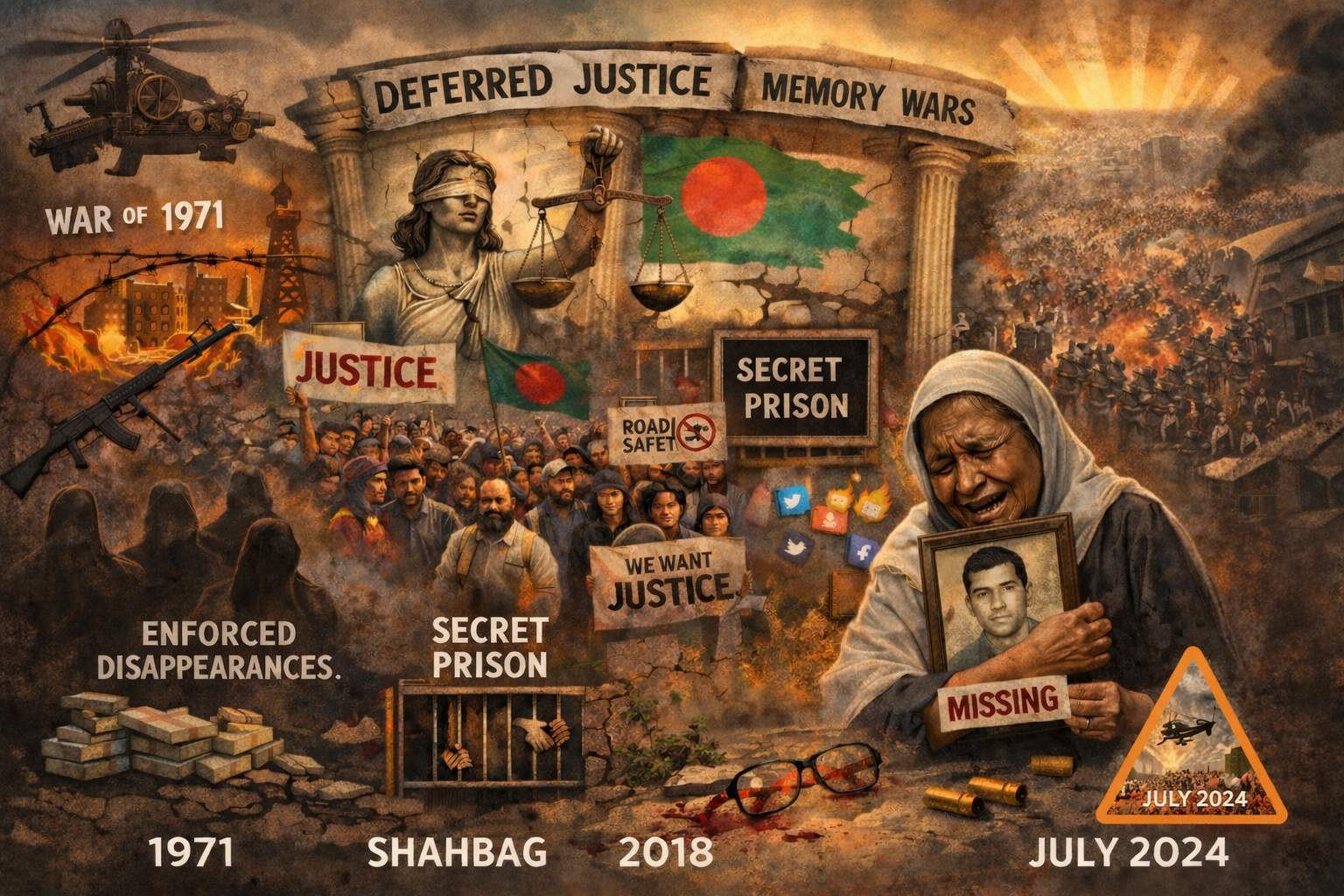
July–August 2024 was not a rupture. It was convergence:
- Shahbag’s moral absolutism
- Shapla’s denied deaths
- bloggers’ silenced truths
- disappearances’ suspended grief
- youth movements repeatedly crushed
What erupted was collective exhaustion—a society no longer able to carry deferred grief.
Without a TRC, July risks becoming another postponed rupture rather than a turning point.
9. The State as a Selective Listener of Grief
Drawing on Judith Butler, Bangladesh operates through hierarchies of grievability: some deaths are sanctified, others erased.
Through Michel Foucault, this is a regime of truth; through Achille Mbembe, it is necropolitical power.
A functioning TRC would require indiscriminate listening. This is precisely what the political order resists.
10. Grief, Grievance, and Political Control
Grief seeks recognition. Grievance seeks justice.
Power intervenes at the moment of conversion—allowing some grief to become grievance while freezing others in silence.
Anthropologist Katherine Verdery shows how the dead acquire political lives. In Bangladesh, they acquire political use—but rarely justice.
11. The Political Economy of Grief
Grief circulates through NGOs, media, donor regimes, courts, and parties as moral capital.
Drawing on Arjun Appadurai and David Graeber, grief generates legitimacy and attention, but rarely material repair.
A TRC would disrupt this economy by demanding accountability, redistribution, and closure—making it politically costly.
In recent years, however, this economy of grief has not remained confined to institutions. It has increasingly circulated through digital platforms, where visibility, speed, and moral intensity reshape how loss is recognized and contested.
12. Social Media as an Amplifier: How Grief Circulates, Hardens, and Disciplines
Social media has become a central arena through which collective grief, memory, and grievance circulate in Bangladesh. It intensifies and accelerates dynamics that already exist in a postponed-conflict society—selective recognition, moral absolutism, grievance conversion, and fear.
First, social media compresses complex histories into moral binaries. Long and unresolved trajectories—1971, Shahbag, Shapla Chattar, the blogger killings, enforced disappearances, July 2024—are condensed into emotionally legible symbols: martyr versus traitor, victim versus enemy, truth versus propaganda. This compression rewards certainty over complexity and immediacy over reflection.
Second, social media transforms grief into a visibility economy. Loss that circulates widely acquires legitimacy; loss that remains unseen risks social erasure. This produces parallel “archives of suffering,” each morally coherent yet mutually distrustful. Instead of shared truth, society experiences parallel truths.
Third, platforms function as disciplinary environments. Surveillance, harassment, and misinterpretation encourage self-censorship. People learn not only what to say, but where, when, and about which dead bodies. Empathy becomes risky; disagreement becomes dangerous.
Finally, in the absence of a functioning TRC, social media acts as a substitute arena for truth-telling—but without safeguards. There is testimony without protection, exposure without due process, and outrage without repair. Grief circulates endlessly, but never settles.
13. Social and Human Consequences: How Unresolved Grief Reshaped Society
The failure of truth and reconciliation has reshaped Bangladeshi society at the deepest level.
Fear becomes common sense. Silence becomes survival. Moral community fragments as victims are ranked and empathy becomes conditional. Youth inherit repetition rather than resolution, cynicism rather than trust.
As Émile Durkheim warned, social cohesion depends on shared moral frameworks. Bangladesh now lives with parallel moral worlds that rarely speak to each other.
Collective exhaustion follows. People are mobilized emotionally and abandoned institutionally. Politics narrows into zero-sum moral warfare. Repair becomes unimaginable.
Without reconciliation, ordinary life itself becomes fragile.
Conclusion: What It Costs Not to Have a TRC
Truth and reconciliation matter in Bangladesh not because they promise harmony, forgiveness, or closure.
They matter because without them:
- fear becomes normal
- grief becomes private burden
- politics becomes moral combat
- the future keeps shrinking
A functioning Truth and Reconciliation Commission would not solve everything.
But it would do something essential: it would make ordinary social life possible again.
The question Bangladesh now faces is no longer whether truth and reconciliation are desirable—but how long its people can afford the cost of living without them.
Author’s Note
This essay is written from a position of diagnostic inquiry, not advocacy.
It does not argue for reconciliation as harmony, forgiveness, or closure. Instead, it examines why truth and reconciliation have remained structurally elusive in Bangladesh, and what this prolonged absence has done to social life, political imagination, and everyday ethics.
The intention is not to adjudicate guilt or prescribe immediate solutions, but to name the conditions under which violence, grief, and grievance continue to recur. Any errors remain the author’s responsibility.
References
Benjamin, W. (1968). Theses on the philosophy of history. In Illuminations (H. Zohn, Trans.). Schocken Books.
Butler, J. (2004). Precarious life: The powers of mourning and violence. Verso.
Das, V. (2007). Life and words: Violence and the descent into the ordinary. University of California Press.
Durkheim, É. (1912/1995). The elementary forms of religious life (K. E. Fields, Trans.). Free Press.
Graeber, D. (2011). Debt: The first 5,000 years. Melville House.
Mbembe, A. (2003). Necropolitics. Public Culture, 15(1), 11–40. https://doi.org/10.1215/08992363-15-1-11
Odhikar. (2013). Fact-finding report on the Motijheel (Shapla Chattar) operation. Dhaka.
Office of the United Nations High Commissioner for Human Rights (OHCHR). (2006). Rule-of-law tools for post-conflict states: Truth commissions. United Nations.
Human Rights Watch. (2013). Bangladesh: Investigate protest deaths.
Human Rights Watch. (2016). Bangladesh: Investigate blogger killings.
Human Rights Watch. (2021). Crossing the line: Enforced disappearances in Bangladesh.
International Center for Transitional Justice (ICTJ). (2013). Truth-seeking: Elements of creating an effective truth commission.
Verdery, K. (1999). The political lives of dead bodies: Reburial and postsocialist change. Columbia University Press.
Reuters. (2013–2025). Coverage of political violence, protests, and memorialization in Bangladesh.
Amnesty International. (2015). Attacks on free expression in Bangladesh.
Amnesty International. (2018). Bangladesh: Stop attacks on student protesters.