Speaking Under Watch
Visibility, Loyalty, and the Populist Rewriting of Intellectual Life on Facebook in Bangladesh
How Facebook posts became social proof in Bangladesh—turning visibility into loyalty, fueling populism, and reshaping intellectual life under surveillance.
Introduction: When speech becomes evidence
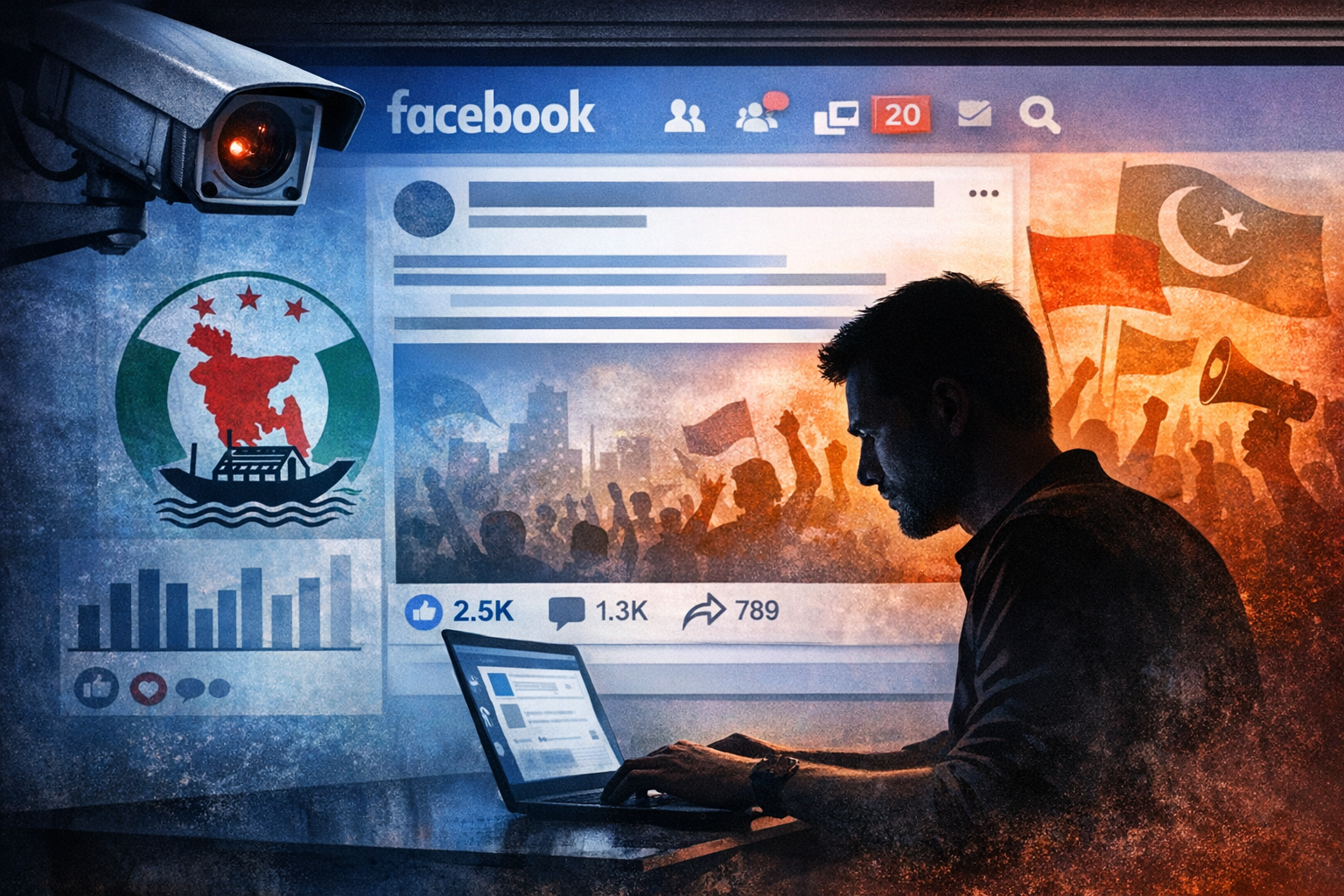
In Bangladesh today, Facebook is no longer simply a platform for opinion or debate. It has become a system of surveillance, valuation, and political classification, where intellectuals are read less for what they argue than for what their posts reveal about identity and loyalty (boyd, 2014; Foucault, 1977).
A Facebook post now functions as evidence:
- evidence of political alignment,
- evidence of moral positioning,
- evidence of belonging or betrayal.
This shift reflects a broader transformation of the public sphere under platform capitalism, where visibility and legibility replace deliberation as the primary modes of participation (Habermas, 1989; Poell, Nieborg, & van Dijck, 2021).
A long history: political legibility before platforms
Bangladesh’s public sphere has long been structured by moral–political sorting rather than open-ended debate. After 1971, public speech was assessed through binaries such as patriot/collaborator, producing a culture where ambiguity was treated with suspicion (Scott, 1998).
During the 1990s and 2000s, this logic was reorganized into party-based intellectual camps—pro/anti BNP and pro/anti Awami League—where intellectual credibility was often inferred from association rather than argument (Chowdhury, 2018).
The Shahbag movement in 2013 marked a decisive intensification: moral positioning became immediate, digital, and publicly auditable, with Facebook posts archived and weaponized to fix political identities (Udupa, 2017).
Facebook did not invent this history. It compressed and accelerated it.
Facebook posts as social proof
In contemporary Bangladesh, Facebook posts operate as social proof—signals used by audiences to infer loyalty, trustworthiness, and legitimacy (Marwick & boyd, 2011).
Posts are evaluated not only for content, but for:
- timing,
- silence,
- repetition,
- association.
Meaning is increasingly inferred from how a post circulates rather than what it carefully states (boyd, 2014).
Audience surveillance: from readers to auditors
The Facebook audience in Bangladesh behaves less like a readership and more like a distributed auditing system. Peers, students, activists, journalists, and anonymous users continuously monitor intellectual speech for alignment and deviation (Zuboff, 2019).
This reflects a form of horizontal surveillance, where citizens police one another using digital traces—an outcome predicted by Foucault’s analysis of disciplinary power operating through visibility rather than force (Foucault, 1977).
Here, disagreement is tolerated; ambiguity is not.
Social media social capital as political currency
On Facebook, social capital becomes quantifiable—followers, likes, shares, reach. In Bangladesh, this visibility capital is increasingly convertible into authority, legitimacy, and leadership (Bourdieu, 1991; Poell et al., 2021).
This conversion follows a recognizable sequence:
cultural capital → visibility capital → moral/political capital
As a result, visibility functions as a proxy for relevance, especially in the absence of strong intermediary institutions (Habermas, 1989).
Identity as currency, loyalty as performance
Under these conditions, political identity becomes transactional. Intellectuals are pressured to signal alignment repeatedly to maintain standing within moral communities (Udupa & Pohjonen, 2019).
Speech is evaluated less epistemically (“Is this accurate?”) and more relationally (“Whose side are you on?”). Posts become performative renewals of loyalty, rather than provisional interpretations (Mudde & Rovira Kaltwasser, 2017).
Failure to perform loyalty risks symbolic exile.
Analytical competition and narrative claiming
Platform research shows that social media environments transform public reasoning into attention-based competition, where speed and emotional clarity outperform verification and complexity (Tufekci, 2017; Sunstein, 2018).
In Bangladesh, this produces a competitive economy of analysis:
- early viral interpretations harden into truth,
- later nuance is dismissed as revisionism,
- intellectuals compete to “claim the narrative.”
James C. Scott’s concept of legibility is instructive here: the first dominant frame renders alternatives unintelligible (Scott, 1998).
The visibility–credibility paradox
A structural paradox now defines intellectual life:
Visibility is required to be credible,
but visibility actively undermines credibility.
To remain visible, intellectuals must simplify and signal; yet simplification erodes analytical integrity. This paradox has been documented globally (boyd, 2014; Sunstein, 2018), but in Bangladesh it is intensified by moral absolutism and loyalty testing.
Typologies as survival strategies
The six Facebook styles are not personalities; they are adaptations to a loyalty-based visibility regime:
- Quietists refuse metricized recognition, accepting invisibility (Scott, 1998).
- Declarativists trade complexity for safety under surveillance (Marwick & boyd, 2011).
- Moralists convert ethical claims into symbolic capital (Udupa, 2017).
- Explainers lose ground in speed-driven publics (Tufekci, 2017).
- Mobilizers translate visibility into action, risking surveillance (Tufekci, 2017).
- Inhabitational Strategists exit the competition altogether, redesigning time and exposure (Zuboff, 2019).
How this fuels populism
Populism thrives on moral binaries, identity clarity, and hostility to ambiguity (Müller, 2016; Laclau, 2005).
Facebook’s loyalty economy:
- rewards binary positioning,
- penalizes complexity,
- elevates symbolic alignment over expertise.
As a result, intellectuals are pressured to speak as representatives of “the people” rather than as analysts of structural problems—a classic populist dynamic (Mudde & Rovira Kaltwasser, 2017).
Why this is dangerous
For intellectual life, this environment discourages:
- revision,
- doubt,
- slow thinking.
For democracy, it replaces accountability with loyalty and debate with moral sorting (Habermas, 1989; Sunstein, 2018).
For society, complex crises are reduced to symbolic battles, allowing power to circulate without scrutiny (Zuboff, 2019).
Closing reflection
Bangladesh’s intellectual crisis is not a failure of courage. It is the outcome of a public sphere where identity functions as currency, loyalty as proof, and visibility as value.
Facebook did not create this history—but it turned loyalty into data, identity into metrics, and speech into evidence.
Until intellectual life is freed from functioning as social proof, the most subversive act will not be dissent, but thinking without signaling.
References
Ahmed, S., & George, C. (2020). Digital rights, digital repression and the politics of digital space in Bangladesh. Journal of South Asian Studies, 43(4), 735–753. https://doi.org/10.1080/00856401.2020.1818592
Amnesty International. (2020). Muzzling dissent online in Bangladesh. Amnesty International.
ARTICLE 19. (2023). Bangladesh: Cyber Security Act fails to protect freedom of expression. ARTICLE 19.
Bourdieu, P. (1991). Language and symbolic power. Harvard University Press.
boyd, d. (2014). It’s complicated: The social lives of networked teens. Yale University Press.
Chowdhury, M. Z. (2018). Social media, activism and the public sphere in Bangladesh. Journal of Bangladesh Studies, 20(1), 23–40.
Foucault, M. (1977). Discipline and punish: The birth of the prison. Vintage.
Goldhaber, M. H. (1997). The attention economy and the net. First Monday, 2(4). https://doi.org/10.5210/fm.v2i4.519
Habermas, J. (1989). The structural transformation of the public sphere. MIT Press.
Human Rights Watch. (2021). Bangladesh: Digital Security Act fuels repression. Human Rights Watch.
Laclau, E. (2005). On populist reason. Verso.
Marwick, A. E., & boyd, d. (2011). I tweet honestly, I tweet passionately: Twitter users, context collapse, and the imagined audience. New Media & Society, 13(1), 114–133. https://doi.org/10.1177/1461444810365313
Mudde, C., & Rovira Kaltwasser, C. (2017). Populism: A very short introduction. Oxford University Press.
Müller, J.-W. (2016). What is populism? University of Pennsylvania Press.
Poell, T., Nieborg, D., & van Dijck, J. (2021). Platforms and cultural production. Polity Press.
Scott, J. C. (1998). Seeing like a state: How certain schemes to improve the human condition have failed. Yale University Press.
Sunstein, C. R. (2018). #Republic: Divided democracy in the age of social media. Princeton University Press.
Tufekci, Z. (2017). Twitter and tear gas: The power and fragility of networked protest. Yale University Press.
Udupa, S. (2017). Gaali cultures: The politics of abusive exchange on social media. Duke University Press.
Udupa, S., & Pohjonen, M. (2019). Extreme speech online: An anthropological critique. Media, Culture & Society, 41(8), 1073–1091. https://doi.org/10.1177/0163443719884059
Zuboff, S. (2019). The age of surveillance capitalism. PublicAffairs.