Shahbag to July Bangladesh’s Digital Street: Who Owns It in 2026?
Shahbag transformed Bangladesh’s politics by creating a digital street where legitimacy is built through visibility. As 2026 nears, the fight is over who controls it.
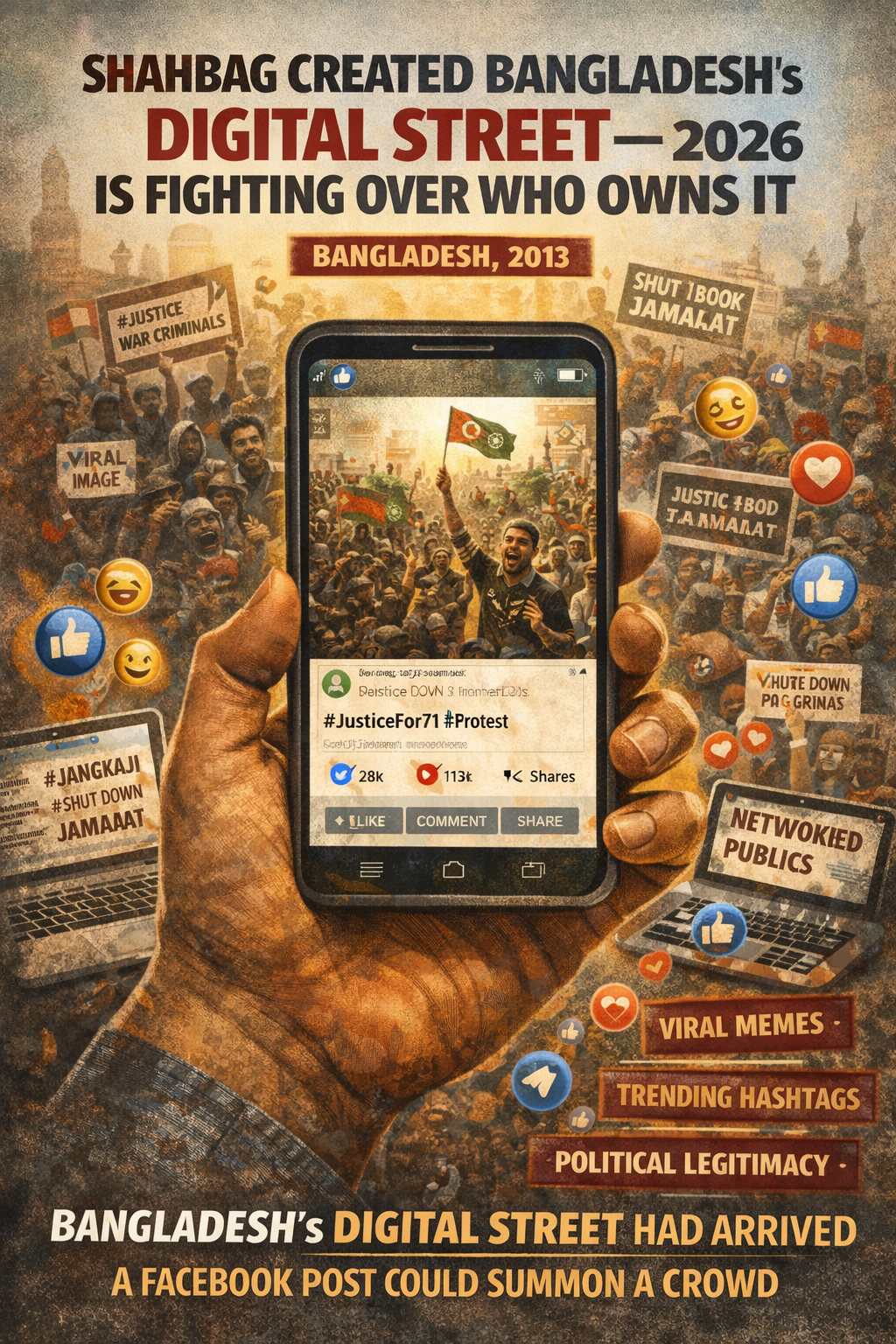
Shahbag Created Bangladesh’s Digital Street — 2026 Is Fighting Over Who Owns It
In 2013, something irreversible happened in Bangladesh’s political life. It did not take place in parliament, inside a party office, or even within a student union. It happened on Facebook.
The Shahbag Movement is often remembered as a protest demanding justice for war crimes. That is only its surface story. What Shahbag truly created was something much deeper: Bangladesh’s first digital street — a space where political legitimacy was produced not by organisations, but by networked publics.
Before Shahbag, politics in Bangladesh moved through familiar channels: party hierarchies, student wings, unions, street marches. After Shahbag, something new appeared. A post could summon a crowd. A hashtag could define who was moral and who was not. A viral image could transform a private grievance into a national cause.
This was not just mobilisation. It was a new way of being political.
From Rallies to Networks
Shahbag did not invent protest. But it fundamentally altered how protest worked.
For the first time at scale in Bangladesh, young people who were not members of any party could feel politically present. They did not need permission from a leader. They needed visibility. A shared post, a profile picture, a slogan typed into a comment box — these became acts of political participation.
The movement’s power did not come only from who stood in the square, but from who was seen standing there online. Facebook became a kind of moral theatre. To be silent was to be suspect. To be visible was to belong.
This was the birth of what we now take for granted: politics as a feed.
What Shahbag Really Taught the Political Class
Shahbag taught every political actor in Bangladesh a dangerous lesson:
Legitimacy could be manufactured by circulation.
If you could make your cause trend, it felt real.
If you could make your enemy go viral, they appeared guilty.
If you could dominate the timeline, you could dominate the meaning of events.
This is why Shahbag frightened the state — not primarily because of its demands, but because of its method. A generation had learned to organise itself without waiting for institutions.
What followed — cyber laws, surveillance regimes, online repression — was an attempt to reclaim control over that digital street.
But the street was already out of the bottle.
July 2024 Was Shahbag’s Ghost
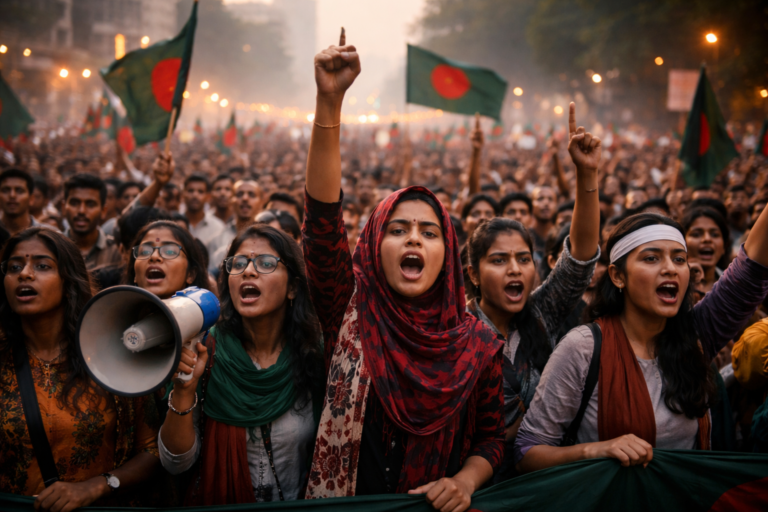
When students poured into the streets in July–August 2024, many observers described it as a new uprising. In another sense, it was a return.
Once again, political life was assembled online before it appeared offline.
Once again, young people became political without joining anything.
Once again, videos, images, and shared emotions moved faster than any party machine.
But something had changed.
The digital street of 2024 was no longer innocent. It was crowded with influencers, pages, algorithms, paid boosts, and propaganda networks. What Shahbag had created as a raw public space had become a platform economy of politics.
2026 Is Not Just an Election — It Is a Struggle Over Digital Territory
As Bangladesh moves toward the 2026 election, what is at stake is not only who will win seats. It is who will own the digital street that Shahbag created.
Every political force now understands that youth power flows through platforms. Islamist networks, nationalist blocs, reformist youth parties — all are attempting to occupy the same online terrain where legitimacy is produced through attention.
This is why contemporary politics feels less like debate and more like combat over narratives, clips, memes, and reputations.
What matters is not only what you stand for, but how you appear in the feed.
The Unfinished Legacy of Shahbag
Shahbag gave Bangladesh a new kind of political subject: the networked youth citizen.
But it did not decide who would control the infrastructure of that citizenship.
Thirteen years later, we are still living inside that unresolved question.
The digital street is still there.
It is louder, faster, more manipulated — but it remains the primary site where political meaning is made.
And in 2026, everyone is fighting over it.
“Dr. Moiyen Zalal Chowdhury, Anthropologist of digital politics and social movements in Bangladesh.”