July as a Turning Point: Moral Authority and Political Reordering in Bangladesh
“Secular” Authoritarianism, Islamic Populism, Structural Capture, and the Moral Reordering of Power
This essay is part of the Digital Dependency & Moral Volatility series—a collection of long-form analyses examining how social media addiction, dopamine-driven platforms, and algorithmic cultures are reshaping morality, authority, and offline social life globally and in Bangladesh.
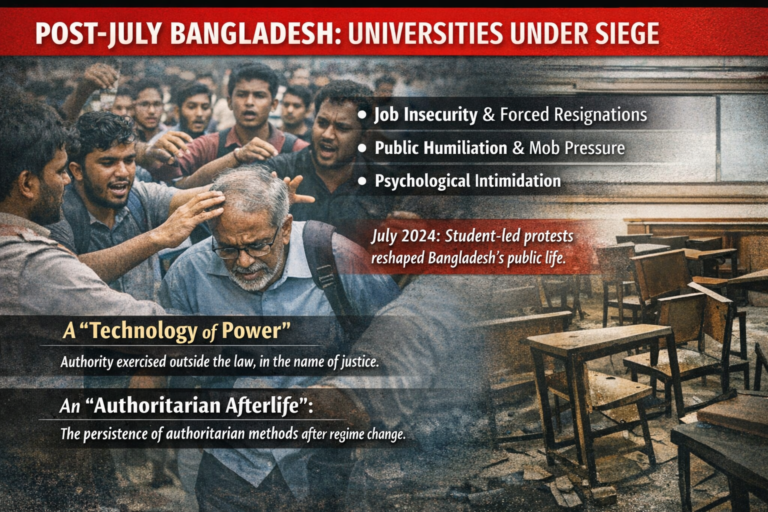
July was not an event—it was a moral rupture
July did not simply weaken a government. It collapsed a moral centre.
For more than a decade, Bangladesh was governed through a carefully managed political order: a party-centric system sustained by a performance of “secular” authority, cultural modernity, and institutional inevitability. Elections occurred, institutions functioned, and order was maintained—but moral legitimacy increasingly relied on management rather than consent (Devine, 2019).
July shattered that arrangement.
What broke was not only confidence in institutions, but trust in the moral grammar through which authority justified itself. In moments like this, societies do not first reorganize policy. They reorganize moral legitimacy—who is credible, who represents “the people,” who is allowed to speak (Asad, 2003; Bayat, 2013).
That is why, after July, the most urgent public question has not been who should govern, but who counts as morally legitimate.
In Bangladesh, this question has condensed into a familiar but volatile category: the “good Muslim.”
The “good Muslim” as a political category
The “good Muslim” under discussion here is not a theological ideal. It is a political and social classification.
In everyday Bangladeshi life, it signals:
- trustworthiness,
- cultural legitimacy,
- moral respectability,
- and political safety.
Such categories become especially powerful before elections, when institutional trust is low and moral shortcuts replace deliberation (Mudde & Kaltwasser, 2017).
After July, this category matters because politics itself appears morally compromised.
From performative piety to ethical exposure
Under prolonged authoritarian conditions, public religiosity often functioned as a protective performance. Visible piety allowed individuals to remain socially respectable while minimizing political risk (Huq, 2009).
July altered this moral economy.
After July:
- silence began to look like complicity,
- neutrality appeared evasive,
- ethical ambiguity lost value.
Moral worth increasingly came to be judged by ethical exposure—who spoke, who documented, who justified violence, who remained quiet.
This is not secularization. It is a reconfiguration of faith as ethical burden rather than symbolic shield (Mahmood, 2005).
Digital Islam and the political economy of morality
This shift cannot be understood without attending to Bangladesh’s digital religious economy, particularly Facebook-based commerce (f-commerce).
Over the past decade, f-commerce has become a crucial infrastructure where:
- religious trust,
- moral credibility,
- consumer loyalty,
- and community belonging
are produced simultaneously (Eickelman & Anderson, 2003).
Islamic language here does not merely express belief—it creates value.
After July, these networks quietly transformed into moral-political infrastructures:
- political positions were implied rather than named,
- criticism was framed as disrespect to Islam,
- silence was coded as prudence or loyalty.
Islam did not newly enter politics. July activated a moral economy already embedded in everyday digital life.
Islamic populism without ballots
Islamic populism in Bangladesh did not grow primarily through electoral competition. It grew through moral narration.
Its logic is recognizably populist:
the morally pure people versus corrupt elites
(Mudde & Kaltwasser, 2017)
But expressed through religious ethics, it gains:
- emotional immediacy,
- immunity from political scrutiny,
- and everyday legitimacy.
This allowed moral authority to expand without the burden of governance.
The orchestrated contradiction of “secular” authoritarianism
Crucially, this populism did not emerge despite authoritarian rule. It emerged through a party-managed version of “secular” authoritarianism.
Under this system:
- political contestation was narrowed,
- dissent was disciplined,
- cultural nationalism was monopolized,
- and religious expression was ranked rather than excluded (Devine, 2019).
Religion was displaced from politics—but not neutralized.
It was repositioned as moral speech.
The paradox was decisive: politics was hollowed out, morality was empowered.
Party loyalists and the outsourcing of moral authority
This arrangement was mediated by party-aligned intermediaries—media professionals, NGO figures, cultural brokers, online influencers—who performed “secular” authority while dismissing ethical critique as extremism or backwardness.
In doing so, they outsourced moral legitimacy.
Religious populist actors could then claim:
- authenticity without accountability,
- moral clarity without institutional responsibility.
This is how moral power migrates under authoritarian conditions (Asad, 2003).
Structural positioning: power beyond elections
Rather than prioritizing electoral victory, Islamic populist actors invested in structural positioning:
- education and coaching networks,
- welfare and charity,
- mediation and dispute resolution,
- digital commerce,
- informal cultural authority.
Power moved horizontally, embedding itself in everyday life.
July transformed this from latent presence into recognized moral authority.
Why July made this possible
July acted as a multiplier.
- It delegitimized the “secular” moral centre.
- It hollowed institutions of ethical credibility.
- It normalized religious moral speech as political language.
- It re-ranked risk: silence became costly; moral certainty became safe.
- It exposed the limits of electoral imagination.
When ballots appeared insufficient, moral reform felt actionable.
Language wars and identity crisis
Post-July moral struggle increasingly takes linguistic form.
Arabic-inflected Islamic language circulates as authenticity.
Bangla cultural language is recoded as suspect.
This linguistic sorting reflects a deeper identity crisis produced by prolonged depoliticization (Anderson, 1983; Hobsbawm, 1990). When civic identity weakens, religious identity rushes in to fill the vacuum.
Selective empathy and moral contradiction
Before elections, moral boundaries harden.
Violence against religious minorities at home is often relativized, while violence against Muslim minorities abroad rightly mobilizes outrage (Human Rights Watch, 2023).
This asymmetric empathy reveals morality operating as politics.
Iran as comparative warning
Iran’s 2022–23 uprising illustrates the endpoint of moral monopoly. When the state defines the “good Muslim,” legitimacy eventually inverts: disobedience becomes ethical credibility (Dabashi, 2023).
Bangladesh is not Iran. But the warning is structural, not theological.
After the election: structural scenarios opened by July
The election will matter—but not as a moral reset.
July altered the terrain on which elections now operate. What follows depends less on electoral outcomes than on how moral authority circulates afterward.
Three structural trajectories are now possible.
Scenario 1: Moral consolidation beyond electoral power
Moral authority may consolidate outside formal office. Actors embedded in education, welfare, commerce, and digital platforms may continue shaping everyday judgments of legitimacy regardless of electoral results. Politics stabilizes, but moral sorting intensifies (Bayat, 2013).
Scenario 2: Informal moral enforcement
Where institutional authority remains fragile, morality can migrate into social sanction, reputational punishment, and digitally mediated surveillance—especially affecting women, minorities, and dissenters. Moral speech risks becoming coercive rather than persuasive (Dabashi, 2023).
Scenario 3: Moral exhaustion and ethical rupture
When moral claims become selective or opportunistic, they lose credibility. What follows is withdrawal, refusal, and quiet dissent—an ethical distancing from moral performance itself (Asad, 2003).
None of these trajectories depends primarily on who wins the election.
Conclusion: the ethical question July leaves behind
July shifted the centre of gravity from institutions to morality.
Elections can redistribute offices, but they cannot easily reclaim moral authority once it has dispersed into everyday life, language, economy, and digital networks.
This is why the coming election is different.
The struggle is not Islam versus “secularism.”
It is about who controls moral authority after July—and how that authority is exercised.
The most consequential question after the election, then, is not:
Who governs?
It is:
What kind of moral authority will be allowed to shape everyday life—and who will be protected, disciplined, or erased in its name?
That question, once opened by July, will not be settled at the ballot box.
Dr. Moiyen Zalal Chowdhury
References (selected)
Asad, T. (2003). Formations of the Secular. Stanford University Press.
Bayat, A. (2013). Life as Politics. Stanford University Press.
Devine, J. (2019). The paradox of state Islamisation in Bangladesh. Contemporary South Asia.
Mahmood, S. (2005). Politics of Piety. Princeton University Press.
Mudde, C., & Kaltwasser, C. R. (2017). Populism. Oxford University Press.
Eickelman, D., & Anderson, J. (2003). New Media in the Muslim World. Indiana University Press.
Dabashi, H. (2023). The End of Two Illusions. Zed Books.
Human Rights Watch. (2023). World Report.
Anderson, B. (1983). Imagined Communities.
Hobsbawm, E. (1990). Nations and Nationalism since 1780.