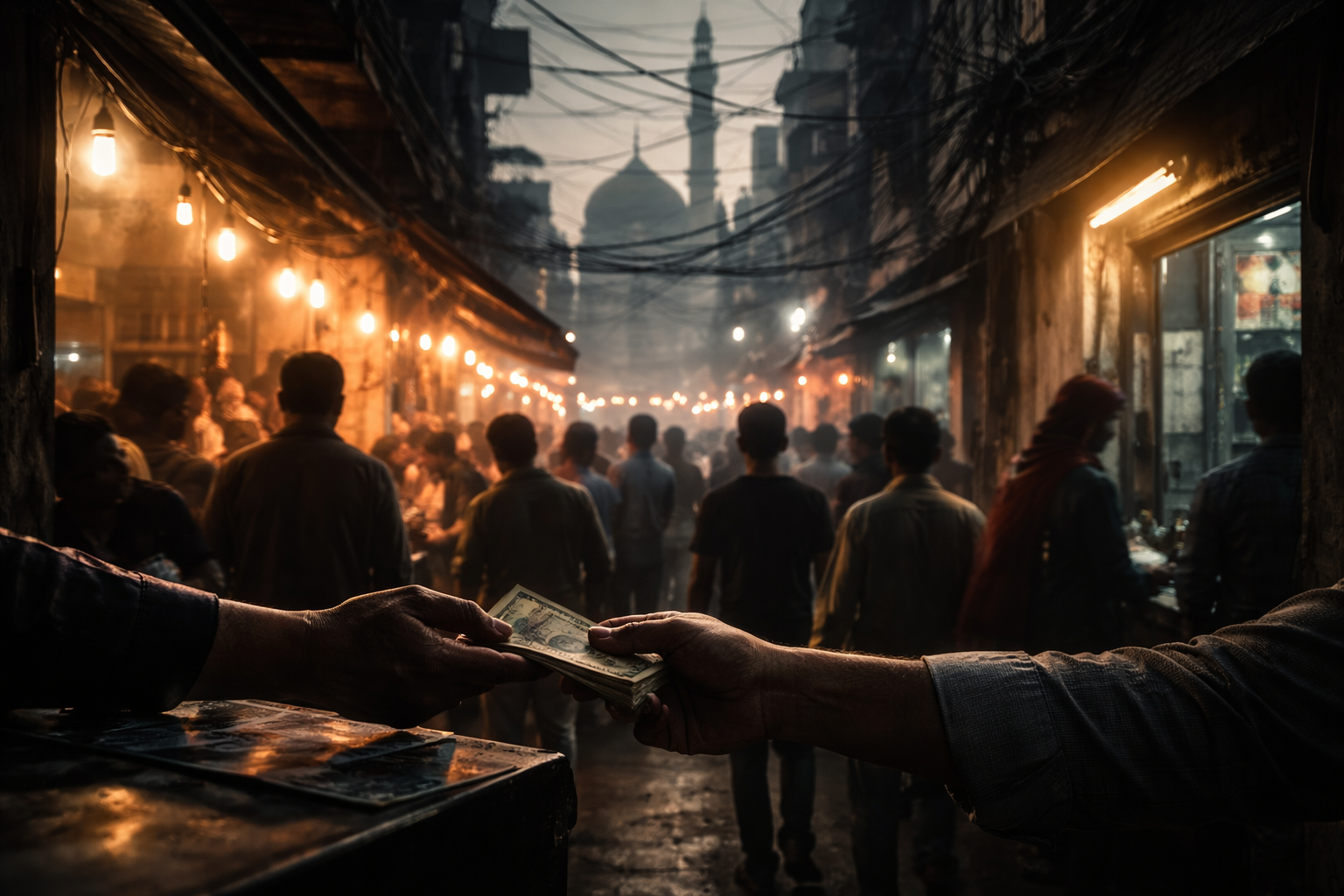
When Moral Economy Replaces the State
Women, Money, Malleability, and Power in Contemporary Bangladesh
A long-form essay examining how moral economy replaces rights under authoritarian state failure in Bangladesh, and how women’s power is recomposed through care, finance, and digital governance.
What happens to gender, power, and legitimacy when the state becomes unreliable and morality replaces rights as the main organizing principle of survival.
Editor’s Note
This essay is shared as a working paper and forms part of a larger book-length project examining moral economy, gender, and governance in contemporary Bangladesh. It is published here to invite careful engagement rather than immediate consensus. The argument developed in the text is diagnostic rather than prescriptive, grounded in long-term ethnographic observation, digital ethnography, and comparative scholarship. While the analysis centers on Bangladesh, the dynamics discussed—moralized survival, gendered authority beyond the state, and the displacement of rights under authoritarian conditions—extend beyond any single national context. The essay is made publicly available in its current form to allow the argument to circulate, be tested, and be refined prior to formal academic publication.
Abstract
This essay examines how prolonged state failure and authoritarian governance in Bangladesh have reshaped the relationship between political economy and moral economy, producing a social order in which survival, legitimacy, and power are increasingly organized through morality rather than rights. Focusing on women’s leadership, financial circulation, and everyday strategies of adaptation, the essay argues that movements such as Jamaat-e-Islami do not merely exploit this transformation but are structurally well positioned to inhabit it. Drawing on long-term ethnographic observation (2019–2025), digital ethnography, and comparative scholarship, the essay demonstrates that women’s exclusion from formal leadership does not signal political absence, but the operation of a gendered power regime in which authority is infrastructural, moralized, and increasingly digital. COVID-19, social media commerce, and authoritarian normalization accelerated these dynamics. Bangladesh is not witnessing a rollback of women’s power, but its recomposition—one that renders liberal, rights-based, and secular feminist frameworks analytically insufficient, though not normatively obsolete.
While grounded in Bangladesh, the dynamics analyzed here—moralized survival, classed visibility, and gendered governance beyond the state—are increasingly visible across diverse political contexts marked by authoritarianism, institutional fragility, and digital mediation.
1. Introduction: Why the Wrong Questions Keep Being Asked
Debates on women’s leadership, political legitimacy, and funding in Bangladesh are often framed through institutional absence: the absence of women from party hierarchies, the absence of transparency in political finance, the absence of reliable state provision, and the absence of democratic accountability. These absences are real. Yet focusing on absence alone obscures a more consequential transformation: the relocation of power away from institutions and into moral, relational, and gendered infrastructures of everyday life. This obscurity is compounded by the assumption that concepts such as feminism, empowerment, or modesty carry stable meanings across social contexts. In practice, these concepts are translated through class, risk, and survival, producing radically different political effects.
This essay advances a demanding claim: in Bangladesh, repeated state failure under authoritarian governance has made moral economy not a cultural preference but a structural necessity. As a result, women’s labor—economic, moral, affective—has become central to political durability, even as women remain largely absent from formal leadership positions. Leadership, funding, and governance now operate through circulation rather than command, malleability rather than confrontation, and moral legitimacy rather than legal authority.
To substantiate this claim, the analysis begins by clarifying how authority is located, observed, and interpreted beyond formal institutions.
Author’s Intervention
This essay advances a diagnostic intervention rather than a normative prescription. It proposes that under conditions of prolonged state failure and authoritarian normalization, moral economy increasingly operates as a form of para-state governance—organizing survival, legitimacy, and authority where legal institutions are unreliable, politicized, or unsafe to confront. Within this configuration, women’s power does not retreat but is structurally recomposed: displaced from formal office into moral infrastructure, financial circulation, affective labor, and digitally mediated governance. By tracing how gendered authority, money, and legitimacy are reorganized through everyday practices rather than institutions, the essay contributes to broader debates on gender, political economy, and authoritarianism by showing how power survives without visibility, how governance persists without the state, and why liberal and rights-based frameworks struggle not because they are normatively wrong, but because the conditions that make them actionable have eroded.
2. Methodological Note: Locating Authority
This analysis is based on long-term ethnographic engagement across urban and peri-urban Bangladesh between 2019 and 2025. Methods include participant observation, informal conversations, and digital ethnography of women-only spaces, household economies, informal welfare networks, and Facebook-based commerce groups. Rather than relying on elite interviews or official doctrine, the argument is grounded in recurrent everyday practices observed across social locations, including pandemic and post-pandemic conditions. Comparative insights are drawn from secondary scholarship on Islamist movements in South Asia and the Middle East.
Particular attention is paid not only to practices, but to how political and moral concepts—such as freedom, modesty, respectability, and empowerment—are translated into everyday strategies under unequal conditions of risk.
This methodological orientation allows gender to be analyzed not as representation alone, but as design and infrastructure.
3. Gender as Design: Why Women’s Leadership Is Displaced, Not Denied
From its Maududian foundations, Jamaat-e-Islami conceptualized gender differentiation as functional design, not transitional inequality. Women were positioned as morally sovereign within bounded domains—family, ethical reproduction, care, and community legitimacy—while formal political authority remained male-dominated. This arrangement was framed not as exclusion but as complementarity.
After 1971, when Jamaat faced bans, stigma, and repression, this design hardened into a survival strategy. As formal politics became inaccessible, the private sphere became the movement’s primary infrastructure. Women’s authority expanded precisely because it was exercised away from visibility and contestation. Leadership was displaced from office into moral reproduction, financial stabilization, and affective endurance.
This design logic is not merely implicit; it is periodically articulated with remarkable clarity by women leaders within Islamist organizations themselves. In a widely circulated press statement, a senior woman figure associated with Jamaat-e-Islami argued that women’s access to top leadership positions is neither necessary nor desirable, framing authority not as office or hierarchy but as responsibility, moral labor, and contribution to collective endurance. Such statements do not deny women’s power; they redefine it. By explicitly separating “position” from “power,” this articulation neutralizes liberal feminist critiques that equate empowerment with representation, while simultaneously affirming women’s indispensability to moral reproduction and organizational durability. Importantly, this argument is not voiced in opposition to patriarchy, but from within it—demonstrating how gendered authority is stabilized through women’s own moral testimony. Rather than signaling confusion or contradiction, such declarations reveal a coherent political theology in which women’s exclusion from formal leadership is reframed as ethical protection, dignity, and strategic positioning under conditions of state failure and political risk. This is not a rejection of women’s agency, but its redirection into infrastructural domains where power operates without visibility and where moral legitimacy substitutes for institutional authority.
There is no singular feminism and no singular modesty in Bangladesh. Both are translated through class, risk, and survival, and both acquire meaning not in abstraction, but in relation to who can afford visibility and who must manage its consequences. Jamaat-e-Islami’s strategic strength lies precisely in governing this translation. Rather than imposing a singular moral code, it offers a framework in which modesty functions as protection rather than purity, and women’s restraint is framed as dignity rather than exclusion. Feminism, encountered by many as visibility without shelter, is counter-translated as exposure without insurance. Under conditions of state failure and authoritarian risk, this translation does not require ideological conversion; it requires only alignment with survival.
Statements by women leaders within Islamist organizations further clarify how gendered authority is redefined rather than denied. When the secretary of Jamaat-e-Islami’s women’s wing publicly asserted that men are the “managers” of women, while simultaneously arguing that securing women’s rights is more important than placing women in top leadership positions, the apparent contradiction was not accidental. This formulation explicitly separates rights from authority, reframing empowerment as protection and management rather than decision-making or autonomy. By doing so, women’s political absence from formal leadership is presented not as exclusion but as ethical prioritization—where care, security, and moral order outweigh representation. Crucially, this argument is voiced by women themselves, lending moral legitimacy to a hierarchical structure while neutralizing liberal feminist critiques that equate empowerment with visibility or office. Such articulations reveal how patriarchy is stabilized not only through male dominance, but through gendered moral testimony that recasts management as care and subordination as responsibility.
Gendered authority, however, cannot be understood without tracing how money circulates through moral infrastructure.
4. Funding Without Spectacle: The Moral Economy of Money
Public discussions of Islamist funding often search for spectacular sources: foreign donors, centralized party accounts, illicit transfers. This essay takes a different approach. The relevant question is not where the money comes from, but how money circulates, stabilizes, and becomes morally legitimate.
Four interlocking financial streams are visible:
- Routine member contributions, framed as ethical obligation rather than political payment.
- Decentralized business ecosystems, legally individual but ideologically aligned, reducing institutional vulnerability.
- Religious charity and welfare, functioning as capital formation rather than expenditure.
- Household finance managed by women, including savings, remittances, emergency funds, and increasingly digital income.
Women do not “fund the party” in liberal accounting terms. They make the movement livable—absorbing shocks, sustaining families, underwriting everyday logistics. This is gendered financial infrastructure, largely invisible to institutional political economy. In contexts where legal accountability is weak and financial transparency is selectively enforced, moral trust often substitutes for institutional trust, allowing money to circulate with less visibility but greater durability.
These dynamics became unmistakable during moments of systemic rupture.
5. COVID-19 as Accelerator, Not Exception
The COVID-19 crisis did not create these dynamics; it confirmed them. As state and NGO systems faltered, households became safety nets. Moral reputation determined access to help. Informal networks outperformed formal ones.
Women absorbed the shock through unpaid care, informal redistribution, and moral justification of endurance. Islamist-aligned moral economies gained legitimacy not because of ideology, but because they worked when institutions did not. COVID-19 accelerated the shift from institutional finance to moral finance, reinforcing survival through relationships rather than rights.
At the same time, the pandemic intensified the digitization of moral and economic life.
6. Digital Commerce and Algorithmic Moral Authority
The pandemic also accelerated Facebook-based commerce, where women act as sellers, brokers, and trust managers. These markets rely on moral signaling—modesty, piety, trustworthiness—rather than contracts or consumer protection.
Algorithms amplify affect: trust, outrage, virtue. Moral reputation becomes datafied capital. Income is flexible, socially legitimate, and easily embedded into family obligation rather than personal autonomy. Markets, rather than secularizing morality, now reward it algorithmically. Yet the risks attached to visibility are unevenly distributed. For some women, digital exposure creates income and autonomy; for others, it invites harassment, moral sanction, or family conflict. The same visibility that enables opportunity also intensifies discipline, depending on class position and social protection.
These processes unfold within a broader political condition defined by chronic state failure.
7. State Failure as Structural Condition
Moral economy does not flourish despite the state; it flourishes because of the state’s failures. Historically, the Bangladeshi state has been widely experienced as partisan, elite-biased, selectively coercive, and unreliable in care. Access to justice, welfare, and protection has often depended on alignment, mediation, or loyalty rather than citizenship.
In such contexts, rights become risky, but relationships become reliable. Moral economies offer predictability where institutions cannot. Under such conditions, moral judgments travel faster and more safely than legal claims, because they do not require institutional mediation or confrontation with state power.
Authoritarian governance intensifies these conditions and reshapes political competence itself.
8. Authoritarian Governance and the Politics of Malleability
Authoritarian governance intensifies this condition. Corruption becomes systemic rather than deviant; assimilation replaces opposition; discretion replaces rule. Citizens learn that consistency is dangerous, visibility invites punishment, and rigidity attracts risk.
What emerges is malleability as a way of life—the capacity to bend, adapt, recalibrate, and survive without breaking. Malleability here should not be mistaken for passivity; it is an active, learned political competence developed in response to unpredictable authority and uneven punishment.
Women are structurally positioned to embody this malleability. Their social roles already emphasize adjustment, endurance, relational labor, and emotional regulation. Under authoritarian pressure, these become politically valuable skills. Authority grows through responsibility, not recognition.
Prolonged authoritarian governance does not only discipline women into adaptive moral labor; it also trains men—especially those embedded in or adjacent to state mechanisms—into forms of strategic malleability. Over time, survival requires not ideological consistency but tactical recalibration. Voting, silence, moderation, sudden moral repositioning, and selective outrage are not signs of confusion; they are learned competencies cultivated under discretionary rule. What distinguishes gender is not malleability itself, but how it is recognized: men’s adaptability is framed as pragmatism, while women’s is absorbed as responsibility.
Islamist moral economies are particularly effective here because they do not confront authoritarian power head-on; they inhabit its gaps and blooms in favorable condition.
The convergence of political economy and moral economy produces distinct and visible social consequences.
9. When Political Economy and Moral Economy Merge:
The Visible Social Consequences in Bangladesh
9.1 Inequality Is Moralized Rather Than Contested
Economic hardship is increasingly explained through moral categories—patience versus entitlement, discipline versus laziness. Inequality becomes survivable but unspeakable. Endurance is praised; protest is morally downgraded. Class suffering persists, but its language of collective grievance erodes.
9.2 Women’s Centrality Increases as Their Voice Narrows
Women’s labor expands across garments, care, informal trade, and digital commerce. Yet legitimate political claims contract. Women are celebrated as stabilizers but discouraged as claim-makers. This produces responsibility without authority.
9.3 Welfare Shifts from Citizenship to Virtue
Aid flows through moral judgment rather than entitlement. Gratitude replaces accountability; shame replaces rights. Survival becomes conditional on reputation.
9.4 Markets Are Moralized Rather Than Neutral
Economic success depends on being morally credible. Trust, modesty, and virtue become economic assets. Opportunity expands under surveillance.
9.5 Masculinity Is Stabilized Through Women’s Labor
Male authority persists even when provision falters, because women absorb shock and justify endurance. Patriarchy becomes less visibly coercive but more dependent.
9.6 Law Loses Moral Authority; Morality Gains Legal Effect
Disputes are resolved through mediation rather than courts. Justice becomes situational and unequal. The vulnerable avoid law to preserve respectability.
9.7 Collective Action Gives Way to Moral Optimization
People focus on self-discipline and family advancement. Conflict declines; transformation stalls. Stability is achieved without justice.
Public statements claiming that women support Islamist politics because they do not seek “Western-style equality” perform an important ideological function: they translate hierarchy into consent. By framing women’s political alignment as a rejection of rights-based equality rather than as a negotiation with precarity, risk, and social survival, such narratives erase the structural conditions under which choices are made. This discourse does not merely oppose feminism; it redefines women’s agency as moral restraint, portraying demands for equal rights as excess rather than entitlement. In doing so, it converts political exclusion into ethical preference and renders hierarchy legible as cultural authenticity. The power of this move lies not in its empirical accuracy, but in its capacity to stabilize inequality by narrating it as voluntary and morally superior.
Together, these produce a stable but brittle equilibrium—low conflict, high endurance, minimal accountability. These consequences are experienced unevenly across class lines, with moral discipline functioning as protection for some and as constraint for others.
This equilibrium poses specific challenges for secular feminist and liberal frameworks.
Clarifying the Scope of the Argument
This analysis should not be read as an endorsement of Islamist politics, a culturalist explanation of women’s choices, a critique of feminism as a political project, or a claim that moral economy is preferable to rights-based governance. Nor does it suggest that women consent freely to hierarchical arrangements absent constraint. Rather, it examines how structural conditions of precarity, authoritarian risk, and institutional unreliability reshape the practical meanings of agency, empowerment, and legitimacy in everyday life. The argument is not about what women want, but about what becomes survivable; not about ideological preference, but about political feasibility under uneven protection. Attending to these conditions is analytically necessary not to abandon feminist critique, but to prevent it from misrecognizing the terrain on which power now operates.
10. Why Secular Feminist and Liberal Frameworks Struggle
Secular feminist and liberal frameworks remain normatively vital, but analytically constrained.
They presuppose:
- a minimally functional state,
- predictable enforcement,
- visibility as empowerment,
- autonomy as aspiration.
Under authoritarian state failure, these conditions do not hold. Rights claims become risky; visibility becomes costly; autonomy becomes isolating. Moral economies displace rights not because they are superior, but because they are safer in practice.
Feminism is not banned or silenced—it is epistemically displaced, losing interpretive authority over everyday survival. This is not a rejection of feminist politics, but a call to reckon with how uneven access to protection, visibility, and exit options reshapes the meanings feminism acquires in everyday life.
The analytical limits of liberal and secular feminist frames in Bangladesh are not only theoretical; they are also reputational. Under conditions of partisan capture and authoritarian normalization, many citizens have come to experience public morality as performative—mobilized as “evidence” against rivals rather than as an equal standard applied to allies. This creates what might be called a credibility deficit: feminist and rights-based claims are not necessarily rejected on principle, but discounted as factional performance. In such a climate, the moral vocabulary of rights—consent, safety, dignity, equality—loses interpretive power precisely when gendered violence persists across political camps. The structural consequence is profound: when universalist critique is widely suspected of selectivity, moral economy becomes the more persuasive organizing logic because it promises coherence and order, not consistency. This does not make moral economy morally superior; it makes it socially competitive in a field where trust in rights talk has been damaged by partisan deployment.
A further driver of moral economy’s expansion is the credibility crisis of selective protest. In public commentary, partisan networks are repeatedly portrayed as performing moral outrage strategically—amplifying women’s guarantees and minority protections when it damages opponents, while remaining quiet when similar harms are linked to their own patrons or political alliances. Whether or not every claim in such commentary is empirically verifiable, the perception itself is sociologically consequential: it teaches audiences that rights language is a factional instrument rather than a shared moral grammar. When moral critique is widely experienced as selective, the space for universalist feminist or minority-rights frames contracts, because people no longer trust the sincerity of the speaker even when the claim is true. In this environment, moral authority migrates away from rights-based advocacy toward actors who can project consistency, discipline, and “non-hypocrisy,” even if their substantive commitments are hierarchical. The result is a paradox: selective liberal activism, rather than weakening conservative moral regimes, can inadvertently legitimize them by exhausting public trust in critique.
These dynamics generate contradictions rather than closure.
11. Fault Lines, Contradictions, and the Double Movement of Patriarchy
11.1 Intensified Patriarchal Discipline as System Maintenance
As women’s labor, income, care work, and moral responsibility have become indispensable to household survival, digital markets, and social legitimacy, patriarchal control has not weakened. It has recalibrated.
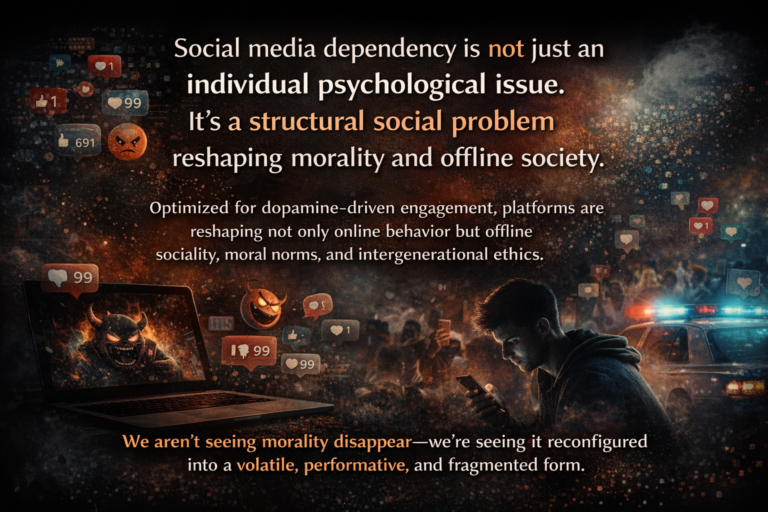
Slut-shaming, reputational attacks, moral policing, and sexualized harassment—both offline and online—have intensified. Women who appear politically vocal, sexually autonomous, or publicly assertive are frequently subjected to character assassination framed not as political disagreement, but as moral correction. Digital platforms amplify this dynamic: surveillance is crowdsourced, discipline is viral, and punishment is reputational rather than legal.
This intensification should not be read merely as backlash against women’s empowerment. It functions as a containment mechanism within a moralized political economy. As women’s structural centrality grows, the system must prevent that centrality from translating into autonomous authority. Discipline hardens precisely where dependence deepens.
The abstraction of gendered “management” is further unsettled when contrasted with women’s lived trajectories that do not conform to such hierarchies. In reflective responses by professional women, the claim that men are the natural managers of women is met not with ideological rejection but with experiential disbelief, as many recount lives shaped by self-navigation, peer mentorship, and women-led accountability rather than male oversight. These accounts do not deny structure or discipline; they describe regimes of competence, responsibility, and evaluation that operate entirely outside gendered guardianship. Importantly, such narratives do not present autonomy as rebellion, but as ordinary institutional practice—education, employment, and management organized through skill rather than moral authority. The dissonance here is not between tradition and modernity, but between abstract moral doctrine and empirical social life. This gap reveals how moral economy depends on symbolic generalization, even as everyday governance increasingly proceeds through gender-neutral mechanisms of competence that remain politically unacknowledged.
From this perspective, slut-shaming and moral policing are not residues of tradition; they are active technologies of governance.
11.2 Selective Incorporation and the Post–July Political Moment
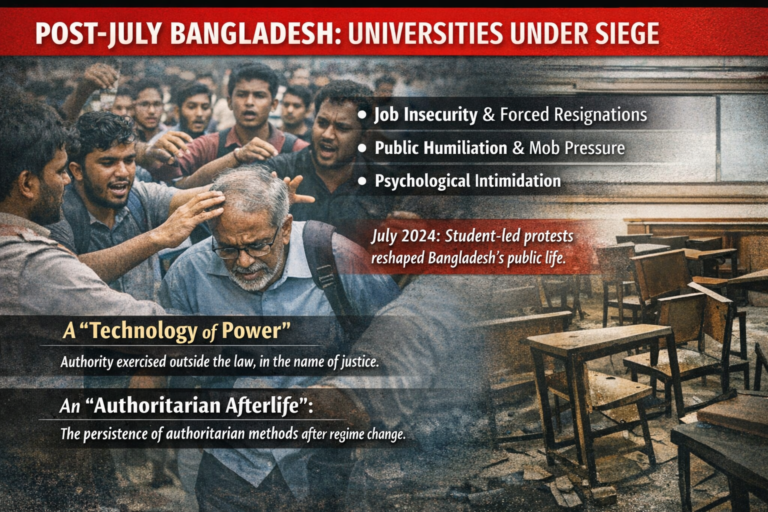
The post–July period illustrates this contradiction sharply. Women were visibly present in protests, digital mobilization, care networks, and affective labor during moments of rupture. Yet this visibility has not translated into proportional representation in formal political institutions or electoral processes.
Where women have been incorporated, it has been selective and symbolic—favoring figures who can be framed as moral exemplars, caregivers, or inspirational icons rather than political decision-makers. Inclusion operates through respectability filtering, not democratic representation.
This produces a paradoxical condition: women are everywhere in the social body but largely absent from decision-making structures. Participation is welcomed when it stabilizes moral order, and penalized when it threatens to exceed it.
For feminist activists, this contradiction is lived as exhaustion: repeated mobilization without institutional conversion, visibility without authority, recognition without power.
11.3 Hyper-Visibility and the Sexualized Public Sphere: A Second Contradiction
Alongside intensified moral policing, another seemingly contradictory phenomenon has emerged: women’s growing visibility in public and digital spaces through styles of dress, language, sexuality, and self-presentation that would previously have been considered transgressive.
Women are increasingly visible on social media—and in certain urban physical spaces—wearing more open clothing, showing skin, using slang, performing confidence, irony, and sexual self-awareness. This visibility is often celebrated as freedom, modernity, or resistance.
Yet this expansion of expressive visibility does not signal a retreat of patriarchy. Instead, it marks a reorganization of control.
First, this visibility is uneven and classed. It is tolerated—sometimes celebrated—within specific urban, digital, and aesthetic circuits, while remaining harshly punished in others. Second, it is highly conditional. The same platforms that amplify sexualized self-expression also facilitate instant moral sanction when boundaries are perceived to be crossed.
Third, this visibility often operates within an economy of attention—likes, follows, monetization—where women’s bodies and performances generate value while remaining vulnerable to discipline. Sexual expression becomes legible not primarily as autonomy, but as content.
In this sense, visibility and discipline do not cancel each other out. They co-produce each other. The more women are visible, the more aggressively their visibility is policed.
Bangladesh’s political history further complicates any simple reading of women’s visibility and power. For much of the post-1990 period, the state itself was symbolically feminized through the figure of women as prime ministers and party leaders. This unprecedented visibility at the apex of political authority did not translate into the dismantling of everyday patriarchy, nor did it secure women’s substantive control over institutions. Instead, it normalized a separation between visibility and authority: women could embody sovereignty while remaining constrained by moral scrutiny, familial expectation, and gendered discipline. In the current conjuncture—where moral economy increasingly replaces the state as the primary organizer of legitimacy—this legacy creates new tensions. If symbolic female leadership once coexisted with patriarchal containment, its capacity to stabilize secular-liberal imaginaries may now be weakening. Visibility itself becomes more contested, more morally charged, and less reliably protective.
An increasingly visible component of this disciplinary regime is the proliferation of social media posts that openly delegitimize so-called “liberal women” by assigning them a moral and social “place.” These posts function less as individual expressions of misogyny than as boundary-making practices within a moral economy. By publicly marking certain women as excessive, elitist, or culturally alien, they redistribute the risks of visibility and instruct wider audiences on the costs of transgressing moral norms. Importantly, this delegitimization does not engage feminist arguments directly; it bypasses debate by reframing feminist presence itself as moral disruption. In doing so, it enables patriarchal containment to operate without overt institutional enforcement, transforming digital platforms into sites of distributed moral governance.
The increased public visibility of hijab-wearing women, religious scholars, and moral-political figures should be understood within this broader reorganization of visibility under moral economy. As rights-based claims become riskier and reputational punishment more pervasive, moralized forms of appearance offer relative insulation. Hijab, religious language, and moral authority do not signal withdrawal from the public sphere; they recalibrate how one can appear safely within it. In this sense, the rise of piety-coded visibility reflects not a rejection of public life, but an adaptation to conditions in which moral legitimacy now protects more reliably than institutional rights.
The delegitimation of liberal women increasingly operates not through direct silencing, but through the strategic reframing of their speech as irresponsible, destabilizing, or socially reckless. Public statements by women scholars and commentators are frequently circulated with the suggestion that their interventions threaten social order, electoral stability, or collective cohesion, subtly repositioning critique as moral hazard rather than political participation. In this framing, women are not attacked for what they say, but for when and how they say it—implying that restraint, silence, or postponement is a civic duty uniquely demanded of them. Such narratives function to discipline liberal women into self-regulation, casting dissent as selfishness and visibility as excess. The effect is not the absence of women’s voices, but their conditional legitimacy, granted only when aligned with dominant moral expectations. This mechanism further illustrates how moral economy governs political speech by transforming women’s critical agency into a problem of timing, tone, and responsibility rather than content or truth.
11.4 Moral Shock, Feminist Freedom, and the Politics of Commodification
Alongside intensified patriarchal discipline and selective incorporation, contemporary Bangladesh is experiencing a deeper and less acknowledged dynamic: moral shock. This shock emerges from the rapid visibility of new forms of female self-presentation—open clothing, sexual confidence, slang, irony, and performative autonomy—circulating through social media and selective urban spaces.
This visibility does not arrive gradually or evenly. It is compressed, algorithmically amplified, and detached from the slow work of political translation. For many, especially in contexts of economic precarity and institutional unreliability, the experience is not one of liberation but of disorientation. Moral reference points appear to shift faster than livelihoods, norms, or protections can adapt.
Within this condition, feminist freedom is frequently encountered not as collective political struggle, but as commodified visibility—influencer culture, monetized sexuality, branded empowerment, and attention economies. As a result, feminist language becomes vulnerable to a powerful reframing: not as emancipation, but as market capture of women’s bodies and desires.
This reframing is politically consequential. It allows moral and conservative actors to present themselves not simply as defenders of tradition, but as critics of commodification. Patriarchal discipline is thus re-legitimized as moral protection, dignity preservation, or resistance to capitalist exploitation.
Crucially, this critique resonates not because it is entirely accurate, but because it aligns with lived precarity. When economic security is fragile and the state unreliable, freedom that appears individualized, aestheticized, and monetized can feel hollow—or even threatening.
In this sense, moral economy does not merely oppose feminist freedom; it absorbs the shock produced by its commodified forms. Slut-shaming, moral policing, and reputational violence intensify not only as instruments of control, but as attempts to restore moral coherence in a rapidly destabilizing social landscape.
This does not invalidate feminist struggles. It reveals the terrain on which they are now received, contested, and misrecognized.
Case vignette: Strategic ambiguity and moral narrative governance (X/Twitter episode)
In early 2026, a controversy emerged around a post circulated from the Jamaat Amir’s X (Twitter) account describing working women in a sexualized and degrading register. Shortly after, party-linked accounts and supporters asserted that the account had been “hacked,” and the post was removed alongside a statement of apology. The ensuing debate quickly shifted from the violence of the claim itself to a conflict over technical authenticity: who posted, whether the account was compromised, and whether a phishing or device-level intrusion had occurred.
Analytically, the episode is less revealing as a question of cybersecurity than as a demonstration of narrative governance under conditions of moralized politics. First, the “hack” claim operated as a device of moral distance without moral repudiation: the content could circulate, resonate, and discipline—while formal accountability remained displaced. Second, the dispute produced a form of strategic ambiguity, in which proof was less important than sustaining interpretive uncertainty. In such conditions, supporters are not required to verify; they are only required to align. Third, the episode illustrates how moral economy travels through translation across audiences: simultaneously sustaining global-facing rhetoric of women’s empowerment (legibility for international media) while reproducing local moral discipline through reputational and sexualized categories.
A recent sequence of public statements by Jamaat-e-Islami’s leadership illustrates how gender ideology is translated across audiences rather than contradicted. In an international media interview, women’s exclusion from party leadership was articulated through theological reasoning and civilizational language, framing gender differentiation as divinely ordained responsibility rather than political denial. Shortly afterward, a social media post circulated that framed women’s participation in paid work outside the home as moral degradation, translating the same position into a disciplinary vernacular aimed at domestic audiences. When public backlash intensified, the organization did not disavow the moral logic of the message but instead attributed the post to a technical breach, invoking an “account hacking” narrative. This move allowed the stigmatizing discourse to circulate while insulating leadership from direct accountability, preserving moral authority without issuing retraction. Taken together, these moments reveal not ideological confusion but a coherent strategy of narrative governance in which moral economy is stabilized through audience-specific translation and strategic ambiguity.
The emergence of organized student-led counter-mobilizations—such as public calls to resist Jamaat-e-Islami’s discourse on women’s morality and labor—further reveals how moral economy has become the primary terrain of political struggle. These mobilizations do not contest policy or institutional authority alone; they contest moral classification itself, challenging attempts to frame women’s work, visibility, and autonomy as ethical transgression. Significantly, such protests must articulate themselves as defenses of dignity rather than as assertions of rights, indicating how deeply moral legitimacy now conditions political speech. The very need to publicly declare opposition to the moral delegitimization of working women underscores the extent to which stigma, rather than law or governance, has become the dominant instrument of power. In this context, protest functions less as a pathway to institutional transformation and more as a struggle to prevent moral foreclosure. The intensity of these symbolic confrontations signals not the collapse of feminist resistance, but the relocation of political conflict into a moralized public sphere shaped by authoritarian risk and uneven protection.
The episode also clarifies a broader point developed in this essay: contemporary patriarchal power is not only enacted through exclusion or prohibition. It increasingly operates through explanation, circulation, and moral framing—amplified by digital platforms—where women’s visibility becomes a primary site of governance, and where institutional adjudication is replaced by reputational warfare.
11.5 Class, Uneven Access, and the Social Geography of Feminism and Moral Authority
The contradictions described above cannot be understood without placing class at the center of analysis. In Bangladesh, neither feminism nor moral economy circulates evenly across social groups. Access to feminist language, history, and political imagination is deeply shaped by education, language, urban location, and institutional proximity. For many middle- and upper-middle-class women, feminism is encountered as a framework of critique, rights, and self-reflection. For large segments of the population, however, feminism appears primarily as fragmented visibility—styles of dress, modes of speech, online performances—divorced from its political genealogy.
This uneven access produces a crucial misalignment. What is lived by some as political freedom is encountered by others as classed privilege. Feminism, stripped of its collective and redistributive dimensions, becomes legible as lifestyle rather than struggle.
Moral economy, too, is classed in its operation. For households facing chronic economic precarity, moral reputation functions as a form of protection where legal rights, institutional care, and state support are unreliable. Conformity, modesty, and respectability are not merely ideological choices; they are strategies of survival. Moral dominance thus derives its legitimacy not only from belief, but from material necessity.
This classed divergence helps explain why moral critiques of feminist freedom—as commodified, elite, or market-driven—resonate so powerfully. Such critiques draw strength from lived inequality. When freedom appears unequally accessible and unevenly risky, moral regulation presents itself as fairness, dignity, and social coherence.
Seen this way, the contemporary struggle is not simply between feminism and patriarchy, or freedom and conservatism. It is a struggle over whose experience of risk, security, and legitimacy counts in a deeply unequal society.
11.6 Why This Is Not Feminist Failure—and Not Feminist Victory
For both local and global feminist movements, this moment can feel disorienting. On the one hand, women are more visible, vocal, and present than before. On the other, patriarchal punishment feels more relentless, more intimate, and more public.
This is not because feminism has failed. Nor is it because patriarchy is simply “fighting back.”
Rather, the terrain itself has shifted.
Power now operates less through exclusion and more through conditional inclusion. Women are invited into visibility, markets, and moral narratives—but on terms that fragment solidarity, individualize risk, and privatize punishment.
Feminist struggle continues, but it now confronts a system that does not merely deny women space; it manages their presence.
11.7 Zones of Instability: Where the System Is Under Strain
These contradictions reveal not coherence, but fragility.
- As women’s income and digital autonomy grow, moral containment becomes harder to sustain.
- As sexualized visibility expands, moral consensus fractures.
- As care labor intensifies without recognition, burnout accumulates.
- As younger generations inhabit global imaginaries alongside local discipline, obedience becomes less stable.
These tensions do not guarantee progressive outcomes. They may generate new forms of conservatism, withdrawal, or individualized survival strategies. But they mark zones of instability where the moral economy can no longer absorb contradiction without escalation.
The increasing intensity of slut-shaming, surveillance, and reputational violence is itself evidence of strain.
Student responses to recent statements further reveal how moral economy operates through categorical degradation rather than debate. In protest speeches, women are described as being reduced to interchangeable moral labels—prostitutes, tokens, vulgar figures, or politically suspect bodies—depending on their visibility, mobility, or dissent. Such formulations capture how moral classification functions as a technology of power: women are not engaged as political subjects, but sorted into stigmatized types that render their claims illegitimate in advance. The invocation of labels like “Shahbagi” illustrates how political disagreement is folded into moral suspicion, collapsing ideology into character judgment. Importantly, these reactions do not emerge in isolation; they reflect a broader social recognition that women’s public presence is increasingly governed through humiliation rather than argument. The protest, therefore, contests not a single statement, but an entire system of moral sorting that converts women’s agency into moral offense.
The defense of gendered authority increasingly extends beyond moral doctrine into assertions of managerial competence and masculine capacity. In public commentary responding to controversy, the inability of leadership to manage a personal social media account has been reframed as evidence of broader unfitness to govern, converting a narrative failure into a test of authority itself. This move shifts debate away from the substance of gendered moral claims toward a performance of control, discipline, and command—qualities implicitly coded as masculine. Rather than addressing the moral violence embedded in earlier statements, the discourse reasserts a managerial logic in which governance is equated with oversight, order, and technical mastery. Such framing reinforces the idea that authority derives not from accountability or ethics, but from the appearance of control. In this way, moral economy fuses with managerial masculinity, transforming political legitimacy into a question of who can command systems—women, critics, and dissenters included—rather than how power should be exercised.
11.8 A Shared Truth for Feminist Activists
For feminist activists—whether working in rights-based advocacy, digital spaces, or everyday resistance—this diagnosis offers a shared truth rather than a dismissal:
- Your sense that patriarchy is intensifying is accurate.
- Your sense that women’s presence has expanded is also accurate.
- The contradiction is real, structural, and systemic.
What has changed is not whether women have power, but how power is permitted to appear, and at what cost.
Observations circulating in political commentary further suggest that moral economy operates through differentiated audience management rather than uniform enforcement. Islamist actors are increasingly perceived as maintaining parallel moral registers: one directed toward rural and conservative constituencies emphasizing family protection, modesty, and moral order, and another aimed at urban, media-facing audiences marked by restraint, silence, or strategic ambiguity. These registers are not contradictory but complementary, calibrated to distinct expectations and risks across social space. What appears as inconsistency is better understood as adaptive governance under electoral pressure, where moral discipline is selectively activated rather than universally applied. Crucially, this dual-track strategy relies on women’s bodies and behavior as its primary site of moral signaling, even as women themselves remain excluded from formal decision-making. The effectiveness of this approach lies precisely in its flexibility, allowing moral authority to be asserted, softened, or deferred depending on context without abandoning its core hierarchical assumptions.
Synthesis: Patriarchy That Depends, Controls, and Fears
Contemporary patriarchy in Bangladesh does not simply repress women; it depends on them. It extracts labor, care, moral legitimacy, and affective stability while policing the boundaries of acceptable agency with increasing aggression.
Slut-shaming, selective incorporation, digital harassment, and moral surveillance are not cultural noise. They are system maintenance.
Understanding this allows feminist politics—local and global—to move beyond the false choice between celebration and despair, toward a clearer recognition of the terrain on which struggle now unfolds.
12. Conclusion: Authority Without Office
Bangladesh is not witnessing the retreat of women’s power, but its recomposition. Leadership now operates through moral infrastructure rather than office, funding through circulation rather than spectacle, politics through malleability rather than confrontation.
Understanding this transformation is essential—not to endorse it, but to grasp how power survives when the state repeatedly fails. In Bangladesh today, neither feminism nor modesty operates as a fixed moral position; both function as translations shaped by class, risk, and survival—revealing not a cultural impasse, but a reorganization of power under prolonged state failure.
Core Conceptual Frameworks: Moral Economy & Survival
Scott, J. C. (1976). The moral economy of the peasant: Rebellion and subsistence in Southeast Asia. Yale University Press.
Thompson, E. P. (1971). The moral economy of the English crowd in the eighteenth century. Past & Present, 50, 76–136. https://doi.org/10.1093/past/50.1.76
Fassin, D. (2012). Humanitarian reason: A moral history of the present. University of California Press.
Gender, Care, and Political Economy
Federici, S. (2012). Revolution at point zero: Housework, reproduction, and feminist struggle. PM Press.
Fraser, N. (2016). Contradictions of capital and care. New Left Review, 100, 99–117.
Fraser, N. (2013). Fortunes of feminism: From state-managed capitalism to neoliberal crisis. Verso.
Feminism, Piety, and Gendered Authority in Muslim Contexts
Mahmood, S. (2005). Politics of piety: The Islamic revival and the feminist subject. Princeton University Press.
Deeb, L. (2006). An enchanted modern: Gender and public piety in Shi‘i Lebanon. Princeton University Press.
Abu-Lughod, L. (2013). Do Muslim women need saving? Harvard University Press.
Islamist Movements, Governance, and Political Strategy
Wiktorowicz, Q. (Ed.). (2004). Islamic activism: A social movement theory approach. Indiana University Press.
Bayat, A. (2013). Life as politics: How ordinary people change the Middle East (2nd ed.). Stanford University Press.
Authoritarianism, the State, and Informal Governance
Gupta, A. (2012). Red tape: Bureaucracy, structural violence, and poverty in India. Duke University Press.
Hibou, B. (2015). The bureaucratization of the world in the neoliberal era. Palgrave Macmillan.
Auyero, J. (2012). Patients of the state: The politics of waiting in Argentina. Latin American Research Review, 47(1), 5–29.
Digital Platforms, Moral Regulation, and Visibility
Couldry, N., & Mejias, U. A. (2019). The costs of connection: How data is colonizing human life and appropriating it for capitalism. Stanford University Press.
Bucher, T. (2018). If…then: Algorithmic power and politics. Oxford University Press.
Tufekci, Z. (2017). Twitter and tear gas: The power and fragility of networked protest. Yale University Press.
Banet-Weiser, S. (2018). Empowered: Popular feminism and popular misogyny. Duke University Press.
Class, Inequality, and Moral Discipline
Bourdieu, P. (1990). The logic of practice. Stanford University Press.
Skeggs, B. (1997). Formations of class and gender. Sage.
South Asia, Bangladesh, and Comparative Context
Riaz, A. (2016). Bangladesh: A political history since independence. I.B. Tauris.
Hassan, M. (2013). Islamism and democracy in Bangladesh. Asian Survey, 53(1), 1–27.
Kabeer, N. (2000). The power to choose: Bangladeshi women and labor market decisions in London and Dhaka. Verso.
An earlier version of this argument appeared as a working paper on moiyenzalal.com.