Faith, Feeling, and the Authoritarian Digital Space
Religion, Social Media, and Post-Uprising Mob Formation in South Asia
How Online Islamic Sermons, F-Commerce, and Sentimental Sociality Circulate Between Platform and Street — and Why This Matters Globally
Introduction: authoritarianism without uniforms
Contemporary authoritarianism no longer relies primarily on censorship, ideology, or visible coercion.
Instead, it operates through affect, circulation, and moral legitimacy.
In many parts of the world—especially across South Asia—religion has become a privileged carrier of this affect, while digital platforms have become its infrastructure.
This essay advances a central argument:
Authoritarian digital space is not imposed from above alone. It is co-produced through everyday digital religious practices—sermons, commerce, moral signaling—that generate a form of sentimental sociality capable of rapid collective action, including mob formation.
The Bangladesh case, when placed in global comparison, reveals a particularly intense and under-theorised configuration of this dynamic.
1. Authoritarian digital space: beyond censorship
1.1 What is “authoritarian digital space”?
Established scholarship shows that digital authoritarianism today works less through blocking content and more through:
- affective modulation
- algorithmic amplification
- informal moral regulation
(Gillespie, 2018; Tufekci, 2015; Roberts, 2018)
An authoritarian digital space is therefore one where:
- emotional conformity is rewarded
- dissent is socially risky
- legitimacy is moralised rather than debated
Crucially, this can exist even without a formally authoritarian state.
1.2 Religion as infrastructural power
Religion becomes central not because it is imposed, but because it:
- already structures moral life
- carries symbolic authority
- legitimises emotion as truth
On social media, religion functions as soft infrastructure—shaping what can be said, felt, or questioned.
2. The platformisation of Islamic sermons
2.1 From mosque and waz mahfil to algorithm
In Bangladesh, Islamic sermons have undergone a platform shift, moving decisively into Facebook and YouTube ecosystems.
Documented patterns (Bangladesh research):
- sermons are clipped, captioned, and decontextualised
- circulation exceeds original audiences
- moral commentary replaces theological depth
(Uddin, 2021; Amin, 2020)
Interpretation:
The sermon no longer ends with the speech. It begins with circulation.
2.2 From belief to affective authority
What gains traction online is not jurisprudence or doctrine, but:
- offense
- fear
- moral outrage
- humiliation
This aligns with platform logic, which systematically rewards high-arousal emotional content.
As a result, preachers and religious influencers increasingly function as affective authorities—interpreters of moral injury rather than religious law.
3. Islamic F-commerce and the moral economy of platforms
3.1 F-commerce as social infrastructure
Bangladesh’s Islamic F-commerce ecosystem—operating primarily through Facebook pages, groups, and live streams—has been widely observed but insufficiently theorised.
Key structural features:
- trust is built through visible piety
- commerce is embedded in moral language
- sellers cultivate “religious familiarity” rather than brand neutrality
Interpretation (building on your prior work on digital sociality):
Islamic F-commerce produces transactional intimacy—a form of social closeness where economic exchange reinforces moral belonging.
3.2 From consumer to moral participant
In this ecosystem:
- buying becomes an ethical act
- loyalty becomes moral alignment
- criticism appears as hostility to faith
This creates what can be called a sentimental moral economy, where emotion circulates alongside goods—and prepares audiences for collective affective mobilisation.
4. Sentimental sociality: from online to offline and back
4.1 What is sentimental sociality?
Analytical concept (synthesis):
Sentimental sociality refers to forms of social bonding produced primarily through shared emotion rather than deliberation, organisation, or ideology.
This builds on:
- networked publics (boyd, 2010)
- affective publics (Papacharissi, 2015)
- digital sociality research in South Asia
4.2 Circulation loop: platform → street → platform
In Bangladesh, we repeatedly observe a three-stage loop:
- Online affective priming
Sermons, clips, moral commerce, visual outrage - Offline activation
Gatherings, protests, intimidation, episodic violence - Re-mediation online
Videos, photos, narratives that retroactively justify action
Critical insight:
Offline action is not the end point. It is raw material for renewed digital affect.
5. From sentimental sociality to mob formation
5.1 Why mobs no longer need leaders
Established research:
Mobs form when coordination costs are low and moral certainty is high.
Digital sentimental sociality provides:
- emotional synchronisation
- identity clarity
- perceived moral urgency
No explicit instruction is required.
5.2 Visuality as mobilisation technology
Images and short videos:
- bypass verification
- collapse context
- produce instant moral judgment
In high-emotion religious frames, seeing becomes believing.
Comparative South Asian Configurations of Digital Religious Mobs
India and Pakistan in the Authoritarian Digital Space
6. India: Hindu Majoritarianism, Platformed Affect, and the Normalisation of the Mob
6.1 Platform religion and Hindu affective mobilisation
In India, social media has played a decisive role in transforming Hindu religious sentiment into a mass political affect—one closely aligned with majoritarian nationalism.
Key platforms:
- WhatsApp (primary)
- YouTube
Established research shows:
- WhatsApp functions as a high-speed rumor and affect relay
- Closed-group forwarding reduces accountability
- Content circulates through trusted social ties, not public scrutiny
(Banaji et al., 2019; Arun, 2019)
6.2 Hindu sermons, online gurus, and moral absolutism
Unlike Bangladesh’s sermon ecology, India’s digital religious sphere is marked by:
- online gurus
- Hindu nationalist preachers
- devotional–political hybrids
These actors:
- fuse religion with civilisational threat narratives
- frame minorities as existential dangers
- moralise violence as “defensive”
Interpretive insight:
Here, religion does not merely justify political power — it naturalises dominance.
6.3 From rumor to routinised violence
India’s mob violence shows a patterned repetition:
- Digital rumor (cow slaughter, conversion, insult)
- Moral panic within closed networks
- Rapid offline violence
- Minimal accountability
- Narrative justification online
What is crucial:
The mob becomes normalised, not exceptional.
Analytical distinction:
India represents ideologically consolidated affective authoritarianism — the mob is not episodic but embedded within a broader political project.
6.4 India vs Bangladesh (key contrast)
| Dimension | India | Bangladesh |
|---|---|---|
| Platform logic | Closed (WhatsApp) | Public (Facebook) |
| Ideology | Consolidated (Hindutva) | Fragmented |
| Mob pattern | Recurrent, routinised | Episodic, volatile |
| Religion | Civilisational dominance | Moral shield |
| State relation | Often tacitly aligned | Ambiguous, shifting |
7. Pakistan: Blasphemy, Digital Accusation, and the Instant Mob
7.1 Digital religion under moral absolutism
In Pakistan, religious mobilisation online operates under a different moral regime — one structured by blasphemy discourses and deep legal–theological entanglement.
Key platforms:
- YouTube
But unlike India, ideological consolidation is less nationalist and more theological.
7.2 The digital accusation economy
Pakistan’s digital religious violence often follows this pattern:
- Online accusation of blasphemy
- Rapid circulation through social media
- Moral panic framed as religious obligation
- Immediate offline violence
- Post-facto justification through religious language
Critical feature:
No mass persuasion is required — accusation itself is sufficient.
7.3 Affect without organisation
Unlike India:
- mobs are less systematically networked
- violence is less politically programmatic
- authority is less centralised
Interpretive claim:
Pakistan exemplifies affective absolutism — where religious sentiment does not need ideological coherence, only moral certainty.
7.4 Pakistan vs Bangladesh (key contrast)
| Dimension | Pakistan | Bangladesh |
|---|---|---|
| Trigger | Blasphemy accusation | Moral offense |
| Speed | Instant | Rapid but staged |
| Organisation | Minimal | Platform-mediated |
| Ideology | Theological absolutism | Moral populism |
| Afterlife | Legal/religious justification | Digital re-mediation |
8. Synthesising the South Asian Pattern
Across South Asia, social media produces religious mobs, but through different affective architectures:
- India:
Ideological consolidation + closed networks → routinised violence - Pakistan:
Moral absolutism + accusation → instantaneous eruption - Bangladesh:
Platformed sentimental sociality + moral ambiguity → episodic but intense mobilisation
Bangladesh’s uniqueness lies in the fusion of:
- sermons
- F-commerce
- influencer economies
- Facebook performativity
This produces a looping affective circuit:
Online affect → offline action → online legitimisation → renewed affect
Why this matters for global theory
This comparison shows that:
- social media does not create a single “religious mob”
- platform architecture + religious moral economy determine outcomes
- authoritarianism today operates through emotion management, not ideology alone
This places Bangladesh at the analytical frontier of:
- affect theory
- digital anthropology
- religion–platform studies
- authoritarian governance research
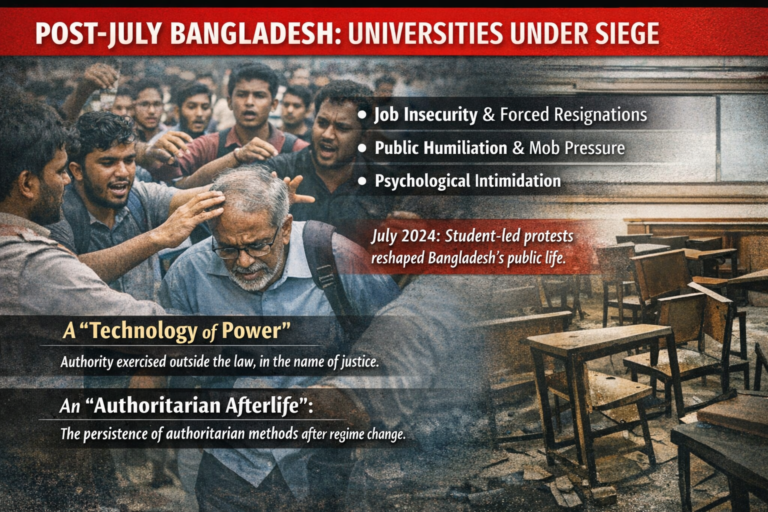
9. Why the Danger Increases After Uprisings
From Shahbag to July: When Mobilisation Expands Faster Than Institutions
9.1 The intuitive but flawed expectation of post-uprising safety
A widespread assumption—shared by activists, commentators, and even sections of academic literature—is that after a popular uprising, political danger should decline.
This expectation follows a classical, linear model of politics:
- mobilisation → reform
- visibility → accountability
- participation → institutionalisation
However, digital-era uprisings consistently violate this sequence.
Empirical evidence from Bangladesh and comparable contexts suggests that the post-uprising phase is often more volatile, not less.
9.2 The counterintuitive pattern: danger rises, not falls
Analytical claim:
After mass mobilisations such as the Shahbag Movement and the July Uprising, the risk of affective violence, moral panic, and mob formation intensifies rather than dissipates.
This is not a failure of particular movements.
It is a structural outcome of digital mobilisation.
9.3 What digital uprisings actually produce
Digital uprisings leave behind capacities, not just memories. Three are especially consequential.
9.3.1 Expansion of affective capacity
Uprisings train participants in how to feel politically:
- moral urgency
- collective entitlement to act
- emotional synchronisation
Once acquired, this affective capacity does not disappear when mobilisation ends.
9.3.2 Normalisation of extra-institutional action
Uprisings legitimate action outside formal institutions:
- streets over courts
- visibility over procedure
- moral conviction over due process
This logic becomes portable—available to actors with very different political projects.
9.3.3 Demonstration of efficacy
Perhaps most critically, uprisings demonstrate that:
emotion + visibility + numbers can work
This lesson is absorbed across the digital ecosystem, including by actors hostile to the original movement.
9.4 From emancipatory affect to transferable political technology
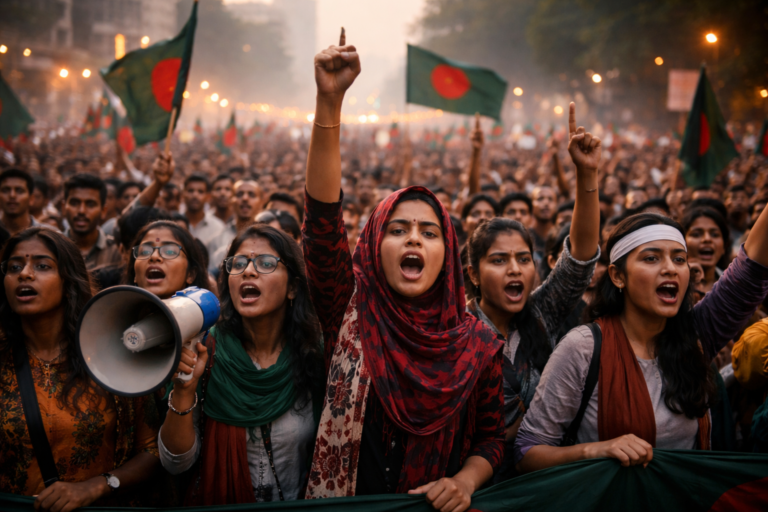
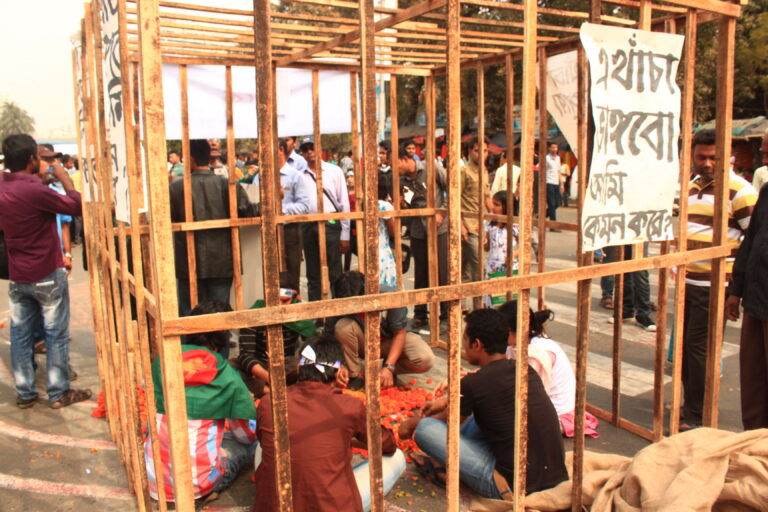
Building on earlier research on Shahbag’s digital aftermath, the movement can be understood as creating Bangladesh’s first large-scale digital street—a space where legitimacy was produced through networked affect rather than organisational hierarchy.
This was historically emancipatory.
However, it also generated a reusable political technology:
- moral framing
- viral circulation
- affective pressure
After Shahbag, the technology remained, even as the ethical project fragmented.
9.5 July and the acceleration of sentimental sociality
The July uprising did not merely repeat Shahbag; it intensified the circulation loop:
- Online affective priming
- Offline presence and confrontation
- Digital re-mediation as proof of power
Each cycle deepened what can be conceptualised as sentimental sociality—a form of collective belonging rooted in shared feeling rather than durable organisation or ideology.
9.6 Why post-uprising contexts are structurally high-risk
Post-uprising environments are dangerous for three interrelated reasons.
9.6.1 Affect outpaces institutions
Mobilisation expands faster than:
- legal reform
- accountability mechanisms
- deliberative norms
This creates an exploitable gap between emotional capacity and institutional absorption.
9.6.2 Moral authority becomes detachable
Once moral mobilisation is normalised, it becomes:
- separable from original causes
- transferable across actors
- resistant to delegitimation
Religious influencers and moral entrepreneurs can occupy this space with minimal friction.
9.6.3 Disillusionment hardens affect
When uprisings fail to deliver structural change:
- hope mutates into frustration
- patience erodes
- moral certainty intensifies
This emotional residue is especially receptive to religious absolutism and mob logic.
9.7 Religion in the post-uprising vacuum
In post-uprising Bangladesh:
- Islamic sermons offer moral clarity amid political ambiguity
- Islamic F-commerce provides belonging amid institutional distrust
- Influencers translate diffuse frustration into targeted outrage
Religion functions less as doctrine and more as emotional governance.
9.8 The authoritarian advantage after uprisings
Authoritarian and authoritarian-leaning actors benefit because they do not need to suppress mobilisation. They can redirect it.
They:
- allow expression
- reward conformity
- penalise deliberation
This produces a condition that can be described as authoritarian affective pluralism:
many voices, one emotional direction
9.9 Theoretical takeaway
Uprisings expand political imagination—but they also expand affective capacity.
If that capacity is not institutionalised, it becomes available to anyone.
In authoritarian digital spaces, those who master:
- emotion
- visibility
- moral framing
inherit the aftermath.
This makes the system unstable yet powerful.
Global Patterns: Religious Affect, Digital Platforms, and Post-Uprising Volatility
10.1 Beyond South Asia: a recurring global configuration
From the Middle East to South Asia, from parts of Eastern Europe to Latin America, recent research shows a recurring pattern:
Moments of digital mobilisation weaken old authorities but do not automatically generate new, stable forms of legitimacy.
Instead, they leave behind:
- heightened emotional capacity
- normalised extra-institutional action
- fragmented moral authority
This has been observed in post–Arab Spring contexts, where initial digital optimism gave way to affective polarisation, moral absolutism, and renewed authoritarian consolidation (Aouragh & Alexander, 2011; Lynch, 2016).
10.2 Religion as post-movement stabiliser of affect
Globally, religion often becomes the most efficient stabiliser of post-uprising affect because it:
- provides moral certainty when politics feels inconclusive
- transforms frustration into ethical clarity
- offers belonging without requiring institutional trust
In this sense, religion does not simply oppose democratic aspirations; it frequently absorbs the emotional surplus generated by failed or incomplete uprisings.
10.3 Digital platforms as affective accelerators, not neutral arenas
Across cases, platforms such as Facebook, YouTube, and WhatsApp function as:
- accelerators of emotional intensity
- amplifiers of moral binaries
- infrastructures of visibility rather than deliberation
This aligns with global scholarship on platform governance, which shows that algorithmic systems systematically privilege high-arousal content irrespective of political ideology (Gillespie, 2018; Tufekci, 2015).
11. Bangladesh as a Global Hinge Case
11.1 Neither exceptional nor derivative
Bangladesh should not be treated as:
- an outlier
- a “lagging” democracy
- or a derivative case of India or the Middle East
Instead, it functions as a hinge case—where multiple global dynamics intersect in compressed form:
- post-uprising affective surplus
- platform-centric publicness
- religious moral economies
- fragmented ideological fields
11.2 Why Bangladesh matters for global theory
Bangladesh demonstrates with unusual clarity that:
- Authoritarian digital space can emerge without formal authoritarian takeover
- Religion can govern affect without becoming a coherent political ideology
- Commerce, sermons, and influence economies can jointly produce mobilisation capacity
This makes Bangladesh analytically valuable for:
- digital anthropology
- affect theory
- religion–politics scholarship
- studies of authoritarianism beyond the state
11.3 From digital sociality to sentimental sociality
Building on earlier work on digital sociality, the Bangladeshi case shows a further transformation:
Digital interaction becomes sentimental sociality when shared feeling, rather than shared purpose or organisation, becomes the primary basis of collective life.
This form of sociality is:
- highly mobilisable
- weakly accountable
- easily redirected
And therefore structurally prone to mob formation.
12. Conclusion: Governing Through Feeling in the Post-Uprising Age
12.1 Core argument revisited
This essay has argued that:
- Digital uprisings expand affective capacity faster than institutions can absorb it
- Religious sermons, influencer economies, and Islamic F-commerce provide moral and emotional infrastructures for that surplus affect
- Social media platforms convert this affect into sentimental sociality that moves fluidly between online and offline worlds
- In post-uprising contexts, this dynamic increases—rather than reduces—the risk of moral panic and mob mobilisation
12.2 Authoritarianism without silence
What emerges is not classical authoritarianism defined by censorship and fear, but affective authoritarianism, characterised by:
- high visibility
- emotional conformity
- moralised legitimacy
- peer regulation
Here, people are not silenced; they are emotionally aligned.
12.3 Why the danger persists
The danger remains high after Shahbag, after July, and after similar mobilisations globally because:
Affective capacity, once expanded, does not disappear. It circulates.
If not institutionalised, it becomes available to:
- religious populists
- moral entrepreneurs
- authoritarian actors
And platforms ensure that this circulation never stops.
12.4 Toward a future research agenda
Rather than asking whether social media is “good” or “bad” for democracy, the more urgent questions are:
- How does affect travel after mobilisation ends?
- Who captures moral authority in post-uprising environments?
- How do commerce, religion, and influence economies intersect to produce mobilisation capacity?
Bangladesh offers a critical site for answering these questions—not as a cautionary tale, but as a theoretical laboratory for understanding digital politics in the twenty-first century.
Dr. Moiyen Zalal Chowdhury
References (APA 7th)
Amin, S. (2020). Digital Islam and vernacular publics in Bangladesh. University Press Limited.
Aouragh, M., & Alexander, A. (2011). The Egyptian experience: Sense and nonsense of the Internet revolution. International Journal of Communication, 5, 1344–1358.
Arun, C. (2019). On WhatsApp, rumours, and lynchings. Economic and Political Weekly, 54(6).
Banaji, S., Bhat, R., Agarwal, A., Passanha, N., & Sadhana Pravin, K. (2019). WhatsApp vigilantes: An exploration of citizen reception and circulation of WhatsApp misinformation linked to mob violence in India. LSE.
boyd, d. (2010). Social network sites as networked publics. In Z. Papacharissi (Ed.), Networked self. Routledge.
Gillespie, T. (2018). Custodians of the Internet. Yale University Press.
Jaffrelot, C. (2017). Hindu nationalism in India. Princeton University Press.
Kahneman, D. (2011). Thinking, fast and slow. Farrar, Straus and Giroux.
Lynch, M. (2016). The new Arab wars. PublicAffairs.
Papacharissi, Z. (2015). Affective publics. Oxford University Press.
Riaz, A., & Fair, C. C. (2021). Political Islam and governance in Bangladesh. Routledge.
Roberts, M. (2018). Censored: Distraction and diversion inside China’s Great Firewall. Princeton University Press.
Tufekci, Z. (2015). Algorithmic harms beyond Facebook and Google. Colorado Technology Law Journal, 13, 203–218.
Uddin, M. (2021). Waz mahfil, Facebook, and religious publics in Bangladesh. South Asia Research, 41(3), 327–343.
Vosoughi, S., Roy, D., & Aral, S. (2018). The spread of true and false news online. Science, 359(6380), 1146–1151.