Martyrdom Without Sovereignty: When Death Does Not Rupture Power
Rapture Politics, Shahbag, Inqilab Moncho, and the Killability of Moral Subjects in Post-July Bangladesh
“Bangladesh no longer lacks resistance; it lacks sovereignty over the outcomes of resistance.”
This essay extends the author’s PhD research (Resistance Sociality in the Shahbag Movement, Hiroshima University, 2019) by examining the long-term political consequences of digitally mediated moral mobilization under post-uprising conditions.
Martyrdom Without Sovereignty: Shahbag, July, and Inqilab Moncho
An ethnographic analysis of Shahbag, July 2024, and Inqilab Moncho, showing how moral rapture produces martyrdom without institutional power in Bangladesh.
Abstract
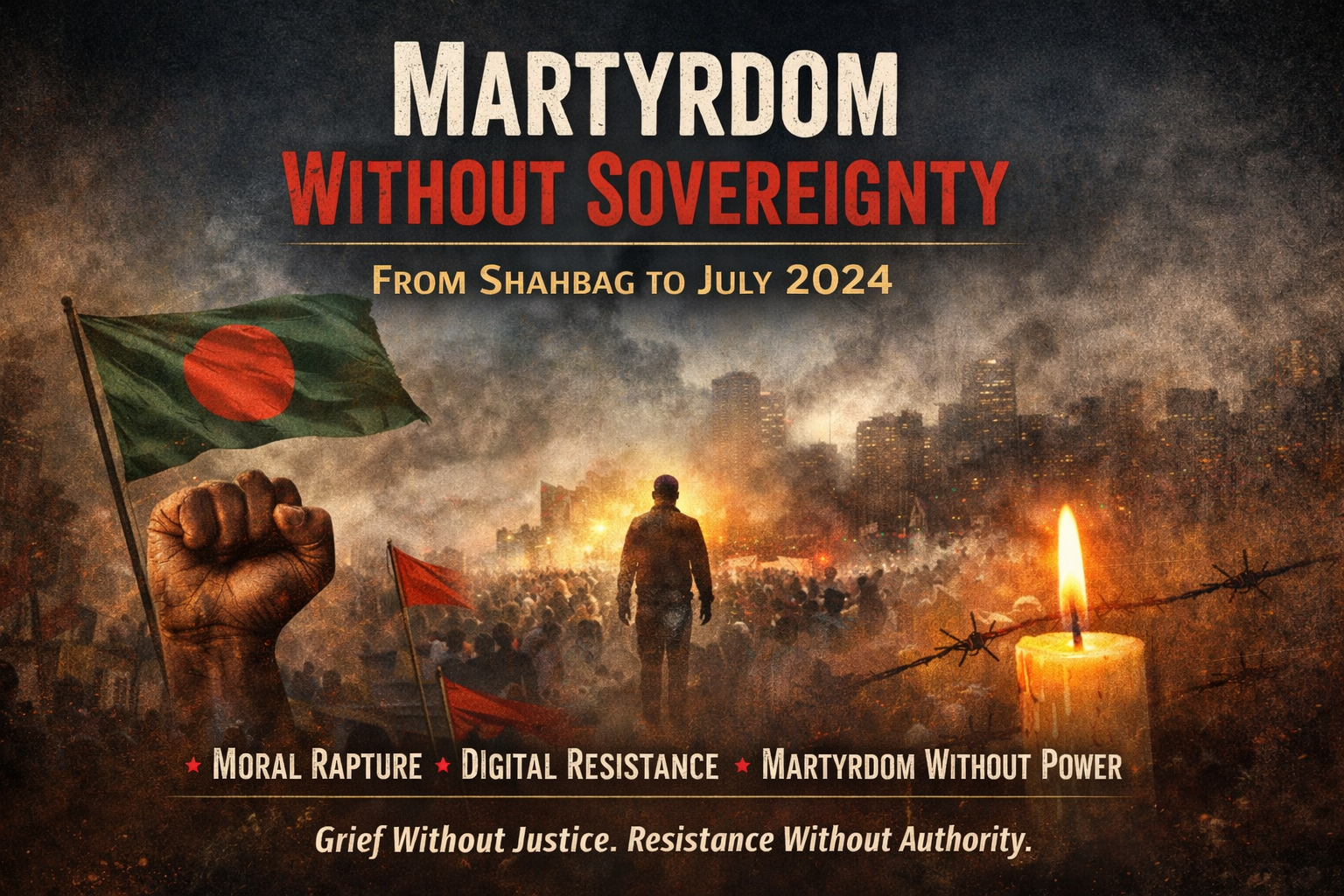
This essay examines a recurring political pattern in contemporary Bangladesh in which moments of intense moral mobilization generate ethical clarity and collective visibility without translating into institutional power or sovereign accountability. Tracing a historical arc from the Shahbag movement of 2013, through the killings of secular bloggers and Hefazat-e-Islam activists, to the July 2024 uprising and the post-July mobilizations led by Inqilab Moncho, the essay argues that Bangladesh has entered a condition of martyrdom without sovereignty: a political economy in which bodies are exposed, sacrificed, and commemorated while power adapts through containment rather than reform.
Drawing on long-term digital ethnography (2012–2025), the analysis treats social media not as a communicative supplement but as a primary political field where legitimacy, risk, and moral alignment are produced through vernacular practices—hashtags, livestreams, slogans, deadlines, and comment ecologies. Re-reading Shahbag as a moment of moral rapture rather than a conventional movement, the essay shows how vernacular moral certainty enabled mass participation while simultaneously narrowing political negotiability, rendering dissenters and later activists increasingly vulnerable. The subsequent targeting of bloggers and protesters marked a shift from discursive delegitimation to bodily killability.
The essay situates the killing of Osman Hadi as a diagnostic event rather than an anomaly, revealing how post-uprising political arrangements absorb legitimacy while externalizing risk onto highly visible, jurisdictionally unprotected actors. Through a comparative analysis of Ganajagaran Mancha and Inqilab Moncho, and of authoritarian versus interim governance regimes, the essay demonstrates how exposure is tolerated, even amplified, while accountability is deferred. Extending the author’s earlier work on resistance sociality, this study argues that contemporary Bangladeshi politics has learned to metabolize moral rapture without conceding sovereignty—producing repeated cycles of ethical intensity, individual sacrifice, and structural survival.
Resistance, Social Media, Political Ethnography, Moral Economy, Martyrdom, Sovereignty, Bangladesh, Digital Activism, Post-Uprising Politics
Introduction: When Death Does Not Break Power
The killing of Osman Hadi did not rupture political authority in Bangladesh. It did not precipitate institutional collapse, judicial reckoning, or a new political settlement. Instead, it generated grief, outrage, protest deadlines, livestreams, moral clarity, and mass circulation—without sovereignty. This paradox is not incidental. It reveals a structural condition that has shaped Bangladeshi political life for more than a decade: moments of ethical intensity repeatedly fail to convert into institutional power.
From the Shahbag mobilization of 2013, through the wave of blogger killings that followed, to the July 2024 uprising and the post-July mobilizations led by Inqilab Moncho, Bangladesh has witnessed a recurring political form. These episodes produce collective rapture, moral certainty, and symbolic authority, yet remain structurally incapable of governing outcomes. Individuals become morally exalted and bodily exposed, while power reorganizes itself around containment rather than accountability. Death circulates as meaning, not as rupture.
This essay argues that Osman Hadi’s death must be understood not as an exceptional tragedy but as a diagnostic event. It exposes how post-uprising political systems distribute risk, absorb legitimacy, and externalize bodily cost. Hadi’s killing clarifies the limits of rapture politics and reveals why movements that generate ethical clarity without jurisdiction repeatedly produce martyrs without sovereignty.
The problem, therefore, is not the absence of resistance, speech, or moral conviction. It is the persistence of a political architecture in which exposure substitutes for power, visibility replaces protection, and ethical intensity is detached from institutional capacity. In such a system, death does not break authority; it is metabolized.
To demonstrate this, the essay traces Shahbag as a moment of moral rapture, examines the blogger killings as the emergence of killability, analyzes the July 2024 uprising as rapture without absorption, and finally situates Inqilab Moncho as the post-uprising reproduction of exposure politics, culminating in Osman Hadi’s death as a threshold moment that makes this structure unmistakably visible.
Author Positioning
This essay is situated as a continuation of my doctoral research on resistance sociality in Bangladesh (Chowdhury, 2019), which examined how social media and vernacular publics produced collective resistance during the Shahbag movement. While that work focused on the emergence of moral publics and the social organization of resistance, the present analysis extends the inquiry across a longer historical arc (2012–2026) to examine the structural fate of such resistance after repeated cycles of exposure, violence, and political settlement. Drawing on longitudinal digital ethnography, this essay shifts analytical emphasis from the formation of resistance to the political economy of its containment, arguing that Bangladesh has entered a recurrent pattern in which ethical clarity and collective mobilization generate martyrdom without sovereignty. The work thus contributes to scholarship on social movements, digital politics, and power by tracing how resistance sociality persists even as institutional accountability remains structurally out of reach.
Methodological Orientation: Vernacular Archives and Digital Ethnography
This essay is grounded in long-term digital ethnography conducted across Bangladesh’s online and offline political spaces from 2012 to early 2026. The analysis draws on sustained observation of blogs, Facebook pages, livestreams, comment threads, screenshots, protest sites, and moments of embodied participation. Social media is treated not as a secondary channel of political communication but as a primary political field—a space where legitimacy, danger, and moral alignment are actively produced and unevenly distributed.
Rather than privileging official statements, institutional records, or elite interviews, the essay relies on what may be described as vernacular political archives: slogans, slurs, hashtags, protest deadlines, silences, viral images, comment ecologies, and the rhythmic escalation of posts during moments of crisis. These artifacts are approached not as expressive residue or popular noise, but as moral technologies—mechanisms through which political belonging is enacted, ethical certainty is stabilized, and bodily risk is assigned.
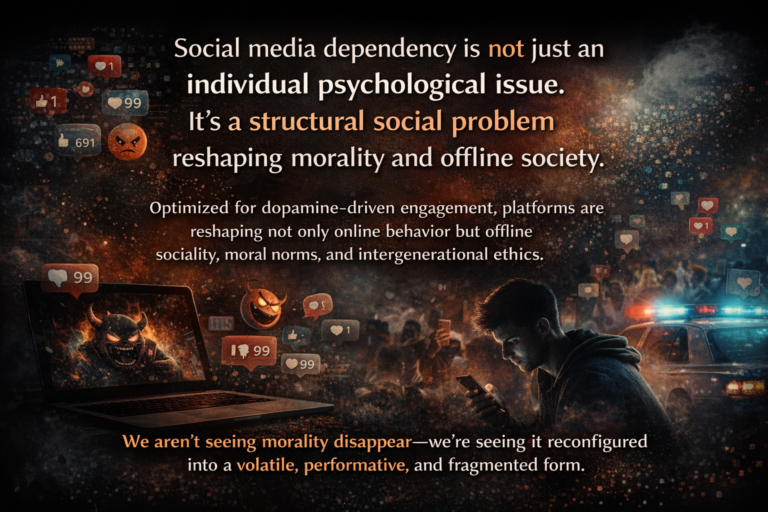
This methodological orientation is informed by an ethnographic sensibility attentive to language, affect, and circulation. Words such as Shahbagi, razakar, insaf, shohid, and inqilab are not treated as descriptive labels but as operative terms that do political work. They sort subjects, authorize action, and render certain bodies vulnerable while insulating others. Similarly, platform affordances—livestreams, countdowns, pinned posts, engagement metrics—are analyzed as part of the political architecture through which urgency is manufactured and exposure intensified.
While this approach does not grant access to classified state archives or closed decision-making processes, it captures something equally crucial: how power is lived, narrated, and negotiated at the level of everyday political practice. It allows us to observe how movements experience legitimacy without jurisdiction, how participants encounter risk without protection, and how death is converted into meaning without institutional consequence.
By following the circulation of moral language and the escalation of visibility across Shahbag, the blogger killings, the July 2024 uprising, and the post-July activities of Inqilab Moncho, this essay reconstructs a political economy of exposure from the ground up. It is through these vernacular archives—fragmented, affective, and often ephemeral—that the structure of martyrdom without sovereignty becomes visible.
Shahbag as Moral Infrastructure (Not Just a Movement)
Shahbag is commonly remembered as a mass mobilization demanding justice for the crimes of 1971. While this description is factually accurate, it is analytically insufficient. Shahbag was not merely a movement oriented toward specific demands; it was a moral infrastructure—a dense assemblage of language, affect, digital circulation, and embodied presence that temporarily reorganized the ethical field of Bangladeshi politics.
As a moral infrastructure, Shahbag did not simply articulate claims against the state. It produced a shared moral atmosphere in which ethical alignment preceded political deliberation. Participation itself became a moral act. To be present, to post, to chant, to display symbolic markers of support was to inhabit a space of ethical legitimacy. Conversely, hesitation, silence, or ambivalence required explanation.
Ethnographically, Shahbag emerged from the Bangla blogosphere, where secular critique, nationalist memory, and online activism had been converging since the late 2000s. Platforms such as blogs and Facebook pages provided not only organizational capacity but a moral grammar through which political meaning was stabilized. The Blogger and Online Activist Network (BOAN) functioned as a connective infrastructure, translating online affect into street presence. Shahbag Square and Facebook timelines became a single, continuous moral field.
Within this field, language did not merely express opinion; it performed ethical sorting. Terms such as 1971, muktijuddho, and razakar functioned as condensed moral signifiers rather than historically bounded references. “1971” operated as an unquestionable moral anchor. “Razakar” ceased to denote a specific historical collaborator and became an absolute category of moral condemnation. These terms did not invite debate; they organized belonging.
The moral force of Shahbag was intensified through repetition, visibility, and amplification. Profile pictures, slogans, poems, songs, placards, and comment threads circulated rapidly across platforms, producing what can be described as collective rapture—a heightened affective state in which ethical certainty saturated both physical and digital space. Rapture here did not mean irrationality; it meant the temporary suspension of ethical ambiguity. Doubt became suspect. Hesitation became betrayal. Ambivalence appeared unethical.
This rapture enabled unprecedented participation. Individuals who had never previously engaged in street politics found themselves drawn into a shared ethical moment. The boundary between online and offline activism collapsed. Posting became a form of presence; presence became a form of moral testimony.
At the same time, this moral infrastructure contained an inherent structural limitation. Rapture produces intensity, not governance. Shahbag generated ethical clarity without institutional jurisdiction. It did not establish mechanisms for internal disagreement, procedural negotiation, or the redistribution of risk. Instead, it relied on moral saturation to sustain coherence.
As Shahbag persisted, this saturation gradually hardened into moral closure. What began as a broad ethical appeal narrowed into a fixed moral position. The movement’s language shifted from persuasion to classification. Ethical plurality diminished. The moral field became less elastic and more exclusionary.
This shift was not accidental. Moral infrastructures, once stabilized, tend to defend their coherence by reducing ambiguity. In Shahbag’s case, this meant that disagreement was increasingly read as bad faith rather than difference. Silence became legible as complicity. The moral vocabulary that had enabled collective mobilization now functioned as a sorting mechanism.
It is at this point that Shahbag’s vulnerability emerged—not as moral failure, but as structural exposure. A moral infrastructure without jurisdiction can generate legitimacy, but it cannot distribute protection. Ethical clarity was collectivized; risk was not.
Understanding Shahbag in this way is crucial, not to discredit its historical significance, but to recognize the political form it inaugurated. Shahbag established a template in which moral intensity, digital visibility, and symbolic authority could be produced rapidly, circulated widely, and sustained affectively—while remaining detached from institutional power.
This template would not disappear with Shahbag’s decline. It would be inverted, weaponized, and later reactivated under different signs. The conditions that made Shahbag powerful also made it vulnerable to moral inversion—and prepared the terrain for the emergence of killability.
From Moral Infrastructure to Moral Inversion: Anti-Shahbag and the Production of Killability
Shahbag did not simply decline; it was actively inverted. The erosion of its legitimacy was not a spontaneous loss of public trust but a politically organized process in which its moral grammar was turned against itself. This inversion transformed Shahbag from a site of ethical authority into a marker of suspicion, and eventually into a technology of bodily risk.
As Shahbag’s moral infrastructure stabilized, counter-networks—particularly Islamist and Jamaat-linked digital formations—began to reframe its ethical vocabulary. Blogs, Facebook pages, and YouTube channels systematically recoded Shahbag as anti-Islamic, elitist, Indian-backed, atheist, and culturally alien. This was not a debate over historical interpretation; it was a struggle over moral classification.
Crucially, the counter-discourse did not contest Shahbag’s factual claims so much as its moral legitimacy. Shahbag was not presented as mistaken but as impure. Its participants were not opponents but deviants. Pages such as Basher Kella circulated names, photographs, screenshots, and accusations, collapsing political disagreement into moral exposure.
Through this process, “Shahbag” ceased to refer to a specific place, time, or mobilization. It became a slur: Shahbagi. The slur functioned as a portable moral designation. To be named Shahbagi was to be marked as anti-Islamic, anti-national, and ethically corrupt. This naming did not require evidence; it required repetition. Once attached, it was difficult to dislodge.
Language here did not persuade.
It designated.
This designation carried consequences. Moral inversion transformed Shahbag’s ethical clarity into a mechanism of killability. Individuals associated with Shahbag—particularly secular bloggers and online writers—found themselves exposed without protection. Their visibility, once a source of moral authority, became a source of bodily risk.
The killings of bloggers such as Avijit Roy, Washiqur Rahman, Ananta Bijoy Das, and Niloy Neel marked the point at which discursive violence crossed into physical elimination. These acts were not random. They followed a clear pattern of prior exposure: naming, circulation, moral accusation, and isolation. Bloggers were identified, discussed, warned, and then attacked.
Ethnographic interviews conducted during this period document a rapid contraction of public space. Bloggers withdrew from gatherings, stopped attending events, altered writing styles, or disappeared from platforms altogether. Surveillance—both state and non-state—intensified. Self-censorship became widespread, not as ideological retreat but as a survival strategy.
What is striking is not only the violence itself but the structure that enabled it. Shahbag had collectivized moral speech but individualized risk. It generated ethical legitimacy without building mechanisms of protection. Once the moral field inverted, individuals carried the cost alone.
State response remained largely symbolic. Condemnations were issued. Investigations were promised. Security was uneven and selective. The state neither fully absorbed the moral energy of Shahbag nor decisively dismantled the networks producing killability. Instead, it managed the situation through selective visibility and delayed accountability.
Killability thus emerged not as a breakdown of order but as a political condition. Certain bodies became exposed, nameable, and eliminable without triggering systemic crisis. Violence was tolerated as long as it remained distributed and individualized.
This moment marks a critical transformation in Bangladesh’s political landscape. Moral rapture had produced a surplus of ethical intensity without jurisdiction. Moral inversion converted that surplus into risk. What began as a movement of collective presence ended as a landscape of individualized vulnerability.
The significance of this transformation extends beyond Shahbag. It established a durable political template: ethical clarity can be generated rapidly through digital circulation, but without institutional anchoring it can be inverted just as rapidly. Exposure becomes a liability rather than protection. Moral authority becomes a marker of danger.
This template would not remain confined to the Shahbag moment. It would resurface, under different signs and grievances, in the July 2024 uprising and in the post-July mobilizations that followed. The lesson carried forward was not one of restraint, but of unresolved structure: rapture without sovereignty produces visibility without safety.
It is against this background that July must be understood—not as a rupture from Shahbag, but as its afterlife under conditions of intensified exposure and diminished protection.
From Resistance Sociality to Martyrdom Without Sovereignty
My 2019 doctoral research on the Shahbag movement conceptualized resistance in Bangladesh not as a product of formal leadership, ideology, or institutional organization, but as a form of sociality—constituted through networks of affect, vernacular language, visibility, and everyday digital interaction (Chowdhury, 2019). That work demonstrated that social media did not merely support resistance; it actively produced it, generating moral publics, ethical alignment, and a collective sense of presence without centralized authority.
The present essay extends that argument historically and structurally. Where Resistance Sociality examined how resistance becomes possible through shared moral worlds and networked interaction, Martyrdom Without Sovereignty examines what happens when such resistance repeatedly encounters a political system that is incapable—or unwilling—of converting moral force into jurisdiction, protection, or accountability. The analytical shift is not a break but a deepening: from the production of resistance to the political economy of its containment.
Across the last decade, distinct moments mark this transformation. Shahbag revealed resistance as sociality. The subsequent killings of bloggers revealed the individualization of risk. The July 2024 uprising revealed the scalability of moral rapture without governability. The death of Osman Hadi revealed the terminal cost of exposure without insulation. Across this arc, resistance sociality does not disappear; it persists. What changes are its outcomes. Collective moral force is repeatedly converted into martyrdom, even as power adapts to metabolize exposure without reform.
Read in this way, Martyrdom Without Sovereignty constitutes the second movement of the analytical project begun in my Hiroshima University dissertation—not a negation of resistance sociality, but its structural consequence under post-uprising conditions.
July 2024: Rapture Without Absorption — and the Unresolved Precedent of 2013
The July 2024 uprising did not emerge in a historical vacuum. While it is often framed as a rupture from Shahbag, its political grammar cannot be understood without acknowledging another, parallel episode of mass killing and unresolved grievance: the violent crackdown on Hefazat-e-Islam protesters in May 2013.
The events surrounding the Hefazat mobilization at Motijheel constitute a suppressed archive in Bangladesh’s post-2013 political history. Students of Qawmi madrasas—many of them young, rural, and politically peripheral—were killed during a nighttime operation following a large-scale protest. The exact number of deaths remains contested, obscured by information control, media silence, and the absence of independent investigation. What matters here is not numerical certainty but structural consequence.
The Hefazat killings produced a form of martyrdom without recognition. Unlike Shahbag, these deaths were not integrated into the state’s moral narrative. They were not publicly commemorated, judicially resolved, or institutionally acknowledged. Instead, they were erased, denied, and rendered unspeakable within official discourse. Families mourned privately. Communities remembered informally. The state moved on.
This moment established a second template alongside Shahbag: mass killing without archive, martyrdom without legitimacy, grief without jurisdiction.
Crucially, the Hefazat episode also revealed how the state could manage lethal violence through denial rather than absorption. Where Shahbag’s moral rapture was partially integrated into institutional legitimacy, Hefazat’s deaths were metabolized through silence. Visibility was not inverted, as with the blogger killings; it was erased. Killability here did not require naming. It operated through disappearance.
This distinction matters because it clarifies why later formations—particularly Inqilab Moncho—would frame justice, sovereignty, and insaf in explicitly oppositional terms to Shahbag. For many actors who would later gravitate toward Inqilab Moncho’s moral universe, 2013 did not signify Shahbag’s triumph but Hefazat’s unresolved trauma.
July 2024 reactivated both lineages simultaneously.
Like Shahbag, July generated moral rapture through digital circulation: livestreams, slogans, rapid naming of victims and perpetrators, and an affective collapse between witnessing and participation. Like Hefazat, July produced deaths that were not cleanly absorbed into institutional resolution. Violence was visible, but accountability was deferred. Mourning circulated faster than justice.
What distinguished July from both earlier moments was its double inheritance:
- from Shahbag, the grammar of rapture and moral urgency;
- from Hefazat, the expectation that deaths may never be formally recognized.
This double inheritance intensified the political stakes of exposure. Participants did not merely fear repression; they feared erasure. Visibility promised solidarity, but history suggested that visibility alone did not guarantee recognition.
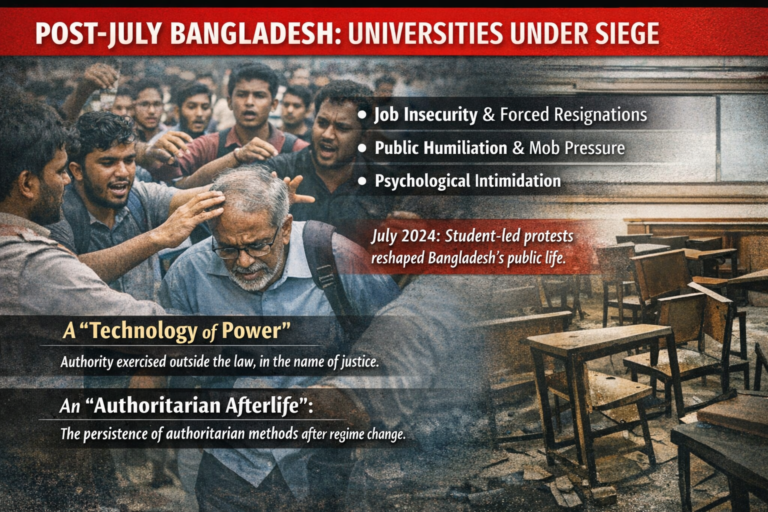
The state’s response to July reflected this continuity. It neither fully absorbed the uprising into a legitimacy narrative, nor fully denied its violence. Instead, it managed July through containment: allowing circulation, tolerating protest, deferring responsibility, and waiting for exhaustion. The shift from authoritarian rule to interim governance altered the style of control, not its logic. Visibility was permitted; sovereignty was withheld.
It is within this unresolved terrain—where Shahbag’s moral rapture had become suspect, Hefazat’s deaths remained unacknowledged, and July’s uprising refused closure—that Inqilab Moncho emerged.
Inqilab Moncho’s emphasis on insaf, sovereignty, and anti-hegemony cannot be read simply as ideological opposition to Shahbag. It is better understood as a response to a longer history of selective recognition. Its insistence on naming martyrs, setting deadlines, and occupying symbolic state spaces reflects an attempt to prevent a repetition of 2013: deaths that vanish without consequence.
Yet this response also reproduces a familiar risk. By inheriting the grammar of rapture without securing jurisdiction, Inqilab Moncho operates within the same political economy of exposure that marked Shahbag and July. It seeks to stabilize moral clarity in a system structurally designed to defer accountability.
July, then, was not only rapture without absorption. It was the moment when two unresolved pasts—Shahbag and Hefazat—collided. The uprising did not resolve these histories; it activated them.
The emergence of Inqilab Moncho represents an effort to hold that unresolved moral field together. Whether it can do so without reproducing martyrdom without sovereignty remains an open question—one that Osman Hadi’s death would soon force into tragic clarity.
Inqilab Moncho: Formation, Platform Grammar, and the Politics of Insaf
Inqilab Moncho did not emerge as a spontaneous continuation of the July 2024 uprising, nor as a conventional political organization seeking electoral power. It emerged as a post-uprising moral formation—an attempt to stabilize ethical clarity in a political environment marked by unresolved deaths, deferred accountability, and selective recognition. Its self-description as an “uprising-inspired cultural platform” is not incidental. It signals a deliberate positioning outside party politics while remaining deeply invested in questions of justice, sovereignty, and moral order.
The platform’s genealogy draws from multiple, unevenly acknowledged pasts. From Shahbag, it inherits the grammar of moral urgency and mass address—the conviction that ethical clarity must be publicly asserted and continuously reaffirmed. From the Hefazat killings of 2013, it inherits a deep suspicion of state recognition and an insistence that deaths unacknowledged by official institutions must be named, remembered, and avenged symbolically. From July 2024, it inherits the immediacy of exposure politics: livestreams, countdowns, deadlines, and the occupation of symbolic state spaces as moral pressure.
This layered inheritance explains why Inqilab Moncho positions itself explicitly against Shahbag while reproducing many of its structural features. The opposition is not primarily procedural or organizational; it is moral-historical. Shahbag represents, for Inqilab Moncho’s constituency, a moment when certain deaths were sanctified while others—particularly those associated with Hefazat—were erased. The critique is less about secularism versus religiosity than about selective martyrdom.
In this sense, Inqilab Moncho’s core moral vocabulary—insaf (justice), sovereignty, anti-hegemony—functions as a corrective to what is perceived as Shahbag’s moral asymmetry. Insaf is invoked not simply as legal justice but as moral rectification: the promise that no death will be dismissed as collateral, no body rendered ungrievable.
Yet the platform through which this promise is articulated remains deeply shaped by the political economy of digital exposure. Inqilab Moncho’s Facebook page—followed by over a million users—operates as its primary site of political action. Posts are not merely informational; they are performative. They announce deadlines (“one hour”), call for physical presence at specific sites (Jamuna, TSC), and escalate urgency through sequential updates. Engagement metrics—views, shares, comments—become indicators of moral traction.
This produces what can be described as countdown governance: justice is narrated through temporality rather than procedure. The structure is repetitive and recognizable:
- A death or injury is named.
- Moral clarity is asserted.
- A deadline is issued.
- A peaceful occupation is announced.
- Updates escalate urgency.
This sequence creates the sense that accountability is imminent, conditional on collective pressure. However, it also reproduces a familiar vulnerability. Deadlines generate intensity, not jurisdiction. Occupations produce visibility, not authority. Moral clarity circulates faster than institutional response.
The politics of insaf, as practiced through Inqilab Moncho, thus occupies a precarious position. On one hand, it refuses the erasure that followed the Hefazat killings. It insists on naming martyrs, documenting violence, and holding the state morally accountable. On the other hand, it operates within a system that has repeatedly demonstrated its capacity to absorb or outlast moral pressure without structural reform.
This tension became unmistakable with the killing of Osman Hadi. Hadi’s death unfolded entirely within Inqilab Moncho’s platformed architecture. His name, image, and story circulated rapidly. Deadlines were announced. Calls were made for peaceful occupation of Jamuna. Updates tracked time rather than institutional response. Engagement surged.
What did not materialize was sovereignty.
Hadi’s killing thus exposed the structural limit of Inqilab Moncho’s politics. The platform could generate collective grief, moral outrage, and sustained visibility. It could not convert these into enforceable outcomes. Nor could it redistribute the risk borne by those most visibly involved.
This is not a failure of intention. It is a consequence of operating within a political system where exposure substitutes for power, and where moral authority is decoupled from institutional capacity. Inqilab Moncho did not invent this condition. It inherited it.
The platform’s significance, therefore, lies not in whether it succeeds or fails by conventional standards, but in what it reveals about post-uprising politics in Bangladesh. It shows how unresolved pasts—Shahbag’s moral closure, Hefazat’s erased dead, July’s contained uprising—continue to shape the present. It demonstrates how movements attempt to hold moral fields together in the absence of sovereignty. And it makes visible the costs of doing so.
Whether Inqilab Moncho can escape this cycle remains uncertain. What is clear is that without mechanisms to redistribute exposure, insulate bodies, and translate archives into jurisdiction, the politics of insaf risks reproducing the very condition it seeks to overcome: martyrdom without sovereignty.
Ganajagaran Mancha and Inqilab Moncho: Structural Continuities and Historical Divergences
Ganajagaran Mancha and Inqilab Moncho are often positioned as moral opposites within Bangladesh’s post-2013 political imagination. Ganajagaran Mancha is remembered as secular, nationalist, Shahbag-aligned; Inqilab Moncho presents itself as anti-Shahbag, anti-hegemony, and grounded in insaf rather than 1971-centric moralism. This opposition is politically potent—but analytically misleading.
What separates these formations is not political form, but historical grievance. What connects them is structure.
Both emerged in moments of political rupture. Both mobilized moral clarity rather than procedural politics. Both relied on digital platforms as primary political infrastructure. And both generated intense ethical legitimacy while remaining structurally detached from sovereignty. The difference lies in which deaths were recognized, which memories were stabilized, and which moral injuries were carried forward.
Ganajagaran Mancha arose in 2013 at a moment when the state was able—at least temporarily—to absorb moral outrage into institutional legitimacy through the International Crimes Tribunal. Its rapture was anchored in historical memory, particularly 1971, which functioned as a settled moral horizon. This allowed the movement’s ethical clarity to be partially translated into state recognition, even as it later became vulnerable to inversion and violence.
Inqilab Moncho, by contrast, emerges in a post-absorption landscape. It is shaped by the memory of deaths that were not recognized: the Hefazat killings of 2013, the blogger murders that followed Shahbag, and the unresolved violence of July 2024. Its moral vocabulary does not seek inclusion within the state’s legitimacy narrative; it assumes from the outset that such recognition is uneven, selective, and unreliable.
Yet despite this divergence, both formations operate within what can be described as rapture politics. Ethical certainty precedes institutional strategy. Moral alignment substitutes for jurisdiction. Exposure becomes the primary political resource. In both cases, language functions as a sorting mechanism—defining belonging, legitimacy, and risk.
The difference is not that Inqilab Moncho escaped the Shahbag grammar, but that it inverted its moral anchors. Where Shahbag sanctified certain deaths and rendered others invisible, Inqilab Moncho organizes itself around the promise that no death will be erased. Where Shahbag relied on historical consensus, Inqilab Moncho relies on moral grievance.
This inversion, however, does not resolve the structural problem. It relocates it.
Both formations face the same fundamental limitation: the inability to translate moral rapture into sovereign capacity. Both produce ethical clarity faster than they can build protection. Both generate martyrs in excess of institutional consequence. And both expose participants to differential risk based on proximity, visibility, and insulation.
Understanding this continuity is essential, not to equate the two movements, but to avoid the false comfort of moral opposition. Anti-Shahbag is not outside Shahbag’s political form. It is Shahbag’s afterlife under conditions of unresolved grievance.
Comparative Table: Ganajagaran Mancha vs Inqilab Moncho
| Dimension | Ganajagaran Mancha (2013) | Inqilab Moncho (Post-July 2024) |
|---|---|---|
| Historical Moment | Post-ICT mobilization | Post-uprising, post-containment |
| Core Moral Anchor | 1971, Liberation War memory | July martyrs, erased deaths (incl. 2013 Hefazat) |
| Primary Affect | Moral certainty | Moral grievance |
| Relation to State | Partial absorption into legitimacy | Structural containment |
| Mode of Politics | Moral rapture + nationalist memory | Moral rapture + insaf |
| Platform Infrastructure | Blogs + Facebook (BOAN) | Facebook-centric, livestream-driven |
| Language Function | Alignment and exclusion | Alignment and rectification |
| Treatment of Ambiguity | Reduced over time | Rejected from outset |
| Risk Distribution | Individualized (bloggers) | Individualized (exposure carriers, martyrs) |
| Violence Outcome | Blogger killings | Hadi’s killing |
| Archival Status of Deaths | Selectively memorialized | Actively contested |
| Capacity to Govern | Legitimacy without sovereignty | Pressure without sovereignty |
| Structural Limit | Moral closure → inversion | Exposure without protection |
Authoritarian Rule and the Interim Post-Uprising Government: Continuities, Shifts, and the Politics of Managed Visibility
The July 2024 uprising in Bangladesh marked a rupture in regime form but not a clean break in power logic. While the authoritarian government that preceded July relied on overt coercion, centralized repression, and juridical instruments of fear, the interim post-uprising government operates through a more diffuse configuration of control—one that substitutes spectacle, delay, and selective recognition for brute force. The difference is not the absence of repression, but its reformatting.
To understand this shift, it is necessary to move beyond the language of regime change and toward an analysis of governance technique. The authoritarian regime governed through certainty: predictable repression, identifiable red lines, and routinized violence. The interim government governs through uncertainty: moral ambiguity, procedural deferral, and managed visibility. Both rely heavily on social media—but for different purposes.
Authoritarian Regime: Coercive Certainty and the Discipline of Fear
Under authoritarian rule, social media functioned primarily as a surveillance and deterrence apparatus. Platforms such as Facebook were simultaneously spaces of expression and sites of capture. The Digital Security Act (DSA) institutionalized fear by criminalizing speech retroactively, producing a climate where visibility itself became a liability. Bloggers, journalists, and activists learned to read repression as patterned: arrests followed posts; posts followed silencing.
This regime relied on clarity of threat. Citizens knew when they had crossed a line—even if that line shifted. Violence was instrumental, demonstrative, and disciplinary. Enforced disappearances, arrests, and targeted killings were not random; they were legible signals meant to regulate behavior across the population.
Importantly, the authoritarian regime did not need to persuade. It needed to contain. Social media outrage was allowed to circulate only insofar as it did not threaten sovereign coherence. When it did, platforms were throttled, accounts were removed, and bodies were detained. Memory was actively suppressed through censorship, intimidation, and narrative closure.
Interim Post-Uprising Government: Moral Performance and the Management of Delay
The interim government inherits a different problem: it governs not after defeat, but after delegitimization. Its task is not to silence dissent outright, but to absorb, defer, and redistribute it. In this context, social media is no longer primarily a surveillance tool; it becomes a theatre of moral performance.
Unlike the authoritarian regime, the interim government allows—and at times encourages—public outrage to circulate. Livestreams are not immediately shut down. Protest pages remain active. Martyr images circulate widely. But this visibility is strategically non-consequential. Recognition is decoupled from resolution.
Justice is promised, not delivered. Investigations are announced, not concluded. Committees are formed, not empowered. The effect is a politics of managed waiting, where moral pressure is acknowledged but structurally neutralized.
This is not weakness; it is technique. Where authoritarianism relied on fear, the interim government relies on hope without horizon. Social media becomes a site of emotional discharge rather than political transformation. Anger is allowed expression so long as it does not acquire jurisdiction.
Social Media as Shared Infrastructure, Divergent Use
Both regimes depend deeply on social media, but their use differs in orientation:
- The authoritarian regime uses social media to identify, discipline, and punish.
- The interim government uses social media to display responsiveness without ceding power.
In both cases, however, social media produces asymmetric risk. Visibility remains unevenly dangerous. Those closest to the ground—organizers, livestreamers, symbolic figures—bear disproportionate exposure. Leadership without institutional shielding remains lethal.
This continuity explains why post-uprising figures continue to face fatal risk despite the absence of overt authoritarian repression. The architecture of exposure remains intact.
Comparative Table: Authoritarian vs Interim Government
| Dimension | Authoritarian Regime | Interim Post-Uprising Government |
|---|---|---|
| Mode of Control | Coercive repression | Moral management |
| Political Affect | Fear | Hope + delay |
| Use of Social Media | Surveillance and deterrence | Performance and absorption |
| Treatment of Dissent | Criminalization | Recognition without resolution |
| Justice Mechanism | Punitive | Investigative |
| Visibility | Dangerous | Permitted but hollow |
| Memory Politics | Erasure | Selective acknowledgment |
| Risk Distribution | Predictable | Diffuse but persistent |
| Violence | Direct | Structural / deferred |
| Sovereign Capacity | Centralized | Fragmented |
Structural Continuity Beneath Regime Change
Despite their differences, both regimes share a fundamental continuity: neither resolves the problem of political translation. Moral energy is produced faster than institutional capacity. Social media accelerates grievance but does not supply jurisdiction. Movements are allowed to speak, but not to decide.
This continuity explains why post-uprising formations like Inqilab Moncho encounter the same structural ceiling faced by Ganajagaran Mancha a decade earlier—despite opposite moral positions. The form of politics remains rapture-driven, exposure-heavy, and institutionally thin.
Preparing the Ground for Hadi
Within this configuration, Osman Hadi’s death cannot be understood as an aberration. It emerges at the intersection of moral visibility and institutional absence. Under authoritarianism, he might have been silenced earlier. Under interim governance, he is allowed to be visible long enough to become killable.
This is not a failure of intention. It is a consequence of political form.
The next section, therefore, turns to Hadi not as a personality, but as a threshold figure—one whose life and death reveal the limits of post-uprising governance itself.
IX. Osman Hadi as Threshold Event: Leadership, Exposure, and the Limits of Post-Uprising Protection
Osman Hadi should not be read as a leader in the conventional sense, nor as a spontaneous victim of political violence. His death marks a threshold event—a moment where the contradictions of post-uprising governance become structurally visible. Hadi stands at the intersection of moral authority, platform visibility, and institutional absence. His killing reveals not the failure of protest, but the limits of a political order that permits exposure without protection.
To call Hadi a threshold figure is to emphasize position over personality. He did not command a party apparatus, control resources, or negotiate policy. What he carried instead was moral proximity: proximity to grievance, to sovereign space, and to public expectation. This proximity proved fatal.
Leadership Without Insulation
Post-July politics in Bangladesh repeatedly invokes the language of leaderlessness. This rhetoric is often celebrated as democratic and horizontal. Yet ethnographic observation suggests that leaderlessness does not eliminate hierarchy; it reorganizes it through exposure.
Hadi occupied a position of functional leadership:
- publicly recognizable
- morally unambiguous
- continuously visible
- physically present near sovereign sites (Jamuna)
What distinguishes functional leadership from institutional leadership is the absence of insulation. There were no legal buffers, no organizational redundancy, no jurisdictional ambiguity. Hadi could not disappear into structure. His body was the structure.
In this sense, Hadi was not protected by anonymity nor shielded by authority. He was legible—ethically, spatially, and digitally.
The Fatal Convergence of Three Registers
Hadi’s death becomes intelligible when we examine the convergence of three registers that define post-uprising politics:
1. Moral Clarity
Hadi’s position was explicit. He did not hedge, triangulate, or soften claims. Justice was framed as absolute and non-negotiable. Moral clarity here functioned as credibility—but also as fixity. There was no discursive exit.
2. Platform Visibility
Inqilab Moncho’s architecture amplified immediacy: countdowns, livestreams, updates, deadlines. These formats collapse distance between grievance and response. Visibility accelerated solidarity—but also compressed reaction time. Escalation became algorithmic.
3. Jurisdictional Absence
Despite public attention, no institution assumed responsibility for Hadi’s safety. Neither the state nor any intermediary body translated moral urgency into protective capacity. Visibility substituted for jurisdiction.
The convergence of these three conditions—clarity, visibility, absence—produced killability.
Why Hadi Was Not Absorbed
Many post-July actors were absorbed into safer positions: advisory roles, symbolic recognition, negotiated silence, or infrastructural anonymity. Hadi was not.
This was not because he was more radical. It was because he was structurally non-absorbable. He could not be reassigned, delayed, or ritualized without dissolving the very function he served. His presence was the pressure.
Where others could move laterally, Hadi was vertically exposed.
From Exposure to Elimination
Hadi’s killing should therefore be understood not as an interruption of politics, but as its completion under current conditions. Once exposure exceeds the system’s capacity to absorb or defer, elimination becomes the terminal mechanism.
This logic is not new. It echoes earlier moments in Bangladesh’s recent history:
- Shahbag bloggers carried moral clarity without protection and were killed.
- Hefazat-aligned madrasa students in 2013 were killed and erased from official memory.
- July’s unnamed bodies circulated briefly before being absorbed into statistics.
Hadi’s difference lies in timing. His death occurs after an uprising, under a regime that claims moral renewal. This makes the threshold visible.
What the Threshold Reveals
Hadi’s death exposes three limits of post-uprising governance:
- Moral recognition does not equal political capacity
- Visibility does not generate protection
- Leaderlessness redistributes risk rather than eliminating it
Until these limits are structurally addressed, post-uprising politics will continue to produce figures who carry justice demands in their bodies—and pay for it with their lives.
Hadi does not close July.
He marks its unresolved edge.
Systemic Sorting and the Post-Uprising Settlement
Post-uprising moments are often narrated through the language of transition: rupture, possibility, renewal. Yet empirically, what follows is rarely transition in the transformative sense. What follows is sorting.
The period after July 2024 in Bangladesh should be understood as a post-uprising settlement—not because a new social contract was forged, but because political forces redistributed roles, risks, and legitimacy in a manner that stabilized power without resolving its crisis. This settlement did not require consensus. It required differentiation.
Systemic sorting is the process through which actors generated by an uprising are selectively absorbed, neutralized, ritualized, or exposed in order to restore governability without structural accountability.
Sorting as a Mode of Power
Sorting is not repression. It is more efficient than repression.
Rather than silencing all dissent, the post-uprising order classified participants according to their utility and threat level. This classification unfolded across digital visibility, organizational location, and bodily proximity to sovereign space.
Ethnographic mapping of post-July trajectories reveals four dominant outcome categories.
1. Absorption: Stabilizers Without Disruption
Some figures—often those with preexisting institutional literacy, elite social capital, or acceptable ambiguity—were absorbed into advisory roles, dialogue platforms, consultative committees, or symbolic proximity to governance.
Their function was not to govern, but to signal continuity. They translated uprising legitimacy into reassurance: the system listens, adapts, includes.
Absorption did not require ideological alignment. It required manageability.
These actors experienced:
- increased safety
- decreased visibility
- rhetorical influence without jurisdiction
Their presence helped convert rupture into reformist appearance.
2. Ritualization: Symbols Without Demands
Another set of figures—often victims, families of the deceased, or iconic images—were ritualized. Their suffering was acknowledged ceremonially but detached from enforceable claims.
Martyr images circulated.
Condolences were issued.
Anniversaries were observed.
But juridical consequence remained absent.
Ritualization neutralizes grievance by honoring it without institutionalizing it. Memory replaces accountability.
3. Infrastructural Erasure: Organizers Without Narrative
Behind every visible uprising lies logistical labor: coordination, transport, shelter, documentation, communication. These actors rarely survive into post-uprising narratives.
They are neither absorbed nor ritualized. They are forgotten.
Their erasure is not punitive—it is functional. Infrastructure is dangerous when remembered, because it reveals how power can be replicated.
4. Exposure Concentration: Pressure Without Protection
Finally, a small number of figures remain publicly visible, morally unambiguous, and spatially proximate to sovereign institutions—without insulation.
These figures continue to articulate demands that cannot be deferred, negotiated, or symbolically satisfied.
They carry unresolved claims.
They become exposure carriers.
Osman Hadi belonged to this category.
Why Exposure Carriers Are Eliminated
Exposure carriers pose a unique problem for post-uprising settlements. They cannot be absorbed without neutralizing their function. They cannot be ritualized because they are still alive. They cannot be erased because their visibility is continuous.
They produce pressure without offering an exit ramp.
In such cases, elimination becomes the system’s final sorting mechanism—not necessarily through direct state action, but through tolerated vulnerability.
Killability emerges not as a command, but as a condition.
Continuities Across Regimes
This sorting logic is not unique to the interim government. It represents continuity across regimes.
Under authoritarian governance:
- dissent was sorted through repression and disappearance
Under the interim post-uprising regime:
- dissent is sorted through exposure, delay, and selective absorption
The method changes. The outcome remains.
Those who convert legitimacy into governance survive.
Those who convert legitimacy into pressure are removed.
Inqilab Moncho Within the Settlement
Inqilab Moncho occupies an unstable position within this settlement.
It is:
- too visible to ignore
- too moral to absorb easily
- too networked to erase
Yet unless it transforms its political form, it risks reproducing the same sorting outcome internally: amplifying exposure while lacking protective capacity.
Hadi’s death signals the cost of remaining unsorted.
Settlement Without Closure
The post-July settlement is incomplete—not because it failed, but because it succeeded on its own terms. Power stabilized without justice. Legitimacy circulated without jurisdiction.
Sorting replaced reckoning.
Until this logic is interrupted, Bangladesh’s political future will remain structurally capable of producing uprisings—and structurally incapable of protecting those who carry them forward.
Why Inqilab Moncho Matters Now
After July, During the Interim, and on the Eve of the Election
Inqilab Moncho’s importance at this moment cannot be explained through scale, popularity, or ideological positioning alone. Its significance lies in its temporal location and structural function within a post-uprising political order that has not resolved its own violence. Inqilab Moncho emerges and persists not at the moment of rupture, but in the unstable interval after rupture and before settlement—a period when power seeks normalization while unresolved deaths continue to circulate without jurisdiction.
After July: The Refusal of Closure
The July 2024 uprising generated moral clarity but failed to produce institutional sovereignty. Its aftermath was marked by diffusion: protest energies fragmented, leadership narratives dissipated, and responsibility for deaths remained unassigned. What followed was not resolution, but suspension.
In this context, Inqilab Moncho functions as a custodian of unresolved grievance. Unlike actors who entered negotiation circuits, electoral alignments, or institutional absorption, Inqilab Moncho retained a position of refusal. It did not translate July into reformist language, nor did it allow July to be stabilized as a commemorative past. Instead, it sustained July as an unfinished present—a moral claim that continues to interrupt narratives of normalization.
This function is politically consequential. Post-uprising regimes depend on temporal closure: once an uprising is framed as “over,” its claims become symbolic, deferrable, or negotiable. Inqilab Moncho resists this closure by repeatedly re-activating July through the language of justice, martyrdom, and unfulfilled accountability. It keeps the uprising structurally alive after collective rapture has dissipated.
During the Interim: Moral Pressure Without Jurisdiction
Interim governments derive legitimacy from neutrality, temporariness, and procedural promise rather than electoral mandate. Their overriding objective is stability, not reckoning. In this period, Inqilab Moncho occupies a structurally distinctive role: it exerts moral pressure without institutional leverage.
It does not negotiate policy, administer governance, or claim sovereign authority. Yet it persistently exposes the interim government’s central contradiction: that calm has been restored without accountability. This is not oppositional politics in the classical sense; it is diagnostic politics, revealing what the interim order is designed to defer.
The events of 6 February 2026 made this function unmistakably visible. On that day, Inqilab Moncho supporters demanding justice for the killing of Osman Hadi attempted to march toward the chief adviser’s official residence at Jamuna. Police responded with batons, tear gas, sound grenades, and water cannons. Dozens of protesters were injured as clashes continued across Shahbagh and surrounding areas (New Age, 2026; Dhaka Tribune, 2026).
What is analytically significant is not the clash itself, but the form of governance it reveals. Under the interim regime, protests are formally permitted, visibility is tolerated, and speech circulates freely—yet when moral pressure approaches sovereign space, it is met with force. Responsibility remains deferred, and violence is managed as a logistical problem rather than a political one. This marks continuity rather than rupture with authoritarian governance, even as the language of neutrality replaces that of repression.
Before the Election: Disrupting Premature Legitimacy
Elections promise closure. In post-uprising contexts, they often function as mechanisms of legitimacy laundering, allowing unresolved violence to be folded into procedural renewal. Reporting by national dailies in early February 2026 makes clear that the upcoming election is framed by the interim administration as a return to stability rather than as an opportunity for retrospective accountability (New Age, 2026; Dhaka Tribune, 2026).
Inqilab Moncho is crucial precisely because it interrupts this substitution. By sustaining unresolved justice claims into the pre-election period, it destabilizes the assumption that voting alone can close July’s ledger. It insists that sovereignty without accountability remains procedural rather than ethical.
This position makes Inqilab Moncho structurally inconvenient. Movements that enter electoral politics gain insulation but lose moral autonomy. Movements that remain outside retain moral force but absorb risk. Inqilab Moncho has remained outside, preserving the capacity to expose the limits of electoral closure while assuming maximum vulnerability.
The Cost of Being Crucial
Inqilab Moncho’s importance is inseparable from its exposure. Movements that preserve moral clarity without jurisdiction become sites where unresolved power concentrates risk. They carry memory without protection, pressure without insulation, and visibility without immunity.
Osman Hadi’s death clarified this cost. His killing did not merely target an individual; it demonstrated what happens to actors who remain structurally crucial in a system organized around containment rather than accountability. The subsequent mobilizations, deadlines, and clashes did not rupture power, but they revealed its design.
What Is at Stake Now
If Inqilab Moncho is absorbed, July is closed.
If it is erased, July is forgotten.
If it remains exposed without protection, July produces further martyrs.
Its continued relevance lies not in its ability to seize power, but in its capacity to reveal where power refuses to go. As Bangladesh approaches an election without reckoning, Inqilab Moncho stands as a reminder that moral clarity without sovereignty is not a failure of movements, but a feature of the political economy they confront.
Containment After the Square
From Ganajagaran Mancha to Inqilab Moncho
The fate of Ganajagaran Mancha offers a critical historical precedent for understanding both the vulnerabilities and the potential futures of Inqilab Moncho. Shahbag did not disappear because it was defeated, disproven, or abandoned by its participants. It was contained through a multi-layered process that combined co-optation, moral inversion, counter-mobilization, and exhaustion. This containment was neither sudden nor singular. It unfolded through time, language, and institutional absorption.
Ganajagaran Mancha initially emerged as a broad moral assembly rather than a party or programmatic movement. Its authority rested on ethical clarity, collective presence, and vernacular legitimacy rooted in the memory of 1971. Yet precisely because it generated moral rapture without jurisdiction, it became structurally legible to power as a site to be managed rather than a force to be negotiated.
Containment began with frame capture. As ruling-party actors increasingly aligned themselves with Shahbag’s demands, the movement’s moral universality narrowed. What had functioned as an open ethical field gradually hardened into a partisan moral identity. This narrowing did not require formal takeover; it relied on repetition, selective amplification, and the slow erosion of ambiguity. Once Shahbag was widely read as politically aligned, it became vulnerable to inversion.
That inversion arrived through counter-mobilization, most notably the Hefazat-e-Islam mobilizations of 2013. Here, moral language was not countered but reversed. Shahbag’s claims to justice were reframed as threats to faith, culture, and sovereignty. The movement’s name itself became a sorting mechanism: Shahbagi. This was not simply a slur; it was a technology of political killability. To be named was to be exposed.
The subsequent killings of secular bloggers marked the terminal stage of containment. Shahbag had collectivized moral speech but individualized risk. Once collective protection receded, ethical clarity persisted in bodies that could be targeted. The state neither fully endorsed nor decisively prevented this violence. Instead, it governed through deferral—condemnation without protection, investigation without resolution. By late 2013, Ganajagaran Mancha no longer functioned as a politically consequential street, even as its symbolic residue remained available for selective invocation.
This trajectory matters because it reveals how moral movements are neutralized without being formally banned. They are absorbed, displaced, or exhausted until their ethical force no longer threatens institutional equilibrium.
Inqilab Moncho enters this historical landscape with a declared opposition to Shahbag and an explicit critique of its legacy. Yet opposition does not exempt it from structural repetition. Inqilab Moncho inherits the same fundamental condition: it generates moral clarity and collective affect without jurisdictional authority. Its insistence on justice, martyrdom, and unfinished accountability places it in direct tension with post-uprising governance, particularly during an interim period oriented toward stability and electoral transition.
The events of 6 February 2026 demonstrate that containment is already underway, though not yet complete. The state’s response to Inqilab Moncho—permitting visibility while enforcing spatial limits through force—mirrors earlier patterns. What differs is timing. Inqilab Moncho confronts containment not after consolidation, but before electoral settlement. This temporal positioning makes it both more dangerous and more consequential.
Whether Inqilab Moncho remains crucial after the election will depend less on its moral vocabulary—which is already established—than on its capacity to resist the pathways that neutralized Ganajagaran Mancha.
Three pressures are already visible.
First, absorption. Post-election politics will likely offer channels of consultation, recognition, or procedural participation. Such absorption does not eliminate movements; it converts them into stakeholders whose grievances are acknowledged but defanged.
Second, delegitimation through moral inversion. As with Shahbag, the risk is that “Inqilab” itself becomes a sorting label—used to distinguish responsible citizens from disruptive actors. Once this occurs, exposure increases while persuasion declines.
Third, exhaustion through managed confrontation. Repeated clashes, injuries, deadlines, and deferrals produce fatigue without resolution. Over time, moral urgency can be worn down by logistical attrition.
Yet Inqilab Moncho is not structurally identical to Ganajagaran Mancha. It operates in a post-Shahbag environment where the costs of moral closure are widely known. It also emerges after July, not before it—after the demonstration that mass rapture can destabilize regimes but cannot govern outcomes.
For Inqilab Moncho to remain crucial after the election, it would need to do what Shahbag could not: transform moral exposure into collective insulation, archive into jurisdiction, and affect into durable political leverage. This is not a question of ideology or intent. It is a question of structure.
If it is absorbed, July will be narrativized as complete.
If it is delegitimized, July will be inverted.
If it is exhausted, July will be remembered without consequence.
The comparison with Ganajagaran Mancha does not predict Inqilab Moncho’s fate. It clarifies the stakes. Bangladesh’s political history suggests that ethical movements do not disappear; they are redistributed—into symbols, slurs, martyrs, and managed memories.
What remains unresolved is whether Inqilab Moncho can interrupt this cycle—or whether it, too, will be remembered as a moment when moral clarity appeared without sovereignty, and courage was asked to carry what institutions refused to bear.
Side-by-Side: Containment Logics
Ganajagaran Mancha vs Inqilab Moncho
| Dimension | Ganajagaran Mancha (Shahbag): Modes of Containment | Inqilab Moncho: Current Pressure Points |
|---|---|---|
| Moment of emergence | During consolidation of authoritarian legitimacy (2013) | After rupture, during interim governance, before election (2024–2026) |
| Primary moral source | Historical justice of 1971 | July martyrdom and unfinished present-tense violence |
| Initial state response | Tacit endorsement followed by selective absorption | Formal tolerance paired with spatial and coercive limits |
| Core containment strategy | Co-optation into ruling narrative | Containment without absorption |
| Frame capture | Movement increasingly read as partisan and elite | Pressure to be framed as destabilizing or irresponsible |
| Counter-mobilization | Hefazat-e-Islam reframes Shahbag as anti-Islamic | Competing “stability” and “closure” narratives pre-election |
| Language inversion | “Shahbag” → “Shahbagi” (slur, sorting device) | Risk of “Inqilab” becoming a label for disorder |
| Risk distribution | Collective speech, individualized bodily exposure | Platform-driven visibility, concentrated frontline risk |
| Killability outcome | Blogger killings after moral inversion | Osman Hadi’s killing amid sustained protest pressure |
| State violence logic | Condemnation without protection | Crowd control, injury management, deferred accountability |
| Role of social media | Blogs + Facebook as moral alignment field | Facebook + livestreams as pressure, archive, and countdown |
| Mechanism of exhaustion | Polarization, delegitimation, movement fatigue | Repeated clashes, deadlines, attrition without resolution |
| Relation to elections | Eventually folded into ruling legitimacy | Actively disrupts pre-election closure |
| Outcome trajectory | Demobilized as politically consequential street | Still live; outcome unresolved and dangerous |
| Structural vulnerability | Moral closure reduced adaptability | Sustained exposure without insulation |
| What power needed | Neutralization after legitimacy secured | Neutralization before legitimacy is settled |
| Key diagnostic question | How did moral clarity become a slur? | Can unresolved grievance survive electoral settlement? |
This table should not be read as a normative comparison between two movements, nor as an evaluation of their ideological correctness, success, or failure. Instead, it maps the changing containment logics of power across two historical moments. The left column documents how Ganajagaran Mancha was neutralized after it had already contributed to the consolidation of political legitimacy. The right column traces how similar techniques are being applied to Inqilab Moncho earlier, faster, and before political settlement is complete. What the table reveals is not repetition, but acceleration: power now anticipates moral rapture and moves to manage exposure preemptively. The comparison therefore shifts analytical focus away from movement behavior and toward the evolving political economy of containment—where ethical intensity is increasingly tolerated only insofar as it does not approach sovereignty.
Martyrdom Without Sovereignty as a Recurrent Pattern (2012–2026)
Read across the long arc from the blogosphere of the early 2010s, through Shahbag, the Hefazat killings, the blogger murders, the July 2024 uprising, and the killing of Osman Hadi, a consistent structural pattern emerges: Bangladesh repeatedly produces martyrs in moments of ethical intensity without generating sovereign accountability. Moral rapture mobilizes bodies, language, and risk, but jurisdiction never follows. Exposure accumulates in individuals rather than institutions; grief circulates faster than responsibility; and violence is acknowledged without being adjudicated. What changes over time is not the outcome, but the speed and efficiency with which power manages this process. Shahbag shows how martyrdom is produced after moral inversion; July and Inqilab Moncho show how it is now produced preemptively, before settlement and before elections. The persistence of this pattern suggests that martyrdom is no longer an aberration or breakdown of politics, but a managed condition within a post-uprising political economy—one in which ethical clarity is repeatedly permitted, even encouraged, so long as it does not acquire sovereignty.
Theoretical Bridge: From Pattern to Framework
The recurring production of martyrdom without sovereignty across the 2012–2026 arc should not be read as a failure of movements, leadership, or moral imagination. It is better understood as a stable outcome of a political system that has learned to metabolize exposure without yielding jurisdiction. Across Shahbag, the blogger killings, the July uprising, and the death of Osman Hadi, ethical intensity is not suppressed; it is permitted, circulated, and even amplified—so long as it remains detached from institutional consequence. What this reveals is a form of power that survives not by denying violence or legitimacy crises, but by reorganizing where responsibility can and cannot settle. The repetition of martyrdom, therefore, is not an accident of history but an index of how contemporary power distributes risk downward while retaining decision-making upward. This essay’s long arc shows that the problem is no longer whether truth is spoken or bodies gather, but whether moral exposure can be converted into sovereign accountability in a system structurally designed to prevent that conversion.
Conclusion: The Politics That Remains
This essay began with a paradox: the killing of Osman Hadi generated clarity, grief, mobilization, and visibility—yet it did not rupture power. Tracing that paradox backward reveals that it is not new. From the early blogosphere, through Shahbag, the Hefazat killings, the murders of secular bloggers, the July 2024 uprising, and the post-July mobilizations of Inqilab Moncho, Bangladesh’s political life has repeatedly organized itself around moments of ethical rapture that end in bodily sacrifice rather than institutional reckoning.
What changes across this arc is not the outcome, but the timing. Shahbag was contained after legitimacy had consolidated. July and Inqilab Moncho confront containment earlier, faster, and before electoral settlement. Power no longer waits for movements to exhaust themselves; it anticipates exposure and manages it preemptively through spatial control, procedural deferral, and selective force. Martyrdom is not produced because sovereignty collapses, but because sovereignty remains intact.
Seen this way, Inqilab Moncho is neither a repetition of Shahbag nor its opposite. It is the latest site where the limits of moral politics are being tested under accelerated conditions. Its importance lies not in whether it “succeeds,” but in what it reveals: that ethical clarity without jurisdiction remains structurally tolerable, while any attempt to move grievance toward sovereign space is met with containment.
The long arc from 2012 to the present thus forces a difficult recognition. Bangladesh does not lack courage, memory, or moral language. It lacks mechanisms that allow those forces to harden into accountability. Until exposure can be transformed into jurisdiction—until archives can outlive power rather than be absorbed by it—political life will continue to honor its dead without changing the conditions that produce them.
Osman Hadi’s death does not close July.
It clarifies what July still demands.
And until that demand acquires sovereignty, martyrdom without power will remain not an exception, but a governing pattern.
Framing martyrdom without sovereignty as a property of post-ideological power, not a failure of movements.
References
Author’s Core Work
Chowdhury, M. Z. (2019). Resistance sociality in the Shahbag movement: A critical understanding of social media, sociality and resistance in Bangladesh (Doctoral dissertation). Hiroshima University, Japan.
Chowdhury, M. Z. (2012–2026). Digital ethnography fieldnotes on blogs, Facebook, protest sites, livestreams, and vernacular political language in Bangladesh. Unpublished research archive.
Bangladeshi Political Events & Media
New Age. (2013, May 6). Hefazat clash leaves scores dead as police clear Motijheel. Dhaka.
New Age. (2026, February 6). 65 injured in clash between police, Inqilab Mancha. Dhaka.
Dhaka Tribune. (2015, February 27). Avijit Roy hacked to death in Dhaka. Dhaka.
Dhaka Tribune. (2015–2016). Series on killings of secular bloggers. Dhaka.
Dhaka Tribune. (2026, February 6). Police, Inqilab Mancha clash again in Shahbagh. Dhaka.
The Business Standard. (2026, February 6). Police halt Inqilab Mancha march towards Jamuna; clashes erupt. Dhaka.
Reuters. (2026, February 6). Bangladesh prepares for election amid unrest and post-uprising uncertainty. London.
Human Rights & Violence Documentation
Human Rights Watch. (2013). Blood on the streets: The use of excessive force during Bangladesh protests. New York.
Amnesty International. (2016). Assault on bloggers and free expression in Bangladesh. London.
Committee to Protect Journalists. (2015). Bangladesh’s bloggers under attack. New York.
Shahbag, Social Movements & Bangladesh Studies
Ahmed, N. (2013). The Shahbag protests and the crisis of secular nationalism in Bangladesh. South Asia Multidisciplinary Academic Journal, 8.
https://journals.openedition.org/samaj/3711
Upal, A. (2018). The theft of the spirit: Co-optation of the Shahbag movement and its consequences.
https://amianupam.com/wp-content/uploads/2018/02/0262728018791698.pdf
Riaz, A. (2016). Bangladesh: A political history since independence. Routledge.
Van Schendel, W. (2009). A history of Bangladesh. Cambridge University Press.
Political Theory, Power, and Violence
Arendt, H. (1970). On violence. Harcourt, Brace & World.
Butler, J. (2009). Frames of war: When is life grievable? Verso.
Tilly, C. (2004). Social movements, 1768–2004. Paradigm.
Tufekci, Z. (2017). Twitter and tear gas: The power and fragility of networked protest. Yale University Press.
Bauman, Z. (2000). Liquid modernity. Polity Press.
Baudrillard, J. (1994). Simulacra and simulation (S. F. Glaser, Trans.). University of Michigan Press.
Harvey, D. (2005). A brief history of neoliberalism. Oxford University Press.
Comaroff, J., & Comaroff, J. L. (2006). Law and disorder in the postcolony. University of Chicago Press.
Žižek, S. (1989). The sublime object of ideology. Verso.
Platform & Vernacular Archives
Blogger and Online Activist Network (BOAN). (2012–2014). Blogs, Facebook posts, and mobilization archives. Dhaka.
Inqilab Moncho. (2024–2026). Official Facebook posts, livestreams, comment threads, and protest calls. Dhaka.