Digital Dependency and Moral Decline: How Social Media Reshapes Society
How Digital Dependency Is Reorganizing Offline Society Across Generations
How dopamine-driven social media addiction is reshaping offline behavior, morality, youth culture, and intergenerational ethics in Bangladesh and globally.
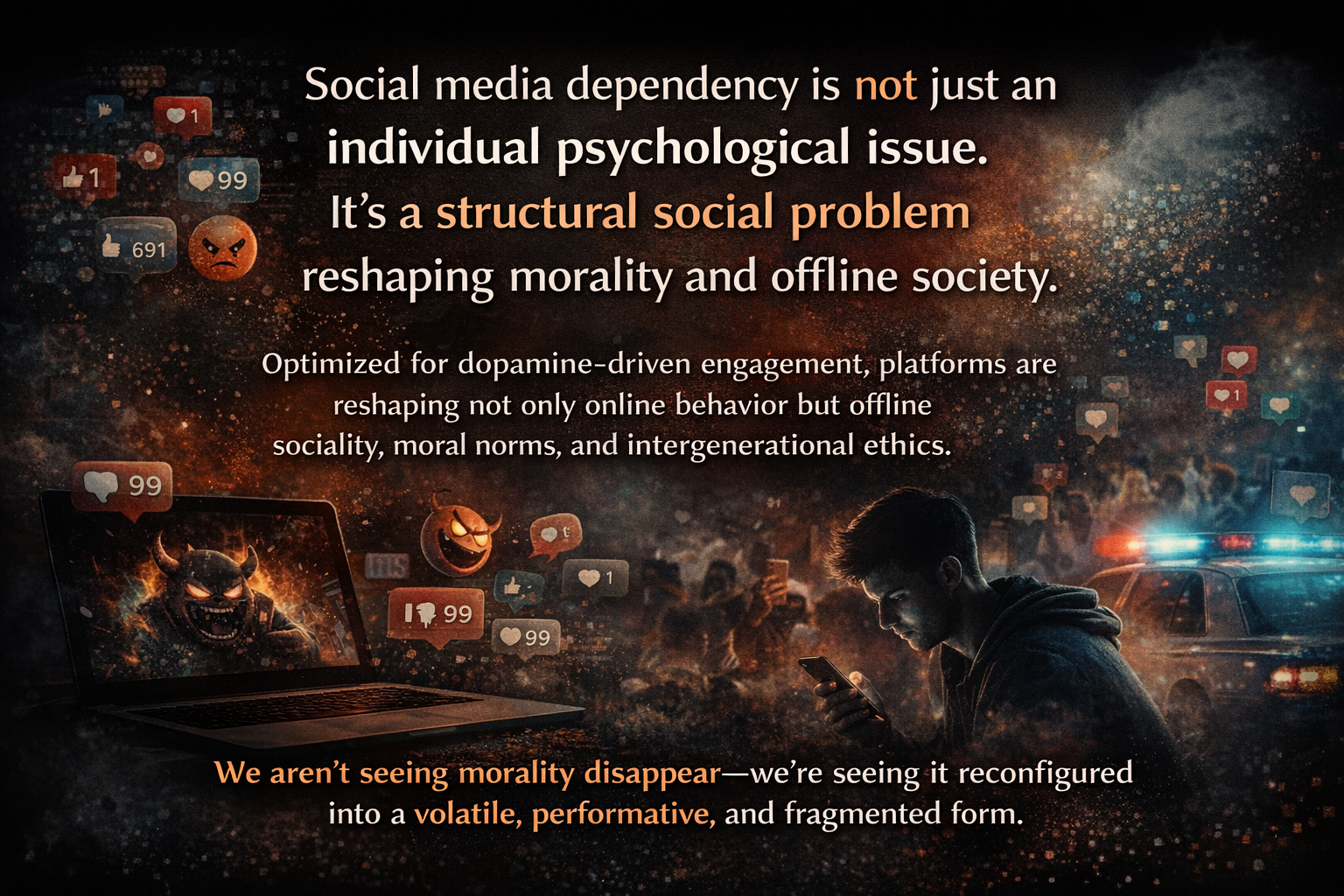
Social media dependency is often discussed as an individual psychological issue. This blog argues that such a view is incomplete. Digital platforms, optimized for dopamine-driven engagement, are reshaping not only online behavior but offline sociality, moral norms, and intergenerational ethics. Practices such as trolling, hypersexualized self-presentation, linguistic aggression, aestheticized criminality, and moral desensitization are not simply signs of cultural decay. They are structural outcomes of algorithmic attention economies that reward transgression, speed, and emotional intensity over restraint, responsibility, and ethical continuity. What we are witnessing is not the disappearance of morality, but its reconfiguration into a volatile, performative, and fragmented form.
This essay is part of the Digital Dependency & Moral Volatility series—a collection of long-form analyses examining how social media addiction, dopamine-driven platforms, and algorithmic cultures are reshaping morality, authority, and offline social life globally and in Bangladesh.
Why Digital Dependency Is Not Just a Screen Problem
Discussions about social media addiction often focus on individual outcomes: reduced attention span, anxiety, or productivity loss. While these effects are real, they are only part of a larger transformation. What is increasingly evident is that digital dependency is reorganizing offline society itself—how people speak, desire, insult, mobilize, and morally judge one another.
Social media platforms today function as primary infrastructures of social learning. They shape what is visible, what is rewarded, and what is punished. As a result, behaviors once considered marginal—trolling, hypersexualized self-presentation, linguistic aggression, public shaming, and even minor criminal acts—are becoming normalized across generations.
This is not a youth-only phenomenon. Older generations are also adapting to the same algorithmic logics of outrage, spectacle, and performative morality.
Dopamine, Reward Loops, and Platform Design
Neuroscience research has established that dopamine plays a central role in reinforcement learning, particularly through variable reward systems. Social media platforms operationalize this mechanism through likes, shares, comments, notifications, and algorithmic ranking.
These features are not accidental. They are designed to maximize engagement, not ethical reflection.
What this produces is a condition where:
- emotional intensity outperforms moral restraint,
- speed is rewarded over reflection,
- visibility replaces accountability.
This dopamine-driven architecture does not merely shape online habits. It re-trains moral perception, especially among users who grow up inside these systems.
Attention Scarcity and the Erosion of Moral Restraint
In environments of infinite content, attention becomes scarce. When attention is governed algorithmically rather than socially, restraint becomes costly. Nuance is penalized. Silence is invisible.
Offline consequences include:
- impatience with complexity,
- hostility toward ambiguity,
- attraction to moral certainty rather than ethical reasoning.
Moral norms historically required time, repetition, and consequence. Digital environments compress time and detach action from consequence, producing what can be described as ethical thinning—morality that is loud but shallow.
From Public Reason to Affective and Volatile Sociality
Public life was once imagined as grounded in deliberation and reason. Today, it is increasingly organized through emotion, sentiment, and affective alignment.
This shift produces:
- rapid escalation of conflict,
- moral judgment without proportionality,
- punishment without due process.
What circulates fastest is not careful argument, but affective charge. As a result, social disagreement increasingly takes the form of humiliation, exclusion, or collective outrage—both online and offline.
Trolling Culture and the Normalization of Cruelty
One of the clearest indicators of moral volatility is the normalization of trolling.
Across platforms and age groups:
- cruelty is framed as humor,
- harassment is dismissed as irony,
- humiliation becomes entertainment.
Originally enabled by anonymity and distance, these behaviors no longer remain confined to online spaces. They increasingly shape offline interaction—especially among students, peers, and public figures—where verbal aggression is trivialized and accountability diffused.
Cruelty, in this environment, becomes a performative strategy rather than a moral failure.
Hypersexuality, Visibility, and Algorithmic Reward
Another major cross-generational shift is the rise of hypersexualized self-presentation. Platforms reward bodily exposure, provocative aesthetics, and sexual signaling—not because of moral intent, but because such content performs well algorithmically.
This should not be reduced to moral panic.
Structurally, hypersexuality functions as:
- a visibility strategy,
- a form of affective labor,
- an adaptation to algorithmic reward systems.
However, the moral cost is significant:
- erosion of intimacy,
- desensitization to objectification,
- normalization of commodified bodies.
What changes is not desire itself, but its moral framing.
Slang, Illegality, and the Aestheticization of Transgression
Short-form video platforms increasingly aestheticize:
- rule-breaking,
- intimidation,
- minor criminal acts,
- public humiliation.
These behaviors are often framed as jokes, trends, or performances. The issue is not criminal intent, but reward alignment. When transgression gains visibility, it becomes culturally normalized.
Across generations, this produces reduced stigma and increased imitation—not because values disappear, but because consequences are detached from action.
Are We Witnessing Moral Decline?
The answer requires precision.
Morality has not vanished. What has eroded instead are:
- moral restraint,
- ethical depth,
- consequence awareness,
- intergenerational continuity.
This is best understood as moral volatility, not moral absence. Ethical signals are intense but unstable. Outrage is frequent but short-lived. Care is invisible, while transgression is amplified.
Morality has been repriced by algorithms.
Across Generations, Not Against Them
It would be misleading to frame this transformation as a generational failure.
Younger generations are socialized inside algorithmic environments where morality is learned through metrics rather than mentorship. Older generations increasingly adapt to the same logics, participating in outrage cycles and spectacle-driven judgment.
This is not a generational conflict. It is a shared structural exposure.
Why This Is a Structural Moral Crisis
This is not primarily:
- a youth problem,
- a parenting failure,
- a cultural collapse.
It is a structural moral crisis produced by socio-technical systems that reward speed, transgression, and emotional intensity while undermining restraint, reflection, and accountability.
Morality has not disappeared.
It has become fast, performative, fragmented, and unstable.
Why This Matters Now (Global and Bangladesh Context)
Globally, societies are grappling with:
- online harassment translating into offline violence,
- youth anxiety and moral confusion,
- political polarization fueled by social media.
In Bangladesh, these dynamics are amplified by dense social networks, politicized moral vocabularies, and high platform penetration. The result is a society increasingly vulnerable to sentiment-driven mobilization, moral panic, and rapid escalation from online cues to offline action.
Bangladesh is not exceptional. It is early and exposed.
Conclusion: From Moral Decline to Moral Volatility
What we are witnessing is not the end of morality, but its transformation under conditions of digital dependency. Algorithms do not erase ethics; they reconfigure them.
The challenge ahead is not to abandon digital life, but to recognize that attention governance is moral governance. Until that is addressed, moral volatility will remain a defining feature of both online and offline society.
Dr. Moiyen Zalal Chowdhury
References (Selected)
Berridge, K. C., & Robinson, T. E. (2016). Liking, wanting, and the incentive-sensitization theory of addiction. American Psychologist, 71(8), 670–679.
Habermas, J. (1989). The structural transformation of the public sphere. MIT Press.
Han, B.-C. (2017). In the swarm: Digital prospects. MIT Press.
Papacharissi, Z. (2015). Affective publics: Sentiment, technology, and politics. Oxford University Press.
Simon, H. A. (1971). Designing organizations for an information-rich world.
Suler, J. (2004). The online disinhibition effect. CyberPsychology & Behavior, 7(3), 321–326.
Zuboff, S. (2019). The age of surveillance capitalism. PublicAffairs.